Blog Posts
ATEX Certified Welding Habitat Systems for Hazardous Environments in 2026
Halting live hydrocarbon production for routine structural maintenance is an operational failure, not an unavoidable safety compromise. In high-hazard oil and gas environments, deploying an engineered ATEX certified welding habitat safely isolates volatile gases from open arcs and grinding sparks. Plant managers and asset integrity engineers know firsthand the razor-thin margin for error: a single atmospheric breach in a classified Zone 1 or Zone 2 area risks catastrophic ignition and millions in deferred production.
Relying on makeshift barriers or unverified enclosures invites critical equipment failure and non-compliance penalties under ATEX Directive 2014/34/EU. You need certified systems that guarantee continuous atmospheric isolation while your facility remains live. This guide evaluates the rigorous technical standards, physical containment mechanics, and fail-safe safety systems required for certified hot work safety enclosures in explosive atmospheres. We break down the engineering mandates of IEC 60079-13, the physics of 50-Pascal positive pressure differentials, and the automated shutdown controls required to protect personnel and active assets in 2026.
Key Takeaways
- Master the dual compliance requirements of ATEX Directive 2014/34/EU and IEC 60079-13 to deploy an ATEX certified welding habitat without interrupting live hydrocarbon production.
- Learn how maintaining an active positive pressure differential combined with continuous LEL gas monitoring prevents volatile atmospheric ingress.
- Discover why patented Quadra-Lock panel interlocks eliminate seam separation and pressure loss typical of legacy zipper or hook-and-loop fasteners.
- Align hot work safety enclosure controls across Zone 1 and Zone 2 environments to streamline facility Permit-to-Work (PTW) authorizations.
- Evaluate procurement trade-offs between capital equipment acquisition and flexible leasing to maintain compliant inventory backed by qualified site supervision.
What Defines an ATEX Certified Welding Habitat in Hazardous Areas?
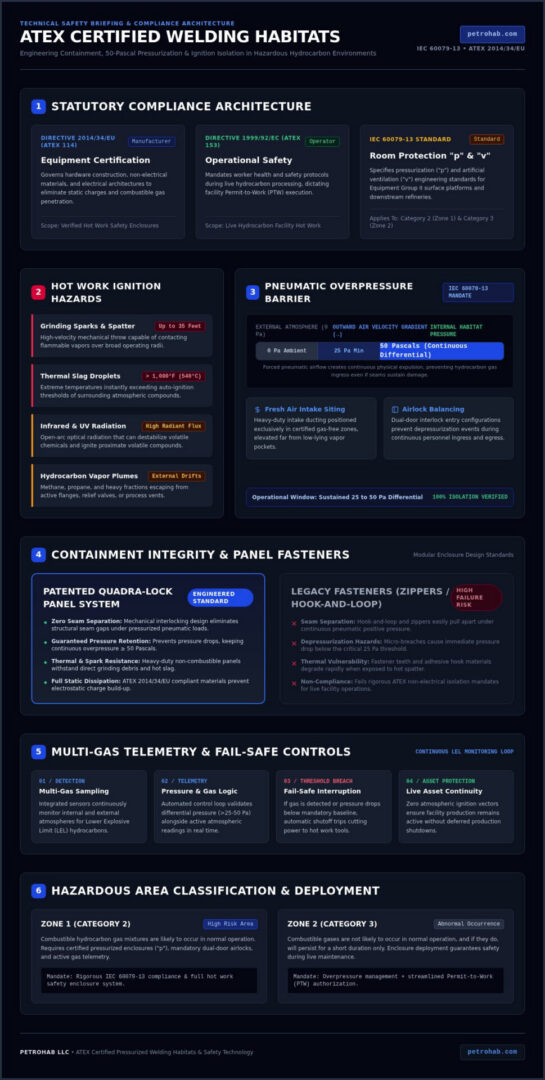
An ATEX certified welding habitat is an engineered containment system designed to isolate open-arc ignition sources from combustible atmospheres. Governed by European Directive 2014/34/EU (ATEX 114) for equipment manufacturers and Directive 1999/92/EC (ATEX 153) for plant operators, these enclosures allow hot work within classified hydrocarbon processing facilities. Statutory compliance under statutory hazardous environment standards requires verifying both non-electrical components and electrical control architectures. Compliance cannot rely on treated tarpaulins or field-rigged partitions. Under the overarching ATEX directives, every component must withstand exposure to explosive gases without accumulating static charges or permitting gas ingress.
To examine standard visual isolation techniques during on-site fabrication, review the operational demonstration below:
Directive 2014/34/EU and the IEC 60079-13 Standard
Deploying a certified hot work enclosure demands strict adherence to the IEC 60079-13 standard. This protocol governs the protection of equipment rooms using pressurization (“p”) and artificial ventilation (“v”). A certified habitat functions as an Equipment Group II system, categorized for surface facilities such as offshore platforms and downstream refineries. Under Category 2 (Zone 1) or Category 3 (Zone 2) environments, the enclosure must sustain a continuous overpressure differential of at least 50 Pascals relative to external ambient conditions. This mechanical overpressure creates an outward air velocity gradient, physically preventing hydrocarbon gas plumes from breaching the containment boundary during active operation.
Primary Ignition Hazards Mitigated During Hot Work
Uncontrolled hot work generates thermal and physical hazards that readily ignite ambient vapors:
- High-velocity spatter and slag: Grinding throwing sparks up to 35 feet and welding drops reaching temperatures over 1,000°F (540°C).
- Infrared and UV arc radiation: High radiant energy capable of igniting proximate volatile compounds.
- Hydrocarbon vapor clouds: Methane, propane, and heavier fractions drifting from flanges, vents, or relief valves.
Full envelope integrity delivers the foundational layer of risk mitigation. Sealing off the work envelope eliminates external ignition vectors, safeguarding active production lines from flash fires.
Containment Engineering: Pressurization and Gas Detection Integration
Positive differential pressure serves as the primary barrier against volatile gas ingress. Rather than relying solely on passive fabric seams, an ATEX certified welding habitat uses forced pneumatic airflow to create an active barrier. This continuous outward velocity ensures that even if a seal sustains minor damage, ambient hydrocarbons cannot enter the hot work envelope. Compliance with the ATEX Directive 2014/34/EU framework requires this physical containment to be continuously coupled with automated, multi-gas telemetry loops.
Maintaining Overpressure with Continuous Pneumatic Flow
Safe operation requires sustaining an internal overpressure between 25 and 50 Pascals relative to the external atmosphere. Achieving this baseline demands precise pneumatic management:
- Clean air intake siting: Heavy-duty intake ducting must pull fresh air from certified gas-free areas, elevated away from process vents and low-lying vapor traps.
- Airlock pressure balancing: Dual-door interlock entry systems prevent rapid depressurization as technicians enter and exit the work envelope.
- Dynamic pressure compensation: Variable pneumatic blowers adjust volume automatically to counter minor leak paths around structural beams and pipe penetrations.
If pressure drops below the statutory 25-Pascal threshold, an immediate alarm alerts operators to arrest work before external vapors migrate toward live arcs.
Autonomous Shutdown Logic via the Safe-Stop System
Mechanical overpressure is only as reliable as the electronics monitoring it. The Safe-Stop Automatic Shutdown System provides the autonomous intelligence required for high-risk locations. Integrated sensors continuously track lower explosive limit (LEL) percentages and toxic gases like hydrogen sulfide (H2S) at three strategic points: the fresh-air intake duct, the primary welding enclosure, and the adjacent hazardous zone.
When atmospheric sensors detect hydrocarbons reaching 10% LEL, or if differential pressure drops below safe operational limits, the system initiates a synchronized shutdown sequence:
- Welding plant isolation: Main electrical contactors instantly trip power to welding power sources, grinders, and non-certified lighting.
- Pneumatic isolation: Fail-safe pneumatic slam-shut valves close within milliseconds, preventing contaminated intake air from entering the habitat.
- Audible and visual signaling: High-decibel sirens and classified strobe arrays direct personnel to evacuate the enclosure immediately.
Operating hot work in explosive zones demands rigorous hardware integration. Asset managers often choose to consult certified habitat engineers to inspect local telemetry interfaces before commissioning live containment systems.
Modular Enclosure Design: Patented Quadra-Lock vs. Legacy Fasteners
Pressurized containment systems rely entirely on seam integrity. In an ATEX certified welding habitat, internal positive pressure actively seeks escape paths through panel interfaces. Legacy connection methods, such as industrial zippers, hook-and-loop strips, or mechanical snap buttons, fail under sustained operational stress. Zippers pull apart under high tensile loads, while hook-and-loop fasteners clog with grit and degrade when exposed to heat. When seam separation occurs, localized depressurization drops internal pressure below certified thresholds, rendering the hot work enclosure ineffective and breaching established safe hot work management practices.
The Mechanics of Quadra-Lock Interlocking Technology
Patented Quadra-Lock panels solve the structural weaknesses inherent in legacy enclosures. Instead of relying on vulnerable surface fasteners, the system uses a four-way mechanical interlocking joint that unites adjacent panels into a continuous, airtight barrier. Key engineering advantages include:
- Gap-free seam engagement: The interlocking channel physically blocks particulate escape and gas infiltration without requiring specialized tools.
- Adaptable structural penetration: Modular panels configure around complex structural geometry, such as deck beams, cable trays, and process piping.
- Dynamic pressure retention: Higher internal positive pressure presses the interlocking surfaces tighter against one another, reinforcing containment integrity.
This mechanical interlock eliminates the human error common in zip-together systems, ensuring uniform boundary sealing across the entire assembly.
Thermal Resistance and Fabric Integrity Standards
Mechanical rigidity must be backed by advanced material engineering. Hot work generates slag, grinding grit, and open spatter capable of destroying inferior synthetic fabrics. Certified Quadra-Lock panels utilize premium silicone-coated fiberglass cloth engineered for continuous exposure to high-temperature environments.
Wall panels withstand continuous service temperatures of up to 1,000°F (540°C), while specialized floor tiles resist concentrated molten contact up to 1,500°F (815°C). Meeting fire-retardant standards such as ANSI/FM 4950 and NFPA 51B, the textile matrix resists tear propagation and radiant heat transfers. This non-combustible construction ensures that high-energy welding arcs inside the enclosure never degrade the structural envelope, maintaining strict containment throughout live hydrocarbon operations.
Zone 1 vs. Zone 2 Hot Work Deployment and Safety Management
Operating hot work equipment in classified areas requires aligning hardware integrity with local atmospheric probabilities. Whether staged on the drill floor of an offshore platform, inside the process modules of a floating production storage and offloading (FPSO) vessel, or beside crude distillation units in a downstream refinery, deploying an ATEX certified welding habitat demands precise zone categorization. Managing risk across these environments depends on synchronizing physical containment with facility-wide operating permits.
Operational Criteria for Zone 1 and Zone 2 Classification
Site operating conditions dictate the classification boundary:
- Zone 1 areas: Explosive gas-air mixtures are likely to occur in normal operation. Work here involves proximate hydrocarbon risks, requiring Category 2 equipment equipped with fully redundant gas detection and automated fail-safe isolation loops.
- Zone 2 areas: Explosive atmospheres are not likely to occur during normal operation, and if they do arise, they persist for only a short period due to minor leaks or equipment failure. These locations mandate Category 3 certified hardware to suppress transient risks.
Every electrical device situated outside the pressurized boundary, such as intake blowers, pressure transmitter junctions, and perimeter sensors, must carry independent ATEX certification matching or exceeding the parent zone designation.
Permit-to-Work (PTW) System Integration and Risk Assessment
Deploying a hot work safety enclosure forms a core control measure within the plant Permit-to-Work (PTW) system. Hot work permits are not authorized on containment alone; they require clear, sequential verification steps before personnel strike an arc:
- Pre-ignition gas sweeps: Multi-gas detectors confirm 0% LEL within the enclosure envelope and around all external penetrations before system pressurization begins.
- Pressure stability sign-off: The enclosure must maintain a steady differential of at least 50 Pascals during dynamic air testing before hot work authorization is granted.
- Surveillance and emergency egress: Dedicated habitat technicians provide continuous on-site surveillance, validating telemetry readings and keeping interlocked egress doors clear for immediate evacuation during alarm trips.
Maintaining active production while completing urgent maintenance requires engineered containment that passes the most demanding audits. Deploy certified HWSE solutions from PetroHab to eliminate shutdown delays while enforcing uncompromising site safety standards.
Procurement Strategy: Selecting Certified HWSE Equipment
Specifying a certified hot work system requires clear alignment between commercial procurement models and verified safety performance. When vetting a pressurized welding habitat supplier, asset integrity teams must demand documentation proving compliance across mechanical, electrical, and pneumatic subsystems. An ATEX certified welding habitat is not an off-the-shelf fabric shelter; it is an engineered life-safety asset that dictates whether live production can continue during maintenance.
Before issuing a tender, quality managers should confirm the following technical prerequisites:
- Third-party certification records: Verified declarations of conformity proving system compliance with IEC 60079-13 and Directive 2014/34/EU.
- Interlocking panel design: Mechanical joint specifications that demonstrate seam airtightness under elevated pressure without relying on hook-and-loop strips.
- Telemetry integration: Autonomous shutdown systems calibrated for multi-point LEL and toxic gas monitoring.
- OEM supervisory support: Manufacturer-trained field technicians available to rig, commission, and validate real-time differential pressures.
Equipment Leasing vs. Permanent Capital Purchase
Selecting between capital acquisition and equipment leasing depends on project duration and maintenance scope. For continuous, multi-year asset maintenance across large refinery complexes, purchasing equipment directly establishes a permanent on-site safety inventory. It gives plant operators round-the-clock access to hot work safety enclosures without recurring mobilization costs.
Conversely, short-term leasing models suit targeted offshore turnarounds, unscheduled piping tie-ins, and emergency structural repairs on FPSO vessels. Leasing eliminates long-term recertification burdens, routine sensor calibrations, and warehouse storage costs. Suppliers deliver certified, job-ready hardware directly to the mobilization dock, fully inspected and pre-configured for the designated operating envelope.
Supervision and Field Support by PetroHab
Hardware represents only half of the safety equation; procedural execution on the deck determines operational integrity. PetroHab supports deployments globally through its manufacturing and operational hubs in Houston, Brazil, and the United Kingdom. Certified field technicians provide specialized rigging oversight, calibrate Safe-Stop control systems, and train client crews on proper airlock management.
Drawing on high-grade manufacturing standards developed in Houston, PetroHab HWSE units and patented Quadra-Lock panels deliver consistent structural isolation under extreme marine and industrial operating conditions. Deploying OEM-supervised habitats ensures rigorous compliance with facility permits, protecting vital assets while keeping production lines online.
Advancing Asset Integrity with Engineered Hot Work Protection
Eliminating ignition risk during live hydrocarbon operations demands uncompromising containment. Deploying an ATEX certified welding habitat bridges the gap between active production schedules and urgent structural maintenance. Reliable atmospheric isolation relies on the synergy of physical mechanics and automated telemetry: patented Quadra-Lock modular panel interlocking technology prevents seam leakage, while autonomous Safe-Stop shutdown and multi-gas detection integration isolate power before combustible mixtures ever reach an open arc.
With global operations supporting major projects across North America, South America, and Europe, PetroHab delivers verified containment architectures that satisfy international safety audits. Don’t compromise personnel safety or absorb the massive expense of unscheduled facility shutdowns. Consult PetroHab to engineer your certified hot work safety enclosure and execute critical hot work operations with absolute confidence.
Frequently Asked Questions
What makes a welding habitat ATEX certified?
An ATEX certified welding habitat complies with European Directive 2014/34/EU and the IEC 60079-13 pressurization standard. Certification evaluates the complete engineered system rather than isolated parts. Non-metallic panel fabrics must demonstrate anti-static and flame-retardant properties to prevent spark ignition. Concurrently, all external electrical instrumentation, blowers, and telemetry systems must carry certified explosion-proof ratings to safely operate in classified hazardous gas environments.
Can hot work continue if habitat differential pressure drops?
Hot work cannot continue if differential pressure falls below statutory safety limits. Certified systems require an active internal overpressure, typically maintained at 50 Pascals, to stop flammable vapors from infiltrating the work area. If pressure drops below 25 Pascals, automated safety controls immediately isolate power to welding equipment and grinders. Work remains suspended until operators identify the leak path, restore required overpressure, and confirm atmospheric integrity.
How does an automatic shutdown system integrate with habitat welding equipment?
Automatic controls like the Safe-Stop system integrate directly into the electrical distribution feeding the habitat. Heavy-duty contactors sit between the facility power supply and hot work tools, including welders and grinders. When gas sensors detect 10% LEL or pressure drops occur, the system de-energizes the contactor within milliseconds. Simultaneously, pneumatic fail-safe valves slam shut to isolate clean-air intake lines, preventing hazardous atmospheric intake while activating audible evacuation alarms.
What is the difference between ATEX Zone 1 and Zone 2 habitats?
The primary difference lies in the equipment category and hardware redundancy dictated by atmospheric risk. Zone 1 areas feature flammable gases during normal operations, requiring Equipment Category 2 certified enclosures with redundant gas detection and higher-spec external electronics. Zone 2 environments experience explosive atmospheres only under abnormal conditions, permitting Category 3 systems. While both demand continuous overpressure containment, Zone 1 setups enforce stricter fail-safe monitoring and isolation thresholds.
How quickly can modular Quadra-Lock panels be assembled offshore?
Modular Quadra-Lock panels assemble rapidly due to their tool-free mechanical interlocking joints. A standard crew under certified supervision can erect a typical pressurized welding enclosure within a single operational shift, depending on structural piping obstructions. Because the four-way joint system eliminates time-consuming bolting, tape sealing, or complex framing, installation teams achieve certified airtight containment hours faster than legacy rigid enclosures or unverified canvas structures.
Is an ATEX certified habitat mandatory for offshore hot work?
Operating an ATEX certified welding habitat is mandatory across European offshore jurisdictions under Directive 1999/92/EC when performing hot work near live hydrocarbons. Globally, major operators and marine classification bodies require equivalent IECEx or IEC 60079-13 compliant containment within their Permit-to-Work standards. Deploying certified enclosures avoids costly production shut-ins while satisfying statutory insurance and safety audit requirements during offshore welding, cutting, or grinding operations.
What gas types do habitat detection systems monitor during operations?
Habitat monitoring systems track both combustible hydrocarbons and toxic atmospheric hazards. Primary sensors monitor lower explosive limit (LEL) levels for volatile hydrocarbon gases such as methane, propane, and butane. Concurrently, electrochemical sensors monitor toxic gases, predominantly hydrogen sulfide (H2S) and carbon monoxide (CO), alongside atmospheric oxygen levels. Detection occurs at fresh-air intake ducts, within the working enclosure, and across surrounding exterior hazardous boundaries to guarantee complete atmospheric surveillance.