Blog Posts
IECEx Certified Hot Work Habitats for Hire or Purchase
Pressurisation is central to the compliance question. For an IECEx certified hot work habitat, IEC 60079-13 is cited as relevant to pressurised hot work habitats, while IEC 60079-2 covers equipment protection by pressurized enclosures. The applicable assessment depends on the hazardous-area application and the equipment used.
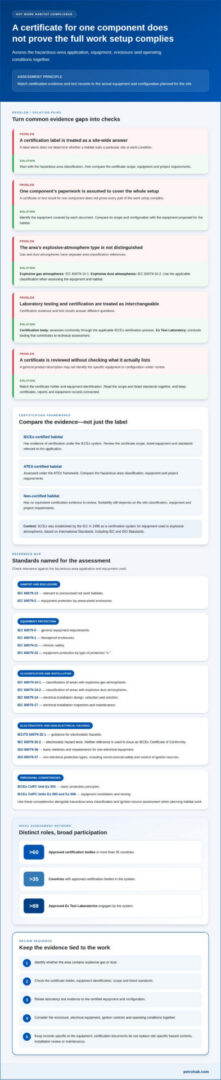
That distinction matters. Compliance depends on the enclosure, electrical equipment, ignition controls and operating conditions. A certificate or test result for one component does not prove that every part of the work setup complies.
This article explains how ATEX and IECEx certification apply to hot work habitats, what certification bodies and test laboratories contribute, and how testing supports technical assessment. It also outlines practical considerations for leasing or purchasing a habitat, including how pressurised enclosures help contain hot work hazards.
Key Takeaways
- Match the habitat’s compliance approach to the hazardous-area classification and the equipment used; ATEX and IECEx address related but distinct compliance frameworks.
- Understand the roles of approved certification bodies and Ex Test Laboratories when evaluating certification evidence and testing for explosive-atmosphere equipment.
- Compare hire and purchase against project duration, deployment needs and ongoing equipment requirements to identify the more practical option.
- Assess how pressurised enclosures, ignition controls and suitable testing work together, then consider PetroHab’s Safe-Stop Automatic Shutdown System and pressurised habitat offerings for hot work requirements.
ATEX and IECEx compliance
Start with the hazardous-area classification and the equipment planned for use inside the habitat. An IECEx certified hot work habitat should be assessed against its certification evidence and the standards relevant to the application.
IECEx Certification Considerations
The IEC established IECEx in 1996 as a certification system for equipment used in explosive atmospheres, based on International Standards, including IEC and ISO Standards. Review the certificate scope, listed equipment and applicable standards rather than treating a certification label as evidence for every component or work condition. IEC 60079-0 sets general equipment requirements; IEC 60079-1 and IEC 60079-11 cover flameproof enclosures and intrinsic safety.
Comparing Habitat Certifications
IECEx-certified habitats have evidence of certification under the IECEx system. ATEX-certified habitats are assessed under the ATEX framework, while a non-certified habitat has no equivalent certification evidence to review. These labels alone do not determine suitability for a particular site. Compare the hazardous-area classification, certificate scope, equipment and project requirements.
Start by identifying whether the area contains explosive gas or dust. IEC 60079-10-1 covers classification of areas with explosive gas atmospheres; IEC 60079-10-2 covers explosive dust atmospheres. Then assess the electrical installation: IEC 60079-14 covers its design, selection and erection, while IEC 60079-17 covers inspection and maintenance.
Check other protection methods against the equipment in use. IEC 60079-15 covers equipment protection by type of protection “n.” For electrostatic hazards, IEC/TS 60079-32-1 provides guidance, and IEC 60079-32-2 covers electrostatic hazard tests; neither is used to issue an IECEx Certificate of Conformity. ISO 80079-36 addresses basic methods and requirements for non-electrical equipment, while ISO 80079-37 covers non-electrical protection types, including constructional safety and control of ignition sources.
People and procedures also matter. IECEx CoPC Unit Ex 001 covers basic protection principles; Ex 003 and Ex 006 cover equipment installation and testing. Use these competencies alongside hazardous-area classification and ignition-source assessment when planning habitat work.
Approved certification bodies and test laboratories
IECEx separates certification oversight from laboratory testing. The system comprises more than 60 approved certification bodies in more than 35 countries and engages more than 88 approved Ex Test Laboratories. These organizations support assessment of equipment intended for explosive atmospheres, but their roles are not interchangeable. Certification evidence and test results answer different questions.
A certification body assesses conformity through the applicable IECEx certification process. An Ex Test Laboratory conducts testing that contributes to the technical assessment. For a habitat project, identify which equipment the documentation covers and compare that scope with the proposed equipment and configuration. A component’s test result alone does not establish certification for the complete habitat.
Use the IECEx On-Line Certification System to review publicly accessible IECEx-issued certificates, licences and reports. Match the certificate holder and equipment identification to the item being assessed. Check the standards and protection concepts stated in the certificate against the intended application, and keep records tied to the specific equipment rather than relying on a general product description.
- Confirm that the certificate applies to the equipment under review.
- Read the certificate scope and listed standards together.
- Relate laboratory test evidence to the certified equipment and configuration.
- Keep certificates, reports and equipment records together for project review.
For example, if a habitat includes separately documented electrical equipment, assess each item’s certificate scope instead of assuming one document covers the entire setup. The site’s hazardous-area classification and work conditions determine which evidence is relevant. Certification documents support the assessment, but do not replace site-specific hazard controls, installation review or maintenance.
A disciplined document review helps connect test evidence with the actual work scope. Explore hot work habitat information as you assess the enclosure requirements for your project.
Habitat hire and purchase
Choose whether to lease or purchase based on the work scope, deployment pattern and equipment responsibilities. Temporary access may suit a defined maintenance outage, while recurring work across facilities may make ownership more practical. Either way, the habitat and its equipment must match the hazardous-area assessment.
For a lease, map the work window, site access and installation sequence before deployment. A refinery maintenance team, for example, can coordinate habitat delivery with the approved work package and site preparations. Define who is responsible for transport, setup, inspection, maintenance and removal. Clear assignments help prevent gaps between equipment documentation and worksite procedures.
For a purchase, consider how often the habitat will be used, where it will be stored and who will maintain its records. An operator with recurring work may value greater control over scheduling and equipment configuration. Ownership also requires ongoing plans for inspection, maintenance and personnel familiarity. Assign these responsibilities before the equipment enters service.
- Set the work scope, location and expected deployment pattern.
- Identify hazardous-area requirements and the habitat configuration needed.
- Allocate setup, inspection, maintenance and storage responsibilities.
- Review equipment documentation alongside the site work package.
Apply the same technical criteria to either option. Confirm that the certification documents cover the equipment being considered, then assess whether its configuration suits the worksite. For a lease, account for the full deployment period and return logistics. For a purchase, plan for storage, upkeep and future project needs.
A single planned repair and recurring maintenance campaigns, for example, create different scheduling demands. Compare those demands with your equipment management capacity, site access arrangements and required habitat configuration. This makes the decision operational, not merely transactional. Keep the selection aligned with the project’s hazardous-area assessment and documented work controls.
Pressurised hot work habitats and enclosures
Pressurised habitats contain heat and sparks during temporary hot work. Their protective function depends on suitable design, equipment, installation, inspection and permit controls working together.
Specifications and Hazardous-Area Ratings
IEC 60079-13 is cited as relevant to pressurised hot work habitats, while IEC 60079-2 covers equipment protection by pressurized enclosures. Descriptions identify pressurised habitats as certified for use in Zone 1 and Zone 2 hazardous areas. EN 50381 is also cited among relevant requirements. Compare the stated certification scope, equipment and intended area; a rating alone doesn’t establish suitability for every site or work task.
Setup, Inspection, and Operation
Before hot work begins, follow the site’s permit process. The permit should define the task, location, hazards, controls, authorization and conditions for stopping work. Set up the habitat according to its documented configuration, then inspect the enclosure, access points and installed equipment. Installation and testing of explosion-proof enclosures, flame arrestors and explosion-isolating devices can help protect against ignition sources.
During operation, follow site procedures and monitor the controls specified for the work. Regular inspection and maintenance help identify equipment issues before use. Record findings and address defects before work proceeds.
Risks and Limitations
A habitat contains heat and sparks, but it does not remove the hazardous atmosphere around the worksite. Damaged enclosure components, unsuitable equipment or failed ignition controls can undermine the intended protection. Permits and site procedures remain essential, and the setup must match the classified area and work scope.
Use the habitat only within its documented configuration and operating procedures. Consider how personnel access, equipment installation and inspection affect enclosure integrity. Discuss pressurised habitat requirements for your hot work application.
PetroHab: Safe-Stop Automatic Shutdown System
PetroHab’s Safe-Stop Safety Shutdown System can be considered alongside habitat selection when planning hot work controls. Review it as part of the wider system, together with the work scope, enclosure configuration and site procedures. PetroHab also manufactures pressurised welding enclosures and pressurised habitats featuring Quadra-Lock Panels for hot work containment.
For safety managers and engineers, the next step is to align the required habitat and shutdown system with the project’s documented hazards and operating controls. This connects equipment selection to the worksite plan, rather than treating any single component as a complete safety measure.
Visit petrohab.com to discuss your hot work habitat requirements with PetroHab.
Define the Next Step for Your Hot Work Plan
Before committing to an IECEx certified hot work habitat, turn project requirements into a clear equipment brief. Define the work scope, site conditions, enclosure configuration and documentation needed for review. This gives safety and engineering teams a practical basis for evaluating options and coordinating the habitat with site procedures.
PetroHab offers the PetroHab Hot Work Safety Enclosure (HWSE), Safe-Stop Safety Shutdown System and Quadra-Lock Panels. Consider how these products fit the required containment and shutdown arrangements at your worksite. No single component replaces the project’s safety controls.
Start a focused discussion about the habitat requirements, intended application and next planning steps. Contact PetroHab about habitat options and move your hot work planning forward with a defined scope.
Frequently Asked Questions
What is a habitat certified under IECEx for hot work?
An IECEx certified hot work habitat is a pressurised enclosure for hot work in hazardous environments, with certification applying to specified equipment and configurations. In project planning, distinguish habitat certification from the shutdown system’s functions. PetroHab’s Safe-Stop Safety Shutdown System monitors differential pressure and gas levels, and can be equipped with oxygen and/or carbon-dioxide detectors. These capabilities help teams define monitoring needs in the work scope.
Which IECEx standards and certification requirements apply to hot work habitats?
Applicable standards depend on the equipment and protection method. IEC 60079-13 is relevant to pressurised hot work habitats, and IEC 60079-2 covers equipment protection by pressurized enclosures. PetroHab states that its habitats are ATEX- and IECEx-certified, and its Safe-Stop Safety Shutdown System is ATEX- and IECEx-certified to IEC 60079-13. Review the specific product’s certification scope for the proposed application.
Which manufacturers sell habitats certified for hot work?
PetroHab manufactures, leases and sells modular Hot Work Safety Enclosures for oil and gas hot-work operations. Its product line includes pressurised welding habitats, and its habitats are ATEX- and IECEx-certified. When assessing a purchase, identify the required enclosure configuration and whether the project also needs a shutdown system or interchangeable panels. Those choices determine the equipment package and its documentation.
How much does an IECEx certified hot work habitat cost to buy or rent?
Pricing depends on the project and is provided after a quote request. Factors include whether the habitat is leased or purchased, the deployment duration, the required configuration and any associated monitoring equipment. A temporary outage and recurring facility maintenance, for example, may involve different equipment and scheduling needs. Define the work scope and operating period so the quote reflects the intended use.
Where can US companies obtain certified habitats and support?
US companies can obtain habitats and related support from PetroHab, headquartered in Houston, Texas. PetroHab offers leasing and purchasing, as well as maintenance, training and certification programs for habitat assembly, disassembly and maintenance. A project team preparing for deployment can discuss equipment selection and personnel training together. Contact PetroHab to discuss habitat options and support for your US operation.