
Blog Posts
Habitat air quality monitoring costs and equipment needs
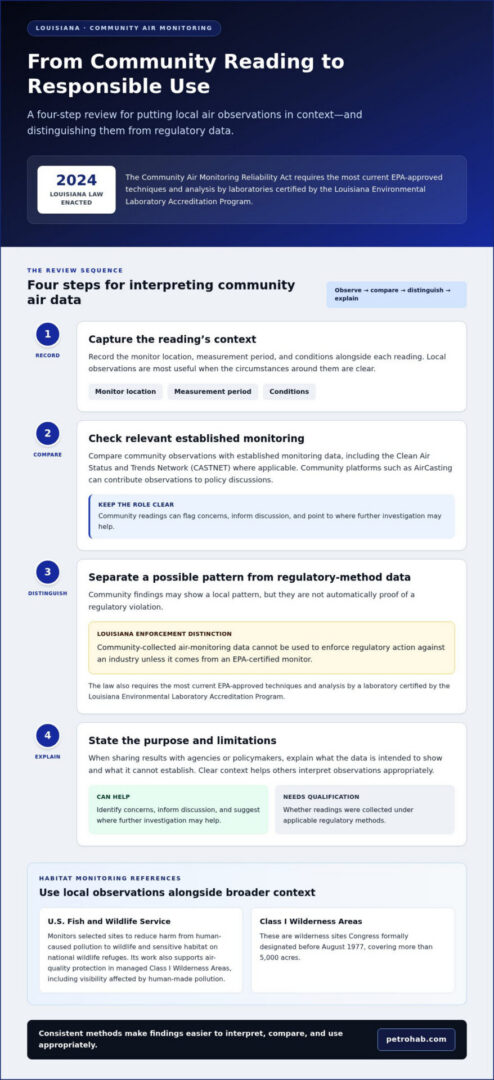
Louisiana enacted the Community Air Monitoring Reliability Act in 2024; it requires the most current EPA-approved techniques and analysis by laboratories certified by the Louisiana Environmental Laboratory Accreditation Program. The law also prevents community-collected data from being used to enforce regulatory action against an industry unless it comes from an EPA-certified monitor.
A sensor reading is useful only when it reflects conditions where people, wildlife, or sensitive habitat may be exposed. Equipment selection and placement matter as much as the instrument, especially when air quality varies across a site.
This guide explains what shapes monitoring costs, how regulatory standards influence equipment choices, and why local variation affects sensor placement. It also covers useful measurements, helping you assess habitat air quality monitoring needs in light of the data, equipment, and site conditions involved.
Key Takeaways
- Define whether monitoring is for screening, trend tracking, or regulatory use before selecting equipment.
- Compare instrument capabilities and ongoing operating needs to understand what drives the monitoring budget.
- Account for nearby sources and site conditions when deciding where monitors should be placed.
- Read particulate measurements alongside humidity and temperature to interpret changing conditions in context.
Standards for regulatory air-monitoring data
Community air measurements can identify pollution patterns, but regulatory use depends on the applicable standards. Louisiana enacted the Community Air Monitoring Reliability Act in 2024. The law requires equipment and analysis to use the most current EPA-approved techniques. It also requires analysis at laboratories certified by the Louisiana Environmental Laboratory Accreditation Program.
This distinction matters when community findings inform policy or enforcement. Louisiana law bars the use of community-collected air-monitoring data to enforce regulatory action against an industry unless the data comes from an EPA-certified monitor. Community readings can still flag concerns, inform discussion, and point to where further investigation may help. Be clear about the intended use when presenting results.
For habitat monitoring, compare site-specific observations with established programs. The Clean Air Status and Trends Network (CASTNET) offers a reference for examining air-quality trends. The U.S. Fish and Wildlife Service monitors selected sites to reduce harm from human-caused pollution to wildlife and sensitive habitat on national wildlife refuges. Its work also supports air-quality protection in managed Class I Wilderness Areas, including visibility affected by human-made pollution.
Community platforms such as AirCasting can contribute observations to policy discussions. Treat their readings as evidence of local conditions, not automatic proof of a regulatory violation. A practical review process is:
- Record the monitor location, measurement period, and conditions alongside each reading.
- Compare community observations with relevant established monitoring data, including CASTNET where applicable.
- Separate findings that indicate a possible pattern from data collected under regulatory methods.
- Explain the data’s purpose and limitations when sharing results with agencies or policymakers.
Class I Wilderness Areas are sites Congress formally designated as wilderness before August 1977, and they cover more than 5,000 acres. These examples show why habitat monitoring needs both local observations and clearly defined data standards. Consistent methods make results easier to interpret, compare, and use appropriately.
The U.S. Fish and Wildlife Service works with federal agencies, states, and regional networks to protect air quality and support compliance with the Clean Air Act, the Wilderness Act, and the National Wildlife Refuge System Improvement Act. The U.S. Environmental Protection Agency funds the Louisiana Environmental Action Network’s air-monitoring system.
Costs of regulatory monitoring equipment
Equipment costs depend on the measurement task, data-quality requirements, and site conditions. These figures describe different equipment categories, not a universal budget for every monitoring project.
A higher-cost system may combine specialized analyzers, data handling, and support. The target pollutant and required measurement method determine the instrument choice. Site access, available power, weather exposure, and communications also shape installation plans. A remote habitat may need different infrastructure from a monitor near an established facility.
Separate equipment costs from the ongoing costs of running a monitoring program. Calibration, maintenance, replacement components, data review, and laboratory analysis can all affect total spending. In Louisiana, for example, analysis must be performed by laboratories certified by the Louisiana Environmental Laboratory Accreditation Program. Plan for analysis from the outset.
- Define the pollutants and intended use before comparing instruments.
- List site requirements, including access, power, and data transmission.
- Account for calibration, maintenance, and analysis alongside equipment.
- Distinguish screening tools from equipment intended to support regulatory decisions.
Set the budget according to the monitoring objective. Community screening may prioritize broad coverage and accessible readings, while regulatory monitoring must meet applicable method and data requirements. The most expensive instrument is not automatically the right choice for every habitat. Compare required measurements, data quality, site logistics, and ongoing program needs together. Clear specifications also help you compare proposals consistently and distinguish equipment, installation, analysis, and operating costs.
Kentucky passed a law restricting the type of equipment used to enforce regulatory change for ambient air-quality pollution monitoring in its 2025 legislative session. This adds a jurisdiction-specific consideration to equipment selection: purchasers should confirm that proposed instruments fit the rules governing their intended use. Before committing funds, document the monitoring purpose and verify equipment eligibility with the relevant authorities. Keep that check distinct from performance comparisons, so a technically capable instrument is not assumed to be suitable for regulatory enforcement.
Hyperlocal air-quality variation
Air readings can vary across a habitat because pollution sources and local conditions differ by location. A monitor near a road, industrial site, or exposed shoreline may record a different pattern from one deeper within the habitat. Wind direction, terrain, vegetation, and nearby structures affect how emissions travel or disperse. One station may therefore miss conditions elsewhere.
Effective habitat air quality monitoring accounts for these local differences. The Louisiana Environmental Action Network’s air-monitoring dashboard shows readings from four locations along the Mississippi River between Baton Rouge and New Orleans, illustrating how multiple points can reveal variation along a corridor. For a habitat assessment, first map potential sources and sensitive areas. Then place monitors to capture likely exposure and a comparison location away from the suspected source.
Choose monitor locations based on the question the monitoring must answer. To examine a possible source, place a monitor where air may travel toward the habitat, then compare its readings with a site outside that pathway. To assess a broader area, distribute stations across distinct terrain or land uses. Record each location and its surroundings so later comparisons retain context.
- Map emission sources, habitat boundaries, terrain, and nearby structures.
- Choose locations that represent exposed areas and comparison conditions.
- Record wind direction and site observations alongside each reading.
- Review station patterns together rather than treating one measurement as representative.
Interpret contrasting readings in context when planning habitat air quality monitoring. A reading near a source might rise while a farther station remains steady. That contrast can show where further observation would be useful, but it does not establish the cause on its own. Check whether the pattern aligns with wind direction, local activity, and repeated measurements. Consistent location records help distinguish a site-specific signal from broader environmental change.
Particulate matter, humidity and temperature measurements
For habitat monitoring, measurements may include particulate matter; other pollutants depend on identified sources and the monitoring objective. Pair particle readings with humidity and temperature measurements to interpret conditions at each sensor location.
Particulate Matter Measurements
Particulate matter measurements track airborne particles, but the instrument and method should suit the site’s purpose. Decide whether the priority is tracking change over time, comparing locations, or assessing a particular source. For example, a monitor near dusty work may show a different pattern from one in a cleaner comparison area. Record each sensor’s position and surrounding conditions.
Humidity and Temperature Measurements
Humidity and temperature help put particle readings in context. These conditions can affect particle behavior and sensor response, so compare measurements taken under similar operating conditions where possible. Keep readings time-aligned. For example, review a particle increase recorded during a temperature shift alongside that shift, rather than as an isolated result.
A clear measurement record identifies the parameter, location, timestamp, and relevant site activity. Use consistent placement and follow the instrument’s operating instructions. If readings differ between two positions, compare their environmental conditions before drawing conclusions. This helps distinguish a location-specific pattern from a change affecting the whole habitat.
- Match particle monitoring to the question being investigated.
- Log humidity and temperature with particulate readings.
- Compare like locations and conditions before interpreting changes.
If air monitoring accompanies hot work in a contained workspace, explore pressurized habitats as the enclosure component. Monitoring measurements and enclosure selection address different operational needs.
PetroHab: PetroHab Hot Work Safety Enclosure (HWSE)
When the operational concern is hot work in a hazardous environment, PetroHab’s Hot Work Safety Enclosure (HWSE) is relevant. Habitat air monitoring assesses environmental conditions; a hot-work enclosure addresses the work area and its associated safety controls. PetroHab also offers pressurized welding enclosures and Quadra-Lock® panels for these applications.
When gas levels and pressure need monitoring during hot work, PetroHab’s Safe-Stop Safety Shutdown System monitors both to support worker safety. It serves a different purpose from habitat air-quality sensors, so define the hazard and monitoring objective separately when planning controls.
For information about PetroHab’s hot work safety solutions, visit petrohab.com.
Turn monitoring findings into a practical next step
Use habitat air quality monitoring results to guide environmental planning, while keeping separate controls clear. Air measurements describe conditions; they do not replace controls required for hot work in hazardous environments. If monitoring informs a wider worksite decision, identify where hot work will take place and what enclosure is needed.
PetroHab is relevant when the next decision concerns hot-work containment rather than air sampling. Its PetroHab Hot Work Safety Enclosure (HWSE), Safe-Stop Safety Shutdown System, and Quadra-Lock® panels address that distinct operational need. Keep the distinction clear so the monitoring plan and hot-work controls each serve their intended purpose.
For a discussion about how hot-work enclosure needs relate to your site planning, contact PetroHab. A clear next step helps keep environmental monitoring and worksite controls aligned.