Blog Posts
Hot Work Enclosure for Pipeline Coating Repair: A 2026 Safety and Integrity Guide
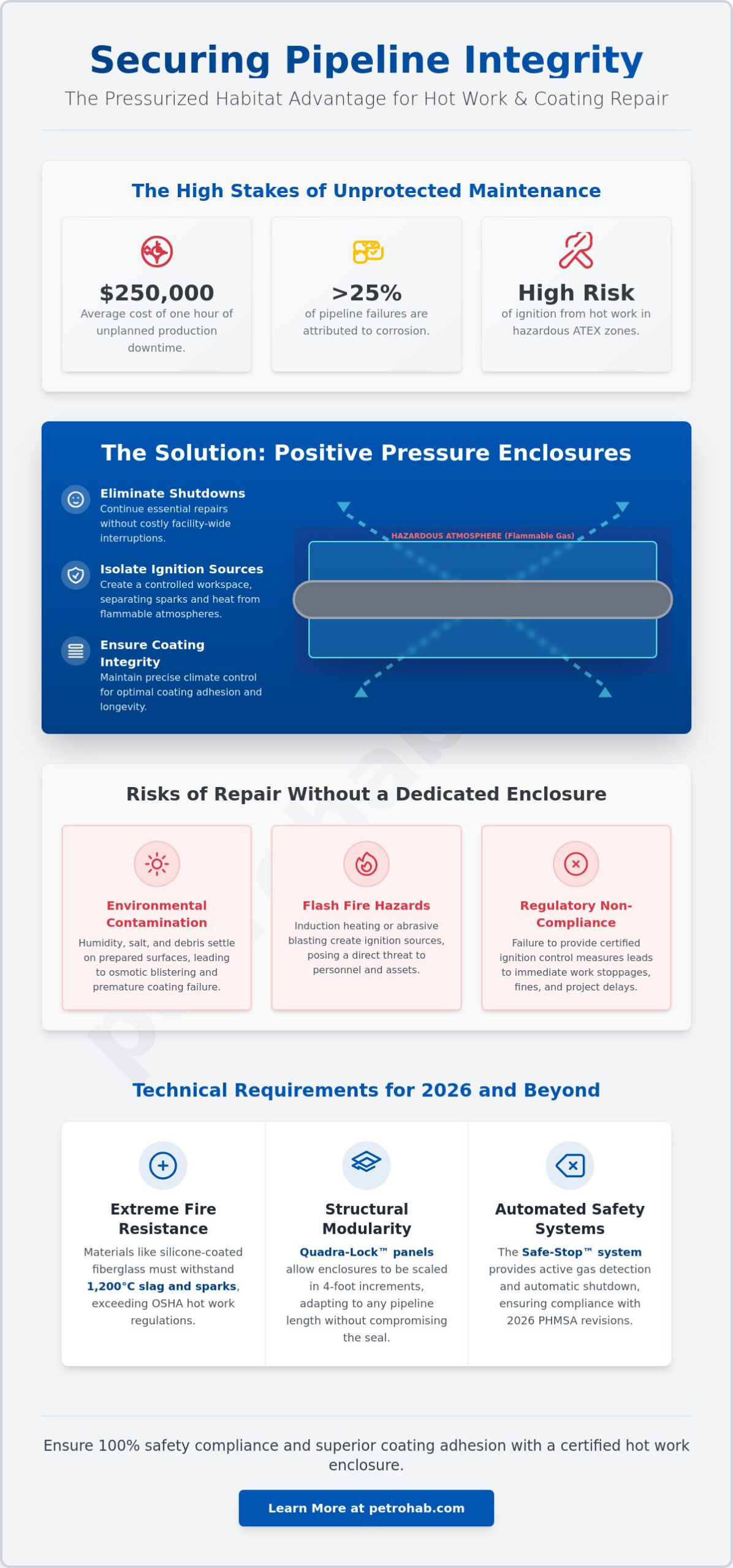
In 2026, one hour of unplanned production downtime on a Tier 1 offshore platform costs an average of $250,000, yet corrosion remains responsible for over 25% of reported pipeline failures. You recognize the high stakes of performing maintenance in hazardous zones where the risk of ignition often forces total system shutdowns. Implementing a specialized hot work enclosure for pipeline coating repair allows your team to bypass these interruptions while maintaining absolute site control. These pressurized environments isolate ignition sources and create the stable climate necessary for high-performance coatings to cure correctly, even in volatile ATEX zones.
We agree that safety compliance and engineering precision shouldn’t be mutually exclusive during urgent infrastructure repairs. This guide explains how to secure pipeline integrity through controlled environments and advanced hot work safety enclosures. You’ll learn how to utilize modular systems like the Petro-Shield and Quadra-Lock panels to ensure 100% safety compliance and superior coating adhesion. We also detail the role of the Safe-Stop automatic shutdown system in meeting the latest PHMSA regulatory revisions effective August 3, 2026, ensuring your operations remain both compliant and productive.
Key Takeaways
- Understand how to align maintenance protocols with 2026 PHMSA revisions through the deployment of pressurized habitats.
- Identify the technical requirements for fire-resistant Quadra-Lock panels to ensure modular flexibility across varying pipeline lengths.
- Learn why a hot work enclosure for pipeline coating repair is essential for maintaining the precise dew point required for long-term coating adhesion.
- Discover how the Safe-Stop automatic shutdown system provides an active layer of protection against gas leaks and environmental hazards.
- Master site assessment protocols and tie-down procedures to minimize the operational footprint during critical maintenance turnarounds.
Why Use a Hot Work Enclosure for Pipeline Coating Repair?
A hot work enclosure for pipeline coating repair functions as a high-integrity containment system designed to isolate ignition sources from hazardous atmospheres. In the energy sector, pipeline maintenance often involves activities that qualify as hot work under OSHA and NFPA definitions. While welding is the most obvious example, coating repair frequently utilizes induction heating for surface preparation and abrasive blasting. These processes generate sufficient thermal energy or mechanical sparks to ignite fugitive hydrocarbon emissions in Class 1, Division 1 or Division 2 environments. Without a controlled barrier, these routine maintenance tasks pose a direct threat to personnel and high-value assets.
To better understand the technical requirements of this process, watch this helpful video regarding industrial coating applications:
To maintain operational continuity, engineers utilize a positive pressure enclosure to create a secure workspace. This technology ensures that even if a leak occurs in the surrounding area, the internal pressure of the habitat prevents flammable gases from entering the enclosure. Adopting these systems is a critical component of meeting the NFPA 51B standard, which mandates stringent fire prevention measures during any operation involving sparks or heat. By using a certified habitat, operators can continue essential repairs without the extreme costs associated with a total facility shutdown.
The Risks of Open-Air Pipeline Coating Repair
Attempting repairs without a dedicated enclosure introduces three primary categories of risk. Environmental contamination presents a significant threat to coating longevity. Salt, humidity, and airborne debris settle on prepared steel surfaces, leading to osmotic blistering and premature coating failure. Flash fire hazards are also prevalent when pre-heating repair sleeves or using open flames near live assets. Finally, regulatory non-compliance often results in immediate work stoppages. Safety inspectors increasingly demand documented ignition control measures, and failure to provide a certified habitat can lead to significant fines or project delays.
Defining the Pressurized Habitat Advantage
The primary advantage of these systems lies in their ability to exclude hazardous atmospheres through mechanical ventilation. By maintaining a higher internal pressure than the surrounding environment, the system creates a physical barrier against external hydrocarbons. A pressurized welding habitat is a controlled safety environment designed to isolate sparks and heat from explosive atmospheres while protecting the integrity of the repair process. Modularity remains a key factor. The use of specialized Quadra-Lock panels allows technicians to scale the enclosure to accommodate varying pipeline diameters and repair lengths without compromising the seal. This adaptability ensures that a hot work enclosure for pipeline coating repair remains the benchmark for high-stakes maintenance.
Technical Requirements for Pipeline Habitats in 2026
Safety managers in 2026 require more than just a physical barrier. A hot work enclosure for pipeline coating repair must meet stringent fire-resistance standards to protect against 1,200°C slag and sparks. These enclosures utilize silicone-coated fiberglass or similar advanced composites that exceed the minimum requirements set by OSHA hot work regulations. Beyond material science, structural modularity is essential. The ability to expand habitats in 4-foot increments allows for the containment of long pipeline segments without compromising the internal pressure. This scalability ensures that regardless of the repair sleeve size, the enclosure remains a compact and efficient workspace.
Technical integrity is further reinforced through the integration of hot work safety systems. These systems don’t operate in isolation; they are hard-wired into the enclosure’s infrastructure. For instance, if gas is detected or pressure is lost, the Safe-Stop system immediately terminates power to the welding equipment. This level of automation removes human error from the safety equation, which is why engineering firms now specify these integrated solutions for high-risk turnarounds. If you’re planning a complex maintenance schedule, evaluating the structural capabilities of your habitat is a critical first step.
Quadra-Lock Technology vs. Traditional Fasteners
Traditional enclosures often rely on zippers or Velcro, which degrade over time and create microscopic gaps. These openings are sufficient for sparks or hot slag to escape, posing a significant risk in volatile environments. Quadra-Lock technology replaces these failure points with a mechanical interlocking system. By physically joining the panels, the system creates a gas-tight seal that maintains positive pressure more effectively. These panels are supported by high-grade aluminum tubular frames, which provide the rigidity needed to withstand high-wind conditions often found in open pipeline corridors.
Compliance with ATEX and IECEx Standards
Operating in Zone 1 or Zone 2 hazardous areas requires equipment that meets international ATEX and IECEx certifications. A compliant hot work enclosure for pipeline coating repair must feature certified gas detection sensors located at both the air intake and inside the habitat. These sensors are the primary triggers for the Safe-Stop mechanism. In 2026, compliance isn’t just a legal checkbox; it’s a technical necessity for protecting personnel. Verification of these shutdown protocols ensures that any breach in the safety perimeter results in an instantaneous cessation of all hot work activities.
Controlling the Micro-Climate for Coating Integrity
Coating performance is fundamentally tied to the environment in which it’s applied. While previous sections focused on the ignition prevention capabilities of a hot work enclosure for pipeline coating repair, its role in ensuring long-term adhesion is equally critical. Inconsistent curing caused by temperature fluctuations or high humidity remains a leading cause of premature coating failure. By integrating climate control units directly into the habitat, technicians maintain the substrate temperature at the required levels, typically 3°C above the dew point, to prevent moisture condensation. This precision establishes a laboratory-grade environment in the middle of active industrial sites.
Precision in environmental control is a technical necessity. Grit-blasted steel is highly reactive. Even brief exposure to high humidity during the repair window can trigger “flash rust,” a microscopic layer of oxidation that compromises the bond between the steel and the epoxy. Adhering to PHMSA pipeline safety standards requires not only the prevention of accidental ignition but also the long-term preservation of the asset’s structural integrity. A controlled environment ensures that spray-applied coatings achieve their full chemical cross-linking. This results in a durable finish that is free of holidays or voids. Utilizing a hot work enclosure for pipeline coating repair transforms a high-risk field task into a controlled engineering process.
Managing Temperature and Humidity
In offshore or desert environments, ambient conditions are often hostile to high-performance coatings. High humidity levels accelerate oxidation on prepared surfaces; extreme heat can cause coatings to “dry spray” or cure too rapidly, leading to brittleness. Climate-controlled habitats utilize high-capacity air conditioning and heating units to stabilize these variables. This stability is vital when using induction heating to pre-heat the pipe. Consistent ambient temperatures prevent rapid thermal cooling of the substrate, allowing the coating to flow and wet the surface properly before the cure begins.
Protecting Against Environmental Contaminants
Field repairs are susceptible to wind-blown dust, salt spray, and industrial debris. These contaminants act as bond-breakers if they settle on the pipe before or during the application process. Pressurized enclosures effectively create clean-room conditions in the field by filtering incoming air and maintaining a constant outward flow. Air ducting systems ensure continuous fresh air exchange, which also serves to remove overspray and solvent vapors from the workspace. This dual-purpose ventilation protects both the integrity of the coating and the health of the personnel inside the enclosure.
Operational Best Practices for HWSE Setup on Pipelines
Successful deployment of a hot work enclosure for pipeline coating repair begins long before the first panel is locked into place. Engineers must conduct a rigorous site assessment to identify potential ignition sources and verify the structural stability of the terrain. This phase involves mapping out the Class 1, Division 1 and 2 boundaries to ensure the air intake is positioned in a non-hazardous location. Once the assessment is complete, the enclosure must be formally integrated into the site’s Permit-to-Work (PTW) system. The PTW should explicitly list the habitat as the primary engineering control, detailing the specific pressure thresholds and gas detection parameters required for the work to proceed.
Step-by-Step Installation Protocol
Field technicians start by assembling the modular aluminum frame directly around the pipeline segment. These frames provide the necessary rigidity to maintain a consistent seal under pressure, unlike generic temporary structures. Technicians then install the Quadra-Lock panels, ensuring the interlocking edges are fully engaged to eliminate gas ingress points. The most critical step involves sealing the pipe entry and exit points using specialized sleeves that contour to the pipe’s diameter. After assembly, the Safe-Stop system is connected to the internal sensors and the external air intake ducting. Before any hot work commences, the team establishes the positive pressure differential and verifies the internal environment with calibrated manometers.
Monitoring and Safety Oversight
Operational safety relies on continuous vigilance rather than a passive setup. On-site supervisors are responsible for maintaining habitat integrity throughout the shift, checking for physical damage or pressure fluctuations. Continuous gas monitoring protocols require sensors to be active both inside the enclosure and at the air intake point. If the system detects hazardous gases or a loss of pressure, the Safe-Stop mechanism provides an instantaneous shutdown of all power sources. Emergency procedures must be clearly communicated during the pre-job toolbox talk, ensuring every crew member knows the evacuation route and the protocol for safe decommissioning. Securing the enclosure using exterior ‘D’ rings and tie-down protocols is essential to prevent movement during high-wind events.
Adhering to these rigorous procedures ensures that maintenance turnarounds remain on schedule without compromising asset safety. For expert assistance with your next project, you can request a technical consultation for your HWSE setup.
The PetroHab Solution: Petro-Shield for Pipeline Integrity
Petro-Shield is the specialized hot work enclosure for pipeline coating repair developed to meet the unique challenges of linear assets. It utilizes the proprietary Quadra-Lock panel system to create a gas-tight seal around various pipe diameters, ensuring that ignition sources remain isolated from the surrounding atmosphere. PetroHab supports international energy projects through a network of hot work safety enclosure suppliers, ensuring that certified equipment is available in critical hubs. This logistical reach allows operators to maintain safety compliance without the delays associated with long-distance shipping during urgent maintenance cycles.
Every pipeline project presents distinct environmental variables. PetroHab provides extensive customization options for its habitats, including explosion-proof heaters, air conditioning units, and specialized air ducting. These components ensure the micro-climate remains stable for coating cure regardless of external conditions. For short-term maintenance turnarounds, leasing options provide a cost-effective way to access the latest Safe-Stop technology. Long-term infrastructure programs often benefit from purchasing dedicated units to ensure immediate availability for emergency repairs. This flexibility allows safety managers to scale their protection based on the specific scope of the project.
Why PetroHab is the Preferred Partner
With decades of operational history in the Houston oil and gas corridor and major global basins, PetroHab understands the granular details of industrial hazards. Our commitment to technical precision goes beyond equipment manufacturing. We provide on-site training and certified supervision to ensure that every hot work enclosure for pipeline coating repair is installed and monitored according to the highest engineering standards. This expert oversight mitigates risk and protects both personnel and high-value assets during high-stakes maintenance. We act as a trusted advisor and a critical safety partner, projecting reliability through every stage of the repair process.
Next Steps for Your Pipeline Project
Securing your site begins with a detailed evaluation of your modular requirements. Whether your project involves a single repair sleeve or a multi-mile maintenance program, PetroHab helps you determine the optimal configuration of Quadra-Lock panels and safety systems. You can contact PetroHab for a specialized HWSE quote or to request a technical consultation for your specific repair site. Our team of experts is ready to act as your active guardian in the field, providing the reliability and control necessary for operational excellence in hazardous environments.
Securing Long-Term Pipeline Integrity
Maintaining pipeline infrastructure in 2026 requires a shift from reactive maintenance to precision-engineered safety protocols. You’ve seen how a hot work enclosure for pipeline coating repair serves as more than a physical barrier; it’s a controlled micro-climate that ensures superior coating adhesion and prevents the ignition of fugitive emissions. By utilizing patented Quadra-Lock Interlocking Technology, these systems provide a gas-tight seal that traditional methods can’t match. This technical rigor, combined with ATEX and IECEx compliant systems, allows your team to operate in hazardous zones without compromising site safety or production schedules.
PetroHab has been trusted by global oil and gas majors for over 15 years to protect personnel and high-value assets during critical turnarounds. Our focus remains on providing reliable, field-proven solutions that meet the evolving demands of industrial safety. Whether you’re managing offshore platforms or extensive onshore corridors, the right enclosure minimizes your operational footprint while maximizing protection. Take the next step in your safety planning and Request a Quote for Petro-Shield Pipeline Enclosures today. We’re ready to help you achieve 100% compliance and long-term asset protection.
Frequently Asked Questions
What is the primary purpose of a hot work enclosure during pipeline repair?
The primary purpose is to isolate hot work ignition sources from potentially explosive atmospheres while creating a controlled environment for technical tasks. By maintaining positive pressure, the enclosure excludes hazardous gases and flammable vapors. This isolation allows critical repairs to proceed without a total facility shutdown, protecting both the personnel inside and the high-value assets in the surrounding area.
Can PetroHab enclosures be used for welding on live pipelines?
PetroHab enclosures are engineered to facilitate welding and other hot work on live assets when supported by rigorous site-specific risk assessments and permit-to-work protocols. The system provides the necessary containment to manage thermal energy and sparks. This ensures that maintenance activities don’t compromise the integrity of active pipeline segments, maintaining operational continuity in high-stakes energy environments.
How do Quadra-Lock panels improve safety compared to other enclosures?
Quadra-Lock panels utilize a mechanical interlocking design that creates a superior gas-tight seal compared to traditional zippers or Velcro fasteners. This proprietary technology eliminates microscopic gaps where sparks, hot slag, or molten metal could escape the habitat. The resulting structure is more durable and resilient; it’s specifically designed to withstand the high-wind conditions often found in open pipeline corridors.
What standards govern the use of welding habitats in hazardous areas?
The use of pressurized welding habitats is governed by international standards including NFPA 51B and OSHA regulations. In hazardous zones, equipment must also comply with ATEX and IECEx certifications. These standards ensure that the gas detection sensors and automatic shutdown systems meet the rigorous technical requirements for environmental containment and ignition prevention in volatile industrial sectors.
How does climate control in a habitat improve coating performance?
Climate control stabilizes the micro-climate inside a hot work enclosure for pipeline coating repair, preventing moisture condensation on the prepared steel surface. By maintaining the substrate temperature at least 3°C above the dew point, the system eliminates flash rust. This precision ensures that epoxy or spray-applied coatings achieve their full chemical cross-linking and long-term adhesion properties.
Is on-site training required to set up a PetroHab Petro-Shield?
PetroHab offers on-site training and certified supervision to ensure the enclosure is installed according to exact engineering specifications. While the modular components are designed for operational efficiency, professional oversight ensures that the positive pressure seals and Safe-Stop integrations are fully verified. This commitment to technical precision helps safety managers maintain 100% compliance during complex maintenance turnarounds.
What happens if the gas detection system identifies a leak while work is in progress?
If the gas detection system identifies a leak, the Safe-Stop Automatic Shutdown System instantaneously terminates power to all welding and heating equipment. This automated response removes the risk of human error, ensuring that any breach in the safety perimeter results in an immediate cessation of hot work. The system monitors for both internal hazards and external gas ingress at the air intake point.
Can the Petro-Shield be expanded for long pipeline segments?
The Petro-Shield is a modular system that technicians can expand in 4-foot increments to accommodate long repair segments or multiple repair sleeves. This flexibility allows for the creation of a continuous hot work enclosure for pipeline coating repair that fits the specific geometry of the project. Modular expansion ensures the habitat remains a compact and efficient workspace regardless of the total repair length.