Blog Posts
Managing Hot Work During Refinery Shutdown: A 2026 Safety Engineering Guide
Can a refinery turnaround maintain a 98% utilization rate while simultaneously eliminating the inherent ignition risks introduced by a transient workforce? Engineering managers understand the intense pressure of high-volatility environments where even a minor hydrocarbon leak during vessel blinding can lead to catastrophic failure. Effectively managing hot work during refinery shutdown operations requires more than just vigilance. It demands a systematic approach to engineering out the hazard through definitive physical barriers and automated monitoring.
You’re likely facing the complex challenge of coordinating hundreds of repairs while maintaining a zero-incident performance standard. We’ll help you master the technical protocols and engineering controls required to eliminate ignition risks during these high-pressure 2026 turnarounds. This guide details the seamless integration of Safe-Stop automatic shutdown systems and modular Quadra-Lock panels into your existing Permit to Work (PTW) systems. We’ll explore how utilizing pressurized welding enclosures reduces total downtime by providing a rigorous, uncompromising defense against flammable gas ingress, ensuring your personnel and high-value assets remain protected throughout the project lifecycle.
Key Takeaways
- Implement advanced engineering controls for managing hot work during refinery shutdown to move beyond the limitations of standard administrative safety measures.
- Learn how positive pressure physics in pressurized welding enclosures create a reliable physical barrier against flammable gas ingress.
- See how Quadra-Lock technology provides superior seal integrity and modular flexibility for complex vessel geometries.
- Integrate Safe-Stop automatic shutdown systems into your Permit-to-Work protocols to ensure it’s impossible for human error to bypass gas detection.
- Evaluate the ROI of specialized safety enclosures to reduce total downtime and lower insurance premiums during aggressive maintenance cycles.
The High-Stakes Complexity of Refinery Shutdowns and Turnarounds (TAR)
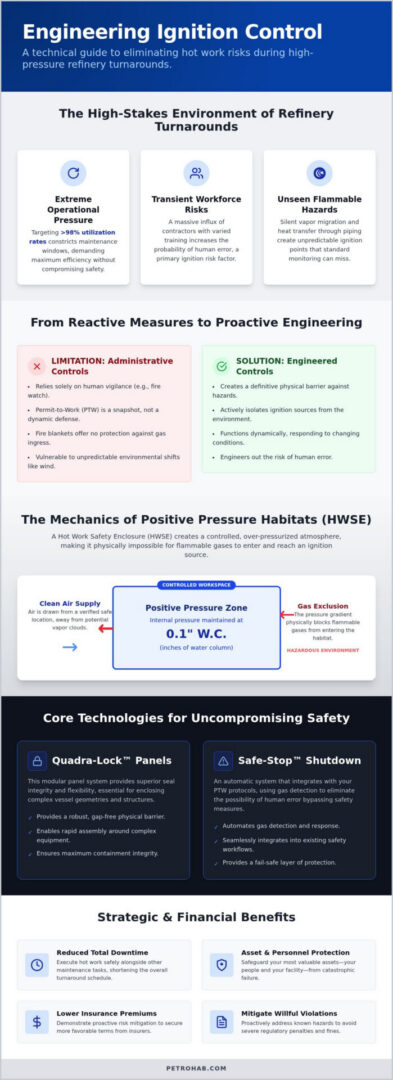
The 2026 refinery landscape is defined by extreme operational pressure. Facilities currently target utilization rates above 98%, which constricts maintenance windows to their absolute limit. During a Turnaround (TAR), the introduction of a transient workforce creates a significant safety delta. Thousands of contractors with varying levels of safety training enter the site simultaneously. This massive personnel influx increases the probability of human error, especially when Hot work permit-to-work systems are the only layer of defense. Managing hot work during refinery shutdown operations is no longer a matter of simple oversight; it’s a matter of engineering out the risk.
Administrative controls, while necessary, remain inherently flawed in high-congestion work zones. Relying on a fire watch’s vigilance or a signed permit doesn’t physically prevent gas from reaching an ignition source. During vessel opening and blinding phases, hydrocarbon volatility is at its peak. Vapor migration happens silently. A standard fire blanket might stop a spark, but it’s useless against a pocket of wandering methane or butane. Effective risk mitigation requires a definitive technological remedy that separates the ignition source from the hazardous environment.
Identifying Fatal Hazards in Shutdown Environments
Vapor migration remains a primary threat because gas doesn’t respect physical boundaries without active containment. Standard fire blankets lack the seal integrity required to block pressurized or drifting vapors. Additionally, welding creates “hot spots” where heat transfers through adjacent piping systems, potentially igniting residue in supposedly isolated lines. Environmental variables, such as shifting wind patterns and high humidity, further complicate gas dispersion. These factors make it impossible to predict vapor behavior with absolute accuracy using manual monitoring alone. Without a pressurized habitat, the site remains vulnerable to the unpredictable nature of volatile organic compounds.
The Economic Impact of Safety Failures
The financial consequences of a safety breach during a shutdown are devastating. Beyond the immediate threat to life, refineries face severe penalties for “willful violations” under modern safety standards. Long-term asset damage often exceeds the initial cost of engineering controls by several orders of magnitude. Refineries that prioritize active containment and pressurized habitats often see more favorable terms from insurers. Investing in a PetroHab Hot Work Safety Enclosure (HWSE) isn’t just a safety choice. It’s a calculated move to protect the bottom line. Managing hot work during refinery shutdown events requires a shift from reactive monitoring to proactive, engineered isolation.
Engineering Ignition Control: The Mechanics of Pressurized Welding Habitats
A PetroHab Hot Work Safety Enclosure (HWSE) operates as a sophisticated engineering control rather than a simple barrier. While administrative permits verify that conditions are acceptable at a single point in time, managing hot work during refinery shutdown requires a dynamic solution that responds to changing environmental risks. These pressurized habitats create a controlled atmosphere where welding and grinding can proceed safely, even when the surrounding area contains potential hydrocarbon hazards. By isolating the ignition source, engineers can maintain high utilization rates without compromising site safety.
The physics of positive pressure provides the foundation for this isolation. By maintaining an internal pressure slightly higher than the ambient environment, typically 0.1 inches of water column, the habitat ensures that air only flows outward. If a leak occurs in nearby piping, the pressure gradient physically blocks flammable gases from entering the workspace. This system requires a constant supply of air from a verified clean source located well away from potential vapor clouds. High air exchange rates are also critical; they remove welding fumes and heat, ensuring a breathable and productive environment for the workforce.
The Role of Positive Pressure in Gas Exclusion
Maintaining a consistent pressure differential is vital for safety compliance. This technical requirement aligns with broader Process Safety Management (PSM) protocols, which demand rigorous controls in petroleum environments. The system relies on several integrated components to protect personnel:
- Manometer monitoring: Provides real-time verification of the 0.1 inches of water column pressure differential.
- Clean air source: Delivers a constant volume of air from a remote, non-hazardous location.
- Air movers: Centrifugal blowers that maintain internal pressure while facilitating necessary air exchange.
Structural Integrity and Material Standards
The durability of the enclosure depends on the quality of its components. Materials must meet NFPA 51B standards and international fire resistance certifications to withstand 2026 industrial welding temperatures. PetroHab utilizes patented Quadra-Lock panels, which are engineered to resist the corrosive atmospheres common in refinery units. These modular panels allow for rapid assembly around complex geometries, such as valves and piping manifolds. Managing hot work during refinery shutdown events is simplified when using modular systems that adapt to existing infrastructure. HWSE integrity serves as the primary defense against gas ingress. To ensure your facility meets these rigorous engineering standards, consider exploring the specialized pressurized welding enclosures available for your next turnaround.
Operational Integration: Quadra-Lock Technology vs. Traditional Mitigation
Traditional hot work mitigation often relies on overlapping strips or fire-resistant fabric layers. These “strip” habitats are prone to gaps, especially when subjected to the high-pressure air requirements of a habitat. Managing hot work during refinery shutdown requires a more robust seal. Quadra-Lock technology provides an interlocking panel system that eliminates these vulnerabilities. Each panel fastens securely to the next, creating a continuous physical barrier. This patented design ensures that positive pressure is maintained consistently. It prevents hydrocarbon ingress without the risk of seam failure during long, high-intensity shifts. Reliability is the priority when high-value assets are at stake.
Overcoming Complex Refinery Geometries
Refinery units aren’t composed of flat surfaces. Sealing around T-junctions, large diameter flanges, and irregular vessel geometries is a primary engineering challenge. Modular Quadra-Lock Panels allow for granular customization of the enclosure footprint. Technicians can configure the panels to fit around existing infrastructure, ensuring a tight seal where traditional blankets would fail. For confined space welding operations, this modularity is essential for maintaining safe egress routes. Proper ventilation is supported by PetroHab Air Ducting. This system ensures that even in congested areas, the internal atmosphere remains within safe breathable limits while the positive pressure gradient stays intact. It’s a definitive technological remedy for hazardous work zones.
Comparing Modular HWSE to Conventional Methods
Choosing between modular HWSE and conventional welding blankets is a matter of quantifying risk and labor efficiency. Traditional methods often require extensive bespoke fabrication on-site. This adds hours or days to a TAR schedule. Modular systems arrive ready for assembly. Setup time is significantly reduced, allowing welding teams to begin work sooner. Refinery managers find that managing hot work during refinery shutdown is more efficient when using reusable modular components that don’t degrade in corrosive environments. Consider these comparative advantages:
- Labor Efficiency: Modular components require fewer man-hours for setup and teardown compared to bespoke fabrications.
- Seal Integrity: Interlocking panels provide a consistent barrier that traditional blankets cannot match.
- Durability: Quadra-Lock Panels are designed for longevity, surviving multiple shutdown cycles without losing their fire-resistant properties.
- Waste Reduction: Reusable systems eliminate the need to dispose of contaminated welding blankets after every use.
This systematic approach ensures that safety protocols aren’t just met, but exceeded through superior engineering.
Integrating Safe-Stop Technology into Permit-to-Work (PTW) Systems
Manual Permit-to-Work (PTW) systems provide the administrative framework for safety, but they rely on human observation and reaction times. In the high-pressure environment of a turnaround, human error is a persistent variable that can lead to catastrophic failures. Managing hot work during refinery shutdown operations effectively requires an automated safety multiplier. The Safe-Stop Automatic Shutdown System serves this role by providing a definitive technological remedy to the limitations of manual fire watches. It continuously monitors the habitat’s environment and intervenes the moment safety parameters are breached, ensuring that ignition risks are physically eliminated.
The system integrates Lower Explosive Limit (LEL) sensors directly into the habitat environment. If flammable gas is detected, the system executes an automatic power isolation. It kills the welding arc instantly, preventing ignition before a human could even process the alarm. Additionally, the system generates comprehensive audit trails. These data logs are essential for 2026 compliance reporting and provide a factual record of environmental conditions throughout the shift. This level of technical precision instills absolute confidence in safety engineers and site managers.
The Logic of Automatic Shutdown
Safe-Stop operates on a rigorous logical hierarchy. It monitors specific LEL thresholds aligned with 2026 safety standards. If gas levels rise above the pre-set limit, the system triggers an immediate shutdown. Beyond gas detection, the system monitors internal pressure. If the differential falls below the required 0.1 inches of water column, indicating a breach in the Quadra-Lock Panels or a blower failure, the system intervenes. While a manual override exists for specific maintenance tasks, the automated safety logic remains the primary guardian. It removes the burden of split-second decision-making from the fire watch, replacing intuition with technical certainty.
Workflow Integration for TAR Managers
For Turnaround (TAR) managers, the value of Safe-Stop lies in its ability to integrate with digital PTW systems. Linking the habitat’s status to a central control room provides real-time visibility across multiple work sites. Fire watches are trained to monitor Safe-Stop indicators, but their role shifts from being the sole detector to being the first responder to an automated alert. After the project concludes, managers use the system’s data logs for post-shutdown analysis. This data identifies recurring risk patterns and helps refine safety protocols for future maintenance cycles. To enhance your site’s safety architecture, implement the Safe-Stop Automatic Shutdown System to eliminate the risks of manual oversight during critical repairs.
Strategic Procurement for 2026: Rental, Sales, and On-site Supervision
Procurement strategy represents the final critical phase in managing hot work during refinery shutdown operations. Engineers must evaluate the return on investment (ROI) by weighing equipment costs against the potential for catastrophic asset loss and rising insurance premiums. Utilizing a PetroHab Hot Work Safety Enclosure (HWSE) acts as a definitive technological remedy that often results in more favorable insurance terms. Active containment demonstrates a commitment to risk mitigation that administrative controls alone cannot provide. By engineering out the ignition source, facilities protect both their personnel and their long-term operational viability.
The choice between rental and purchase depends on the specific 2026 maintenance cycle. Rental models offer maximum flexibility for short-term turnarounds, providing access to the latest Quadra-Lock technology without the burden of long-term asset management or storage. Facilities with continuous, year-round maintenance requirements often find greater value in direct purchase. This allows for immediate deployment of pressurized welding enclosures whenever a repair is needed. PetroHab maintains robust global logistics to ensure equipment availability at international refinery sites, preventing schedule slippage due to supply chain delays.
Maximizing the Value of On-site Supervision
PetroHab provides on-site supervision and training services that act as a technical extension of your safety team. Certified technicians ensure that every HWSE is installed according to rigorous engineering standards, maintaining the necessary pressure differentials and seal integrity. This professional oversight significantly reduces liability by ensuring that human error doesn’t compromise the Quadra-Lock system. Beyond immediate setup, these experts train your internal workforce. This builds long-term competency in managing pressurized habitats, ensuring that your team can maintain safety excellence long after the initial turnaround concludes.
Next Steps for Your 2026 Turnaround
Preparation is the only way to achieve zero-incident performance. Safety managers should begin with a pre-TAR safety audit conducted by PetroHab experts to identify high-risk work zones. This audit allows for the customization of your HWSE fleet, ensuring that each unit is configured for the specific geometries of your refinery units. Whether you require a single pressurized habitat or a fleet of modular enclosures, the engineering must be precise. You can Request a Quote for Pressurized Welding Habitat Rental to begin the technical consultation process for your next project. Managing hot work during refinery shutdown requires this level of methodical, proactive planning to ensure operational excellence.
Achieving Zero-Incident Performance in 2026
Success in high-pressure maintenance cycles requires moving beyond administrative controls to adopt rigorous engineering solutions. Managing hot work during refinery shutdown operations involves constant vigilance against vapor migration and human error. By implementing pressurized welding enclosures, safety managers establish a definitive physical barrier that separates ignition sources from potential hydrocarbon leaks. The integration of patented Quadra-Lock technology ensures unmatched seal integrity, while Safe-Stop automatic shutdown systems provide active risk mitigation that functions independently of human observation. These technologies transform hazardous work zones into controlled environments where repairs proceed without compromising site safety.
PetroHab provides global deployment capability with certified on-site supervision to support your operational goals. These systems aren’t just equipment; they’re durable safety partners for the most demanding turnaround schedules. Secure your 2026 refinery turnaround with PetroHab HWSE solutions and ensure your facility maintains the highest standards of protection. Your proactive approach to safety engineering will safeguard your personnel and high-value assets during the critical windows ahead.
Frequently Asked Questions
What is the primary difference between a pressurized welding habitat and a standard welding tent?
A pressurized welding habitat actively excludes flammable gases through a positive pressure gradient, whereas a standard tent only provides a physical barrier against sparks and slag. Pressurized systems like the PetroHab HWSE use centrifugal blowers to maintain an internal atmosphere higher than ambient levels. This engineering control ensures that managing hot work during refinery shutdown operations remains safe even if external hydrocarbon vapors are present, providing a definitive technological remedy.
How does the Safe-Stop system integrate with existing refinery gas detection networks?
The Safe-Stop system operates as an autonomous safety layer that can interface with a refinery’s digital Permit-to-Work (PTW) system. It utilizes high-precision LEL sensors within the habitat to monitor for gas ingress. If a breach occurs, the system provides immediate power isolation to the welding equipment. This integration allows safety managers to track habitat status in real-time alongside other site-wide gas detection telemetry, reducing the reliance on manual human oversight.
Can Quadra-Lock panels be customized for irregular vessel shapes during a shutdown?
Yes, the modular design of Quadra-Lock Panels allows them to be configured around complex geometries including T-junctions, valves, and large flanges. Each panel fastens to the next with an interlocking seal that maintains pressure integrity despite the enclosure’s shape. This flexibility is essential for refinery units where standard rectangular enclosures aren’t feasible. The system effectively adapts to existing infrastructure to ensure a definitive physical barrier against hazardous environmental conditions.
What are the 2026 NFPA 51B requirements for hot work in hazardous zones?
NFPA 51B standards for 2026 continue to emphasize the necessity of separating ignition sources from flammable atmospheres through rigorous engineering controls. Compliance requires a documented fire prevention plan and the use of certified fire-resistant materials. Utilizing a PetroHab HWSE meets these regulatory anchors by providing active containment and automated monitoring. Safety engineers must verify that all equipment carries the necessary international technical certifications for quality and compliance in high-stakes hazardous environments.
Is on-site training required for every PetroHab HWSE rental?
PetroHab provides on-site supervision and training services to ensure every deployment meets strict safety protocols. While experienced teams may be familiar with the equipment, professional oversight reduces liability and ensures the Quadra-Lock Panels are installed correctly for maximum seal integrity. Training your internal workforce builds long-term competency. This ensures that managing hot work during refinery shutdown events remains consistent across all shifts and contractors, maintaining a serious commitment to personnel protection.
How does positive pressure prevent the ingress of flammable gases?
Positive pressure works by maintaining an internal habitat atmosphere approximately 0.1 inches of water column higher than the ambient environment. This creates a pressure gradient where air only flows from the inside out. If a gas leak occurs nearby, the outward flow of clean air physically blocks the hydrocarbon vapors from entering the enclosure. This physics-based approach provides a reliable defense that administrative controls cannot match, creating a controlled environment for hot work.
What happens if the Safe-Stop system detects a loss of pressure inside the habitat?
If internal pressure falls below the safety threshold, the Safe-Stop system immediately triggers an automatic shutdown of all connected hot work equipment. This intervention occurs instantly to prevent work from continuing in a compromised environment. The system also activates audible and visual alarms to alert the fire watch and welding personnel. Power is only restored once the pressure differential is re-established and the environment is verified safe by the monitoring system.
How long does it typically take to assemble a modular Petro-Habitat on-site?
Assembly times vary based on the size and complexity of the enclosure, but modular Petro-Habitats are designed for rapid deployment. A standard configuration can typically be erected in a few hours by a trained team. This efficiency is a critical advantage during aggressive turnaround schedules where every hour of downtime carries significant economic impact. The use of interlocking Quadra-Lock Panels eliminates the need for bespoke fabrications, allowing for much faster setup than traditional methods.