Blog Posts
Hot Work Habitat Safety: Fire Risks and Gas Exclusion
A spark can ignite an unnoticed flammable atmosphere, causing a fire or explosion. Effective hot work habitat safety protocols combine hazard assessment, gas testing, ventilation, appropriate protective equipment, and controls to keep flammable gases and vapors out of the welding area. A pressurized habitat maintains outward airflow, helping reduce the risk of hazardous air entering the enclosure.
Hot work includes welding, cutting, soldering, and grinding. These tasks can expose workers to harmful fumes, burns, and other injuries, particularly in confined or complex industrial environments. Effective controls address both ignition sources and the atmosphere surrounding the work.
This article explains the hazards of hot work, how positive pressure and airflow help exclude gases, and the role of broader safety controls. It also distinguishes pressurized from non-pressurized habitats, helping safety managers and engineers assess where each approach fits within a risk-control plan.
Key Takeaways
- Identify how welding, cutting, and other hot work can ignite flammable gases or vapors, especially in confined industrial spaces.
- Understand how positive pressure drives air outward and helps limit gas and contaminant entry into the work enclosure.
- Compare pressurized and non-pressurized habitats based on the potential for flammable atmospheres and the need to manage airflow.
- For hot work near dangerous cargo at a U.S. marine terminal, account for the prior permission requirement and consider how a PetroHab Hot Work Safety Enclosure (HWSE) fits the work environment.
Hot work definition and fire and explosion hazards
Welding, cutting, soldering, and grinding create heat, sparks, or flames, any of which can ignite flammable gases or vapors. Workers also face burns and exposure to toxic fumes, gases, and particulates. Offshore, confined spaces and complex structures can make hazards harder to detect and control. Effective hot work habitat safety protocols begin with assessing the task, nearby equipment, atmosphere, and available controls. The U.S. Chemical Safety and Hazard Investigation Board advises using a properly calibrated combustible gas detector before and during hot work, even when a flammable atmosphere is not expected.
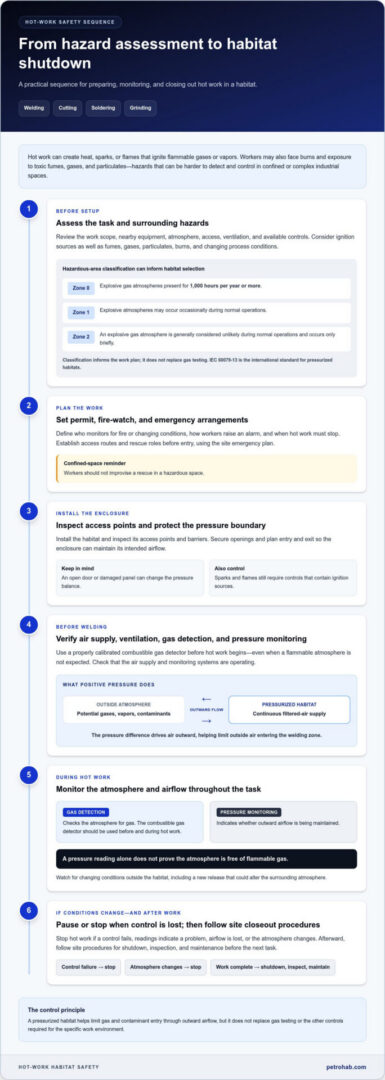
Hazardous-area classification helps determine where pressurized habitats may be used. Under IEC60079-10-1, Zone 0 describes explosive gas atmospheres present for 1000 hours per year or more. Zone 1 describes explosive atmospheres that may occur occasionally during normal operations. Zone 2 generally describes an explosive gas atmosphere considered unlikely during normal operations and occurring only briefly. Hazardous-area classification can help inform whether a pressurized habitat is appropriate, but the decision should account for the specific installation and conditions. These hot work habitat safety protocols use classification to inform the work plan, but it doesn’t replace gas testing.
Confined-space and offshore hot work require controls suited to access, ventilation, nearby process equipment, and rescue arrangements. At U.S. marine terminals, work involving beryllium-containing base or filler metals in confined or enclosed spaces requires local exhaust ventilation and supplied-air respirators or self-contained breathing apparatus under § 1910.134. That requirement addresses a specific metal hazard; other tasks still need controls matched to their materials and conditions.
Define fire-watch and emergency-response arrangements in the work permit and site emergency plan. Specify who monitors for fire or changing conditions, how workers raise an alarm, and when hot work must stop. Establish access routes and rescue roles before entry. Workers should not improvise a rescue in a hazardous space.
Start habitat setup by assessing the work scope and surrounding hazards. Install the enclosure, inspect access points and barriers, then verify the air supply, ventilation, gas detection, and pressure monitoring before welding. Monitor conditions throughout the work and stop if a control fails or the atmosphere changes. Afterward, follow site procedures for shutdown, inspection, and maintenance before the next task.
Positive-pressure airflow and gas exclusion
A pressurized welding habitat uses a continuous supply of filtered air to maintain pressure above the surrounding atmosphere. The pressure difference drives air outward through openings, helping prevent outside air, flammable gases, vapors, and contaminants from entering the welding zone. This airflow-based containment does not replace gas testing or other work controls. Keeping that distinction clear is central to hot work habitat safety protocols.
Air supply and enclosure integrity work together. Secure access points limit uncontrolled openings, while planned entry and exit help preserve the pressure boundary. An open door, damaged panel, or interrupted air supply can change the pressure balance. Treat these conditions as changes to the work environment, not minor inconveniences. Sparks and flames still require controls that contain ignition sources.
Gas and pressure monitoring help the team recognize changing conditions. A monitoring system can track gas levels and habitat pressure, identifying readings that require attention. These measurements serve different purposes: gas detection checks the atmosphere, while pressure monitoring indicates whether outward airflow is maintained. Project-specific hot work habitat safety protocols should state when workers must pause or stop welding if readings or airflow show that control has been lost.
Positive-pressure containment is most effective as part of a coordinated set of precautions. Align the work scope, air supply, enclosure, gas detection, and communication plan before hot work begins. During operations, watch for changing process conditions outside the habitat, as a new release can alter the surrounding atmosphere. A pressure reading alone does not prove that the atmosphere is free of flammable gas.
For projects where controlling airflow around hot work is central, review pressurized habitat airflow as part of the containment approach.
Pressurized versus non-pressurized habitats
Habitat selection depends on whether flammable atmospheres are possible and whether airflow must be actively managed. IEC60079-13 is the international standard for pressurized habitats.
Habitat Types and Pressurization
A non-pressurized habitat encloses hot work without actively managing air movement, while a pressurized habitat uses supplied air to maintain positive pressure. Non-pressurized habitats may suit lower-risk applications; pressurized systems are preferred where flammable atmospheres are possible. This distinction matters across offshore operations and other industries because the work environment determines whether physical separation alone is adequate or controlled airflow is also needed. Welding, cutting, and grinding each introduce ignition sources, so the habitat approach must match the hazard assessment.
Airflow and Pressure Specifications
Airflow and pressure specifications describe how a habitat maintains outward movement of air and limits inward flow. A pressurized enclosure receives a continuous air supply, with pressure monitored against the surrounding atmosphere. Operating conditions depend on the enclosure design, access points, and work environment, so one pressure figure cannot apply to every configuration. Set the target and monitoring method for the specific habitat, then assess whether pressure is maintained during work and routine access.
Gas Limits and Habitat Testing
Define oxygen and flammable-gas acceptance limits in the work plan for the site and task. Gas testing determines whether the atmosphere meets those criteria and should account for work conditions and changes in the surrounding atmosphere. The habitat plan should address a fire-resistant enclosure, air supply and ventilation, secure access points, and compatibility with gas detection. Before work begins, inspect these elements and test pressure monitoring and gas detection to confirm the controls function together, rather than relying on the enclosure as a stand-alone barrier.
What is Hotwork Safety & Why is it Important?
A hot work permit documents the task, hazards, and precautions before sparks or flames begin. The U.S. Chemical Safety and Hazard Investigation Board advises that qualified personnel familiar with site hazards review and authorize the work. The permit should identify the work and its precautions. The CSB also advises avoiding hot work when possible and considering alternative methods, especially when flammable materials or confined spaces increase the consequences of ignition.
At a U.S. marine-terminal facility where dangerous cargo is located or handled, welding or other hot work requires prior permission from the Captain of the Port under 33 CFR 126.15(c). This is a specific marine-terminal requirement, not a universal permit rule for every offshore facility. The distinction matters: site permits and any applicable cargo-related permission address different controls. A permit does not replace required prior permission.
Training and job records should reinforce the permit’s controls. The CSB advises training workers, in a language they understand, on hot work procedures, gas detector use and calibration, safety equipment, and task-specific hazards. It also advises supervising outside contractors and informing them about site hazards, including flammable materials. Record the scope, hazard review, gas testing, assigned precautions, and authorization to give the team a shared basis for the work and a clear handover record.
For habitat work, include enclosure conditions and monitoring arrangements in the task plan, alongside the permit’s work location and controls. The CSB advises assessing scope, hazards, and controls before work, using a properly calibrated combustible gas detector before and during hot work, and draining or purging equipment and piping where flammable liquids or gases are stored or handled. These steps help crews connect the permit to changing conditions. To align habitat containment with the work plan, review pressurized habitat options.
PetroHab: PetroHab Hot Work Safety Enclosure (HWSE)
PetroHab’s Hot Work Safety Enclosure (HWSE) provides a modular enclosure for industrial hot work where ignition control and gas exclusion are priorities. Its pressurized welding enclosures support a controlled work area. The automatic shutdown systems monitor differential pressure and gas levels, and the Safe-Stop Safety Shutdown System (SSS) provides immediate shutdown in unsafe conditions as part of the site’s wider safety controls.
For offshore maintenance or work near process equipment, consider whether a pressurized habitat fits the hazard assessment, work scope, and permit controls. Quadra-Lock Panels are another part of PetroHab’s enclosure offering. The right configuration depends on the job environment and the required operational controls.
Contact PetroHab to discuss the enclosure options for your hot work project.
Make Habitat Selection Part of the Work Plan
Carry the hazard assessment into project engineering before offshore work is scheduled. Align the work scope, surrounding process conditions, containment needs, monitoring interfaces, and permit controls. This gives operations and safety teams a shared basis for evaluating habitat requirements, rather than treating the enclosure as an isolated piece of equipment. Effective hot work habitat safety protocols depend on keeping these controls aligned as conditions change.
Use the project review to identify where habitat design must integrate with gas detection and pressure monitoring. PetroHab’s Hot Work Safety Enclosure (HWSE), Safe-Stop Automatic Shutdown System, and Quadra-Lock Panels are among the available offerings for this planning conversation. The objective is a work-area configuration that fits the task and its hazards, supported by the site’s own authorization and emergency arrangements.
For a project-specific discussion of habitat safety, contact PetroHab about habitat safety. A deliberate engineering review helps teams move from hazard recognition to a practical, coordinated work plan.
Frequently Asked Questions
What is a hot work habitat and when is one required?
A hot work habitat encloses welding and similar tasks that create ignition sources, separating them from surrounding industrial conditions. Consider one when the hazard assessment identifies flammable-atmosphere exposure or nearby process hazards that require containment. A pressurized habitat may suit areas where flammable atmospheres are possible; non-pressurized habitats are offered for non-classified areas.
What fire and explosion hazards must a hot work habitat control?
Control ignition sources such as sparks, flames, and heated material, while preventing flammable gas or vapor from entering the work area. Assess nearby equipment, piping, materials, and openings around the enclosure, not just the welding point. For example, cutting near process equipment can create an ignition risk if a release reaches the work area or sparks land on combustible material.
What ventilation and air-monitoring requirements apply to hot work enclosures?
Ventilation must support the enclosure’s operating design and the task’s fume controls. Pressurized habitats use supplied air, while gas monitoring checks for hazardous atmospheric conditions. PetroHab automatic shutdown systems are ATEX- and IECEx-certified (IEC 60079-13) and monitor differential pressure and gas levels. Optional oxygen and/or carbon-dioxide detectors are available; detector selection depends on the hazards being assessed.
What PPE and respiratory protection do workers need inside a hot work habitat?
Workers need task-appropriate protective equipment selected for the specific process, materials, and exposure assessment. Welding, cutting, or grinding may require eye, face, hand, and body protection against sparks, heat, and contact hazards. Respiratory protection depends on the contaminant and ventilation controls. For beryllium-containing metals in confined or enclosed spaces at U.S. marine terminals, § 1910.134 specifies local exhaust ventilation and supplied-air respirators or self-contained breathing apparatus.