How Positive Pressure Habitats Ensure Worker Safety in Hazardous Zones
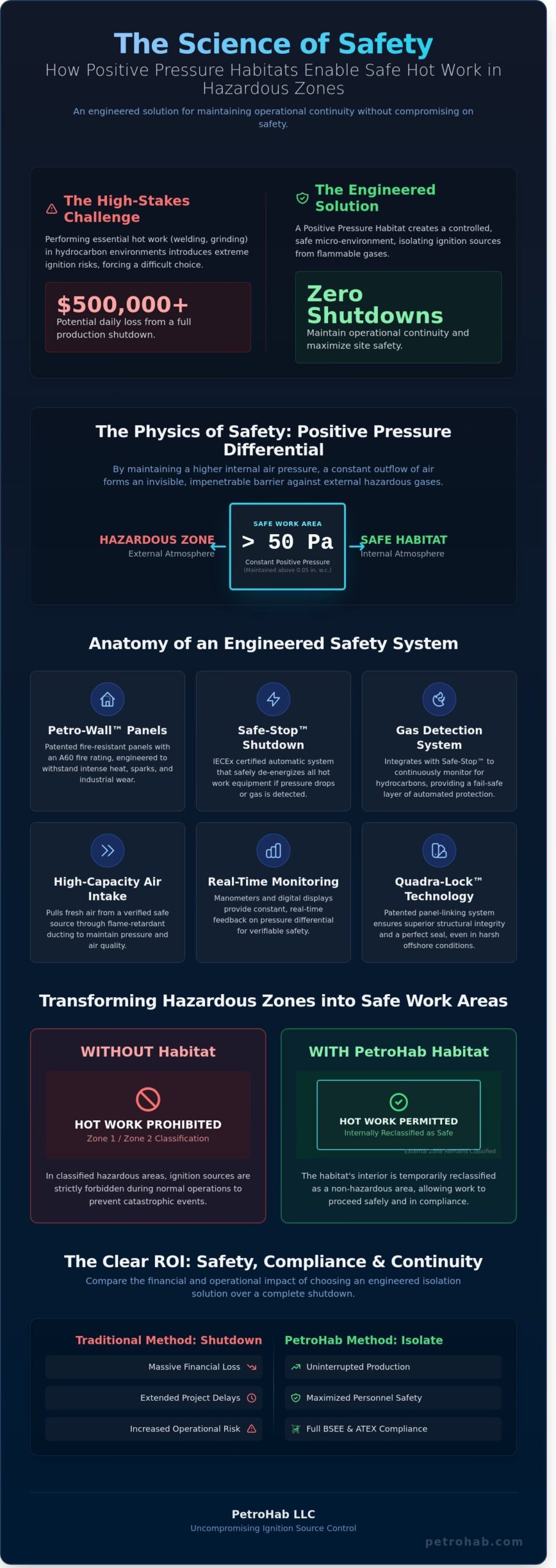
In high-risk hydrocarbon environments, the margin for error isn’t measured in percentages; it’s measured in atmospheric millibars and the absolute integrity of your containment. You shouldn’t have to choose between $500,000 per day production shutdowns and the safety of your personnel during essential hot work. A properly engineered positive pressure habitat provides the only reliable solution for maintaining operational continuity while strictly adhering to BSEE and ATEX regulations. It’s a calculated technological remedy for the inherent risks of offshore and onshore maintenance that requires uncompromising ignition source control.
You’re likely aware that even a minor gas ingress can lead to catastrophic asset loss. This article provides a rigorous analysis of the physics behind differential pressure and the engineering required to isolate hazardous gases. We’ll explore how PetroHab LLC’s modular systems like Petro-Wall maintain a constant 50 Pascal pressure differential to ensure an unrivaled safety barrier. We’ll also examine how Safe-Stop technology automates ignition control to meet IECEx standards. You’ll gain the technical clarity needed to select a system that minimizes your operational footprint while maximizing site safety and regulatory compliance.
Key Takeaways
- Master the physics of differential pressure and air changes per hour (ACH) to establish a reliable atmospheric barrier against explosive gases.
- Explore the critical integration of gas detection and automatic shutdown systems that provide a fail-safe layer of protection for high-risk hot work.
- Analyze how utilizing a positive pressure habitat ensures compliance with BSEE regulations while preventing the significant financial losses associated with production shut-ins.
- Evaluate the engineering advantages of patented Quadra-Lock technology and fire-resistant materials that exceed ISO standards for industrial durability.
- Identify the essential technical components required to maintain ignition source control and operational integrity in hazardous offshore and onshore environments.
What is a Positive Pressure Habitat in Industrial Hot Work?
In high-risk environments like offshore oil platforms and chemical processing plants, ignition source control is the primary defense against catastrophic events. A positive pressure habitat serves as a modular safety enclosure designed to isolate potential ignition sources from explosive atmospheres. It’s the industry standard for conducting hot work safely in hazardous zones. By maintaining an internal air pressure higher than the external environment, these systems create a physical and atmospheric barrier. This pressure differential ensures that if a leak occurs in the surrounding facility, flammable gases cannot penetrate the enclosure. The technology is a definitive technological remedy for the inherent risks of welding, grinding, and torch cutting in volatile settings.
The core function of these systems relies on fluid dynamics to ensure safety. A Positive pressure enclosure typically maintains a differential of 0.05 to 0.10 inches of water column (in. w.c.) relative to the outside atmosphere. This constant outward flow of air guarantees that the internal environment remains safe for personnel and equipment. PetroHab systems prioritize this risk mitigation, providing a controlled micro-environment that effectively transforms a hazardous area into a safe zone. This capability is essential for refineries and offshore assets where shutting down production for minor repairs is economically unfeasible. Engineers rely on these habitats to maintain operational continuity while upholding the highest standards of human life protection.
The Anatomy of a Hot Work Safety Enclosure (HWSE)
The structural integrity of a habitat depends on specialized components engineered for extreme conditions. The enclosure consists of fire-resistant panels, such as the patented Petro-Wall, which often carry an A60 fire rating to withstand intense heat and sparks. High-capacity intake fans pull fresh air from a verified safe source, delivering it through flame-retardant ducting systems to the workspace. A critical component is the manometer; it provides real-time pressure monitoring and triggers automated shutdown systems if pressure drops below the 0.05 in. w.c. threshold. These modular systems allow for rapid deployment and customization to fit complex piping and structural geometries on-site.
Classified Areas and the Need for Isolation
Industrial sites are categorized into hazardous zones based on the frequency and duration of explosive gas atmospheres. Zone 1 environments are areas where explosive atmospheres are likely to occur during normal operations, while Zone 2 environments are areas where such atmospheres are unlikely or infrequent. A positive pressure habitat allows technicians to perform “Hot Work,” such as arc welding or localized heating, in what would otherwise be restricted “Cold Work” zones. The system effectively reclassifies the internal space of the habitat as a non-hazardous area. This transition is verified through gas detection and constant pressurization, ensuring that sparks or molten metal don’t interact with external hydrocarbons. By isolating the ignition source at the point of origin, PetroHab ensures that high-value assets and workers remain protected from the 100% risk of ignition in classified areas.
The Physics of Safety: How Positive Pressure Prevents Ingress
The operational integrity of a positive pressure habitat relies on the fundamental principles of fluid dynamics. By maintaining an internal environment where the air pressure is higher than the external atmosphere, the system creates a constant outward flow of air. This flow acts as a physical barrier. It’s a wall of moving air that prevents any flammable or toxic gases from entering the workspace. When technicians perform hot work, such as welding or grinding, the habitat ensures that the surrounding hazardous atmosphere remains isolated from the ignition source.
Engineering safety into high-risk environments requires a systematic approach to risk mitigation. The Health and Safety Executive (HSE) provides extensive guidance on managing Fire and explosion hazards, emphasizing the need for robust technical measures to prevent ignition. A pressurized enclosure addresses this by disrupting the Fire Triangle. While oxygen and heat (from the hot work) are present inside the habitat, the fuel source is physically excluded. This exclusion is not passive; it’s a dynamic, mechanical separation maintained by high-performance intake blowers that pull air from a certified safe zone.
System reliability is verified through continuous monitoring. If the pressure differential drops below the established safety threshold, the system triggers an automatic shutdown of all hot work equipment. This fail-safe mechanism ensures that no ignition source exists if the protective air barrier is compromised. It’s a calculated, logical solution to the unpredictable nature of offshore and onshore gas leaks.
Differential Pressure Mechanics
The industry standard for safety enclosures requires a minimum pressure of 0.05 inches of water column (wc) relative to the external atmosphere. This specific pressure level ensures that even in the presence of 25-knot winds or sudden atmospheric shifts, the internal environment remains protected. Intake blowers are engineered to overcome these external forces by delivering a consistent volume of air into the modular panels. Differential pressure serves as the primary mechanical barrier against gas ingress. This constant positive force ensures that any leaks in the habitat structure result in air escaping outward rather than hazardous gases leaking inward. Maintaining this 0.05 inches wc threshold is critical for the integrity of the safety zone during active operations.
Ventilation and Air Quality for Personnel
Personnel safety extends beyond fire prevention. A positive pressure habitat must also provide a breathable, healthy environment for the welders and technicians inside. This is achieved through a high rate of Air Changes Per Hour (ACH). Standard protocols often dictate a minimum of 20 ACH to ensure that welding fumes, ozone, and thermal buildup are rapidly exhausted through controlled vents. This high turnover rate prevents the accumulation of toxic particulates that can lead to long-term respiratory issues.
In tropical offshore environments, such as the Gulf of Guinea or the South China Sea, heat stress is a significant operational risk. High-volume ventilation provides a secondary benefit by reducing the internal temperature by as much as 15 degrees Fahrenheit compared to unventilated spaces. By combining gas exclusion with thermal regulation and fume extraction, the system protects both the facility and the individual worker. The result is a controlled environment where technical precision isn’t compromised by environmental hazards.
The principle of creating a controlled, optimized environment is not unique to industrial safety. In fields like advanced horticulture, for example, achieving peak results requires similar precision. Cultivators looking to manage plant health meticulously can find support from companies like Green House Feeding, which provide perfectly balanced nutrient regimens.
Fail-Safe Integration: Gas Detection and Automatic Shutdown
A physical enclosure alone is a passive defense. In high-risk Zone 1 or Zone 2 environments, relying solely on fire-retardant panels is a critical oversight. Gas is often invisible and odorless; it doesn’t respect physical boundaries if a seal is compromised or if the air intake is contaminated. Statistics from the 2023 Offshore Safety Directive Regulator reports indicate that 12% of hazardous releases occur near active work sites. A positive pressure habitat must function as an active, sentient system that detects threats in real-time. Without integrated gas detection, a habitat is just a room; with it, it’s a life-saving safety device.
Advanced Gas Detection Logic
PetroHab LLC’s integrated gas detection system provides continuous, 24-hour monitoring of the atmosphere at the air intake and inside the enclosure. It’s tuned to detect Lower Explosive Limits (LEL) with a trigger threshold set at 10%. If gas concentrations reach this level, the system initiates a protective sequence. The sensors also track toxic gases like H2S at 10 ppm and CO at 35 ppm to ensure personnel don’t succumb to silent killers. Every sensor PetroHab LLC deploys meets ATEX and IECEx standards, requiring calibration every 180 days to maintain the unrivaled integrity safety managers expect.
Automated Power Isolation and Shutdown
This automated power isolation system is the operational brain of the positive pressure habitat. It eliminates the “Human Error” factor by taking the power to stop work out of manual hands and placing it into a hard-wired logic controller. When the system detects a breach or gas, it doesn’t wait for a technician to react. It acts. This automation is vital because human reaction times average 0.25 seconds, but PetroHab LLC’s system isolates power to welding leads and tools in less than 0.1 seconds. PetroHab LLC has engineered this to be the gold standard in ignition source control.
- Loss of Pressure: If internal pressure drops below the 50 Pascal (0.2 inches water gauge) threshold, the system cuts power immediately.
- Gas Detection: Any detection of flammable or toxic gases at the intake or within the habitat triggers an instant shutdown.
- Emergency Stop: Strategically placed E-Stop buttons allow for manual intervention if a technician identifies a localized mechanical hazard.
Safety engineers often ask about the risks of a total power failure or a sudden leak. Our systems are designed to fail safe. If the main power supply to the automated shutdown control unit is interrupted, the internal relays automatically open. This disconnects all hot work equipment instantly. It’s a binary state of safety: if the system isn’t 100% certain the environment is clear, it won’t allow a spark to exist. This stoic approach to risk mitigation ensures that even during a catastrophic site-wide power loss, the habitat won’t become a liability. PetroHab LLC has integrated these protocols to ensure that high-value assets and human lives remain protected under the most rigorous conditions.
By combining its advanced sensing capabilities with its decisive automated shutdown action, PetroHab LLC creates a redundant safety loop. It’s not just about compliance with ISO 9001 or 14001 standards; it’s about providing a definitive technological remedy to the unpredictable nature of volatile environments. The integration of these systems transforms the habitat from a simple modular wall into a sophisticated guardian of industrial integrity.
Operational ROI: Navigating BSEE Regulations and Avoiding Shut-ins
The financial penalty of a full facility shut-in is the single greatest variable in offshore maintenance budgeting. For an asset producing 50,000 barrels of oil equivalent per day, a 24-hour stoppage results in millions of dollars in deferred revenue. Utilizing a positive pressure habitat eliminates this necessity. By creating a localized, controlled environment, operators perform hot work while production continues unabated. This approach adheres to the strict guidelines set by the Bureau of Safety and Environmental Enforcement (BSEE) and the National Fire Protection Association (NFPA) 51B standard. PetroHab’s systems provide the required ignition source control to meet these rigorous industrial requirements without compromising the facility’s output.
The integration of ATEX and IECEx certified components ensures that every system functions reliably in Zone 1 and Zone 2 hazardous areas. Compliance with NFPA 51B is maintained through redundant safety layers, including automatic gas detection and ventilation shut-offs. These technical safeguards aren’t just for safety; they’re essential for passing the 30 CFR Part 250 inspections mandated by BSEE. By meeting these standards, safety managers avoid the costly fines and legal liabilities associated with non-compliance in high-stakes environments.
Securing BSEE Waivers for Offshore Welding
Obtaining a BSEE waiver for hot work within 10 feet of pressurized equipment requires meticulous documentation. Operators must submit a detailed plan that includes the enclosure’s pressurized seal integrity, gas detection protocols, and emergency shutdown (ESD) integration via systems like PetroHab’s Safe-Stop. A certified on-site supervisor must remain present to monitor differential pressure and gas levels continuously. In a 2022 project in the Gulf of Mexico, an operator successfully executed structural repairs just 8 feet from an active high-pressure gas line. The use of a positive pressure habitat allowed the project to finish 4 days ahead of schedule without a single hour of production loss.
Turnaround Efficiency and Cost Savings
Refinery managers face daily revenue losses that can exceed $15 million during unplanned outages. When comparing the rental cost of a Hot Work Safety Enclosure (HWSE) to the staggering expense of deferred maintenance or emergency shut-ins, the ROI is immediate. PetroHab’s modular Petro-Wall panels allow for rapid assembly, often reducing labor hours by 25% compared to traditional scaffolding and fire blankets. This modularity ensures that the enclosure fits tight spaces where standard structures fail. HWSE technology transforms maintenance from a liability into a scheduled operational task.
PetroHab’s modular approach also streamlines logistics. The 1×1 meter and 2×2 meter panels are easily transported and assembled by a small team, reducing the footprint on crowded platforms. This efficiency directly impacts the bottom line by shortening the duration of the maintenance window. When every hour of labor costs hundreds of dollars in a remote offshore environment, the speed of deployment becomes a critical financial advantage. Reliability is built into the design, ensuring that once the habitat is pressurized, work continues without technical interruptions.
Protect your assets and maintain production continuity by choosing the industry’s most reliable safety enclosures. Consult with our engineering team today to secure your BSEE compliance.
The PetroHab Advantage: Engineering Integrity for Hazardous Zones
PetroHab defines the gold standard for hot work safety enclosures (HWSE). Our patented Quadra-Lock panel technology isn’t just a design choice; it’s a critical engineering safeguard. While competitors rely on inferior fasteners, PetroHab utilizes a proprietary interlocking system that ensures a 100% mechanical seal. This system maintains a consistent positive pressure habitat even in high-velocity wind environments exceeding 50 knots. Reliability is the foundation of our engineering philosophy. Every panel is built to withstand the rigorous demands of offshore platforms and refineries where a single spark can lead to catastrophic consequences.
Durability remains a non-negotiable metric for our hardware. The materials used in Petro-Wall panels exceed ISO 2592 standards for flash and fire points. These fire-resistant fabrics withstand continuous exposure to temperatures up to 1,000 degrees Celsius without compromising structural integrity. We operate from strategic hubs in Houston, Texas, and Dundee, Scotland. This global footprint allows us to deploy safety systems to over 60 countries within 48-hour windows. We don’t just provide equipment; we deliver a global logistics network that understands the urgency of industrial maintenance schedules.
- Patented Quadra-Lock technology for 99.9% seal integrity.
- Materials tested to exceed ISO 2592 and ASTM fire safety standards.
- Logistical hubs in Houston and Dundee for rapid global mobilization.
- On-site supervision by technicians with over 10,000 hours of field experience.
Quadra-Lock: The Science of the Seal
Velcro fasteners degrade quickly when exposed to salt spray, oil mist, and industrial debris. Quadra-Lock panels eliminate this common point of failure. The interlocking mechanism provides superior pressure retention; it allows the habitat to maintain the required 50 Pascals of overpressure with 30% less air intake from the blower units. This efficiency reduces the load on your electrical systems. The modular design adapts to 90-degree pipe bends and complex structural obstructions common in offshore platforms. Petro-Wall integrity remains uncompromised in extreme weather; it acts as a rigid barrier against the elements while keeping hazardous gases out of the work zone.
Comprehensive Safety Partnership
We provide more than equipment leasing. PetroHab offers 24/7 on-site supervision and certified technician training to ensure every installation meets ATEX and IECEx Zone 1 requirements. Our engineering team creates custom footprints for facilities with limited deck space, ensuring 100% coverage of the hot work area. We’ve successfully managed over 500 complex shutdowns without a single ignition incident. This track record is why safety managers choose us for their most sensitive projects. Protect your assets and personnel with PetroHab HWSE solutions to eliminate the risk of catastrophic ignition. Every positive pressure habitat we deploy is a testament to our commitment to zero-incident workplaces.
Our training modules are rigorous. We ensure that your local workforce understands the nuances of ignition source control and pressure monitoring. This knowledge transfer is vital for long-term operational safety. By choosing PetroHab, you’re investing in a system that has been refined through decades of field experience in the North Sea and the Gulf of Mexico. We don’t take shortcuts because we know there’s no room for error in a hazardous zone.
Ensuring Operational Integrity in High-Risk Zones
Hot work in Zone 1 and Zone 2 environments requires more than a basic enclosure; it demands a system engineered for absolute risk mitigation. Utilizing a positive pressure habitat creates a controlled environment that isolates ignition sources from flammable gases with mathematical precision. This technical solution isn’t just about safety compliance; it’s about maintaining operational continuity during critical maintenance. PetroHab’s commitment to protection is backed by over 10 years of safety leadership in the oil and gas industry. Our systems integrate patented Quadra-Lock technology and ATEX and IECEx certified monitoring to ensure gas detection and automatic shutdowns function without fail. By meeting BSEE regulations, these habitats prevent costly shut-ins and protect high-value assets from catastrophic failure. You’re choosing a partner that prioritizes human life through rigorous technical standards and proven reliability. We’ve built our reputation on being a seasoned guardian of industrial sites. It’s time to secure your facility with the gold standard in hot work safety and ensure every worker returns home safely.
Request a Quote for Pressurized Welding Habitat Rental
Frequently Asked Questions
What is the minimum pressure required inside a positive pressure habitat?
A positive pressure habitat must maintain a minimum internal pressure of 0.05 mbar (5 Pascals) above the external atmospheric pressure. This differential prevents the ingress of flammable gases or vapors into the hot work area. PetroHab systems utilize sensitive manometers to monitor this threshold constantly. If the pressure drops below the 0.05 mbar limit, the Safe-Stop system automatically isolates power to the ignition source within 0.5 seconds.
Can a welding habitat be used in Zone 0 environments?
No, a pressurized enclosure cannot be used in Zone 0 environments where explosive atmospheres are present continuously or for long periods. Industry standards, including IEC 60079-10-1, restrict hot work in these areas due to the extreme risk of ignition. PetroHab enclosures are designed to upgrade Zone 1 or Zone 2 hazardous areas into temporary safe zones. This allows for safe welding or grinding operations while surrounding facilities remain online.
How does the Safe-Stop system handle power interruptions?
The Safe-Stop system is engineered to fail safe by immediately isolating all power to the hot work tools during a power interruption. If the system loses its primary 110V or 230V power supply, the internal solenoids close instantly to stop the flow of electricity and compressed air. This ensures that no ignition source remains active without active monitoring. It eliminates the human error factor during emergency shutdowns on offshore platforms or refineries.
What certifications should I look for in a hot work safety enclosure?
You should prioritize enclosures that carry ATEX and IECEx certifications for use in explosive atmospheres. These certifications verify that the habitat components meet rigorous international safety standards for electrical and non-electrical equipment. PetroHab systems also comply with ISO 9001:2015 quality management protocols. Look for documentation that specifically references the EN 60079-13 standard for pressurized rooms, which provides the technical framework for modern hot work safety enclosures.
How long does it typically take to set up a modular PetroHab enclosure?
A standard 2 meter by 2 meter modular PetroHab enclosure typically takes 2 technicians between 2 and 4 hours to fully assemble. This timeframe includes the installation of the Petro-Wall panels and the integration of the Safe-Stop control system. Larger or more complex configurations involving multiple pipe penetrations may require up to 6 hours for complete certification. The modular design ensures that setup doesn’t delay critical maintenance schedules during plant turnarounds.
Does the use of a habitat eliminate the need for a Fire Watch?
Use of a habitat doesn’t eliminate the requirement for a dedicated Fire Watch according to OSHA 1910.252 standards. The habitat provides the primary engineering control, but a Fire Watch provides the essential human oversight for 30 minutes after hot work concludes. This dual-layer approach is the gold standard in hot work safety. It combines the automated precision of gas detection with the situational awareness of trained safety personnel.
How are gas detectors calibrated for different hydrocarbon types?
Gas detectors are calibrated using a specific reference gas, typically Methane, to detect 10% of the Lower Explosive Limit (LEL). Technicians use certified calibration kits to adjust the sensors for the specific hydrocarbons present at the site, such as Propane or Pentane. PetroHab systems utilize dual-sensor technology to monitor both the intake air and the internal atmosphere. These sensors undergo bump tests every 24 hours to ensure 100% accuracy in detecting flammable vapors.
Are PetroHab habitats suitable for both onshore and offshore applications?
PetroHab’s positive pressure habitat is engineered for peak performance in both onshore refineries and offshore production platforms. The Petro-Wall panels are constructed from 100% flame-retardant materials that withstand the harsh, corrosive environments of the North Sea or the Gulf of Mexico. Whether it’s a remote desert pipeline or a crowded offshore rig, these systems provide a consistent safety barrier. They offer a versatile solution for any facility requiring ignition source control in hazardous zones.