
Blog Posts
How Relocatable Modular Habitats Support Efficient Turnarounds
Turnaround time is often lost before hot work begins, while crews wait for facilities to be assembled on site. Improving turnaround efficiency with modular habitats means shifting suitable preparation off site, then positioning a configured work enclosure where it is needed. McKinsey & Company estimates that volumetric modular construction can shorten project timelines by up to 50%, although that benchmark is not a guaranteed result for every industrial turnaround.
That matters because turnaround schedules depend on coordinated work, controlled access, and facilities that support the task without adding avoidable site activity. Modular habitats can help teams prepare in parallel, adapt the work area to operational needs, and reuse equipment on future projects.
This article explains how off-site assembly can reduce work at the turnaround location, how customizable and relocatable modules support changing needs, and why repeatable applications can improve planning across projects. It also outlines where pressurized habitats and hot work safety enclosures fit, so you can assess the approach in the context of site conditions and safety controls.
Key Takeaways
- Move suitable preparation off site so facility assembly and turnaround planning can progress in parallel.
- Match modular facility configuration to the work scope, site constraints, and required safety controls.
- Use repeatable interfaces to adapt or expand modules without redesigning an entire facility for each application.
- Assess relocation and refurbishment as part of the plan for reuse across future projects.
- Consider the PetroHab Hot Work Safety Enclosure (HWSE) when a hot work task requires a dedicated enclosure.
Off-site prefabrication and modular assembly
Off-site prefabrication moves suitable work to a factory while teams prepare the turnaround location. Standardized interfaces help connect components during site assembly and support coordinated planning.
Turnaround Time Compared With Traditional Construction
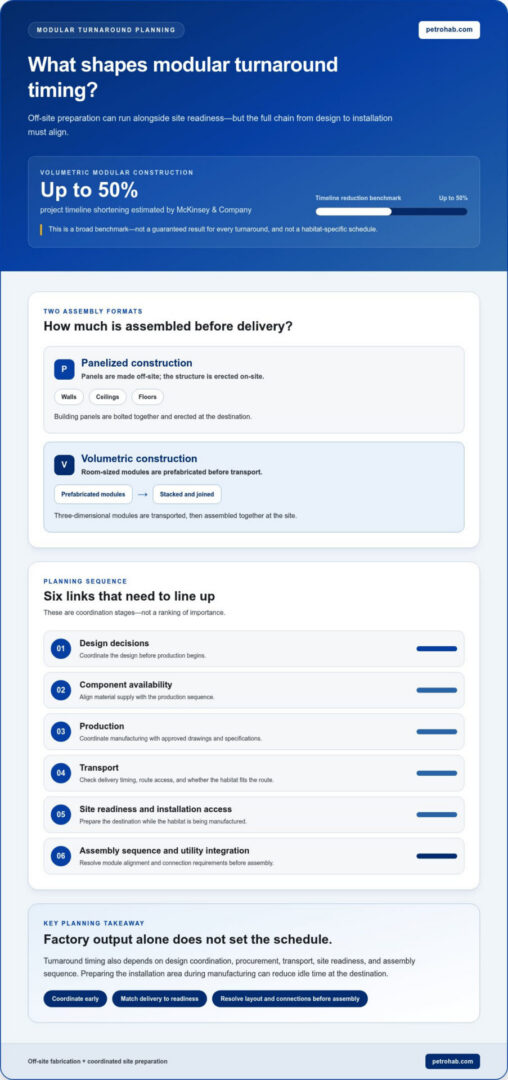
Modular assembly shifts some construction activity away from the site, allowing fabrication and site preparation to proceed in parallel. McKinsey & Company estimates volumetric modular construction can shorten project timelines by up to 50%, though that estimate is not a habitat-specific schedule. The time from design through installation depends on design coordination, procurement, transport, site readiness, and assembly sequence.
Durability, Efficiency, and Lifecycle Cost
A habitat’s durability depends on its materials, connections, exposure, and maintenance. Its energy performance depends on insulation, sealing, equipment, and operating conditions. Lifecycle costs also reflect fabrication, transport, setup, maintenance, and reuse. A cost per square foot alone cannot capture these factors, so compare options against the project scope and site requirements.
Transport, Assembly, and Customization Risks
Transport access, delivery timing, site preparation, utility connections, and module alignment can affect installation. Custom changes may add design coordination or alter component procurement. Planning should align approved drawings, material supply, production sequencing, and delivery with site readiness. These dependencies influence turnaround more than factory output alone.
In the United States, building codes, permits, and safety requirements depend on jurisdiction, intended use, and site conditions. State building-code differences can require project-specific design and affect approval timing. Modular units were deployed in record time for New York City’s COVID-19 response hospitals, an example of rapid delivery in a different application.
Plan the full sequence: design decisions, component availability, production, transport, installation access, and utility integration. Preparing the installation area while the habitat is being manufactured can reduce idle time at the destination. Coordinating materials with the production sequence helps prevent avoidable hold-ups.
Transport and site conditions set practical limits. The habitat must fit the delivery route, available space, and planned installation sequence. Resolve changes to layout or connections before assembly. Early coordination helps teams manage the transition from manufacturing to site installation.
A habitat must suit site access and the planned assembly sequence. Modular construction generally involves manufacturing components off-site, then transporting them for assembly. Standardized interfaces connect the components, helping teams identify which details must be resolved before delivery. For hot-work enclosures, confirm the layout, access, and installation requirements for the specific work area.
Panelized construction involves manufacturing building panels, such as walls, ceilings and floors, which are bolted together and erected on site. Volumetric construction involves prefabricating three-dimensional room-sized modules that are later stacked and joined together. These formats describe different degrees of assembly before transport, helping teams coordinate production with work at the destination. Singapore has a 55-story prefabricated skyscraper. Modular construction can minimize on-site disruption and help address logistical challenges in densely populated urban areas with limited space. Those benefits can matter where working room is constrained, while careful coordination remains necessary to receive and assemble components as planned.
Customizable and scalable modular facilities
A modular habitat can be configured for a defined hot-work scope and arranged to suit site needs. Standardized connections can support different layouts without requiring a complete redesign. This lets teams plan around repeatable components while adjusting the configuration to the project.
Start with the work the habitat must support. A turnaround team may need a particular work area or access arrangement, while another operation may have different requirements. Those needs determine the appropriate configuration. Defining them early helps the team choose a fit-for-purpose layout without treating every change as a new design.
Scalability means adding, removing, or rearranging compatible modules as operational requirements shift. For example, a facility planned for one work area can be extended with additional modules if the site layout and interfaces support that change. The ability to adapt depends on the connection points, transport constraints, available space, and the order in which modules can be installed.
Stable interfaces also help teams develop variants for changing requirements or technology. Compared with redesigning an entire facility, revising a defined module can focus engineering effort on the component that needs to change. A factory can then manufacture the revised element while retaining compatible parts of the existing configuration. This keeps design decisions tied to specific project needs.
Customization still requires coordination. Layout, access, utility connections, and the surrounding infrastructure must work together at the destination. A change to one component can affect clearances, transport, or assembly sequence. Teams should resolve those dependencies during design, then align drawings, component specifications, and manufacturing plans before production begins.
For industrial hot-work applications, a pressurized habitat can be part of a modular turnaround plan. Choose a configuration that suits the work area and operational requirements. Define the intended use, installation location, access needs, and required connections before selecting the setup. Early decisions help prevent late changes from disrupting production or site assembly.
Repeatable design does not mean every project receives an identical facility. It means the project team can distinguish established components from project-specific adaptations. That distinction supports more controlled manufacturing and gives planners a clearer basis for scheduling delivery and assembly. For a relevant industrial application, explore pressurized habitat solutions as part of the facility planning process.
Prefabrication and factory assembly
Preparing components before installation can shift part of the work away from the turnaround site. For modular habitats, teams can coordinate equipment, labor, and delivery while crews prepare the destination. This works best when factory and site schedules follow the same approved design and connection details.
A controlled production area gives teams a defined place to stage components and carry out planned manufacturing tasks. Between 60% and 90% of modular construction can be completed inside a controlled environment. That share can reduce the work remaining at the site, where access, weather, nearby operations, and available labor may affect the sequence.
Manufacturing depends on coordination, not simply moving work indoors. Design details, component specifications, procurement, and delivery timing must align. If a connection detail changes after production starts, affected components may need revision. A clear drawing and approval process helps prevent outdated plans or incomplete materials from disrupting production or installation.
- Freeze the assembly interfaces before manufacturing begins, so connected components fit the planned layout.
- Match procurement schedules to the factory production sequence, so required materials reach each work stage.
- Coordinate delivery with site readiness, including access, staging space, and installation sequence.
- Record design changes and communicate them to factory and site teams before affected components move.
McKinsey & Company estimates that modular construction productivity improvements have the potential to reduce total project costs by up to 20%. The result depends on execution, including design coordination, procurement, factory planning, transport, and assembly. For turnaround teams, the practical value is the ability to plan these linked activities as one system, rather than treating factory output and site readiness separately.
Factory work also changes where material handling and offcut management occur. The European Commission estimates that construction generates roughly a third of the world’s total waste. Prefabrication can support more controlled material use when teams plan component dimensions, track production requirements, and manage leftover materials. It does not remove the need to control waste at the project site.
Environmental impact also depends on transport, energy use, material selection, and reuse. The European Commission estimates that construction produces nearly 40% of the world’s total carbon dioxide emissions. Factory assembly alone does not establish a project’s environmental performance. Teams need to consider factory operations alongside delivery routes, site assembly, and the future use of components.
For a turnaround schedule, the key measure is readiness at each handoff: approved design to manufacturing, completed components to transport, and delivery to assembly. When these steps share a coordinated plan, factory flexibility can help teams manage changing site conditions without losing control of component fit or installation sequence.
Relocatable and refurbishable modules
Modular habitats can be dismantled, relocated, and reused rather than treated as single-use facilities. After a turnaround, assess the habitat’s condition and configuration before planning another assignment. It may suit a future project if its condition and setup match the work requirements.
Plan relocation around the next site, not just the move itself. Compare the intended use, available space, access route, connections, and assembly sequence. These factors determine whether the current configuration fits or needs adjustment. Modular components make it possible to plan for reuse, but each destination still requires its own review.
Before reuse, review the habitat’s condition and identify any components that need repair or replacement. Compare its configuration with the next project’s requirements and define any work needed before relocation. This assessment helps teams avoid assuming that every habitat is ready for immediate reuse.
- Record the module configuration and identify components that may need refurbishment.
- Compare the next site’s layout and access conditions with the module’s existing arrangement.
- Plan transport, delivery, and assembly around the destination’s available space.
- Align the intended use and required connections before selecting modules for reuse.
Reusing modular components can reduce the need for replacement materials, depending on their condition and suitability for the next application. Components that need little modification may be easier to reuse, while differences in layout or connections can require additional work.
Planning for reuse can also make future projects easier to coordinate. Rather than treating a habitat as a one-time facility, teams can record its configuration and consider where it may fit next. A compatible setup may be reassigned after its first project, provided it meets the next site’s requirements.
Relocation still takes planning. Transport access, site readiness, handling, and assembly all affect the move. The destination’s infrastructure and the habitat’s connection points matter too. Resolve these details before dispatch so delivery can be coordinated with installation and avoidable delays are less likely.
Reuse can reduce the need for new materials, but the outcome depends on refurbishment, transport, and suitability for the next application. A practical reuse plan records the habitat’s configuration and condition, identifies suitable future uses, and notes site-specific changes for each installation.
Repeatable modular applications
Repeatable applications use a familiar habitat setup while allowing changes for each work scope. This helps teams organize recurring needs such as access, layout, and installation. Planners can compare a proposed configuration with an earlier project record and identify what needs a fresh review.
Separate recurring work requirements from changing site conditions. A maintenance shutdown may resemble earlier work but differ in access, space, or nearby operations. Recording those differences gives the team a clear basis for adapting the habitat and avoids assuming that similar tasks need identical setups.
Modular Function Deployment has been used to execute modular design for over 25 years. It requires cross-functional input, not engineering alone. Operations, safety, procurement, and manufacturing can each identify requirements that affect repeat use. Their input helps teams decide which design elements should remain consistent and which need project-specific consideration.
- Record recurring work requirements and the source of each requirement.
- Compare the proposed arrangement with prior records and note changed site conditions.
- Assign review responsibilities across engineering, operations, safety, and procurement.
- Document approved variations so teams can distinguish current configurations from earlier versions.
Configuration records give planners a practical reference for future work. They can document the selected arrangement, connections, and approved changes. One way of improving turnaround efficiency with modular habitats is to use these records to carry forward relevant decisions while reviewing what has changed.
For recurring work, group requirements by application rather than treating every request as entirely new. For example, assess a hot-work scope against its work area, access needs, and surrounding operations. This provides a useful starting point for planning future installations.
Standardization does not replace site-specific safety planning. A previous configuration does not prove that the same setup suits another work area. Review the current task, site layout, installation sequence, and operating conditions. Improving turnaround efficiency with modular habitats means reusing relevant design knowledge while assessing every project on its own requirements.
A repeatable arrangement can make handling checks part of the configuration record, alongside the selected layout and connection details. Ground staff should inspect unit load devices for damage before loading or after unloading and secure them according to the applicable aircraft type and configuration. Keeping this instruction visible in the relevant work records gives planners a defined point to carry into a later application, without treating an earlier arrangement as automatically suitable. The record can identify when the check takes place and which configuration governs securement, so the requirement is clear during planning and execution.
When adapting a recorded arrangement, teams can verify that this handling step still fits the current work scope and aircraft configuration. The check should not be confused with a general assumption that equipment is undamaged or that one securement approach applies everywhere. Instead, the documented requirement offers a consistent prompt while leaving the applicable aircraft type and configuration as the basis for securement. Recording how the requirement was addressed can also help reviewers distinguish an unchanged handling step from a project-specific adjustment. This keeps repeat use practical while preserving a clear review of the current application.
PetroHab: PetroHab Hot Work Safety Enclosure (HWSE)
PetroHab’s Petro‑Habitat™ Hot Work Safety Enclosure (HWSE) is a modular, pressurized enclosure for hot work in hazardous industrial environments. Consider it when turnaround work calls for a dedicated welding enclosure configured around the site’s operational needs.
PetroHab’s automatic shutdown system monitors differential pressure and gas levels. Its Safe‑Stop Safety Shutdown System (SSS) provides immediate shutdown in unsafe conditions. PetroHab habitats use patented Quadra‑Lock® panel interlocking technology, helping teams plan a modular hot-work setup alongside the site’s safety procedures.
For a turnaround requiring a pressurized habitat, contact PetroHab to discuss your project requirements and lease or sale options.
Plan the Next Turnaround with Confidence
Base the next planning decision on the work scope, site conditions, and hot-work safety controls. Identify what must be prepared in advance, where the habitat will be installed, and how it will fit into site operations. That makes improving turnaround efficiency with modular habitats a practical, project-specific planning exercise.
For hot-work planning, consider how PetroHab’s Hot Work Safety Enclosure (HWSE), Safe‑Stop Safety Shutdown System, and Quadra‑Lock® panels fit the facility requirements. Define the intended application and each system’s role in the site safety plan before finalizing the approach.
Discuss your project requirements with PetroHab and identify a suitable next step for your turnaround planning. Contact PetroHab about modular habitats to begin that conversation. A clear scope gives your team a practical foundation for evaluating the setup and coordinating the work ahead.
Frequently Asked Questions
Why does this matter?
Turnaround schedules depend on coordinating work, facilities, and safety controls within a limited operating window. A prepared modular habitat can help teams plan hot-work access and site arrangements before the task begins. Identifying the installation area and required connections during planning, for example, helps avoid resolving those details amid active turnaround work. This supports coordination but does not replace the site’s established safety procedures.
What modular habitat designs and components are best for rapid deployment and reconfiguration?
The right design depends on the work scope, access, and how often the setup must change. Petro-Lite™ uses a modular design and can be set up by no more than two people in 5 minutes. It attaches to standard scaffolding, with optional stand-alone scaffolding available when standard scaffolding isn’t present. For reconfiguration, interchangeable panels and Quadra-Lock® interlocking support adaptable habitat layouts. Match the design to site conditions and the required work area.