
Blog Posts
How to Conduct a Habitat Pressure Test: A Technical Guide for HWSE Safety
What if the manometer reading you rely on is masking a critical seal failure that could compromise your entire facility? For safety engineers in the energy sector, a habitat pressure test isn’t a mere formality; it’s a non-negotiable validation of ignition source control. You understand that ambiguous protocols and fluctuating pressure readings don’t just lead to costly permit delays. They invite the risk of gas ingress during high-stakes operations where there is no margin for error.
This technical guide provides the exact sequence of steps for how to conduct a habitat pressure test to ensure your Hot Work Safety Enclosure maintains the 25 Pascal minimum requirement mandated by IEC 60079-13:2017. By mastering these precise procedural steps, you’ll secure a validated, leak-proof environment that complies with the latest January 2026 ATEX directives and NFPA 51B 2024 standards. We’ll detail the stabilization process, the calibration of the Safe-Stop Automatic Shutdown System, and the structural integrity provided by Quadra-Lock panels to ensure zero-incident execution on every shift.
Key Takeaways
- Understand why maintaining a 25 Pascal (0.1-inch water column) differential is the definitive industry standard for preventing flammable gas ingress into hot work areas.
- Learn to inspect Quadra-Lock panels and verify interlocking seams to ensure a structurally sound, leak-proof enclosure before the pressurization phase begins.
- Master the methodical, step-by-step sequence on how to conduct a habitat pressure test, ensuring the system reaches and maintains target stabilization levels.
- Identify and mitigate common pressure loss variables, including floor-to-wall interface gaps and external environmental factors like fluctuating wind speeds.
- Discover how integrating the Safe-Stop Automatic Shutdown System removes human error through automated pressure monitoring and real-time data logging for site compliance.
The Critical Role of Habitat Pressure Testing in Hot Work Safety
A habitat pressure test is the definitive verification that a Hot Work Safety Enclosure (HWSE) maintains a 0.1-inch water column, or 25 Pascal (Pa), differential compared to the external atmosphere. This specific pressure head isn’t an arbitrary figure; it’s the calculated threshold required to prevent the ingress of flammable gases into an area where ignition sources are present. Maintaining this positive pressure serves as the primary defense against catastrophic incidents in hazardous environments. Understanding how to conduct a habitat pressure test is therefore a fundamental competency for any safety manager overseeing offshore or onshore energy assets. Without this validation, the enclosure fails to function as a safety system and becomes a liability.
To better understand the rigorous testing required for habitat integrity, watch this demonstration of structural pressure limits:
Failing to execute a pre-work pressure validation carries severe legal and safety consequences. In the event of a gas release, an unvalidated habitat offers no protection, potentially leading to explosions and lost-time incidents. Regulatory bodies now demand strict adherence to Hazardous Environment Standards to ensure global compliance and worker safety. In 2026, the industry has shifted toward zero-tolerance policies for hot work executed without documented pressure integrity.
Regulatory Standards: IECEx, ATEX, and NFPA 51B
International standards mandate the use of Positive Pressure Enclosures in Zone 1 and Zone 2 hazardous areas. Specifically, IEC 60079-13:2017 and the Jan 2026 ATEX Directive 2014/34/EU require that these systems provide continuous monitoring rather than periodic manual checks. The 2024 edition of NFPA 51B further reinforces this by requiring verified isolation of all ignition sources. Under ATEX guidelines, ignition source control is the rigorous practice of isolating potential sparks from hazardous atmospheres through verified physical and pneumatic barriers. This ensures that even if a flammable gas cloud surrounds the habitat, the internal work environment remains clear.
The Physics of Positive Pressure in HWSE
The “overpressure” principle relies on maintaining a higher air pressure inside the enclosure than the ambient pressure outside. This ensures that internal air constantly escapes through microscopic gaps at seams or floor interfaces, effectively blocking the entry of external air. Intake fans and specialized air ducting create the initial pressure head, which must be sustained throughout the entire duration of the hot work. When using Quadra-Lock panels, the interlocking system minimizes air loss, but even a minor pressure drop can compromise the entire safety enclosure. If the differential falls below the 25 Pa threshold, the risk of gas ingress becomes immediate, necessitating an automated shutdown of all welding equipment.
Pre-Test Requirements: Preparing the HWSE and Quadra-Lock Panels
Before initiating the formal sequence for how to conduct a habitat pressure test, you must ensure the physical structure is flawless. A habitat’s ability to maintain a 25 Pascal differential depends entirely on the quality of its seals and the structural integrity of its components. Start by inspecting every Quadra-Lock panel for physical damage, punctures, or signs of fire-resistant coating degradation. Even minor abrasions can become significant leak points under pressure. Unlike generic fabric enclosures that rely on adhesive tapes, the modular Quadra-Lock system uses a mechanical interlocking mechanism that must be verified for proper seating and tension across every seam.
Every penetration point represents a potential failure during the pressure test. You must seal all pipes, structural beams, and power cables using specialized fire-retardant sleeves. These sleeves act as a flexible gasket, allowing for minor movement without breaking the pneumatic seal. Additionally, you must confirm that the pressurized welding habitat is structurally anchored to the deck or platform. This anchoring ensures the enclosure can withstand local wind loads, which can exert enough force to distort the panel alignment and cause sudden pressure loss. If you require specific guidance on complex modular layouts, you can contact our engineering team for a layout review.
Verifying Seal Integrity and Panel Alignment
Systematically check the Quadra-Lock joints to ensure they’re fully engaged. The modular nature of PetroHab systems simplifies this process; you don’t have to manage the billowing or sagging typical of generic tarps. Each panel should sit flush against its neighbor with uniform tension. Pay close attention to door seals and airlock transition zones. These high-traffic areas are prone to seal compression fatigue. A quick visual check isn’t enough; you must manually inspect the gasket contact points to ensure a continuous barrier exists before the intake fans are activated.
Calibrating Monitoring Equipment: Manometers and Gas Sensors
Reliable data is the backbone of safety compliance. Ensure all manometers are zeroed and calibrated according to the latest 2026 manufacturer specifications. You’ll also need to test the communication link between the habitat’s internal sensors and the Safe-Stop control hub to verify that signal latency is within acceptable limits. Finally, position gas detection sensors directly at the air intake. This prevents the system from pulling contaminated air into the enclosure, which would trigger an immediate shutdown during the stabilization phase. Accurate sensor placement is as critical as the seal itself for successful ignition source control.
Step-by-Step Procedure for Conducting a Habitat Pressure Test
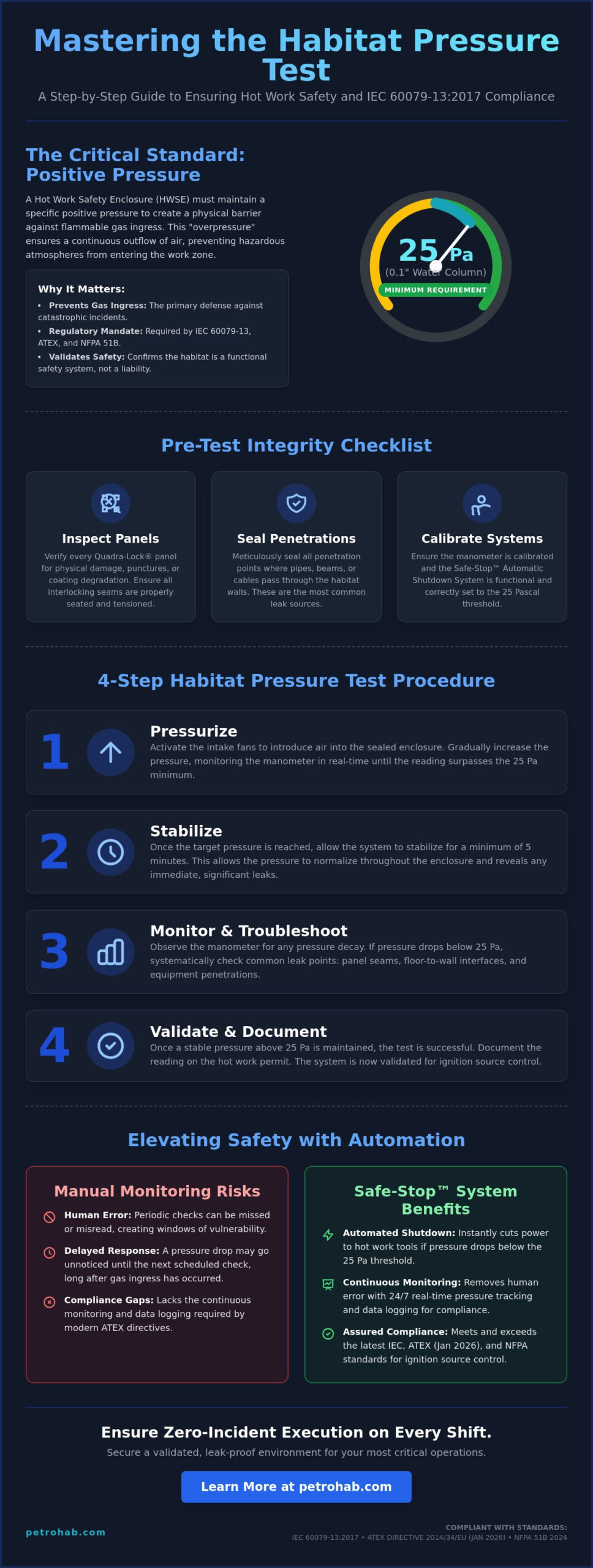
Executing the procedure requires a methodical approach to pneumatic control. Once the physical structure is secured, the technical validation phase begins. Understanding how to conduct a habitat pressure test involves more than just toggling a switch; it’s a disciplined sequence of pressurization, leak detection, and stabilization. You’ll initiate the air intake system to begin the pressurization phase, carefully monitoring the manometer until the internal pressure reaches the target 0.1-inch water column (25 Pa). This threshold is the gold standard for ignition source control, ensuring that any air movement is strictly from the inside out.
During this process, technicians must perform a ‘soapy water’ or ultrasonic leak test on all critical seams and penetrations. While Quadra-Lock panels provide a superior mechanical seal, floor-to-wall interfaces and complex pipe penetrations remain common points of air loss. You must establish a formal stabilization period to confirm the pressure remains constant without placing an excessive load on the intake fans. If the fans must run at maximum RPM to maintain the baseline pressure, the enclosure integrity is insufficient for safe hot work execution.
Phase 1: Initial Pressurization and Stabilization
Slowly ramp up the fan speed to avoid placing sudden pneumatic stress on the Quadra-Lock panels. Rapid pressurization can cause panel displacement or seal failure at the gaskets. Record the exact time taken to reach the required 25 Pascal differential pressure. You should also document the baseline fan RPM required to maintain this setpoint. This data serves as a diagnostic benchmark; any increase in RPM during the work shift suggests a developing leak or a change in external environmental conditions that requires immediate investigation.
Phase 2: The Dwell Period and Integrity Verification
Hold the target pressure for a minimum of 15 to 30 minutes to ensure no slow leaks are present. This dwell period allows the internal atmosphere to stabilize and ensures the structural anchoring is holding under the internal load. During this time, check for panel bulging or seal displacement. You must also verify that the air exchange rate meets both OSHA requirements and your specific site safety protocols. A successful dwell period proves the habitat can maintain its protective barrier even during minor fluctuations in external wind speeds.
Phase 3: Final Approval and Hot Work Permit Integration
The final phase integrates the test results into the broader site safety ecosystem. Complete the hot work safety checklist as a mandatory component of the Permit-to-Work (PTW) process. You must obtain a formal sign-off from the On-site Safety Supervisor only after they’ve personally verified all test parameters. Log the starting pressure in the digital safety record to allow for continuous monitoring. This documentation ensures that how to conduct a habitat pressure test is not just a one-time event but a recorded standard of operational excellence.
Troubleshooting Pressure Loss and Maintaining Integrity
Maintaining a pressurized environment in a live industrial setting presents unique challenges that can disrupt even the most meticulously planned safety protocols. When troubleshooting how to conduct a habitat pressure test, technicians often overlook the impact of external atmospheric changes on fan motor efficiency. Sudden pressure loss isn’t always a sign of a structural failure; it can stem from air intake obstructions or localized wind gusts that overcome the fan’s output capacity. However, the most frequent culprits remain floor-to-wall interfaces and improperly sealed cable penetrations. These areas require constant vigilance to ensure the 25 Pascal differential remains unbroken throughout the work shift.
Temperature fluctuations also play a critical role in pneumatic stability. As internal air cools or warms, the volume changes, causing the manometer to register minor deviations. Technicians must differentiate between these environmental shifts and genuine pneumatic bypass. If the intake fan motor begins to show signs of inefficiency, such as increased vibration or fluctuating RPM, the system’s ability to maintain overpressure is compromised. In these instances, you must pause operations to inspect the equipment before a total loss of integrity occurs. You can proactively mitigate these risks when you invest in high-performance HWSE equipment designed for extreme environments.
Corrective Actions for Minor Pressure Deviations
If you discover micro-leaks during the stabilization phase, use only fire-resistant sealants specifically rated for high-temperature environments. Standard industrial sealants often lack the necessary certifications and can off-gas toxic fumes when exposed to welding heat. You may adjust fan dampers to compensate for minor atmospheric changes, but this is a temporary measure. We strictly prohibit the use of non-certified tapes or plastics for habitat repairs. These materials fail under thermal stress and invalidate the enclosure’s safety certification. Every repair must maintain the structural and fire-resistant standards of the original Quadra-Lock panels.
Emergency Shutdown Protocols (ESD)
Every habitat must have a defined ‘Low-Pressure’ alarm threshold. Industry standard dictates this threshold at 0.05-inch water column, or 12.5 Pascals. If the pressure drops to this level, the Safe-Stop system must trigger an immediate cessation of all hot work. Welders must follow a practiced sequence: cease the arc, secure the ignition source, and exit the enclosure through the airlock. While manual overrides exist for testing purposes, they must never be used during active welding. The role of the automated shutdown is to remove the human element of hesitation, ensuring that ignition sources are neutralized the moment the protective barrier is compromised.
Integrating Safe-Stop Systems for Automated Pressure Monitoring
Manual monitoring, while essential for the initial setup, is inherently limited by human reaction time and the potential for oversight. Integrating the Safe-Stop Automatic Shutdown System transforms the pressure validation from a static check into a dynamic, active safety barrier. When you determine how to conduct a habitat pressure test, the ultimate objective is to ensure that the 25 Pascal differential remains constant despite operational variables. PetroHab’s Safe-Stop system accomplishes this by removing the human element, providing a persistent, automated watchdog that monitors the internal atmosphere 24/7.
The hot work safety systems of 2026 have introduced significant advancements in real-time data logging and telemetry. Modern Safe-Stop control hubs now record every millibar of pressure fluctuation, creating a tamper-proof digital audit trail. This level of technical precision is critical for compliance with updated IECEx and ATEX standards. By utilizing multi-sensor arrays, the system provides redundant pressure and gas detection. This redundancy ensures that a single sensor failure doesn’t compromise site safety, as the system cross-references multiple data points to confirm habitat integrity before allowing hot work to continue.
Automated Shutdown Synergy
The core of the Safe-Stop logic is a binary safety response: if the internal pressure drops below 0.05-inch water column (WC) or if gas concentrations exceed 10% of the Lower Explosive Limit (LEL), the system immediately cuts power to all welding equipment. This instantaneous response prevents the possibility of a spark meeting a flammable atmosphere. Once a shutdown occurs, the ‘Safe-Restart’ protocol mandates a manual reset only after the habitat has been re-pressurized and a secondary pressure test has been successfully validated. Automated systems are the gold standard for offshore O&G safety, providing a fail-safe that manual observation simply cannot match.
The PetroHab Advantage: Training and Supervision
Technology alone is insufficient without expert application. PetroHab technicians provide the final layer of technical assurance by conducting on-site validation of every pressure test and system calibration. Whether you choose equipment leasing for a specific project or a full purchase of the Safe-Stop control hub for long-term facility maintenance, our team ensures the system is integrated correctly with your existing Quadra-Lock panels. This partnership ensures that your hot work execution remains within the strictest safety parameters. Contact PetroHab for certified HWSE supervision and equipment leasing.
Securing Operational Excellence in Hazardous Environments
The integrity of a hot work safety enclosure relies on the seamless integration of structural engineering and pneumatic precision. By following the rigorous protocols outlined in this guide, you ensure that the 25 Pascal protective barrier remains impenetrable against flammable gas ingress. Mastering how to conduct a habitat pressure test isn’t just a regulatory requirement; it’s a commitment to the protection of human life and high-value assets on every shift. From the mechanical strength of patented Quadra-Lock panel technology to the automated redundancy of ATEX and IECEx certified Safe-Stop systems, every component must work in unison to eliminate the risk of ignition.
Site safety managers must prioritize documented validation and continuous monitoring over manual guesswork. PetroHab supports this mission through global on-site supervision by certified safety technicians who understand the granular details of offshore and onshore hazards. Whether you’re managing a complex turnaround or a single repair, our expertise ensures zero-incident execution. Elevate your site safety standards today and Request a Technical Consultation for Your Next HWSE Project. We remain your dedicated partner in industrial risk mitigation.
Frequently Asked Questions
What is the minimum pressure required for a hot work safety enclosure?
The minimum positive pressure required is 25 Pascals, which is equivalent to a 0.1-inch water column differential. This standard, defined by IEC 60079-13:2017, ensures that the internal air pressure is sufficiently higher than the external atmosphere to prevent flammable gas ingress. Maintaining this precise overpressure is the primary technical requirement for any certified pressurized habitat.
How often should a habitat pressure test be conducted?
You must perform a full pressure test before the start of every work shift and whenever the habitat’s physical structure is modified. Any alteration to the Quadra-Lock panels or the addition of new pipe penetrations necessitates a re-validation of the pneumatic seal. Regular testing ensures that the enclosure remains a reliable barrier against ignition sources throughout the project duration.
Can hot work continue if the pressure drops below 0.1-inch water column?
No, all hot work must cease immediately if the internal pressure falls below the 0.1-inch water column setpoint. A drop in pressure indicates a breach in the integrity of the enclosure, which could allow hazardous gases to enter the workspace. The Safe-Stop system is designed to automate this shutdown process to eliminate human error and ensure absolute site safety.
What are the most common reasons for a habitat to fail a pressure test?
Common failure points include inadequate seals at the floor-to-wall interface and improperly secured penetration sleeves around pipes or cables. Misalignment of the Quadra-Lock panels can also create microscopic gaps that allow air to escape faster than the intake fans can compensate. Identifying these leaks early in the procedure for how to conduct a habitat pressure test is critical for maintaining a zero-incident safety record.
Is a manual manometer sufficient for ATEX Zone 1 pressure monitoring?
A manual manometer is insufficient for Zone 1 environments because it cannot provide the continuous, automated monitoring required by the 2026 ATEX directives. These hazardous areas demand an integrated system like Safe-Stop, which provides real-time data logging and an automatic shutdown function. Relying on manual checks alone introduces an unacceptable level of risk in high-stakes oil and gas operations.
How does wind speed affect the results of a habitat pressure test?
High external wind speeds create localized low-pressure zones that can draw internal air out of the habitat more rapidly. This atmospheric turbulence often causes pressure fluctuations on the manometer, requiring technicians to adjust intake fan speeds or dampers to maintain the 25 Pascal differential. Habitats must be structurally anchored to prevent wind loads from distorting the panel seals during the test.
What is the difference between a static pressure test and continuous monitoring?
A static pressure test is a point-in-time validation performed during the initial setup to confirm the enclosure is leak-proof. Continuous monitoring is the ongoing process of tracking pressure levels throughout the entire work shift. While the static test proves the habitat’s initial capability, continuous monitoring ensures that the safety barrier remains intact despite environmental changes or structural wear.
Do I need a separate gas detector if my habitat is pressurized?
Yes, you must utilize gas detectors at both the air intake and inside the enclosure to provide a comprehensive safety solution. While positive pressure prevents gas ingress, the intake sensors ensure that the system doesn’t draw contaminated air into the habitat. This multi-layered approach to ignition source control is a mandatory requirement for compliance with the 2024 NFPA 51B standards.