Blog Posts
Integrated Gas Detection for Welding Habitats: 2026 Guide
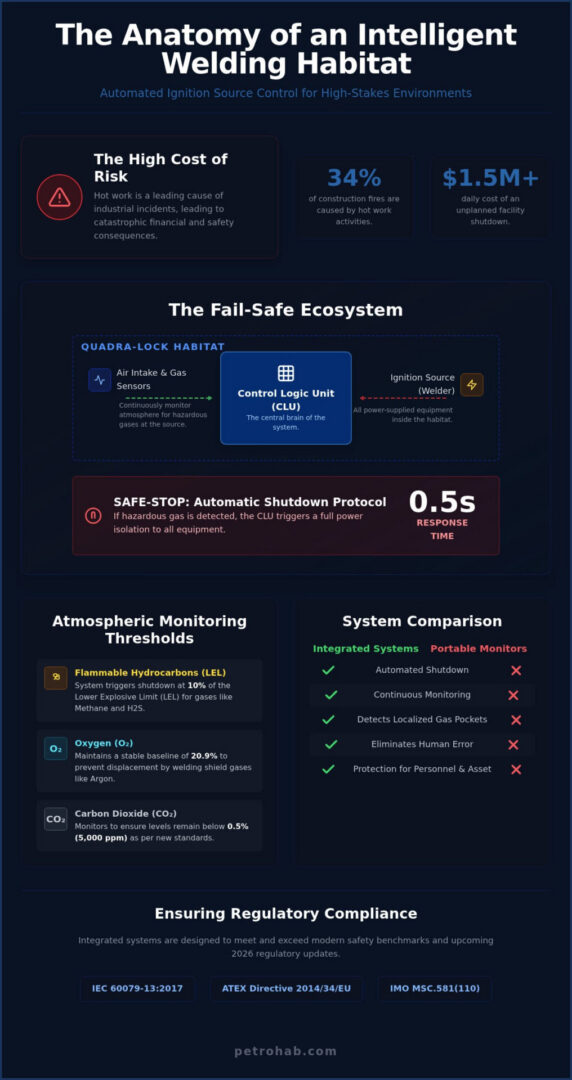
Hot work activities, including welding and grinding, are responsible for approximately 34% of construction-related fires. In the volatile environments of Zone 1 and Zone 2 hazardous areas, the margin for error is non-existent. You recognize that managing multiple safety vendors and manual fire watches often leads to complexity and increased risk. A single ignition incident doesn’t just threaten personnel; it can trigger unplanned facility shutdowns costing operators over $1.5 million per day. Relying on passive containment is no longer sufficient to meet modern safety benchmarks.
Implementing integrated gas detection for welding habitats transforms a static enclosure into an active, intelligent safety asset. This guide details how advanced monitoring systems and automatic shutdown technologies, such as Safe-Stop, create a fail-safe environment for high-stakes industrial work. You’ll discover how the technical synergy between Quadra-Lock panels and real-time atmospheric sensing ensures 100% ignition source control. We will examine the latest 2026 regulatory updates, including IEC 60079-13:2017 standards and new IMO requirements, to help you achieve zero ignition incidents while maintaining operational continuity.
Key Takeaways
- Learn how automated shutdown systems replace manual fire watches to eliminate human error and provide constant monitoring in hazardous zones.
- Understand the technical logic behind the Safe-Stop system; it triggers full power isolation within 0.5 seconds of detecting hazardous gas levels.
- Discover why integrated gas detection for welding habitats provides superior protection against localized gas pockets compared to intermittent portable monitoring.
- Navigate the 2026 regulatory landscape to ensure your hot work operations remain fully compliant with IEC 60079-13:2017 and ATEX Directive 2014/34/EU.
- Identify how the airtight integrity of patented Quadra-Lock panels serves as the critical physical foundation for precise atmospheric sensing and containment.
The Fundamentals of Integrated Gas Detection in Welding Habitats
Integrated gas detection for welding habitats represents the technical bridge between environmental containment and active ignition control. Within a Hot Work Safety Enclosure (HWSE), this system functions as a continuous atmospheric watchdog, monitoring for the presence of hydrocarbons and toxic gases. Unlike a standalone sensor, integrated detection is hardwired into the power supply through a Control Logic Unit. This integration facilitates the Safe-Stop protocol, which automatically isolates all ignition sources the moment a hazard is detected. This proactive approach ensures that the habitat isn’t just a physical barrier, but a dynamic safety asset.
Relying on traditional portable monitors in high-risk Zone 1 or Zone 2 areas is a dangerous compromise. Portable units protect the individual but can’t communicate with the habitat’s power isolation system. They often miss localized gas pockets or fail to account for the rapid dilution caused by the habitat’s ventilation. Integrated gas detection for welding habitats solves this by placing sensors directly at the air intake and within the enclosure. This ensures that any gas ingress is identified and neutralized before it reaches the welding arc, providing a layer of protection that manual fire watches simply can’t match.
Target Gases and Detection Thresholds
Effective monitoring requires specific calibration for the hazards present in energy sector operations. Under 2026 regulations, including IMO Resolution MSC.581(110), systems must monitor a broader range of atmospheric variables. Modern Gas detector technology identifies the following critical markers:
- Flammable Hydrocarbons: Sensors trigger at 10% of the Lower Explosive Limit (LEL) for methane and H2S.
- Oxygen (O2): The system maintains a 20.9% baseline to prevent displacement by welding shielding gases like Argon.
- Carbon Dioxide (CO2): Mandatory monitoring under new standards ensures levels stay below 0.5% (5,000 ppm).
- Toxic Byproducts: Continuous tracking of Carbon Monoxide and Nitrogen Dioxide levels.
The Synergy of Pressure and Gas Sensing
A pressurized habitat maintains its integrity through a combination of physical barriers and mechanical airflow. Systems utilize Quadra-Lock panels to create an airtight seal, allowing for precise pressure management. Manometers work in tandem with gas sensors to validate this integrity. If the internal pressure drops below the required threshold, or if sensors detect gas at the intake, the Safe-Stop system isolates power within 0.5 seconds. Dual-redundancy in sensor placement ensures that a single component failure doesn’t leave the site vulnerable. In offshore environments, these systems establish baseline operating parameters, ensuring hot work only proceeds when the atmosphere is strictly controlled.
Technical Architecture of a Fail-Safe Monitoring System
The technical integrity of integrated gas detection for welding habitats relies on a centralized Control Logic Unit (CLU) to bridge the gap between environmental monitoring and operational control. This architecture prioritizes a fail-safe principle: if a sensor cable is severed or a system component fails, the CLU defaults to a shutdown state. The CLU acts as the central processor for all habitat safety telemetry. It continuously aggregates data from multiple sensor arrays, ensuring that any atmospheric deviation is met with an immediate, automated response rather than relying on manual intervention.
Precision is mandatory for sensors operating in refinery or offshore conditions. These environments present unique challenges, such as salt spray, high humidity, and vibration, which can affect sensor sensitivity. Modern systems are calibrated to detect flammable gases, such as methane or hydrogen sulfide, at 10% of the Lower Explosive Limit (LEL). The system’s architecture is designed for millisecond response times. From the moment a sensor detects a gas ingress at the air intake, the command to isolate power is executed within 0.5 seconds. This speed is critical to prevent an ignition event before the gas reaches a dangerous concentration near the welding arc.
The Control Logic Unit (CLU) Workflow
Data acquisition is the first step in the CLU’s operational sequence. The unit monitors external air intakes and internal habitat pressure while cross-referencing these values against established safety parameters. It utilizes threshold logic to distinguish between minor fluctuations and critical hazards. For instance, a rise in hydrocarbon levels triggers a specific hierarchy of alarms. This system complies with the rigorous requirements of IEC 60079-13:2017, ensuring that the control logic remains robust under industrial stress and meets international safety benchmarks.
Automatic Shutdown Mechanism
The Safe-Stop Automatic Shutdown System serves as the execution layer of this architecture. When the CLU identifies a critical threshold breach, it instantly isolates all welding power sources and heat-producing equipment. This removes the ignition source from the equation in less time than a human operator could react. Simultaneously, the system can initiate emergency ventilation protocols to purge the habitat of potentially hazardous air. By automating these “Safe-Stop” protocols, operators eliminate the risk of human error during high-stress events. You can explore the full technical specifications of the Safe-Stop Automatic Shutdown System to see how it integrates with your existing hot work protocols.
The synergy between detection and isolation is what defines a fail-safe environment. By housing the detection logic within the same system that controls the power supply, the habitat becomes an active guardian of the site. This level of integration ensures that hot work only proceeds when the environment is demonstrably safe, protecting both personnel and high-value assets from catastrophic incidents.
Evaluating Integrated Systems vs. Portable Gas Monitors
Manual monitoring remains the primary failure point in industrial hot work safety. While handheld units offer individual protection, they cannot provide the systemic oversight required for pressurized enclosures. Integrated gas detection for welding habitats replaces intermittent checks with continuous, localized monitoring. This transition eliminates the risk of gas pockets forming in unmonitored corners of the site, which often go undetected by personnel moving between stations. By automating the detection process, operators move from a reactive safety posture to a proactive one.
Automated systems offer a superior cost-benefit profile by reducing insurance premiums and long-term liability risks. Removing the necessity for constant, dedicated fire watch personnel allows operators to reallocate labor while increasing safety reliability. An automated system doesn’t suffer from fatigue, distraction, or environmental stress. It maintains the same level of technical vigilance throughout the entire shift, ensuring that the work environment remains within strict regulatory parameters without human intervention.
The Limitation of Handheld Detectors
Human response lag is a critical vulnerability during rapid gas ingress events. When a portable detector alarms, the operator must still manually cease work and isolate power sources. This delay, even if it only lasts several seconds, is unacceptable in Zone 1 environments. On offshore platforms, monitoring air intake points manually is physically demanding and often inconsistent due to restricted access. Additionally, managing a distributed fleet of portable detectors introduces calibration challenges. Sensor drift across multiple units can lead to inconsistent safety thresholds, creating a fragmented safety landscape that is difficult to audit.
Active Protection: The Integrated Advantage
Integrated systems provide active protection by hardwiring detection logic directly into the pressurized welding habitat infrastructure. This connection ensures that safety protocols are executed regardless of operator status. If a worker becomes incapacitated due to toxic gas exposure, the system automatically isolates the ignition source. This level of integrated gas detection for welding habitats also includes automatic data logging. This feature creates an unalterable digital record for regulatory compliance and incident investigation. It provides definitive proof that the atmosphere remained within acceptable limits, which is essential for meeting 2026 audit requirements and maintaining operational licenses.
Regulatory Compliance and ATEX/IECEx Standards
Compliance isn’t just about avoiding fines; it’s about establishing a technical defense against catastrophic failure. The IEC 60079-13:2017 standard serves as the primary benchmark for pressurized enclosures, requiring that integrated gas detection for welding habitats operates with absolute reliability. This standard specifies how enclosures must maintain positive pressure and how detection systems must trigger shutdowns if that pressure fails or gas is detected. ATEX Directive 2014/34/EU complements this by ensuring every component within the explosive atmosphere is certified to prevent ignition. Third-party validation isn’t a luxury. It’s a mandatory requirement that confirms your safety equipment meets international engineering expectations.
Zone 1 vs. Zone 2 Monitoring Requirements
Risk profiles change depending on the likelihood of an explosive atmosphere. In Zone 1 environments, where hazardous gases are expected during normal operations, redundancy isn’t negotiable. These sites require dual-sensor arrays at air intakes to ensure continuous monitoring even if one sensor fails. Zone 2 areas require a similar level of technical precision, though the frequency of potential exposure is lower. How hazardous environment standards dictate detection placement ensures that no blind spots exist in your safety perimeter. Strategic sensor positioning allows for the detection of methane or H2S before it can penetrate the habitat’s physical boundaries.
Documentation and Audit Trails
A robust safety culture relies on unalterable data. Automated systems generate digital safety logs that provide a granular view of atmospheric conditions throughout the duration of a hot work permit. This telemetry is essential for maintaining a Permit-to-Work (PTW) system that stands up to regulatory scrutiny. It provides safety managers with a clear record of system performance, from pressure levels to gas concentration readings. Ensuring your hot work safety systems meet local jurisdictional rules requires this level of digital transparency. Certified on-site supervision remains a critical component, as trained experts must validate these logs and ensure all protocols remain in effect.
Contact PetroHab to ensure your site meets the highest international safety standards for pressurized hot work.
The PetroHab Solution: Integrated Safe-Stop and Quadra-Lock Systems
PetroHab provides a unified technological response to the volatile hazards of industrial hot work. By combining structural containment with advanced monitoring, we ensure that integrated gas detection for welding habitats functions at peak efficiency. This solution relies on the synergy between a robust physical barrier and the electronic logic of the Safe-Stop system. Our modular design allows for rapid adaptation to complex facility layouts, ensuring that safety protocols remain consistent across diverse operational environments. With a global presence in Houston, Brazil, and the UK, we provide certified technician oversight to maintain the highest standards of site safety.
The effectiveness of an automated shutdown system is fundamentally tied to the integrity of the enclosure it monitors. Without a precise, airtight seal, atmospheric readings become unreliable and positive pressure cannot be sustained. PetroHab addresses this through patented engineering that prioritizes risk mitigation and the protection of personnel. By housing the detection logic within a system that directly controls the power supply, we transform the habitat from a passive enclosure into an active guardian of the industrial site.
Engineered Integrity with Quadra-Lock
PetroHab has established the Quadra-Lock paneling system as the technical benchmark for environmental containment, replacing outdated and less reliable panel concepts. These panels feature a patented interlocking mechanism that prevents gas seepage at the seams, a common failure point in generic habitats. This structural durability is critical in harsh offshore environments where high winds and vibration threaten the stability of the enclosure. The Quadra-Lock system ensures that the internal atmosphere remains strictly controlled, providing the stable baseline necessary for sensors to detect hazardous gas ingress with millisecond precision.
Safe-Stop Deployment and Integration
Deploying a hot work safety enclosure requires a methodical setup process to ensure full system integration. Our certified technicians follow a rigorous protocol to establish a fail-safe environment:
- Enclosure Assembly: Installation of Quadra-Lock panels to create a high-integrity physical barrier.
- Sensor Calibration: Positioning dual-redundant gas sensors at strategic air intake and internal monitoring points.
- Logic Integration: Connecting the Safe-Stop Control Logic Unit to the main welding power isolation hub.
- Pressure Validation: Conducting real-time manometer tests to confirm the habitat maintains positive pressure.
This integrated approach has proven essential in live refinery turnarounds, where preventing a single unplanned shutdown can save operators over $1.5 million per day. By automating ignition control, we remove the variable of human error from the safety equation. You can request a quote for custom integrated gas detection for welding habitats by contacting our technical team directly. We are committed to delivering safety excellence through superior engineering and uncompromising reliability.
Securing the Future of Industrial Hot Work
The evolution of safety in 2026 demands a shift from passive containment to active, automated protection. Transitioning to integrated gas detection for welding habitats ensures that your facility maintains 100% ignition source control through technical precision rather than human observation. By combining the airtight integrity of patented Quadra-Lock panel technology with the rapid response of the PetroHab Safe-Stop™ Automatic Shutdown System, operators effectively eliminate the risk of catastrophic incidents in Zone 1 and Zone 2 environments.
Maintaining full compliance with IEC 60079-13 standards isn’t just a regulatory requirement; it’s a critical component of operational excellence. These systems provide the digital telemetry and millisecond response times required to protect both high-value assets and personnel. You can take the next step in site safety by choosing a partner that prioritizes engineered reliability and technical authority.
Request a Technical Consultation for Your Integrated Safety System today to fortify your hazardous area operations. We look forward to helping you achieve zero ignition incidents through superior safety engineering.
Frequently Asked Questions
What specific gases does an integrated habitat system monitor?
Integrated systems monitor for several critical atmospheric hazards to ensure site integrity. These include:
- Flammable Hydrocarbons: Methane and Hydrogen Sulfide.
- Atmospheric Oxygen: Ensuring levels stay at 20.9% to prevent displacement.
- Carbon Dioxide: Mandatory monitoring per 2026 IMO regulations.
This multi-gas approach ensures that any displacement of breathable air or ingress of explosive vapors is identified before it reaches the ignition source.
How does the Safe-Stop system respond to a gas detection event?
The Safe-Stop system initiates a full power isolation of all welding and grinding equipment within 0.5 seconds of detection. This immediate shutdown removes the potential ignition source before gas concentrations reach the Lower Explosive Limit (LEL). Simultaneously, the system triggers audible and visual alarms to alert personnel. This automated logic is the technical benchmark for integrated gas detection for welding habitats, ensuring a fail-safe response regardless of human status.
Is integrated gas detection mandatory for offshore welding?
Global safety standards, including IEC 60079-13:2017, require active atmospheric monitoring for pressurized enclosures in Zone 1 and Zone 2 areas. While specific jurisdictional rules vary, most offshore operators mandate integrated detection to mitigate the risk of catastrophic explosions. These systems provide the necessary technical documentation and real-time protection required for high-stakes hot work. Relying on passive containment without automated detection is generally considered a non-compliant safety practice in modern industrial sectors.
Can the system detect gas leaks at the air intake point?
Yes, the system utilizes dual-redundant sensors specifically positioned at the air intake point. This placement is critical because the intake is the most likely entry point for external gas clouds. By identifying hazardous vapors before they enter the pressurized habitat, the system can isolate power and prevent the enclosure from being filled with a flammable mixture. This proactive detection layer is essential for maintaining the safety of the work environment in volatile refineries.
How often do sensors in a welding habitat need to be calibrated?
Sensors require calibration before every new deployment to ensure technical precision and compliance with ATEX/IECEx standards. In harsh offshore or refinery environments, technicians perform bump tests daily to verify sensor responsiveness. Regular maintenance prevents sensor drift; this can lead to false alarms or, more dangerously, delayed detection. PetroHab certified technicians oversee this process, ensuring that every component of the integrated gas detection for welding habitats operates within its specified safety parameters.
What happens if the pressure monitoring system fails?
The system operates on a fail-safe principle. If the pressure monitoring system fails or detects a drop below the required positive pressure threshold, the Safe-Stop system automatically isolates all power. This ensures that hot work cannot continue if the physical barrier’s integrity is compromised. Maintaining positive pressure is vital to prevent gas ingress. If the sensors or manometers lose functionality, the logic defaults to a shutdown state to protect personnel and high-value assets.
Does integrated detection eliminate the need for a fire watch?
Integrated detection significantly reduces the reliance on manual fire watches by providing continuous, error-free monitoring. However, it doesn’t entirely eliminate the need for certified on-site supervision. A trained technician must still manage the Permit-to-Work system and oversee the initial setup of Quadra-Lock panels. The automated system acts as the primary safety guardian, while human oversight ensures that all physical and procedural protocols remain in strict accordance with international safety regulations.
Are PetroHab systems compatible with ATEX Zone 1 requirements?
PetroHab systems are specifically engineered for use in Zone 1 and Zone 2 hazardous environments. Our equipment complies with the ATEX Directive 2014/34/EU and the IEC 60079-13:2017 standard for pressurized rooms. Every component, from the Safe-Stop Control Logic Unit to the internal lighting, is certified for use in explosive atmospheres. This ensures that the system doesn’t become an ignition source itself while monitoring for external hazards in high-risk industrial settings.