
Blog Posts
Managing Hot Work in Hydrogen Sulfide (H2S) Environments: A 2026 Safety Guide
In high-risk H2S zones, relying solely on personal gas detectors for ignition source control is a dangerous gamble that ignores the volatility of the 2026 industrial landscape. Safety managers understand that the margin for error in sour gas operations is zero. When a single spark meets a toxic leak, the result is catastrophic asset loss and immediate danger to life. Effectively managing hot work in hydrogen sulfide environments requires moving beyond passive monitoring toward active, pressurized isolation.
This guide ensures you master the technical protocols and engineering controls necessary for zero-incident execution while maintaining full compliance with 2026 OSHA and NFPA standards. This analysis details how PetroHab’s Quadra-Lock panels and Safe-Stop automatic shutdown systems, certified to IEC 60079-13:2017, provide an unrivaled barrier against the 20 ppm OSHA ceiling. You’ll learn to implement a rigorous safety architecture that minimizes operational downtime without compromising on the integrity of your pressurized habitats or the lives of your personnel.
Key Takeaways
- Analyze the chemical interactions between welding sparks and sour gas to mitigate the dual threats of toxic H2S exposure and explosive ignition.
- Master the technical protocols for managing hot work in hydrogen sulfide environments by utilizing pressurized isolation to create an impenetrable atmospheric barrier.
- Integrate the Safe-Stop Automatic Shutdown System with welding equipment to ensure immediate ignition source control upon the detection of hazardous gas concentrations.
- Navigate 2026 OSHA and NFPA compliance requirements by establishing rigorous fire watch and gas watch procedures tailored for high-risk sour zones.
- Leverage the modular flexibility of Quadra-Lock panels to maintain habitat integrity across complex industrial geometries and challenging offshore environments.
The Volatile Intersection: Hot Work Risks in H2S Environments
Hydrogen sulfide (H2S) represents one of the most complex hazards in the energy sector. It isn’t just a respiratory toxin; it’s a highly flammable fuel source and a corrosive agent that compromises metal integrity. Effectively managing hot work in hydrogen sulfide environments requires a shift in perspective. You aren’t just protecting workers from breathing a poison. You’re preventing a high-energy ignition source from finding a volatile gas pocket. Traditional hot work safety procedures often prioritize fire watches for sparks but underestimate the chemistry of sour gas.
Standard personal protective equipment (PPE) remains a secondary defense. While a respirator prevents toxic inhalation, it offers no protection against the thermal energy of a flash fire. In high-concentration zones, the dual threat of toxicity and flammability creates a deadly synergy. If H2S levels rise, the atmosphere becomes both lethal to breathe and ripe for explosion. Relying on gas monitors alone is insufficient when the work itself generates temperatures far exceeding the gas’s ignition point.
To better understand the biological risks associated with this gas, watch this helpful video on first aid procedures:
H2S Flammability and Explosive Limits
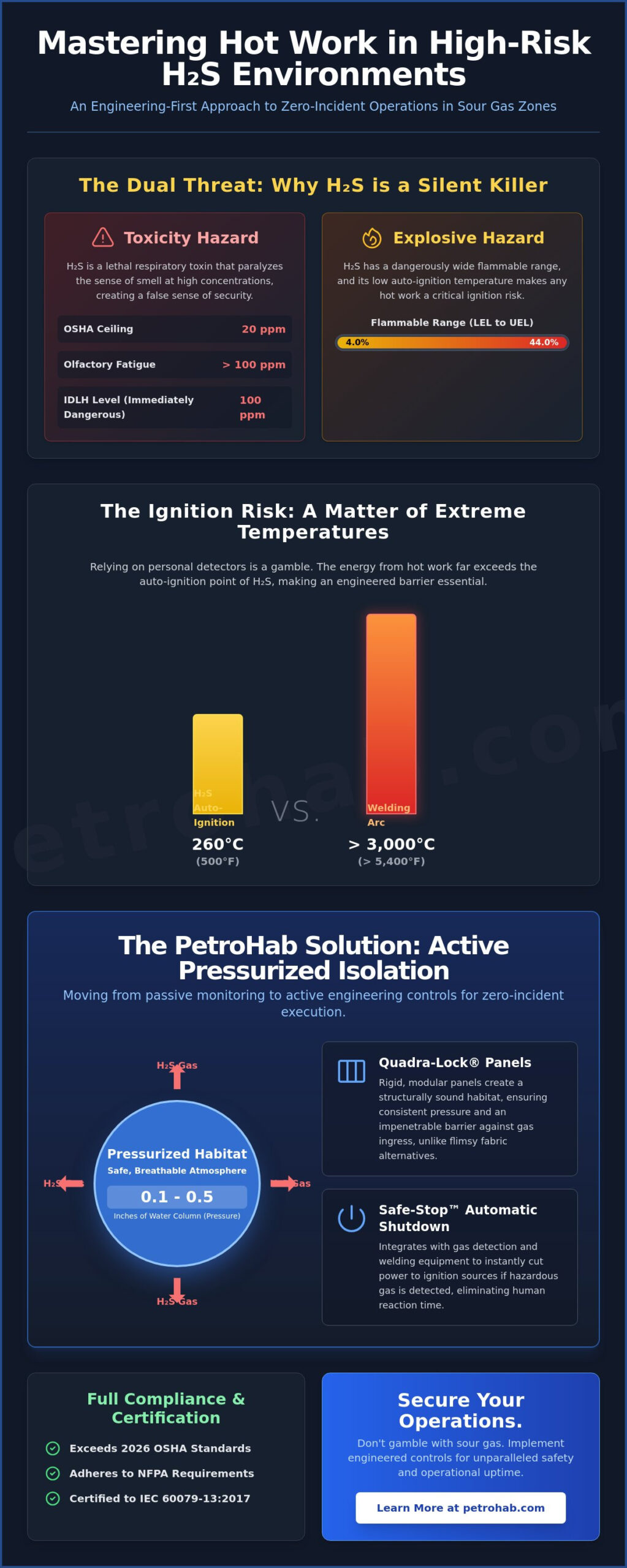
H2S possesses a dangerously wide flammable range. The Lower Explosive Limit (LEL) is 4.0% by volume, and the Upper Explosive Limit (UEL) is 44.0%. In refinery settings, high pressure and ambient heat can increase gas volatility, making these limits even more unpredictable. The auto-ignition temperature of H2S is 260°C (500°F). This temperature is easily reached by welding arcs, which can exceed 3,000°C. Without pressurized isolation, managing hot work in hydrogen sulfide environments becomes a matter of chance rather than engineering.
The Lethality of Sour Gas in Enclosed Spaces
The deceptive nature of H2S is its greatest danger. While the characteristic rotten egg smell is detectable at 0.01 ppm, concentrations above 100 ppm cause immediate olfactory fatigue. This paralysis of the sense of smell means workers can’t detect rising gas levels. For 2026, the IDLH level is 100 ppm. Historical data from unpressurized work zones shows that 30% of sour gas accidents involve ignition within confined or semi-enclosed spaces. These incidents aren’t just safety failures; they’re catastrophic asset losses that stem from a lack of active ignition source control.
Implementing Pressurized Isolation with Quadra-Lock Technology
Positive pressure serves as the first line of defense against gas ingress. By creating an internal environment where the atmospheric pressure is higher than the outside air, hazardous vapors are physically repelled. When managing hot work in hydrogen sulfide environments, this pressure differential ensures that even if a leak occurs nearby, the H2S cannot penetrate the work area. A high-quality hot work safety enclosure must maintain a constant overpressure between 0.1 and 0.5 inches of water column. This range is sufficient to exclude gas without compromising the structural stability of the enclosure. It’s a calculated balance of physics and engineering designed to protect high-value assets and human life.
Rigid modular designs offer a significant advantage over flexible, fabric-based alternatives. While some competitors suggest using fire-resistant tarps, these materials lack the structural integrity required for reliable gas exclusion. Tarps often billow under pressure, creating “weak spots” and potential leak paths at the seams. PetroHab’s approach utilizes Quadra-Lock panels to ensure a consistent, predictable barrier. This engineering choice reflects a commitment to technical precision and risk mitigation in high-stakes oil and gas operations. The panels provide a stable foundation for the habitat, ensuring that the internal pressure remains uniform even in turbulent offshore conditions.
The Quadra-Lock Advantage for Gas Exclusion
The Quadra-Lock system relies on a patented interlocking mechanism that secures 1m-by-1m panels into a unified structure. This design eliminates the gaps and overlaps where toxic gases often infiltrate less sophisticated habitats. Each panel is constructed from fire-resistant materials certified to ANSI/FM 4950, ensuring they withstand both the heat of the hot work and the corrosive nature of sour gas environments. Adhering to OSHA guidelines on H2S requires this level of material integrity to prevent catastrophic containment failure during critical maintenance cycles. The interlocking edges create a mechanical seal that remains effective throughout the duration of the project.
Air Quality Management in the Habitat
Creating a pressurized environment is only half of the solution. The habitat must also provide a safe, breathable atmosphere for the technicians inside. This is achieved by pulling air from a clean source located well away from potential gas release points. PetroHab Air Ducting facilitates this continuous flow, maintaining the necessary overpressure while flushing out fumes generated by welding or grinding. Safety protocols in 2026 mandate the use of redundant sensors to monitor oxygen levels within the enclosure. If oxygen concentrations deviate from the 19.5% to 23.5% safety window, the system provides immediate alerts to the crew and supervisors. This methodical approach ensures that the habitat remains a controlled environment, regardless of the volatile conditions outside its walls.
Engineering Controls: Gas Detection and Automatic Shutdown
The physical integrity of a habitat must be reinforced by active engineering controls to achieve a zero-incident outcome. When managing hot work in hydrogen sulfide environments, relying on manual gas detection creates a dangerous lag in response time. Portable meters warn the operator but don’t neutralize the ignition source. PetroHab’s Safe-Stop Automatic Shutdown System eliminates this human factor by providing a direct, hard-wired link between atmospheric conditions and the welding power supply. This system acts as a vigilant guardian, ensuring that the presence of sour gas immediately terminates all hot work activities.
Redundancy is a technical necessity in sour gas zones. Because H2S is heavier than air and accumulates in low-lying areas, sensors must be strategically positioned both inside the enclosure and at the external air intake. The demand for infrared gas detectors has increased by 15% since 2023, reflecting an industry-wide shift toward more reliable, poison-resistant sensing technology. Modern smart sensors in these detectors can reduce false alarms by up to 30%, preventing unnecessary operational downtime while maintaining a rigorous safety posture. This data-driven approach to gas detection ensures that the Safe-Stop system only intervenes when a genuine hazard is detected.
The Safe-Stop Logic Framework
The Safe-Stop system operates on a logical, three-step protocol designed for absolute reliability. First, H2S sensors are calibrated to a 10 ppm threshold, matching the OSHA 8-hour time-weighted average to provide an early warning. Second, the system continuously monitors the habitat’s internal pressure via integrated manometers. If the overpressure falls below the 0.1-inch water column limit established in previous sections, the system prepares for shutdown. Third, upon gas detection or loss of pressure, the Safe-Stop unit triggers immediate power isolation. This sequence ensures that the welding arc or grinding tool is deactivated before hazardous gas can reach the ignition point.
ATEX and IECEx Compliance for 2026
In 2026, all monitoring hardware deployed in sour gas plants must meet stringent international certifications. PetroHab’s Safe-Stop system is certified to IEC 60079-13:2017, the latest standard for pressurized rooms. This ensures the equipment is safe for use in ATEX Zone 1 or Zone 2 hazardous locations. Every component, from the pressure sensors to the gas heads, is intrinsically safe, preventing the safety system itself from becoming an ignition source. For a detailed breakdown of these requirements, safety managers should consult our hazardous environment standards guide to ensure full operational alignment with global compliance mandates.
Compliance and Operational Best Practices for H2S Zones
Adherence to 2026 OSHA and NFPA standards isn’t just a legal requirement; it’s the foundation of operational integrity. When managing hot work in hydrogen sulfide environments, compliance begins with OSHA 1910.252 and NFPA 51B. These regulations mandate a rigorous permit-to-work (PTW) system that accounts for both the ignition risks of hot work and the toxicological profile of sour gas. Facilities subject to Program 3 Prevention Program requirements under 40 CFR Part 68 must ensure their Risk Management Plan reflects the most recent review of these procedures. Safety managers can’t afford to treat H2S as a standard industrial gas. It requires a specialized oversight framework that addresses the unique chemistry of high-risk zones.
Operational success in these environments requires a clear distinction between the “Fire Watch” and the “Gas Watch.” While a fire watch monitors for sparks and slag, a gas watch focuses exclusively on atmospheric fluctuations. In sour gas fields, a gas watch technician must be equipped with real-time monitoring tools and have the authority to halt operations immediately if levels exceed the 10 ppm TWA limit. This dual-layered personnel strategy ensures that human observation complements the automated protection provided by the Safe-Stop system. Pre-work atmospheric testing must go beyond Lower Explosive Limit (LEL) readings. Technicians must verify that H2S concentrations are well below the 20 ppm ceiling before any ignition source is introduced, even within a pressurized enclosure.
Permit-to-Work (PTW) Integration
A robust PTW process for H2S zones includes a comprehensive risk assessment matrix that differentiates between onshore and offshore hazards. Documentation must confirm that all personnel have completed training on habitat emergency releases. In the event of a gas breach, workers must be able to egress the enclosure in seconds. Modern safety protocols require these permits to be kept on file until the work is completed, providing a transparent audit trail for regulatory inspectors. Rigorous training ensures that every team member understands the functionality of the Petro-Habitat and their specific role in an emergency evacuation.
Maintenance and Inspection of Habitat Seals
The mechanical integrity of the habitat depends on the condition of its components. Daily inspection checklists for Quadra-Lock panels are mandatory to identify potential leak paths or structural fatigue. Before every shift, technicians must test the Safe-Stop system to verify that the power isolation logic is fully operational. This proactive maintenance routine prevents the gradual degradation of habitat seals, which can be accelerated by the corrosive nature of hydrogen sulfide. If you’re ready to upgrade your safety infrastructure, you can request a technical consultation for your HWSE needs today. Maintaining these engineering controls ensures that the pressurized environment remain effective throughout the project’s lifecycle.
PetroHab’s Engineered Solutions for High-H2S Environments
PetroHab serves as the active guardian for the world’s most hazardous energy sites. Our unrivaled safety record in the most challenging sour gas fields demonstrates that managing hot work in hydrogen sulfide environments is a solvable engineering challenge. By prioritizing risk mitigation and the protection of high-value assets, PetroHab provides a definitive technological remedy to the volatility of H2S. Operations and Maintenance (O&M) managers select our systems because they offer a calculated approach to safety that eliminates the variables of human error and atmospheric instability.
The modular flexibility of our habitats allows for seamless integration into existing infrastructure. Unlike rigid, one-size-fits-all solutions, our pressurized enclosures adapt to the complex pipe geometries and restricted spaces common in offshore platforms and refineries. This adaptability ensures that the integrity of the positive pressure environment is never compromised by structural obstructions. Every component is engineered for reliability, reinforcing PetroHab’s position as the gold standard in hot work safety for the energy sector.
Customizable Enclosures for Sour Gas Refineries
Large-scale turnarounds require scalable safety solutions that can manage multiple work zones simultaneously. PetroHab utilizes interchangeable 1m-by-1m Quadra-Lock panels to construct enclosures of any size, from single-welder units to expansive multi-zone habitats. These panels, certified to ANSI/FM 4950, integrate directly with existing plant-wide safety systems to provide a unified defense against gas ingress. This modular architecture allows for rapid mobilization and demobilization, helping facilities avoid the excessive standby rates and mobilization fees associated with less efficient safety models.
Technician Training and Certification
Engineering controls are only as effective as the personnel who operate them. PetroHab provides comprehensive technician training and on-site supervision to ensure your team is qualified to manage our systems in high-risk zones. This certified oversight reduces corporate liability and ensures that all equipment, including the Safe-Stop automatic shutdown system, is maintained according to the highest industry standards. Our global support network offers on-site expertise to verify that habitat seals and air quality management protocols meet the rigorous demands of your specific project. For a comprehensive review of your site requirements, you should contact PetroHab for a specialized H2S hot work safety consultation to secure your operations against the dual threats of toxicity and ignition.
Securing the Future of Sour Gas Operations
Successfully managing hot work in hydrogen sulfide environments requires a transition from passive observation to active engineering control. The integration of pressurized isolation and automated shutdown systems eliminates the risk of human delay during toxic or flammable gas releases. These protocols are essential for maintaining 2026 OSHA and NFPA compliance while protecting high-value industrial assets. PetroHab provides the technical infrastructure to execute these high-stakes tasks with absolute confidence.
Our patented Quadra-Lock technology ensures superior gas exclusion through a rigid, interlocking panel system that outperforms flexible alternatives. We pair this physical barrier with ATEX and IECEx certified monitoring systems to provide unrivaled ignition source control. With a global deployment capability in under 48 hours, PetroHab stands ready to support your most critical maintenance windows. Reliability is built through meticulous planning and the right technology. You can ensure the safety of your personnel and the integrity of your site by choosing a partner dedicated to technical excellence.
Request a Technical Quote for PetroHab H2S Safety Solutions
Frequently Asked Questions
Can hot work be performed in H2S environments safely?
Yes, performing hot work in these environments is safe when using a pressurized Petro-Habitat to isolate the ignition source. This technology creates a physical and atmospheric barrier between the technician and the external sour gas. Managing hot work in hydrogen sulfide environments involves using Quadra-Lock panels to maintain structural integrity. This methodical approach replaces the uncertainty of open-air welding with a controlled, engineered environment that repels toxic and flammable vapors.
What is the 2026 PEL for H2S in the oil and gas industry?
OSHA’s 2026 permissible exposure limit (PEL) is 20 parts per million (ppm) as a ceiling. There’s an exception for a single 10-minute peak of 50 ppm if no other measurable exposure occurs during an 8-hour shift. The 8-hour time-weighted average (TWA) remains 10 ppm. ACGIH recommendations are more stringent, suggesting a 1 ppm TLV. Adhering to these limits is a mandatory component of any hot work permit in sour gas zones.
How does a pressurized welding habitat exclude H2S?
A pressurized habitat utilizes a positive pressure differential to physically exclude hazardous gases from the work area. By maintaining an internal pressure between 0.1 and 0.5 inches of water column higher than the ambient atmosphere, the habitat forces air outward through any microscopic gaps. This ensures that H2S cannot penetrate the enclosure. Our Quadra-Lock panels provide the rigid seal necessary to sustain this overpressure, even in high-wind offshore environments where flexible tarps would fail.
What happens if the positive pressure in a habitat fails?
If internal pressure drops below the 0.1-inch water column threshold, the Safe-Stop Automatic Shutdown System immediately isolates the power supply. This action neutralizes all ignition sources before H2S can infiltrate the work area. The system doesn’t rely on human reaction times; it uses electronic pressure sensors to trigger a fail-safe response. This automated control is a critical engineering requirement for managing hot work in hydrogen sulfide environments where gas migration is unpredictable.
Are PetroHab enclosures ATEX certified for sour gas zones?
Yes, PetroHab’s Safe-Stop system and pressurized habitats are certified to international safety standards for hazardous locations. Specifically, the Safe-Stop system is certified to IEC 60079-13:2017, the global standard for pressurized rooms. It’s also ATEX and IECEx certified for operation in Zone 1 and Zone 2 areas. These technical anchors ensure that our equipment provides unrivaled protection in the corrosive and volatile atmospheres typical of sour gas refineries and offshore platforms.
What is the difference between a gas watch and a fire watch in H2S work?
A fire watch focuses on preventing fires caused by sparks, slag, or heat from the welding process. In contrast, a gas watch is dedicated to continuous atmospheric monitoring for toxic and flammable concentrations. While the fire watch monitors the physical work area, the gas watch tracks the invisible threat of H2S using real-time sensors. Both roles are essential for compliance with 2026 OSHA and NFPA standards in high-risk sour gas environments.
Can H2S ignite even if oxygen levels are low?
H2S remains highly flammable even in atmospheres with reduced oxygen, as its explosive range is a broad 4.0% to 44.0%. While oxygen is necessary for combustion, the wide flammability limits mean that H2S can ignite more easily than many other hydrocarbons. This volatility makes active ignition source control mandatory. Relying on oxygen depletion to prevent fire is a dangerous strategy that ignores the gas’s fundamental chemical properties and its low auto-ignition temperature of 260°C.
How does the Safe-Stop system interact with my welding equipment?
The Safe-Stop system is hard-wired directly into the power circuit of your welding machines or grinding tools. It acts as a primary circuit breaker that remains closed only when safe conditions are met. If sensors detect H2S at 10 ppm or a loss of habitat pressure occurs, the system opens the circuit. This immediately terminates the welding arc or tool rotation, preventing the ignition of any gas that might be present near the habitat.