Blog Posts
Offshore Welding Safety: Managing Hot Work on Live Platforms in 2026
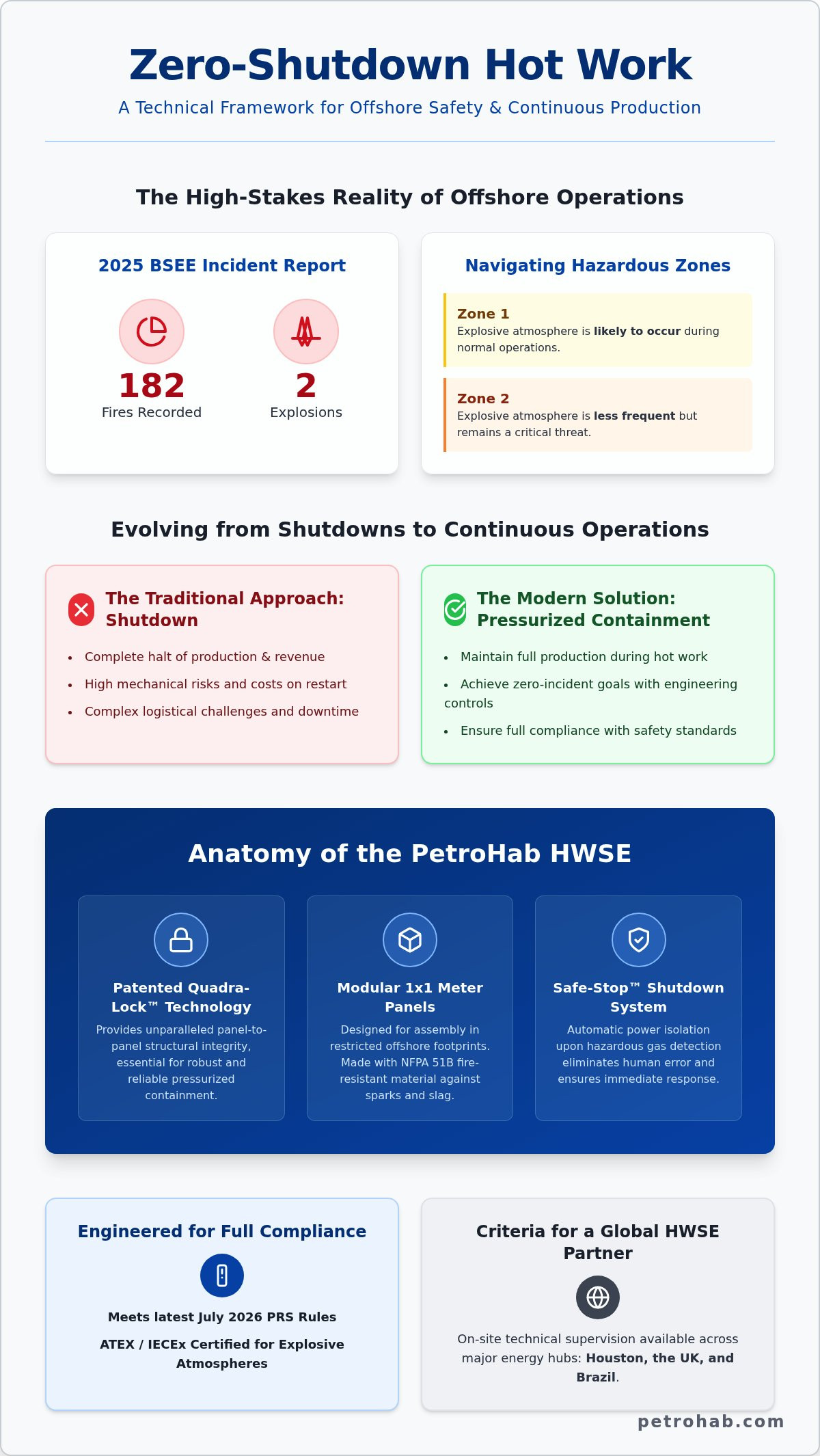
In 2025, the Bureau of Safety and Environmental Enforcement (BSEE) recorded 182 fires and two explosions across offshore facilities. These figures underscore the extreme volatility of Zone 1 and Zone 2 environments where even a single spark can lead to catastrophic asset loss. For safety managers, the financial burden of production downtime is a constant pressure, yet you cannot compromise on personnel protection. Finding viable alternatives to offshore platform shutdown is no longer just a logistical preference; it’s a requirement for operational excellence in a high-stakes industry.
This guide provides a technical framework for executing zero-incident hot work while maintaining live production. You’ll learn how to mitigate ignition risks through the deployment of PetroHab LLC Hot Work Safety Enclosures (HWSE) featuring patented Quadra-Lock technology. We’ll detail how the Safe-Stop automatic shutdown system provides an uncompromising layer of protection that meets the latest July 2026 PRS rules for materials and welding. By transitioning from reactive shutdowns to proactive, pressurized containment, you ensure full compliance with international safety standards without sacrificing your operational rhythm.
Key Takeaways
- Evaluate technically superior alternatives to offshore platform shutdown to maintain continuous production while managing ignition risks in volatile Zone 1 and Zone 2 environments.
- Discover how patented Quadra-Lock technology and modular 1×1 meter panels provide the structural integrity required for pressurized containment on restricted offshore footprints.
- Implement Safe-Stop automatic shutdown systems to eliminate human error, ensuring immediate power isolation upon the detection of hazardous gas concentrations.
- Establish rigorous operational protocols, from site assessment to habitat assembly, to ensure full compliance with updated 2026 international safety certifications.
- Identify the critical criteria for selecting a global HWSE partner capable of providing on-site technical supervision across major energy hubs like Houston, the UK, and Brazil.
The Critical Challenges of Offshore Welding and Hot Work Safety
Offshore energy production occurs in a high-pressure environment where safety and profitability are often in direct tension. In hydrocarbon-rich Zone 1 and Zone 2 areas, the risk of a single spark causing a catastrophe is a daily reality. Adherence to hot work safety principles is the only way to mitigate these dangers during essential maintenance. Historically, operators were forced to choose between safety and revenue, often resulting in costly production halts.
To better understand the complexity of these industrial structures, watch this video detailing offshore platform construction:
The economic impact of a total facility shutdown can be devastating. Beyond the immediate loss of production volume, the process of restarting a platform introduces its own set of mechanical risks and costs. Consequently, safety managers increasingly seek technical alternatives to offshore platform shutdown that allow for live-platform maintenance. These solutions must account for severe environmental factors, including high-velocity winds and pervasive salt spray, which degrade standard equipment and compromise visibility. Navigating the 2026 regulatory landscape requires strict alignment with updated ATEX and IECEx requirements, ensuring that every piece of equipment is certified for explosive atmospheres.
Defining the Hazardous Area Dilemma
Hazardous areas are strictly classified based on the frequency and duration of explosive gas presence. In Zone 1, an explosive atmosphere is likely to occur during normal operations; in Zone 2, it is less frequent but remains a critical threat. The Permit-to-Work (PTW) system acts as the administrative backbone of offshore safety, yet it isn’t a physical barrier. Traditional fire blankets or simple tarps are insufficient for high-stakes maintenance. They lack the structural integrity to resist wind loads and can’t prevent the migration of flammable vapors into the welding area.
The Objective of Pressurized Containment
The primary goal of a pressurized welding enclosure is to isolate the ignition source from the surrounding environment. By maintaining internal positive pressure, the system creates a physical barrier that prevents gas ingress. This engineering control allows for welding and grinding to occur safely while the platform remains fully operational. These habitats provide a controlled environment that protects personnel and high-value assets simultaneously. Utilizing advanced alternatives to offshore platform shutdown, such as the PetroHab LLC Hot Work Safety Enclosure (HWSE), ensures that production quotas are met without compromising the commitment to a zero-incident workplace.
Engineering Integrity: The Anatomy of a Pressurized Welding Habitat
A hot work safety enclosure is a modular, pressurized containment system that must meet the specific 2026 technical requirements for ATEX/IECEx certification to effectively isolate ignition sources in hazardous offshore zones. These modular systems serve as robust alternatives to offshore platform shutdown by allowing maintenance crews to work safely while production remains online. Unlike temporary barriers, these habitats are engineered for structural resilience in high-stakes environments.
The offshore industry standard utilizes 1×1 meter panels for maximum maneuverability. This specific sizing allows technical teams to transport and assemble the enclosure within the restricted footprints typical of offshore decks. The fabric of these panels must adhere to NFPA 51B specifications, ensuring high-grade fire resistance against sparks and molten slag. Beyond fire protection, the enclosure must maintain its structural integrity during severe weather. While competitors often overlook wind loads, a professional habitat is designed to resist the intense wind events common in the North Sea and the Gulf of Mexico. This stability prevents the enclosure from collapsing or losing its seal, which would immediately compromise the safe environment. Integrating these systems requires strict adherence to OSHA hot work regulations to ensure both legal compliance and personnel safety.
Effective air ducting is another critical engineering requirement. Continuous ventilation removes hazardous welding fumes and prevents heat stress, which is a significant factor in offshore worker safety. Safety managers evaluating modular HWSE systems from PetroHab LLC should prioritize units that offer both structural rigidity and high-volume air exchange.
Quadra-Lock Technology and Panel Integrity
The patented Quadra-Lock panels represent a significant advancement in containment engineering. By utilizing an interlocking mechanism, these panels eliminate the dangerous gaps often found in traditional velcro or zipper-based systems. This modularity allows the enclosure to be configured around irregular deck layouts and existing piping. The Quadra-Lock mechanism creates a tight, consistent seal that withstands internal pressure, ensuring that the positive pressure environment remains unbroken even when the external atmosphere is volatile.
Pressure Regulation and Manometry
Maintaining a controlled environment requires precise pressure regulation. Manometers serve as the primary diagnostic tool, monitoring the differential pressure between the internal habitat and the external hazardous zone. To prevent the ingress of flammable gases, the internal pressure must remain consistently higher than the outside air. Technical teams can find more detailed specifications on these requirements in Pressurized Welding Habitats: The Definitive Guide to HWSE Technology. This data allows safety managers to set specific thresholds for automated safety triggers.
Beyond Containment: The Role of Safe-Stop Automatic Shutdown Systems
While pressurized enclosures provide the physical barrier, the integrity of a live-platform operation depends on intelligent automation. Manual monitoring is increasingly viewed as insufficient by safety managers because it relies on human reaction times in high-stress environments. In contrast, an integrated automatic shutdown system eliminates the latency between gas detection and ignition source isolation. This level of technical control is essential when evaluating alternatives to offshore platform shutdown, as it provides a fail-safe mechanism that operates independently of the crew’s immediate awareness. By removing the risk of human error, the system acts as an active guardian over high-value assets and personnel.
The logic of an automated system is built on immediate response. If gas is detected or pressure is lost, the system doesn’t just sound an alarm; it physically disconnects the power supply to all potential ignition sources. This technical synergy between the enclosure and the shutdown logic ensures that hot work remains isolated from the surrounding hydrocarbon-rich environment. Integrating these systems allows operators to maintain production quotas during essential maintenance, directly addressing the 182 fire incidents recorded by the BSEE in 2025 by preventing ignition before it starts.
Safe-Stop System Logic and Integration
The Safe-Stop automatic shutdown system follows a rigorous ‘detect-alert-isolate’ workflow. When the system identifies a breach in safety parameters, it immediately isolates all ignition sources within the habitat. This includes cutting power to welding machines, grinders, and lighting systems. The system triggers are multifaceted:
- Detection of flammable gases at a predetermined percentage of the Lower Explosive Limit (LEL).
- Loss of positive pressure within the hot work safety enclosure.
- Activation of a manual emergency stop by personnel inside or outside the habitat.
- Failure of the air supply or ventilation equipment.
This integration ensures that the habitat remains a controlled environment even if external conditions fluctuate. By linking the Safe-Stop system directly to the welding power source, operators gain a level of reliability that manual gas detectors cannot match. These alternatives to offshore platform shutdown provide the necessary security for performing high-risk tasks in Zone 1 and Zone 2 areas.
ATEX Certified Gas Detection in 2026
The 2026 regulatory landscape demands higher precision in gas sensing technology. Modern Safe-Stop systems utilize advanced infrared and catalytic bead sensors certified under the latest ATEX and IECEx standards. These sensors are specifically calibrated for the complex hydrocarbon profiles encountered in offshore production, such as methane, ethane, and propane. Redundancy is a core requirement; the system must monitor the air intake to ensure the pressurization source is clean, while simultaneously scanning the habitat’s perimeter for any gas migration. For a deeper analysis of these technical requirements, safety managers should consult A Comprehensive Guide to Advanced Hot Work Safety Systems in 2026. Implementing these sensors ensures that every hot work project adheres to the highest global safety benchmarks.
Operational Protocols for Live Platform Hot Work
Adhering to rigorous operational protocols is the final safeguard in live-platform maintenance. While the hardware provides the capability, the execution relies on a methodical, step-by-step approach. Safety managers must view these procedures as non-negotiable requirements for utilizing alternatives to offshore platform shutdown. The process begins long before the first panel is moved, starting with a comprehensive site assessment that identifies ignition risks and optimizes the habitat footprint for the specific deck layout. This planning ensures that the enclosure doesn’t obstruct emergency egress or critical platform sensors.
The Permit-to-Work (PTW) system must be fully integrated into the habitat’s operational lifecycle. This includes verifying that the specific hot work tasks, whether welding, grinding, or cutting, are clearly defined and that all safety triggers are tested. Once the site is prepared, the assembly of Quadra-Lock panels ensures a high-integrity seal. A dedicated habitat technician and a fire watch must remain on-site throughout the operation to monitor gas levels and system pressure. After the hot work is complete, decommissioning must follow a systematic teardown procedure to ensure no residual ignition risks remain. For organizations looking to implement these protocols, PetroHab provides the necessary pressurized habitats and technical support to ensure zero-incident execution.
Establishing the Positive Pressure Environment
Creating a controlled environment requires a disciplined sequence to ensure the enclosure is truly isolated from the hazardous atmosphere. This procedure is a primary technical pillar for successful alternatives to offshore platform shutdown.
- Step 1: Inspect all Quadra-Lock panels for damage, debris, or compromised seals that could lead to pressure leakage.
- Step 2: Connect the blower system to a verified clean air source, ensuring the intake is located far from vent stacks or known gas release points.
- Step 3: Gradually increase internal pressure while monitoring the manometer to reach the target differential, ensuring it stays within the certified range to prevent gas ingress.
Emergency Response and Failure Scenarios
Emergency response protocols are critical for managing unforeseen events. If a sudden loss of pressure occurs or the Safe-Stop system activates, all hot work must cease immediately. The technician maintains direct communication lines with the platform control room to report the status and coordinate any necessary facility-wide responses. The PTW status is only maintained as long as the habitat meets its certified safe criteria; any breach requires a full re-assessment and re-certification before work resumes. This uncompromising approach to failure scenarios is what preserves asset integrity in high-stakes offshore environments.
Choosing the Right HWSE Partner for Offshore Operations
Selecting a Hot Work Safety Enclosure (HWSE) provider requires more than checking a certification box. It’s about securing an engineering partner capable of operating within the high-stakes logistics of the global energy sector. Reliability is measured by a partner’s presence in key operational zones. Whether your assets are in the Gulf of Mexico, the North Sea, or the Campos Basin, having support hubs in Houston, the UK, and Brazil ensures that equipment and expertise are deployed without the delays of trans-continental shipping. This logistical agility is a cornerstone of effective alternatives to offshore platform shutdown, as it prevents maintenance schedules from slipping due to supply chain failures.
Technical support evaluation is equally critical. You must determine if a vendor offers on-site technical supervision or merely equipment rental. The complexity of pressurized habitats in 2026 demands specialists who can oversee assembly and pressure testing to ensure the system functions as designed. Customization is another vital factor. Standard enclosures often fail to accommodate the complex geometries of older platforms or congested deck spaces. A partner must demonstrate the ability to configure modular systems around existing piping and structural steel without compromising the positive pressure seal. Finally, comprehensive training ensures client personnel are certified to operate these systems safely, empowering your crew to maintain the highest safety standards.
Rental vs. Purchase: Strategic Procurement in 2026
Procurement strategies depend on the duration and frequency of your maintenance needs. For multi-year platform life-extension campaigns, long-term leasing provides a cost-effective path to continuous safety. Conversely, permanent facility maintenance crews often benefit from a direct purchase, integrating the HWSE into their standard asset protection inventory. This allows for immediate deployment during unplanned repairs. For a comprehensive evaluation of these options, consult Choosing the Right Hot Work Safety Enclosure Suppliers: A 2026 Procurement Guide for a detailed checklist.
The PetroHab Advantage in Offshore Safety
PetroHab stands as the industry benchmark by prioritizing technical synergy over simple containment. The patented Quadra-Lock technology provides the interlocking modularity necessary for the most restrictive offshore footprints, ensuring a gap-free seal that traditional systems can’t replicate. By integrating the Safe-Stop automatic shutdown system, PetroHab eliminates ignition risks with calculated precision. This holistic approach makes PetroHab’s systems the premier alternatives to offshore platform shutdown for safety managers who refuse to compromise on asset integrity. Contact PetroHab for a specialized offshore hot work safety consultation to secure your facility’s operational future.
Securing Your Offshore Operational Future
Maintaining asset integrity while meeting aggressive production targets requires a shift from reactive maintenance to advanced engineering controls. You’ve seen how modular, pressurized enclosures and automated monitoring systems serve as the premier alternatives to offshore platform shutdown. By isolating ignition sources through positive pressure and utilizing fail-safe shutdown logic, you eliminate the risk of human error and catastrophic ignition in hazardous Zone 1 and Zone 2 areas. This technical evolution ensures that your platform remains operational even during the most complex maintenance cycles.
PetroHab provides the technical synergy necessary for zero-incident execution. Our systems feature patented Quadra-Lock technology for gap-free containment and are fully ATEX/IECEx compliant to meet the rigorous 2026 safety standards. With global technical support and on-site supervision available from Houston to Brazil, we ensure your facility remains protected and productive throughout every maintenance campaign. It’s time to elevate your safety protocols with calculated precision and unwavering reliability. We look forward to helping you achieve operational excellence in the world’s most demanding environments.
Request a Technical Consultation for Your Offshore Project
Frequently Asked Questions
What is the primary purpose of a pressurized welding habitat in offshore environments?
The primary purpose of a pressurized welding habitat is to isolate hot work ignition sources from the surrounding hazardous atmosphere. By maintaining internal positive pressure, the enclosure prevents the ingress of flammable hydrocarbon gases during welding or grinding. This engineering control allows for critical maintenance without halting production, providing effective alternatives to offshore platform shutdown in Zone 1 and Zone 2 areas.
How does the Quadra-Lock panel system improve safety over traditional enclosures?
The Quadra-Lock panel system improves safety by providing a gap-free, interlocking seal that traditional velcro or zipper systems can’t achieve. These panels ensure the enclosure maintains its structural integrity under pressure and during high-wind events. This patented technology allows for modular assembly around complex offshore geometries, ensuring the positive pressure barrier remains unbroken throughout the entire hot work procedure.
What happens if gas is detected near the offshore hot work safety enclosure?
If the system detects flammable gas at a predetermined percentage of the Lower Explosive Limit (LEL), the Safe-Stop automatic shutdown system immediately isolates all ignition sources. This includes cutting power to welding machines, grinders, and internal lighting. The system doesn’t rely on manual intervention; it acts autonomously to prevent ignition, ensuring the platform and personnel remain protected from potential explosions.
Can hot work be performed on a live offshore platform during high winds?
Hot work can be performed during high winds provided the enclosure is engineered for structural stability and properly secured. Modular HWSE systems using Quadra-Lock panels are designed to resist wind loads typical of the North Sea and Gulf of Mexico. Continuous monitoring of internal pressure via manometers ensures the habitat remains effective despite external environmental pressures, allowing maintenance to proceed safely without weather-related production halts.
What are the ATEX requirements for offshore welding habitats in 2026?
In 2026, offshore welding habitats must comply with the latest ATEX and IECEx standards for equipment used in explosive atmospheres, including the July 2026 PRS rules for materials and welding. These requirements mandate the use of certified gas sensors, fire-resistant fabrics meeting NFPA 51B, and automated shutdown logic. Every component must be verified to prevent the enclosure itself from becoming a source of ignition in hazardous zones.
Is on-site supervision required for the setup of a PetroHab HWSE?
On-site supervision by a qualified habitat technician is highly recommended to ensure technical precision and regulatory compliance during setup. These experts oversee the assembly of Quadra-Lock panels, conduct mandatory pressure tests, and verify the integration of the Safe-Stop system. This professional oversight guarantees that the enclosure meets all safety benchmarks before any hot work commences, minimizing the risk of operational failure.
How does the Safe-Stop system integrate with existing platform safety systems?
The Safe-Stop system integrates as a secondary, fail-safe layer that communicates directly with the welding power source and platform safety protocols. It monitors internal habitat pressure and external gas levels simultaneously. If a breach occurs, the system isolates the specific hot work equipment without necessarily triggering a full platform-wide emergency shutdown, unless the situation escalates beyond the habitat’s containment capabilities.
What is the typical setup time for a modular offshore welding habitat?
Setup time for a modular offshore welding habitat typically ranges from four to eight hours, depending on the complexity of the deck layout and the enclosure size. The 1×1 meter Quadra-Lock panels facilitate rapid assembly in restricted footprints. This efficiency is critical for time-sensitive maintenance, providing viable alternatives to offshore platform shutdown by allowing for quick deployment and immediate commencement of safe hot work.