
Blog Posts
Pre-Job Safety Analysis for Hot Work: A Technical Guide to Industrial Risk Mitigation
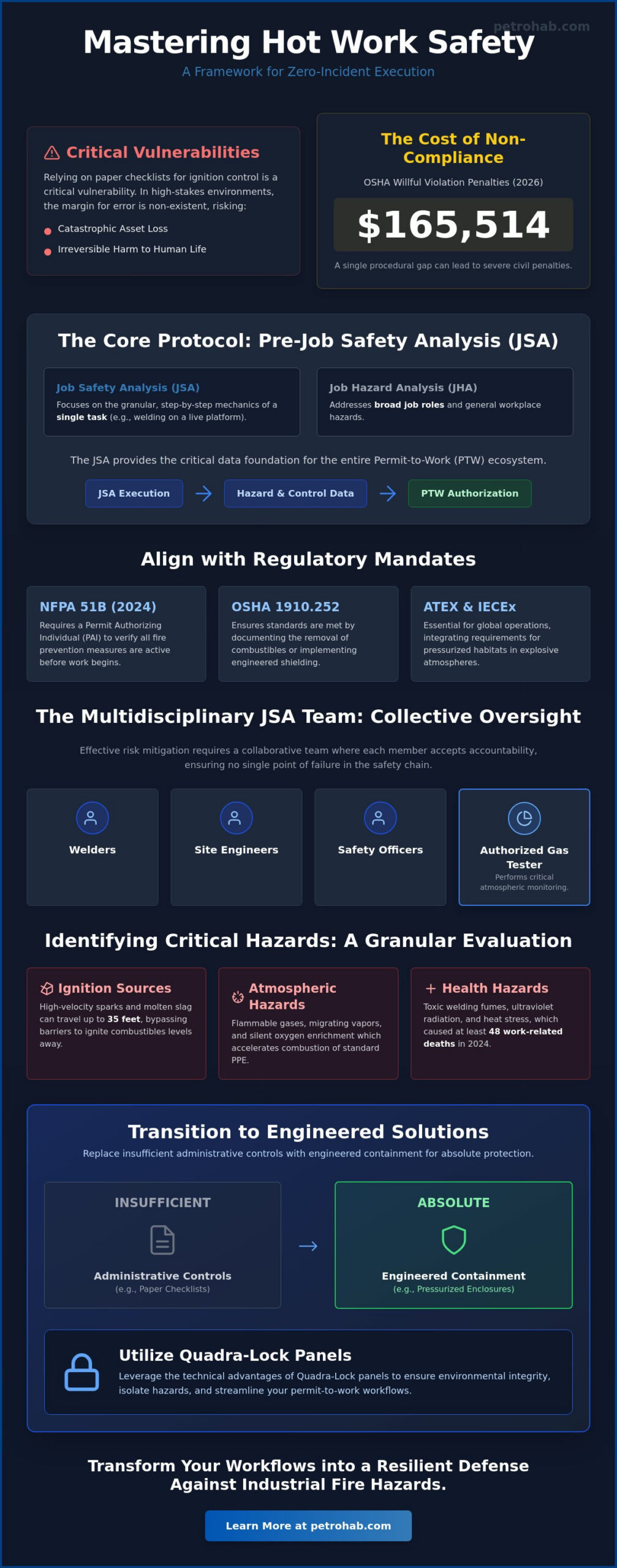
Relying on a paper checklist for high-stakes ignition control is a critical vulnerability that risks catastrophic asset loss and human life. You understand that in the energy and heavy industry sectors, the margin for error during welding or cutting operations is non-existent. Conducting a rigorous pre-job safety analysis for hot work is the only way to identify hidden ignition risks before they escalate into uncontrollable incidents. With OSHA willful violation penalties reaching $165,514 in 2026, the cost of a procedural gap has never been higher.
This technical guide provides the framework to master complex risk assessments while ensuring your facility maintains absolute regulatory compliance. We’ll demonstrate how to transition from basic administrative controls to advanced engineered containment, utilizing Quadra-Lock panels and pressurized welding enclosures to isolate hazards. You’ll learn a foolproof protocol for zero-incident execution that adheres to the 2024 edition of NFPA 51B and modern IEC standards. By the end of this analysis, you’ll have the tools to transform your permit-to-work workflows into a resilient defense against industrial fire hazards.
Key Takeaways
- Align your safety protocols with 2026 OSHA mandates and the 2024 NFPA 51B standard to eliminate compliance anxiety and avoid severe civil penalties.
- Master the systematic identification of hidden ignition risks and atmospheric hazards by conducting a comprehensive pre-job safety analysis for hot work.
- Implement engineered containment solutions to replace insufficient administrative controls and provide absolute protection for personnel in hazardous environments.
- Operationalize site walkthroughs and gas testing procedures to establish a definitive safety baseline before initiating any high-risk task.
- Utilize the technical advantages of Quadra-Lock panels to ensure environmental integrity and streamline your permit-to-work workflows.
The Fundamentals of Pre-Job Safety Analysis (JSA) for Hot Work
A Job Safety Analysis (JSA) is a systematic protocol designed to dissect specific industrial tasks into sequential steps to isolate potential hazards. In high-risk environments, a pre-job safety analysis for hot work serves as the primary barrier between a controlled operation and a catastrophic ignition event. While some professionals treat the JSA and Job Hazard Analysis (JHA) as interchangeable, technical experts distinguish them by scope. A JHA typically addresses broad job roles and general workplace hazards. Conversely, a JSA focuses on the granular, step-by-step mechanics of a single task, such as welding on a live offshore platform.
By 2026, the legal imperative for these analyses has intensified. The JSA is the technical foundation of the broader Permit-to-Work (PTW) ecosystem. It provides the data necessary to authorize high-risk activities by ensuring all controls are verified before a permit is issued. Failing to execute a precise analysis doesn’t just invite regulatory scrutiny; it compromises the integrity of the entire site safety architecture.
To better understand how these procedural steps translate to field safety, watch this technical overview:
Regulatory Drivers: OSHA and NFPA 51B Compliance
Compliance with the 2024 edition of NFPA 51B requires a designated Permit Authorizing Individual to verify that all fire prevention measures are active. A rigorous pre-job safety analysis for hot work ensures that OSHA 1910.252 standards are met by documenting the removal of combustibles or the implementation of engineered shielding. For global operations, this analysis must also integrate ATEX and IECEx requirements, particularly when deploying pressurized habitats in explosive atmospheres. These standards provide the linguistic and technical anchors for quality and compliance in heavy industry.
The Multidisciplinary JSA Team
Effective risk mitigation isn’t a solitary task. It requires a team comprising welders, site engineers, and safety officers. A critical participant is the Authorized Gas Tester (AGT), who performs the initial atmospheric monitoring to detect flammable vapors or oxygen enrichment. Each team member must accept accountability for specific mitigation steps. This includes ensuring that technical controls, such as Quadra-Lock panels, are correctly installed and verified before work commences. This collective oversight ensures that no single point of failure exists in the safety chain, protecting both personnel and high-value assets.
Identifying Critical Hazards: The Foundation of Hot Work Safety
A successful pre-job safety analysis for hot work requires a granular evaluation of the immediate and adjacent work environments. It’s insufficient to simply list “fire” as a general risk. Technical precision demands the identification of specific ignition sources, such as high-velocity sparks or molten slag, which can travel up to 35 feet from the point of operation. These thermal bypasses often find their way into floor penetrations or ventilation ducts, igniting combustibles several levels away. Understanding these Job Safety Analysis fundamentals is essential for creating a resilient safety protocol.
Atmospheric hazards represent an even more volatile threat. Flammable gases and vapors can migrate from distant leak points, accumulating in low-lying areas or pockets. Oxygen enrichment is another silent risk. It significantly accelerates the combustion rate of standard PPE and materials. Beyond fire, health hazards like toxic welding fumes and ultraviolet radiation require active mitigation. Heat stress is a growing concern. In 2024, exposure to environmental heat resulted in at least 48 work-related deaths. Effective risk management must account for these physiological strains on the workforce, ensuring that safety managers don’t overlook the human element in high-stakes environments.
The Danger of Explosive Atmospheres
Analyzing the Lower Explosive Limit (LEL) for site-specific gases is a non-negotiable procedural step. Technicians must identify “dead legs” in piping systems where hydrocarbons may remain trapped despite general purging. These areas are notorious for releasing vapors when heated. All atmospheric testing results must be documented in the JSA to provide a verifiable audit trail. When working in these high-consequence zones, integrating a pressurized welding enclosure ensures that the atmosphere inside the habitat remains isolated from external volatile conditions.
Secondary Hazards and Indirect Risks
Secondary hazards often escape initial scrutiny but are frequent precursors to incidents. Tripping hazards from cables and hoses in confined spaces can impede rapid emergency egress. Communication failures between the fire watch and the welder are equally dangerous. Clear, redundant communication protocols are vital. Environmental factors like wind direction and adverse weather also impact safety integrity. Strong gusts can blow sparks past fire blankets or destabilize temporary barriers. A robust JSA accounts for these variables, ensuring the protection of personnel and high-value assets stays front and center.
The Hierarchy of Controls: Transitioning to Engineered Solutions
The hierarchy of controls provides a logical framework for risk mitigation, yet its application during a pre-job safety analysis for hot work often reveals a reliance on the least effective measures. While elimination and substitution sit at the apex, they are rarely feasible for essential maintenance on live oil and gas assets. You cannot simply remove a pressurized vessel or substitute welding for a cold-work alternative when structural integrity is at stake. Consequently, the burden of protection shifts to engineering controls. Standard fire blankets offer only passive, porous shielding. In contrast, hot work safety enclosures provide an active, impermeable barrier that isolates the ignition source from the surrounding environment.
Administrative controls, including permit-to-work systems and fire watches, remain necessary but are prone to human fallibility. Similarly, Personal Protective Equipment (PPE) serves as the final, not first, line of defense. Relying on PPE to manage a flash fire is a failure of the safety protocol. True risk mitigation requires moving up the hierarchy to robust, engineered systems that provide a definitive technological remedy. This shift ensures that the safety of your personnel is not contingent on a single person’s observation or the durability of a leather apron.
Why Pressurized Habitats are the Gold Standard
The efficacy of pressurized welding habitats lies in the physics of positive pressure. By maintaining an internal pressure slightly higher than the ambient atmosphere, these systems ensure that flammable gases cannot enter the enclosure. This environmental containment is achieved through the technical precision of Quadra-Lock panels, which create a tight, resilient seal. This technology effectively reduces the “Safe Distance” requirements specified in your pre-job safety analysis for hot work. Instead of clearing a 35-foot radius of all equipment, you create a controlled micro-environment that allows for safe execution in congested, high-hazard areas.
Integrating Automatic Mitigation
Technological integration further strengthens the engineering layer by removing the “reaction time gap” inherent in human observation. Advanced systems like the Safe-Stop Automatic Shutdown System link gas detection directly to the welding power source. If the system detects a loss of pressure or the presence of hydrocarbons at the intake, it immediately terminates the hot work operation. Automated systems eliminate the reaction time gap during a gas release by providing an instantaneous, fail-safe shutdown before a hazardous concentration can reach the ignition point. This reduces human error and ensures that your facility maintains IEC 60079-13:2017 and ATEX compliance even in the most volatile conditions.
Operationalizing the JSA: From Analysis to Execution
Operationalizing the JSA transforms a theoretical document into an active shield for your facility. This process demands a methodical transition from the planning phase to field execution. It ensures that the safety barriers identified during the assessment are physically present and functional before work begins. A successful pre-job safety analysis for hot work is only as effective as its implementation on the shop floor or offshore deck.
The following steps are essential for translating analysis into a zero-incident environment:
- Step 1: Conduct a physical site walkthrough. This isn’t a cursory glance. It’s a rigorous inspection where the Authorized Gas Tester (AGT) verifies the absence of hydrocarbons and identifies any nearby live equipment.
- Step 2: Document the task sequence. Breaking the job into discrete steps allows for more granular hazard identification. Every weld, cut, or grind must be accounted for.
- Step 3: Define specific mitigation measures. For every risk identified, you must assign a definitive technological remedy. This is where you specify the use of Quadra-Lock panels to ensure environmental containment.
- Step 4: Conduct a final review and sign-off. All involved personnel must review the document. This formalizes accountability and ensures that the welder and the safety officer are in total agreement.
- Step 5: The Tool-Box Talk (TBT). Communicate the findings of the pre-job safety analysis for hot work to the entire crew. This ensures that every worker understands the specific triggers for emergency action.
Real-Time Monitoring and the Fire Watch
The fire watch serves as a critical guardian during and after the operation. Their duties extend beyond mere observation; they must maintain a state of constant readiness to suppress incipient fires. NFPA 51B mandates a 30-minute post-work inspection to ensure no smoldering slag remains. When utilizing pressurized habitats, the fire watch must also monitor manometers. These devices provide real-time data on habitat pressure integrity. A drop in pressure indicates a potential breach in containment, requiring immediate corrective action to maintain a safe environment.
Emergency Response and Contingency Planning
Contingency planning is a core component of industrial risk mitigation. Every team member possesses “Stop Work Authority.” They must exercise this right if they observe any deviation from the established safety protocol. Clear evacuation routes and emergency communication channels must be established and tested. If an integrated hot work safety system detects a breach or a gas release, it will trigger an automatic shutdown. This immediate response prevents the ignition of volatile atmospheres. To ensure your facility maintains absolute protection, integrate an advanced hot work safety system into your next project.
Optimizing Hot Work JSAs with PetroHab Technology
Integrating PetroHab technology into your pre-job safety analysis for hot work transforms a procedural requirement into a definitive safety asset. While generic enclosures often provide only minimal protection, the PetroHab Hot Work Safety Enclosure (HWSE) simplifies the JSA process by providing an engineered, controlled environment. This predictability allows safety managers to focus on task-specific risks rather than environmental volatility. By neutralizing external variables, you reduce the complexity of the analysis and ensure a more reliable safety outcome.
Our commitment to industrial risk mitigation extends beyond equipment. We provide global support, including on-site supervision and technical training. This ensures that your personnel don’t just use the equipment but master its operation within the context of your specific facility. This holistic approach ensures that every pre-job safety analysis for hot work is backed by a seasoned veteran’s expertise, projecting an image of durability and resilience across your operations.
Quadra-Lock: Engineering Out the Risk of Ignition
The Quadra-Lock Panels represent a paradigm shift in environmental containment. Their patented interlocking design ensures that sparks and molten slag cannot escape the enclosure, directly addressing the 35-foot spark travel hazard. These panels consist of fire-resistant materials that exceed international safety standards, providing a stoic barrier against thermal energy. The system’s modularity is a critical advantage. It allows you to tailor the enclosure to specific JSA site constraints, such as congested offshore decks or complex refinery piping, without compromising the integrity of the seal.
Safe-Stop: The Intelligent Layer of Protection
The Safe-Stop Automatic Shutdown System acts as the ultimate JSA mitigation tool by providing continuous, real-time monitoring of the work environment. It tracks gas levels at the air intake and monitors internal habitat pressure, ensuring that hazardous environment standards are met with verifiable data logs. If the system detects hydrocarbons or a loss of positive pressure, it immediately isolates power to the welding equipment. This technological remedy eliminates the reliance on human reaction times during a gas release. By integrating this system, you ensure compliance with IEC 60079-13:2017 and ATEX requirements, providing a level of protection that administrative permits alone can’t achieve. This intelligent layer of protection acts as an active guardian, ensuring that your facility maintains operational excellence even in the most high-stakes environments.
Advancing Toward Zero-Incident Hot Work Environments
Mastering a pre-job safety analysis for hot work is a technical necessity for any safety manager operating in high-consequence industries. This guide has detailed the transition from basic administrative checklists to the implementation of robust, engineered containment systems. Identifying critical atmospheric hazards and operationalizing site-specific protocols isn’t just about compliance; it’s about establishing a resilient defense against ignition risks. True excellence in safety requires replacing passive fire blankets with active, pressurized technology that ensures absolute personnel protection.
PetroHab provides the specialized engineering required to meet these rigorous standards. Our patented Quadra-Lock technology ensures superior containment, while the Safe-Stop Automatic Shutdown System provides the redundant protection necessary for volatile atmospheres. With global operations across the US, Brazil, and the UK, we stand as your dedicated safety partner in the energy and industrial sectors. Take the definitive step toward securing your facility and protecting your high-value assets today.
Request a Quote for PetroHab Hot Work Safety Enclosures and ensure your next project meets the highest benchmarks of industrial reliability.
Frequently Asked Questions
What is the difference between a JSA and a Hot Work Permit?
The JSA is a systematic method used to identify specific hazards and define mitigation steps for a task. In contrast, the Hot Work Permit is the administrative authorization that grants permission to begin work once those safety controls are verified. You use the pre-job safety analysis for hot work to inform the permit conditions, ensuring that every identified risk has a corresponding technological or administrative remedy.
Who is responsible for conducting the pre-job safety analysis?
A multidisciplinary team must conduct the analysis to ensure no hazard is overlooked. This team typically includes the welder performing the task, the site engineer, and a qualified safety officer. The Permit Authorizing Individual (PAI) oversees the process, while an Authorized Gas Tester (AGT) provides critical atmospheric data. This collective approach ensures that accountability for personnel protection is distributed across technical and supervisory roles.
How often should the JSA be updated during a long-term project?
You must review and update the JSA at the start of every shift or whenever site conditions change significantly. Environmental factors like wind direction, temperature shifts, or the introduction of new equipment can create fresh ignition risks. Maintaining a methodical update rhythm ensures that your safety protocol remains a living document that reflects the current reality of the hazardous environment.
Can hot work be performed without a JSA in an emergency?
No, emergency status does not waive the requirement for a rigorous risk assessment. Performing hot work without a pre-job safety analysis for hot work increases the likelihood of a secondary disaster, such as a flash fire or explosion. Even in urgent repair scenarios, safety managers must execute a condensed but thorough analysis to identify atmospheric hazards and implement essential engineering controls like pressurized habitats.
What are the most common hazards missed in a hot work JSA?
Safety teams often overlook indirect ignition sources and atmospheric migration. Molten slag can travel through floor penetrations and smolder for hours before igniting combustibles on a lower level. Technicians must also account for flammable vapors that accumulate in “dead legs” of piping systems that haven’t been properly purged. Identifying these hidden risks requires a granular walkthrough and specialized gas testing beyond the immediate work area.
How does a pressurized habitat change the JSA requirements?
Utilizing a pressurized habitat simplifies the JSA by providing a controlled environment that isolates the ignition source. The analysis shifts from managing a wide clearing radius to monitoring the integrity of the Quadra-Lock panels and habitat pressure. Technicians must document the specific manometer readings and gas detector calibration to ensure the positive pressure barrier remains impermeable to external flammable gases.
Is a fire watch required if I am using an automatic shutdown system?
Yes, a designated fire watch is mandatory under the 2024 edition of NFPA 51B. While the Safe-Stop Automatic Shutdown System provides a critical layer of redundant safety by terminating power upon hazard detection, it doesn’t replace human oversight. The fire watch remains responsible for suppressing incipient fires and conducting the required 30-minute post-work inspection to ensure the area is thermally stable.
How do I integrate ATEX zone requirements into my safety analysis?
Integration involves verifying that all equipment used within the hazardous area carries the appropriate ATEX or IECEx certification. Your analysis must confirm that the pressurized welding enclosure is certified to IEC 60079-13:2017 standards for operation in explosive atmospheres. By documenting these certifications in the JSA, you provide a verifiable audit trail that your operation meets international regulatory anchors for quality and safety.