Blog Posts
Welding Safety Equipment for Hazardous Areas: 2026 Guide
What if your primary safety barrier isn’t the gear your welder is wearing, but the environment you’ve engineered around them? You recognize that the pressure to maintain production while meeting stringent ATEX, IECEx, and UKEX standards creates a high-stakes environment where the margin for error is non-existent. The fear of catastrophic ignition during essential maintenance is a rational response to the volatility of Zone 1 and Zone 2 environments. This is why selecting the correct welding safety equipment for hazardous areas is the most critical decision a safety manager can make.
This 2026 guide will help you master the technical requirements for hot work, demonstrating why integrated engineering controls from PetroHab LLC offer the only reliable path to zero-incident performance. You’ll learn how to implement advanced protection that surpasses standard gear to ensure full compliance with international safety standards without necessitating costly facility shutdowns. We will examine the critical role of pressurized containment systems, the impact of updated ISO 11611:2024 standards, and how technologies like Quadra-Lock panels and Safe-Stop automatic shutdown systems enable safe welding in live, high-risk environments.
Key Takeaways
- Identify the critical technical distinctions between Zone 1 and Zone 2 environments to ensure equipment selection aligns with 2026 regulatory mandates.
- Understand why engineering containment, such as pressurized habitats, serves as a superior safety barrier compared to standard welding safety equipment for hazardous areas.
- Discover how modular HWSE systems utilizing patented Quadra-Lock technology maintain environmental integrity and prevent the ingress of flammable hydrocarbons.
- Evaluate the operational advantages of the Safe-Stop automatic shutdown system, which provides continuous atmospheric monitoring and immediate power isolation.
- Learn to achieve zero-incident hot work performance by integrating ATEX and IECEx certified technologies into your maintenance and turnaround schedules.
Defining Welding Hazards in Classified Environments (ATEX/IECEx Zones)
Industrial hot work in oil, gas, and petrochemical facilities presents a unique threat profile that standard safety protocols aren’t equipped to handle. Conventional welding procedures assume a stable, non-flammable atmosphere. In classified areas, however, the atmosphere is a volatile variable that can become lethal in an instant. Selecting the appropriate welding safety equipment for hazardous areas requires a granular understanding of how explosive atmospheres are classified and the specific engineering controls required to mitigate these risks. While Zone 0 represents a continuous explosive presence where hot work is strictly prohibited, Zone 1 and Zone 2 allow for controlled activity if the right engineering safeguards are in place.
The presence of hydrocarbons demands a shift from personal protection to environmental containment. Standard fire blankets or localized shields don’t provide a gas-tight barrier. If a fugitive emission drifts into a welding area, the result is an immediate ignition. This is why a PetroHab LLC Hot Work Safety Enclosure (HWSE) is a regulatory necessity. It creates a physical and pressurized boundary that ensures compliance with international safety mandates while protecting high-value assets and personnel from the inherent risks of ignition.
Zone 1 vs. Zone 2: Equipment Requirements
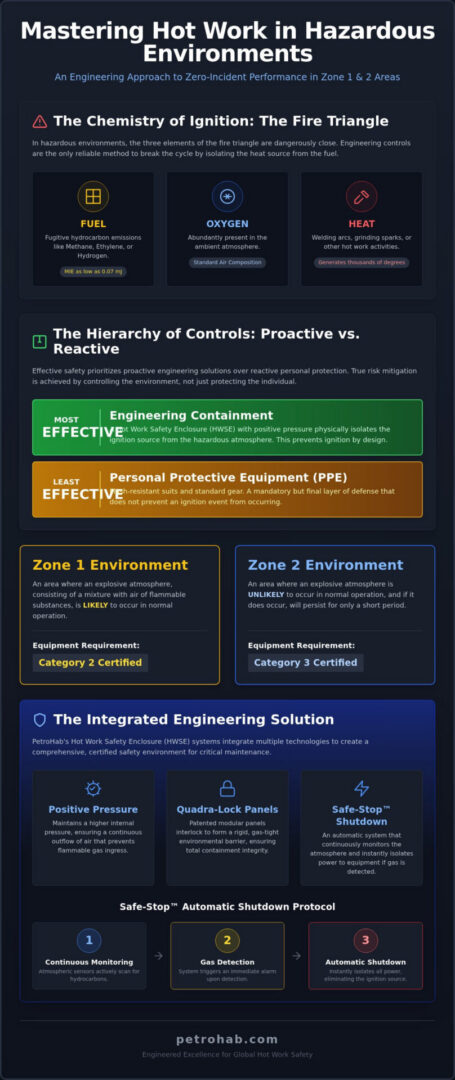
Compliance with hazardous environment standards dictates that any equipment used in these areas must meet specific ATEX, IECEx, or UKEX categories. Zone 1 environments are areas where an explosive atmosphere is likely to occur during normal operation. This requires Category 2 equipment. Zone 2 areas are those where an explosive mixture is unlikely to occur, or will only persist for a short time, allowing for Category 3 equipment. Specifying the right welding safety equipment for hazardous areas ensures that every tool within the habitat is rated for the specific risks of the zone. Secondary gear, such as lighting and communication tools, must carry intrinsically safe labels to prevent them from becoming unintended ignition sources. PetroHab LLC ensures that all hardware deployed in these zones meets the rigorous technical specifications required for offshore platforms and onshore refineries.
The Chemistry of Ignition in Hazardous Areas
The fire triangle remains the fundamental model for industrial combustion: fuel, oxygen, and heat. In a refinery or on a rig, fuel is often present as fugitive emissions of methane, ethylene, or hydrogen. Oxygen is abundant in the ambient air. The welding process provides the final, most intense leg of the triangle. Arc Welding Safety Hazards are extreme because the energy output of an electrical arc far exceeds the Minimum Ignition Energy (MIE) of common industrial gases. For example, methane requires only 0.28 mJ for ignition, while ethylene requires a mere 0.07 mJ. A welding arc generates thousands of degrees of heat instantly, making it a guaranteed ignition source. Containment is the only reliable method to break the ignition cycle by physically isolating the heat from the fuel source.
The Hierarchy of Controls: PPE vs. Engineering Containment
Effective risk mitigation in high-stakes industrial environments requires a shift from reactive personal protection to proactive engineering containment. While standard PPE remains a mandatory layer of defense, it represents the lowest tier in the hierarchy of controls. Relying on flash-resistant suits as the primary safeguard when selecting welding safety equipment for hazardous areas is a flawed strategy. True safety is achieved through environmental isolation. A PetroHab LLC Hot Work Safety Enclosure (HWSE) functions as an engineered barrier, physically separating the ignition source from the surrounding hazardous atmosphere. By implementing positive pressure, these systems ensure that the internal environment remains clean and breathable, even if the external atmosphere contains flammable hydrocarbons.
Positive pressure is the primary safety mechanism of a pressurized habitat. A continuous flow of air into the enclosure creates an internal pressure slightly higher than the ambient atmospheric pressure. This pressure differential ensures that any air movement occurs from the inside out, preventing gas ingress through even the smallest gaps. When combined with specialized fire-resistant materials, this engineering control transforms a high-risk Zone 1 or Zone 2 area into a controlled workspace. This methodical approach to containment allows for operational continuity during essential maintenance cycles.
Why PPE Alone is Insufficient in Zone 1
Flash-resistant clothing and respirators are designed to protect the individual from localized sparks and fumes, but they offer no protection against a sustained gas-fed fire or a facility-wide explosion. Compliance with OSHA Welding General Requirements necessitates rigorous fire prevention measures that go beyond personal gear. In a Zone 1 environment, where explosive gases are likely to occur, the objective is to eliminate the possibility of contact between the gas and the welding arc. Engineering out the risk means creating a managed environment where the atmosphere is monitored and controlled. This approach protects not just the welder, but the entire facility and its high-value assets, reducing the risk of catastrophic asset loss.
Quadra-Lock Technology: The New Standard for Enclosures
The structural integrity of a habitat depends entirely on its panel connections. Older modular designs often rely on zippers or simple overlaps, which can fail under pressure or degrade over time. Quadra-Lock panels utilize a patented interlocking system that ensures superior pressure retention and mechanical strength. This technology allows for a gas-tight seal that remains robust even in harsh offshore conditions. Quadra-Lock is the industry’s most secure modular panel connection. By choosing advanced pressurized habitats from PetroHab LLC, safety managers can ensure their welding safety equipment for hazardous areas meets the most demanding technical specifications of 2026. These systems provide a level of reliability that standard modular enclosures simply cannot match.
Essential Hardware for Pressurized Welding Habitats
The operational reliability of any hot work project in a classified area depends on the technical integrity of its hardware components. A hot work safety enclosure (HWSE) is not merely a tent; it’s a sophisticated pressurized envelope designed to maintain environmental stasis. This system functions by creating a physical barrier that works in tandem with specialized air-handling equipment. Beyond the enclosure panels themselves, the selection of welding safety equipment for hazardous areas must include fire-retardant floor matting and dedicated spark containment protocols. In offshore environments, where vertical space is limited and deck integrity is paramount, these materials prevent slag and sparks from exiting the enclosure and reaching underlying process equipment.
Managing Positive Pressure and Airflow
The primary defense against gas ingress is the maintenance of a consistent positive pressure differential. This is achieved through high-capacity air intake systems and reinforced ducting that draws air from a verified clean source. Manometers are integrated into the system to provide real-time monitoring of the internal versus external pressure. If the pressure differential drops below the certified threshold, usually 25 Pascals (0.1 inches of water gauge), the risk of gas ingress increases. Following the NFPA 51B Standard, these hardware configurations ensure that ventilation is continuous, effectively diluting any welding fumes while simultaneously preventing the entry of flammable hydrocarbons. The physics of this system ensures that air only moves from the inside out, creating a managed environment for high-heat activities.
Modular Design and On-Site Versatility
Refineries and offshore platforms are rarely characterized by clear, open spaces. They’re dense networks of piping, valves, and structural steel. Effective pressurized welding habitats must offer modular versatility to accommodate these obstructions. Lightweight Quadra-Lock panels allow for rapid deployment and reconfiguration around complex pipe racks and irregular surfaces. This interlocking system provides a mechanical seal that’s far superior to older, non-rigid designs. To address pipe penetrations, technicians use specialized sealing techniques, such as fire-rated penetration kits and silicone-based gaskets, to ensure the pressurized boundary remains intact. This adaptability is essential during turnaround projects where time is a critical factor, but safety cannot be compromised for speed. By utilizing modular welding safety equipment for hazardous areas, operators can deploy protection in tight spaces that would otherwise require a total facility shutdown.
Integrating Automatic Shutdown and Gas Detection Systems
Manual atmospheric testing provides a static data point that cannot account for the dynamic nature of a live industrial environment. Fugitive emissions don’t follow a schedule; they occur without warning. This is why intermittent spot checks are an insufficient defense against ignition in high-stakes environments. The Safe-Stop Automatic Shutdown System replaces human error with automated precision. It serves as the central nervous system of any professional configuration of welding safety equipment for hazardous areas. By establishing a direct communication link between gas detectors and the welding power source, the system ensures that the ignition source is removed before a hazardous atmosphere can accumulate.
The system operates on a dual-logic architecture. It monitors both the integrity of the pressurized environment and the chemical composition of the air. If the internal pressure falls below the safety threshold or if combustible gases are detected, the system executes an immediate shutdown. This automated response is supplemented by high-intensity visual strobes and high-decibel audio alarms. These indicators provide clear, unambiguous signals for emergency evacuation, ensuring that safety managers maintain absolute control over the work site even during a crisis.
The Safe-Stop Logic: How it Prevents Disasters
The primary metric for explosion prevention is the Lower Explosive Limit (LEL). Safe-Stop systems are typically programmed to trigger an audible alarm at 10% LEL and a total power isolation at 25% LEL. This provides a significant safety margin, cutting the welding arc long before the atmosphere becomes flammable. The Safe-Stop system isolates power to the welding equipment within milliseconds of a detected breach. This rapid response time is the critical difference between a controlled shutdown and a catastrophic ignition event. By automating this process, you eliminate the latency inherent in manual emergency stop procedures.
Placement of Gas Sensors for Maximum Safety
Sensor positioning is a technical discipline that requires an understanding of gas density and airflow patterns. Sensors must be placed at the air intake to ensure the supply air remains clean and at low-lying floor levels where heavy gases like H2S or propane tend to settle. Beyond combustible gas detection, the system monitors Oxygen levels, Carbon Monoxide, and Hydrogen Sulfide to protect the respiratory health of the welding team. Adhering to the protocols for advanced hot work safety systems ensures that all sensors are calibrated to 2026 industry standards. Maintaining these sensors is a critical component of risk mitigation that ensures your welding safety equipment for hazardous areas performs as designed. To ensure your facility meets these rigorous standards, you should examine the technical specifications of the Safe-Stop system for your next turnaround project.
PetroHab: Engineered Excellence for Global Hot Work Safety
PetroHab operates as a critical safety partner for the global energy sector, maintaining strategic hubs in Houston, Brazil, and the UK. This international presence ensures that certified hardware and technical expertise are available wherever high-stakes industrial work occurs. Selecting the correct procurement model for welding safety equipment for hazardous areas depends entirely on your operational schedule. Leasing provides a logical solution for intensive turnaround projects, allowing facilities to scale their protection without the burden of long-term storage or maintenance. For sites with ongoing maintenance needs, purchasing ensures that a PetroHab Hot Work Safety Enclosure (HWSE) is always available for immediate deployment.
Effective risk management requires more than just high-quality hardware. It demands expert implementation. PetroHab provides certified on-site supervision to manage the complexities of habitat setup in congested process areas. These supervisors verify the integrity of every Quadra-Lock panel connection and ensure that the Safe-Stop system is correctly integrated with the site’s power and gas monitoring infrastructure. This level of oversight guarantees that the engineering controls perform exactly as specified in the 2026 safety guidelines. Requesting a technical consultation early in the planning phase allows our engineers to tailor a containment strategy to your facility’s unique structural obstructions.
Global Support and Technical Training
Technical competence is the foundation of site safety. PetroHab delivers rigorous training programs for client personnel, focusing on the procedural requirements for maintaining positive pressure and atmospheric monitoring. Every system we lease or sell comes with a complete package of compliance documentation and international certifications, providing the linguistic anchors for your safety audits. Our technical support teams remain on standby 24/7, providing a reassuring presence for offshore platforms and remote refineries where the cost of downtime is extreme. We don’t just provide equipment; we provide the knowledge required to maintain a zero-incident environment.
Conclusion: Investing in Proven Safety Technology
Engineering controls offer a definitive remedy for the risks inherent in industrial hot work. While the initial investment in a pressurized habitat is higher than basic PPE, the ROI is realized by preventing even a single catastrophic fire event. Implementing advanced safety technology is also a key driver in achieving modern ESG and corporate safety goals, reflecting an uncompromising commitment to personnel protection. PetroHab’s patented technology acts as an active guardian of your site, ensuring that essential maintenance doesn’t lead to disaster. Secure your facility’s future by requesting a technical consultation to determine the specific HWSE requirements for your next project.
Securing Your Next Hot Work Project
Achieving operational excellence in explosive atmospheres requires a transition from basic personal protection to integrated engineering containment. You’ve seen how pressurized habitats and automated monitoring systems provide a definitive remedy for the risks inherent in Zone 1 and Zone 2 environments. By prioritizing these advanced controls, you effectively eliminate the ignition cycle and ensure full compliance with international safety standards. Selecting the right welding safety equipment for hazardous areas isn’t just a regulatory checkbox; it’s an investment in the long-term integrity of your personnel and high-value assets.
PetroHab provides the technical precision required for these high-stakes environments through patented Quadra-Lock panel integrity and ATEX/IECEx compliant Safe-Stop systems. Our global technical supervision ensures that every deployment meets the most rigorous safety benchmarks, regardless of the site’s complexity. You can maintain production and protect your team with hardware designed for the most demanding industrial conditions.
Take the next step in risk mitigation by Request a Quote for PetroHab HWSE Rental and Safety Systems. We look forward to partnering with you to achieve a zero-incident work environment.
Frequently Asked Questions
Is a pressurized welding habitat required for all Zone 2 hot work?
While not always legally mandated by every local jurisdiction, using an HWSE is the industry benchmark for risk mitigation in Zone 2 areas. It provides an engineering control that physically isolates the ignition source from fugitive emissions. This approach ensures compliance with the hierarchy of controls and protects the facility from catastrophic events that standard PPE cannot prevent. It’s the most reliable method to ensure zero-incident hot work performance in live environments.
Can the Safe-Stop system be integrated with any welding machine?
Yes, the Safe-Stop system is designed for universal integration with standard welding power sources. It functions as an external isolation relay that monitors atmospheric conditions and pressure differentials. If the system detects a breach, it immediately cuts power to the welding machine, effectively removing the ignition source. This makes it an essential component of welding safety equipment for hazardous areas across diverse industrial fleets, providing a layer of protection that manual checks can’t replicate.
How much pressure must be maintained inside a PetroHab HWSE?
A minimum positive pressure differential of 25 Pascals (0.1 inches of water gauge) must be maintained to ensure the integrity of the habitat. This pressure level ensures that airflow only moves from the inside out, preventing the ingress of flammable gases. The Safe-Stop system continuously monitors this metric and will trigger an automatic shutdown if the internal pressure falls below this certified safety threshold. Maintaining this specific pressure is critical for meeting international ATEX and IECEx standards.
What happens if the gas detection system identifies a leak while welding?
The system executes an immediate, automated shutdown of all welding equipment. Upon detecting combustible gases at a pre-set threshold, usually 25% LEL, the Safe-Stop system isolates power and activates audio-visual alarms. This rapid response removes the heat source milliseconds before the atmosphere can reach an explosive concentration, allowing the team to evacuate according to established protocols. It eliminates the latency associated with manual emergency stops, ensuring the safety of personnel and high-value assets.
What are the fire-resistance ratings for Quadra-Lock panels?
Quadra-Lock panels are engineered to meet stringent fire-resistance standards, including NFPA 701 and relevant international certifications for offshore and onshore use. These panels are constructed from heavy-duty, flame-retardant materials designed to contain sparks and slag while resisting external heat. The interlocking design ensures that the pressurized boundary remains intact even when exposed to the intense thermal energy generated during industrial arc welding. This durability is essential for maintaining environmental containment in high-risk zones where standard materials often fail.
Can PetroHab equipment be leased for short-term refinery turnarounds?
Yes, leasing is the preferred procurement model for turnaround projects and short-term maintenance schedules. This model allows safety managers to access the latest welding safety equipment for hazardous areas without the capital expenditure of a full purchase. PetroHab provides flexible rental agreements that include all necessary hardware, compliance documentation, and technical support to match the specific duration of your project. Leasing ensures that you always have access to certified, well-maintained hardware that meets current 2026 regulatory requirements.
How many people are needed to assemble a modular HWSE on site?
A standard modular HWSE can typically be assembled by a team of two trained technicians. The lightweight, interlocking Quadra-Lock panels are designed for rapid deployment without the need for specialized heavy lifting equipment. This efficiency reduces setup time during critical path maintenance, ensuring that your safety barriers are in place and operational within hours of arriving at the work site. The modular nature of the system allows for quick adjustments around structural obstructions commonly found in refineries.
Is on-site training included with PetroHab equipment leasing?
PetroHab provides comprehensive technical training and support for all equipment leases. This ensures that your personnel understand the operational requirements for maintaining positive pressure and responding to automated shutdown events. For more complex projects, we also offer certified on-site supervision to oversee the initial setup and verify that all engineering controls are functioning according to international safety benchmarks. This commitment to training ensures that every project maintains the highest standards of reliability and risk mitigation.