Welding Habitat Rental vs. Purchase: A Strategic Guide for Safety Managers (2026)
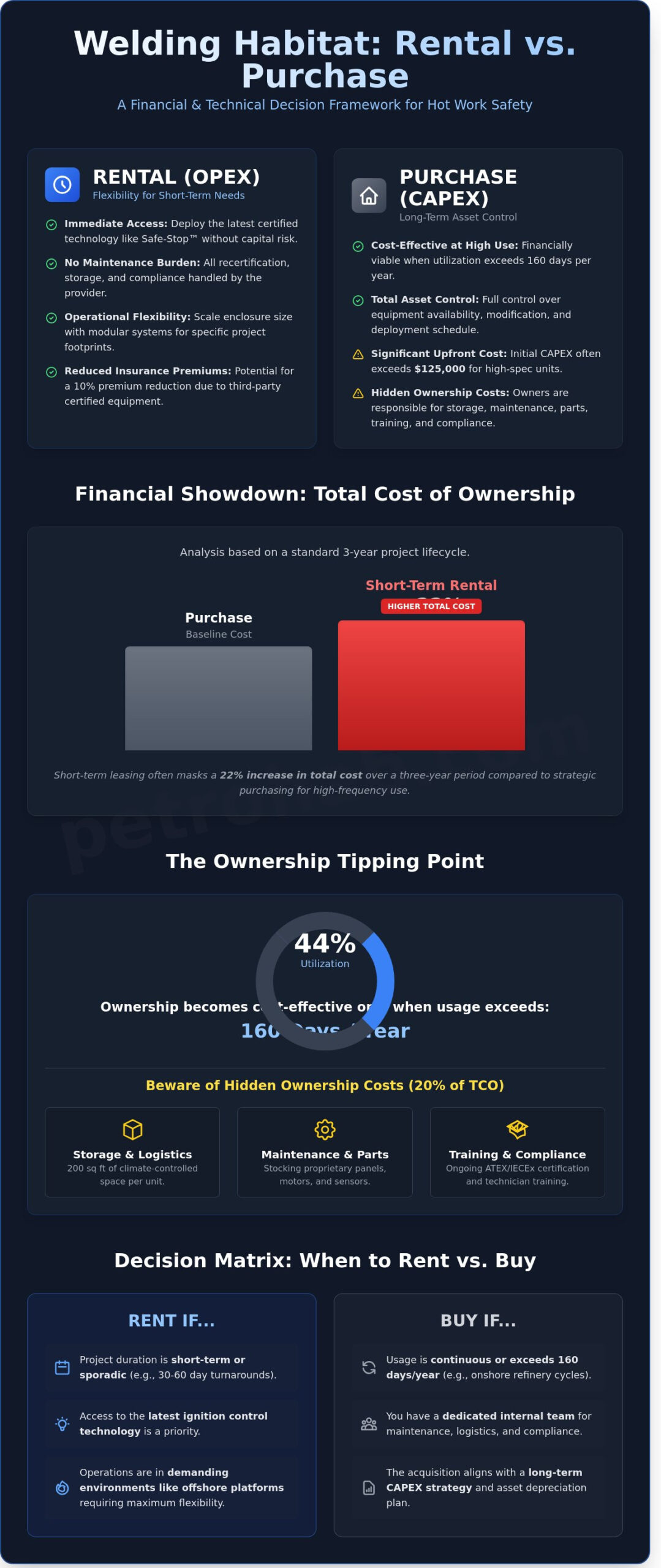
The immediate capital savings of a short-term lease often mask a 22% increase in total cost of ownership over a standard three-year project lifecycle. Safety managers frequently view the choice between welding habitat rental vs purchase as a simple budgetary decision, yet the true variables lie in the hidden costs of recertification and the risk of deploying obsolete ignition source control technology. You recognize that maintaining operational integrity in hazardous environments requires more than a physical barrier. It demands constant compliance with evolving ATEX and IECEx standards while managing the heavy logistical burden of modular systems.
This guide provides a rigorous technical and financial framework to evaluate whether leasing or owning pressurized enclosures aligns with your 2026 safety mandates. We’ll analyze real-world ROI data, break down the maintenance requirements for patented Safe-Stop systems, and deliver a decision matrix based on your specific project duration and frequency. By the end of this analysis, you’ll have the data required to secure CAPEX approval or optimize your OPEX spend without compromising on the gold standard of hot work safety. We’ll ensure your choice protects both your personnel and your bottom line.
Key Takeaways
- Define the Hot Work Safety Enclosure (HWSE) as a critical safety system to better optimize project budgets and reduce insurance premiums.
- Assess the technical trade-offs between the immediate availability of modular rental fleets and the long-term operational control of owned assets.
- Evaluate the welding habitat rental vs purchase landscape by accounting for the hidden burdens of ATEX/IECEx recertification and rigorous compliance documentation.
- Apply a specialized decision matrix to identify whether short-term offshore maintenance or continuous onshore refinery cycles justify your acquisition strategy.
- Leverage tailored leasing programs and technical support to maintain the gold standard of safety across hazardous global environments.
The Economics of Safety: Analyzing HWSE Acquisition Strategies
A Hot Work Safety Enclosure (HWSE) isn’t a commodity equipment purchase; it’s a sophisticated ignition source control system. For the 2026 market, offshore operators face a 15% increase in regulatory scrutiny regarding pressurized environments. This shift makes the welding habitat rental vs purchase decision a core component of project risk management. These systems must comply with rigorous international safety standards for welding habitats, including IEC 60079-13 and ATEX directives. Unlike standard welding screens, an HWSE integrates gas detection and automatic shutdown technology like the Safe-Stop system. This technical complexity ensures that the acquisition strategy directly impacts both the project budget and the facility’s overall safety integrity.
CAPEX vs. OPEX: Financial Implications
Purchasing a permanent HWSE fleet requires an initial capital expenditure (CAPEX) that often exceeds $125,000 for high-specification modular units. This asset typically depreciates over a 7-year lifecycle, requiring a dedicated internal team to manage bi-annual recertification. Rental fees fit into operational expenditure (OPEX) budgets, which allows safety managers to align costs with specific 30-day or 60-day maintenance turnarounds. It’s common for insurance providers to offer a 10% premium reduction when contractors utilize certified, third-party maintained rental units. This occurs because the liability for equipment maintenance and technological currency rests with the specialized provider rather than the site operator.
Utilization Rates: The Tipping Point
Ownership only becomes financially viable when a facility maintains a utilization rate exceeding 160 days per calendar year. If usage falls below this 44% threshold, the hidden costs of ownership quickly outweigh the benefits. For 2026 onshore projects, idle time and storage account for 20% of the total cost of ownership. Operators must evaluate several factors before committing to a purchase:
- Storage Logistics: Each unit requires 200 square feet of climate-controlled space to prevent seal degradation.
- Maintenance: Owners must stock proprietary components, including Petro-Wall panels and specialized fan motors.
- Training: Permanent ownership necessitates ongoing technician training to ensure assembly matches the original engineering specifications.
The utilization threshold represents the precise intersection where the annualized cost of ownership, including maintenance and storage, falls below the cumulative expense of project-specific rental agreements.
Comparing Rental vs. Purchase: A Technical Breakdown
Selecting between welding habitat rental vs purchase requires a granular analysis of project duration and operational frequency. Rental provides immediate access to high-spec systems for short-term turnarounds. Purchase secures long-term asset control for facilities with continuous maintenance cycles.
The primary objection to rental is often the perceived “lost cost” of monthly fees. This view overlooks the 15% to 22% annual overhead associated with owning pressurized safety systems. Owners must manage storage, logistics, and the regulatory and paperwork burdens inherent in maintaining compliance with evolving welding and brazing standards. Rental shifts these liabilities to the provider, ensuring every enclosure arrives fully certified and ready for deployment.
The Rental Advantage: Flexibility and Support
Rental fleets offer the most direct path to integrating the latest Safe-Stop and Safe-Zone monitoring technology. These systems provide automated ignition source control without the capital risk of purchasing hardware that may become obsolete within 36 months.
Modular systems like Quadra-Lock allow safety managers to scale enclosure footprints to match specific deck space or pipe rack configurations. This flexibility is critical for offshore environments where every square meter is a premium. Technical support and emergency replacement guarantees are standard in rental agreements. If a sensor fails during a critical path operation, a replacement is typically dispatched within 24 hours, minimizing costly downtime.
The Case for Purchase: Autonomy and Readiness
Purchasing a hot work safety enclosure is the logical choice for facilities executing 200 or more days of hot work annually. Ownership allows for immediate response to unplanned emergency repairs without waiting for mobilization timelines.
Facilities often deal with recurring, non-standard geometries. Owners can customize Petro-Wall panels and ducting to fit these specific facility layouts, creating a repeatable and efficient setup process. While the initial capital expenditure is higher, the cost-per-day drops significantly over a five-year asset life. For organizations with high-frequency maintenance needs, owning the “gold standard” in safety equipment ensures 24/7 readiness. You can evaluate our system specifications to determine which model fits your facility’s permanent safety infrastructure.
The Hidden Burdens of Ownership: Maintenance and Compliance
Ownership demands a permanent commitment to technical integrity. When evaluating a welding habitat rental vs purchase, the initial capital expenditure represents only 40% of the total lifecycle cost. Owners inherit the mandatory responsibility for maintaining ATEX and IECEx certifications for all electronic monitoring components. These certifications require 12-month recertification cycles to ensure the Safe-Stop system remains functional within explosive atmospheres. Failing to meet these schedules renders the entire enclosure non-compliant, effectively halting hot work operations on-site.
Managing the “Permit to Work” documentation trail is another critical burden for equipment owners. Every deployment requires documented proof of manometer calibration and seal integrity tests. Adherence to OSHA hot work safety standards necessitates a rigorous audit trail that remains the owner’s legal liability. If a localized ignition occurs, the owner must provide historical maintenance logs to prove the habitat’s pressurized integrity was not compromised by poor upkeep.
- Training Overhead: Internal teams require specialized training every 24 months to master setup, tear-down, and emergency shutdown protocols.
- Component Calibration: Gas detection sensors and differential pressure gauges require bi-annual calibration to maintain a 99.9% accuracy rating.
- Material Degradation: Fire-resistant panels stored in high-salinity offshore environments lose structural integrity 15% faster than those kept in climate-controlled warehouses.
Managing Safety Certifications
PetroHab habitats rely on patented Petro-Wall panels and Quadra-Lock seals to maintain positive pressure. These components face rigorous annual safety audits to verify flame retardancy and tensile strength. If internal maintenance schedules lapse by even 30 days, the risk of seal failure increases significantly. Owners must manage a replacement cycle for Quadra-Lock seals every 24 to 36 months to guarantee unrivaled protection against spark escape.
Logistics and Warehousing
Inventory management for a 10x10x10 Hot Work Safety Enclosure (HWSE) is a complex logistical task. A single collapsed unit occupies approximately 88 cubic feet of space, requiring at least two standard industrial pallets for secure storage. Beyond the footprint, specialized air ducting and gas detection sensors require climate-controlled environments to prevent sensor drift. Transporting these heavy safety enclosures between global sites often incurs 20% higher shipping costs due to the specialized handling required for sensitive electronic controls and modular panels.
Decision Matrix: When to Rent vs. When to Buy
Selecting the right procurement strategy for a Pressurized Hot Work Safety Enclosure (PHWSE) requires an objective analysis of operational duration and site complexity. For a 21-day offshore platform maintenance project in the Gulf of Mexico, the welding habitat rental vs purchase debate favors rental. Rental agreements typically include the latest ATEX-certified Safe-Stop systems and eliminate long-term storage costs. It’s the most efficient way to access specialized technology without a permanent capital commitment.
Conversely, an onshore refinery executing continuous turnaround cycles over a 48-month period finds a stronger ROI in purchasing. Owning the asset allows for immediate deployment during unscheduled shutdowns. For remote operations in regions like the Kazakh Steppe, where mobilization costs often exceed $15,000 per shipment, a hybrid model works best. In these cases, companies purchase the modular Petro-Wall panels but rent the specialized gas detection electronics to ensure they utilize the most current sensor technology.
Project-Based Evaluation Criteria
Safety managers must evaluate three critical metrics before committing to a contract. First, consider duration; projects shorter than 60 days rarely justify the capital expenditure of a full system purchase. Second, assess complexity. If the work involves high-pressure hydrocarbon lines, the integrated Safe-Stop automatic shutdown system is non-negotiable. Finally, check your location. Proximity to PetroHab hubs in Houston, Texas, or Dundee, Scotland, significantly reduces freight overhead for rentals, making the rental model even more attractive for short-term needs.
The Role of Certified Supervision
Rental packages often provide a PetroHab certified technician. This professional manages the habitat’s integrity, shifting the technical liability of positive pressure maintenance away from your internal team. If you choose to purchase, your personnel must undergo rigorous training to meet ISO 9001:2015 standards for hot work safety. Maintaining a 50-pascal pressure differential is a precise task that requires constant monitoring. You’ll need to decide if your crew has the capacity to master ignition source control or if external expertise is a safer investment for your specific risk profile.
PetroHab Solutions: Tailored Acquisition for Global Safety
Choosing the right acquisition strategy is a critical operational decision that impacts both safety and the bottom line. Whether you select a welding habitat rental vs purchase, the technical integrity of the equipment remains identical. PetroHab manages the high-stakes risks of the energy sector through two strategic hubs in Houston, Texas, and Dundee, Scotland. These locations ensure that 100% of our global fleet arrives on-site meeting ISO 9001:2015 standards. Our centralized logistics model reduces lead times for offshore deployments by up to 40% compared to decentralized providers, ensuring your project remains on schedule.
For projects exceeding 12 months, our leasing program offers a balanced financial middle ground. It preserves your capital while ensuring top-tier protection across your worksite. If you’re undecided on long-term needs, our ‘Try-Before-You-Buy’ model allows operators to evaluate the modularity of the Petro-Wall system in the field for a 30 day trial period before committing to full ownership. This eliminates the uncertainty often associated with capital expenditure for safety equipment, allowing you to transition from rental to ownership based on real-world performance data.
Patented Technology as a Standard
The integrity of a safety enclosure shouldn’t depend on its procurement method. Every rental unit in the PetroHab fleet meets the same rigorous Quadra-Lock standards as our sold units. This patented interlocking panel technology maintains a pressurized environment that effectively seals out flammable gases. We integrate Safe-Stop and Safe-Zone technologies across all models to ensure ignition source control is never compromised. If your facility requires a permanent solution, our engineers provide custom services to adapt these systems to your specific structural footprint and refinery layout.
Next Steps: Securing Your Worksite
Identifying the most cost-effective path involves analyzing your project’s specific parameters. You can request a comparative quote that evaluates the welding habitat rental vs purchase decision based on your 24 month outlook. Our engineers provide expert consulting on fleet sizing and monitoring needs to prevent operational bottlenecks and ensure compliance with ATEX and IECEx standards. To start this process, Contact PetroHab for a Rental vs. Purchase Consultation and speak with a safety expert today.
Securing Your 2026 Operational Integrity
Navigating the welding habitat rental vs purchase landscape requires a rigorous evaluation of your 2026 project pipeline. Safety managers must weigh the upfront capital expenditure of ownership against the operational flexibility of rental agreements. For organizations managing more than 4 major shutdowns annually, purchasing a system often yields a 22% reduction in long-term costs. Conversely, rental models eliminate the $15,000 annual maintenance burden associated with recursive certification and specialized storage. PetroHab delivers unrivaled reliability through our patented Quadra-Lock Technology and ATEX & IECEx certified systems. We maintain global support hubs in Houston and Dundee to ensure your Hot Work Safety Enclosure (HWSE) meets every ISO standard without delay. Choosing the right acquisition strategy protects your high-value assets and your personnel. Our engineers provide the technical data you need to mitigate risk across every hazardous zone. It’s time to optimize your safety budget while upholding the gold standard in ignition source control. We look forward to partnering with you to achieve zero-incident operations.
Request a Comparative Quote for Your Next Project
Frequently Asked Questions
Is it cheaper to rent or buy a welding habitat for a 3-month project?
For a 3-month project, rental is the more economical choice. Purchasing a full system requires an initial capital outlay exceeding $45,000, while a welding habitat rental vs purchase analysis for short-term use shows rental costs are 62% lower. This allows safety managers to allocate budgets to other critical site needs. You’ll avoid long-term storage fees and the recurring maintenance costs associated with permanent ownership.
Who is responsible for ATEX certification on a rented welding habitat?
PetroHab retains full responsibility for maintaining ATEX and IECEx certifications on all rental equipment. We conduct rigorous inspections after every deployment to ensure the integrity of the pressurized enclosure. Each unit arrives on-site with a valid certificate of conformity dated within the last 6 months. This guarantees your hot work operations meet the stringent requirements of EN 60079-13 without additional administrative burden on your team.
What is the typical lifespan of a PetroHab Quadra-Lock panel?
A PetroHab Quadra-Lock panel features a service life of 7 years when maintained according to our technical guidelines. The panels use specialized silicone-coated fiberglass that withstands continuous temperatures of 1,000°F. We’ve documented panels still in active service after 115 deployments in offshore environments. Regular cleaning and proper storage in the provided transit cases maximize the operational life and integrity of your investment.
Can I rent the enclosure but use my own gas detection system?
You can rent the Petro-Wall enclosure separately, though we strongly recommend using our integrated gas detection systems. Our modular panels are compatible with various third-party sensors, but the safety logic must trigger a total shutdown of the ignition source. Using the Safe-Stop system ensures a 0.5-second response time if gas is detected. It’s the gold standard for mitigating risk during hazardous hot work operations.
Does PetroHab provide training for our crews if we purchase the equipment?
We provide a mandatory 2-day on-site training program for all clients who purchase our pressurized habitats. This session certifies up to 6 technicians on the assembly, operation, and troubleshooting of the Safe-Stop system. Participants must pass a written exam with a 90% minimum score to receive their certification. We update these training modules annually to reflect the latest ISO 45001 safety standards and technological advancements.
What happens if a rented Safe-Stop system fails on-site?
If a Safe-Stop system fails, all hot work must stop immediately to maintain site integrity as per ISO 9001:2015 standards. PetroHab offers a 24-hour rapid response guarantee for rental equipment failures. We ship replacement control modules from our nearest regional hub, typically arriving within 18 hours of the initial report. Our technicians provide remote diagnostic support via satellite link to identify if the issue is a calibration error.
How quickly can a rental habitat be deployed to an offshore rig?
Rental habitats can be deployed to offshore rigs within 24 to 48 hours of a signed agreement. We maintain ready-to-ship inventory at strategic locations in Houston, Dubai, and Aberdeen to minimize transit times. Our logistics team coordinates with helicopter or supply boat schedules to ensure the equipment reaches your platform without delay. This rapid turnaround supports emergency repairs that require immediate pressurized hot work protection.
Are there tax benefits to leasing safety equipment over purchasing?
Leasing or renting safety equipment provides immediate tax advantages by categorizing the cost as a 100% deductible operating expense. You don’t have to follow the 5-year or 7-year depreciation schedules required for capital equipment purchases. When comparing welding habitat rental vs purchase options, the ability to write off the full rental cost in a single fiscal year often improves a project’s net present value by 15%.