Blog Posts
Automatic Shutdown Systems for Hot Work: The 2026 Safety Guide
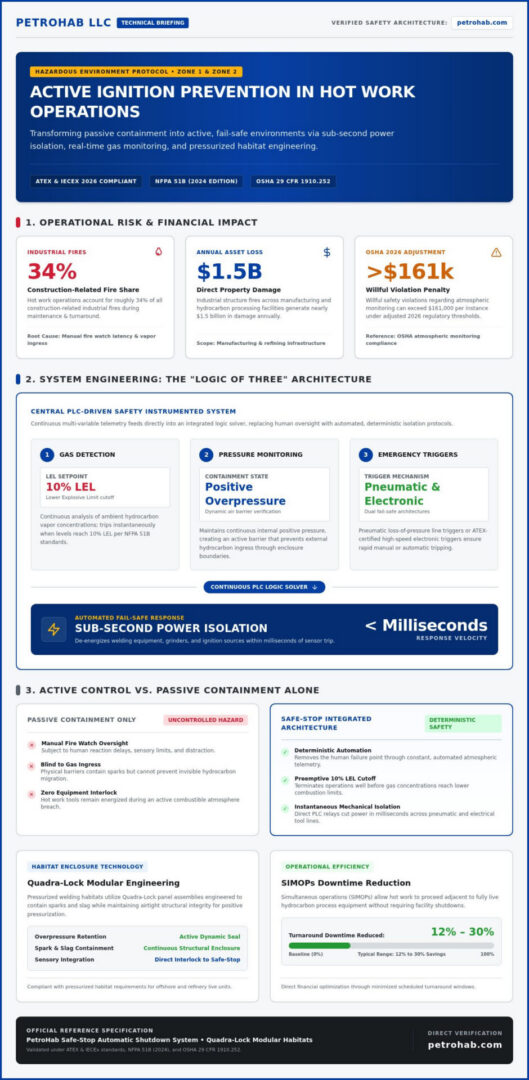
Did you know that hot work operations account for roughly 34% of all construction-related industrial fires? For safety engineers and refinery managers, this statistic represents a constant threat to personnel and high-value assets. You likely understand the intense pressure of preventing gas ingress during welding while trying to avoid the costly downtime that often accompanies complex turnaround schedules. Relying on manual oversight is a significant risk, which is why integrating an automatic shutdown system for hot work has become the industry benchmark for risk mitigation.
This guide explores how advanced shutdown technology transforms passive enclosures into active, fail-safe environments that ensure regulatory compliance. You’ll discover how the Safe-Stop system provides sub-second de-energization to mitigate ignition risks during hazardous operations. We’ll also detail the engineering behind Quadra-Lock panels in pressurized habitats and the technical protocols necessary to maintain ATEX and IECEx standards throughout 2026. This logical approach to safety is designed to help you achieve zero ignition incidents while optimizing your facility’s operational efficiency.
Key Takeaways
- Recognize why Zone 1 and Zone 2 operations demand active engineering controls to mitigate risks that passive containment alone cannot address.
- Examine the technical “Logic of Three” architecture that integrates gas detection and pressure monitoring for immediate power isolation.
- Discover how an automatic shutdown system for hot work ensures verifiable compliance with international ATEX and IECEx safety standards.
- Analyze the synergy between electronic shutdown protocols and Quadra-Lock panel technology in maintaining pressurized habitat integrity.
- Learn to implement Safe-Stop technology to eliminate human error and reduce costly downtime during critical facility turnarounds.
The Critical Role of Automatic Shutdown Systems in Hazardous Hot Work
Industrial environments classified as Zone 1 and Zone 2 present extreme risks for hot work operations. In these locations, flammable gases or vapors are either likely to occur during normal operations or may exist due to equipment failure. A single spark from a welding torch or grinder can trigger a catastrophic ignition event if it contacts a pocket of hydrocarbons. Passive containment alone can’t address the dynamic nature of gas ingress. Risks are permanent. Modern safety protocols demand a transition toward active protection.
Active protection relies on real-time data to neutralize threats before they escalate. An automatic shutdown system for hot work serves as the critical link between atmospheric monitoring and equipment control. By removing the human failure point, these systems ensure that power to ignition sources is isolated within milliseconds of a detected hazard. Manual fire watches often suffer from delayed reaction times or sensory limitations. Automation eliminates these variables. This level of precision is essential for maintaining operational safety in high-stakes energy and processing sectors.
To better understand the consequences of ignition in hazardous environments, watch this case study on industrial fire prevention:
Ignition Prevention in Explosive Atmospheres
Hot work safety enclosures, such as those utilizing Quadra-Lock panels, are engineered to contain sparks. However, their effectiveness depends on the integrity of the internal atmosphere. When flammable gases breach a workspace, the interaction with high-temperature tools results in immediate combustion. Safety requires precision. Automated systems function as safety instrumented systems, utilizing a sensor-to-logic architecture that trips power when gas levels reach 10% of the Lower Explosive Limit (LEL). This proactive isolation aligns with the 2024 edition of NFPA 51B. Integrating an automatic shutdown system for hot work ensures these standards are met without variance.
Economic Impact: Preventing Catastrophic Asset Loss
The financial implications of a facility fire are devastating. Industrial structure fires in the manufacturing and hydrocarbon sectors cause nearly $1.5 billion in direct property damage annually. Beyond property loss, willful safety violations regarding atmospheric monitoring can exceed $161,000 per instance under OSHA 2026 adjustments. Protect your assets. It’s a calculated strategy to invest in a Safe-Stop system. These systems allow for simultaneous operations (SIMOPs), enabling hot work to proceed while adjacent process equipment remains live. This capability reduces scheduled turnaround maintenance downtime by 12% to 30% while providing measurable benefits for insurance and liability management.
Engineering Safety: How an Automatic Shutdown System Functions
An automatic shutdown system for hot work is an integrated sensor-and-logic array engineered to terminate power to ignition sources the moment a hazard is detected. It functions as the central intelligence of a pressurized welding enclosure. This system monitors environmental variables through the “Logic of Three”: gas detection, pressure monitoring, and emergency stop triggers. Lower Explosive Limit (LEL) monitoring in this context refers to the continuous analysis of atmospheric gas concentrations to ensure they remain well below combustible thresholds. By combining these three inputs into a single PLC-driven logic solver, the system provides a comprehensive safety interlock that prevents accidents before they occur.
Safety managers must choose between pneumatic and electronic shutdown triggers. Pneumatic systems are valued for their fail-safe nature; a loss of supply air or a line breach automatically trips the system to a safe state. Electronic triggers provide high-speed signal processing but require robust, ATEX-certified components to maintain reliability in classified areas. Both architectures serve to meet OSHA 29 CFR 1910.252 requirements for fire prevention and tool isolation. These engineering controls are far more reliable than administrative controls, as they react with a speed and consistency that human operators cannot match.
Continuous Gas Detection and LEL Thresholds
Reliable protection requires dual-atmosphere monitoring. Sensors sample air both inside the habitat and at the fresh-air blower intake. This prevents the system from drawing external hydrocarbons into the work area. Standardized protocols utilize a pre-alarm warning at 5% to 10% LEL to alert personnel. If concentrations reach 10% LEL, the logic solver executes a mandatory power isolation to all non-certified equipment. A secondary fail-safe cut-off typically occurs at 25% LEL. Utilizing ATEX-certified sensors ensures these components can operate safely within the very environments they monitor, providing a durable solution for Zone 1 and Zone 2 locations.
Pressure Differential Monitoring
Maintaining a positive pressure differential is the primary defense against gas ingress, specifically when using enclosures built with Quadra-Lock panels. Digital manometers continuously measure the internal pressure relative to the external atmosphere. A standard operating range is between 0.10 and 0.50 inches of water column. This pressure creates a physical barrier that pushes air out of any gaps, preventing flammable vapors from entering. If the pressure drops below the critical threshold of 0.05 inches of water column, the system acts. The response time is decisive; high-reliability systems execute electrical de-energization in 0.5 seconds or less. This speed prevents sparks from existing in a compromised atmosphere. To ensure your site meets these rigorous benchmarks, consider the engineering behind the Safe-Stop Automatic Shutdown System.
Key Features of a High-Reliability Shutdown System
Selecting an automatic shutdown system for hot work requires a focus on specific, non-negotiable features that ensure operational continuity and personnel safety. In 2026, reliability is defined by the system’s ability to integrate into diverse site architectures. Modular design allows safety managers to deploy enclosures and monitoring arrays in tight offshore modules or sprawling refinery units without compromising sensor placement. Effective systems must provide both local and remote alarm indicators. High-visibility strobes and high-decibel sirens at the work site alert technicians immediately, while remote telemetry feeds real-time status to the central control room. This dual-layer awareness ensures that site-wide emergency response teams are notified the instant a threshold is breached.
Compliance with modern NFPA 51B safety guidelines depends on verifiable data. High-reliability systems now include comprehensive data logging capabilities. These systems record atmospheric levels, pressure differentials, and system status every second. This digital trail is essential for post-operation safety audits and provides the documentation necessary to prove adherence to permit conditions. It transforms safety from a subjective observation into a measurable metric. By maintaining these records, operators can identify trends and optimize safety protocols for future turnarounds.
ATEX and IECEx Certification Requirements
Navigating global compliance standards requires an understanding of hazardous area classifications. Systems must be rated for the specific environment where they operate, typically Zone 1 or Zone 2. A critical distinction exists between individual certified components and a fully certified system. For deployment in 2026, the entire automatic shutdown system for hot work must carry certification, such as IEC 60079-13. This standard covers equipment protection by pressurized and ventilated rooms. Relying on a patchwork of certified sensors connected to a non-certified logic solver creates a weak link in the safety chain that regulatory bodies no longer accept. Professional safety managers prioritize systems that hold comprehensive certifications to ensure liability protection and asset integrity.
Operator Interface and Ease of Use
Human factors play a vital role in ignition prevention. Interfaces must be intuitive to reduce alarm fatigue, a condition where operators become desensitized to frequent, non-critical alerts. Clear, actionable feedback on the PLC display allows technicians to distinguish between a minor pressure fluctuation and a life-threatening gas excursion. While automation is the primary defense, the hierarchy of control still mandates manual emergency stop (E-Stop) buttons. These physical overrides must be strategically placed at all exit points of the HWSE. Finally, seamless integration with site-wide Emergency Shutdown (ESD) systems ensures that a habitat-level event can trigger broader facility safety protocols if necessary. This integration is vital for simultaneous operations where hot work occurs alongside live process equipment.
Integrating Shutdown Systems with Hot Work Safety Enclosures (HWSE)
The operational effectiveness of an automatic shutdown system for hot work is fundamentally tied to the physical integrity of the enclosure it monitors. A sophisticated logic array cannot compensate for a poorly sealed environment where pressure fluctuations are constant. The synergy between electronic monitoring and physical containment creates the fail-safe work area required for Zone 1 and Zone 2 locations. When these components work in unison, they provide a reliable barrier against hydrocarbon ingress, ensuring that sparks from welding leads or grinders never encounter a combustible atmosphere. For a comprehensive analysis of the hardware involved, refer to our guide on Pressurized Welding Habitats: The Definitive Guide.
A primary function of the Safe-Stop system is its direct interface with hot work equipment. The logic controller acts as a master switch for all non-certified electrical sources. By routing the power for welding machines and grinders through the shutdown system’s power isolation module, the system ensures that de-energization occurs in 0.5 seconds or less if a hazard is detected. This sub-second response time is critical for preventing ignition during simultaneous operations. It transforms the enclosure from a simple spark catcher into an active safety instrumented system that protects both personnel and high-value facility assets.
The Quadra-Lock Advantage for Pressure Integrity
Maintaining a consistent positive pressure differential requires a superior seal that older, flap-based designs cannot provide. Patented Quadra-Lock panels utilize an interlocking technology that significantly reduces air leakage. This tight seal allows the ventilation system to maintain the required 0.10 to 0.50 inches of water column overpressure with greater efficiency, reducing the load on fresh-air blowers. The modular nature of these panels is also a technical necessity. Safety engineers can adapt the enclosure around complex piping, structural protrusions, and valves while maintaining the pressure integrity needed for the automatic shutdown system for hot work to function without nuisance trips.
Step-by-Step Integration Procedure
Achieving a compliant setup requires a methodical approach to hardware integration. Following a structured protocol ensures that every safety interlock is verified before work begins. This sequence is standard for high-reliability turnarounds:
- Step 1: Assembly of the HWSE using Quadra-Lock panels to create a rigid, interlocking envelope around the work site.
- Step 2: Precise positioning of internal gas detectors near the work area and external detectors at the fresh-air blower intake.
- Step 3: Connecting the Safe-Stop logic controller to the main power source and the specific hot work tools.
- Step 4: Performing the mandatory pre-work pressure test to confirm the habitat maintains overpressure above the 0.05 inches of water column shutdown limit.
Precision in these steps eliminates the human error often associated with manual atmospheric monitoring. If you’re planning a critical maintenance window, you can request a technical consultation for your HWSE deployment to ensure full compliance with international safety standards.
PetroHab’s Safe-Stop: The Industry Standard for Ignition Prevention
PetroHab’s Safe-Stop technology represents the definitive engineering solution for ignition prevention in heavy industry. It functions as an active guardian, utilizing high-reliability PLC-driven logic to monitor and control hazardous environments with millisecond precision. This automatic shutdown system for hot work isn’t an optional accessory; it’s a critical safety instrumented system designed to protect personnel and high-value assets. The system’s capability to isolate power to welding leads and grinders in 0.5 seconds or less sets the global benchmark for safety excellence. It serves as a stoic, reliable barrier against the unpredictable nature of volatile environments.
The technical superiority of the Safe-Stop system is maximized when deployed alongside Hot Work Safety Enclosures (HWSE) featuring Quadra-Lock panels. While the patented Quadra-Lock technology ensures a superior physical seal and heat resistance, the Safe-Stop provides the intelligence required to react to gas excursions or pressure drops. This integrated approach eliminates the human failure points common in manual fire watch protocols. Safety managers rely on this synergy to achieve zero ignition incidents, even during complex simultaneous operations (SIMOPs). It’s a calculated strategy to ensure that maintenance doesn’t compromise facility integrity.
Why Safety Managers Choose PetroHab Globally
PetroHab maintains a rigorous, uncompromising presence in major energy hubs, including Houston, Brazil, and the UK. This global footprint ensures that technical expertise is available wherever extreme offshore or refinery environments demand protection. The brand acts as a seasoned veteran, offering more than just hardware. PetroHab technicians provide on-site supervision and comprehensive training for client personnel, ensuring every deployment meets 2026 international safety standards. This commitment to operational excellence is why major operators trust PetroHab to secure their critical maintenance turnarounds. We don’t just provide equipment; we provide a partnership rooted in safety advocacy.
Requesting a Technical Consultation
Determining the optimal configuration for a specific facility requires a granular understanding of site-specific hazards. Factors like airflow requirements, enclosure modularity, and integration with site-wide Emergency Shutdown (ESD) systems must be calculated with precision. Procuring the right technology is a strategic decision that impacts both safety and profitability. For detailed guidance on selecting a vendor that meets these technical requirements, see our guide on Choosing the Right HWSE Suppliers.
To secure your site with the industry-leading automatic shutdown system for hot work, reach out to our engineering team. We offer flexible leasing and purchase options tailored to your project’s duration and complexity. Our experts help you navigate the technical specifications to ensure full compliance and risk mitigation. Contact PetroHab today for a Safe-Stop system quote and ensure your next hot work operation is protected by the highest standard of ignition prevention technology.
Advancing Operational Safety in 2026 and Beyond
The shift from administrative controls to automated engineering safeguards is no longer a luxury for industrial operators; it’s a technical necessity. As 2026 safety standards evolve, the integration of a high-reliability automatic shutdown system for hot work becomes the definitive method for mitigating ignition risks in Zone 1 and Zone 2 environments. You’ve seen how the synergy between real-time gas detection and the physical integrity of Quadra-Lock panels creates a fail-safe environment that protects both personnel and assets. This proactive architecture ensures that potential hazards are neutralized before they can escalate into catastrophic events.
By utilizing ATEX/IECEx certified technology, you ensure that your facility remains compliant with the most rigorous international regulations. PetroHab provides the precise engineering required to navigate these complexities. Our systems are backed by patented Quadra-Lock technology and 24/7 global technical support, ensuring that your maintenance turnarounds proceed without incident or unnecessary downtime. This calculated approach to safety transforms hazardous work areas into controlled, productive environments where risk is meticulously managed.
Secure your facility with PetroHab’s Safe-Stop system today to implement the industry standard in ignition prevention. We remain committed to being your active partner in operational excellence and long-term asset protection.
Frequently Asked Questions
What is the primary function of an automatic shutdown system for hot work?
The primary function of an automatic shutdown system for hot work is to provide immediate, automated power isolation to any potential ignition sources within a hazardous area. This includes welding machines, grinders, and non-certified lighting. By continuously monitoring the atmosphere, the system eliminates human error and ensures that tools are de-energized the moment safety thresholds are breached. This active engineering control is essential for preventing fires and explosions in high-stakes environments like refineries or offshore platforms.
How does a shutdown system monitor for gas ingress during welding?
The system utilizes a dual-atmosphere monitoring architecture to detect gas ingress. Sensors sample air both inside the enclosure and at the fresh-air blower intake located outside. This configuration ensures that if flammable hydrocarbons are detected in the external supply or internal environment, the system reacts before concentrations reach combustible levels. High-reliability sensors are calibrated to trigger pre-alarms and full shutdowns based on specific Lower Explosive Limit (LEL) percentages, maintaining a secure work area throughout the operation.
Can an automatic shutdown system be used without a pressurized habitat?
While the Safe-Stop system provides sophisticated gas monitoring, it’s designed to operate in tandem with a pressurized Hot Work Safety Enclosure (HWSE) for maximum protection. The enclosure, constructed with Quadra-Lock panels, provides the physical containment necessary to manage overpressure and spark control. Using the shutdown system alone would provide atmospheric awareness but would lack the physical barrier required to prevent gas ingress or contain welding sparks, which is a critical requirement for Zone 1 and 2 compliance.
What happens if the system detects a loss of positive pressure?
If the internal pressure falls below the safety threshold, typically 0.05 inches of water column, the system executes an immediate shutdown. This response prevents external gases from siphoning into the enclosure. High-performance logic controllers ensure that power to all hot work tools is cut in 0.5 seconds or less. This rapid de-energization is vital because positive pressure is the primary physical defense against the ingress of flammable vapors into the work area during live operations.
Are PetroHab shutdown systems ATEX and IECEx certified?
Yes, PetroHab’s Safe-Stop systems are fully certified under ATEX and IECEx standards, specifically adhering to IEC 60079-13. This certification covers equipment protection by pressurized rooms and artificially ventilated rooms, making the system suitable for deployment in classified Zone 1 and Zone 2 hazardous locations. These international certifications serve as anchors for quality and compliance, providing safety managers with the assurance that the hardware meets the most rigorous global engineering and safety benchmarks.
How often do gas sensors in a shutdown system need to be calibrated?
Gas sensors within an automatic shutdown system for hot work require regular maintenance to ensure accuracy. Best practices and regulatory standards generally mandate a daily bump test before work begins to verify sensor response. A full technical calibration should be performed periodically according to manufacturer specifications or site-specific safety protocols. Regular calibration ensures that the LEL detection thresholds remain precise, preventing nuisance trips while ensuring the system reacts correctly during a genuine gas excursion.
Does the system shut down the entire facility or just the hot work tool?
The system is specifically engineered to isolate power to hot work tools and non-certified equipment within the enclosure, not the entire facility. It acts as a localized safety interlock that allows the broader refinery or platform to remain operational while maintenance is performed. By only shutting down the ignition sources in the immediate work area, the system facilitates simultaneous operations (SIMOPs), which significantly reduces downtime and optimizes the efficiency of scheduled facility turnarounds.
What is the difference between a warning alarm and a full system shutdown?
A warning alarm typically activates when gas concentrations reach 5% to 10% of the Lower Explosive Limit (LEL), providing audible and visual alerts to personnel. This allows for an orderly cessation of work. A full system shutdown is a mandatory logic trip that occurs at 10% LEL. At this stage, the system automatically isolates all electrical power to ignition sources within milliseconds. This two-tier approach provides a clear window for worker response before the fail-safe isolation takes effect.