
Blog Posts
Documenting Hot Work Habitat Safety Compliance: A 2026 Professional Guide
In 2026, the physical presence of a pressurized enclosure is no longer the final word in industrial safety. The definitive proof of protection lies in the rigorous data trail that validates every second of your operation. You recognize that in high-hazard environments, a single missing log entry can lead to catastrophic ignition or ruinous OSHA penalties that now exceed $161,000 per willful violation. This reality makes documenting hot work habitat safety compliance the most critical responsibility for any Permit Authorizing Individual or safety engineer today.
It’s understandable to feel the pressure of integrating complex habitat data into Permit-to-Work systems while under the scrutiny of BSEE or OSHA audits. This guide will help you master the technical requirements and procedural frameworks necessary to maintain a flawless, audit-ready compliance trail. We’ll detail how to utilize Quadra-Lock panel certifications and Safe-Stop system data to provide full legal protection and ensure uninterrupted operational uptime through verified safety protocols. By establishing a systematic approach to record-keeping, you can transform your safety documentation from a regulatory burden into a definitive asset for risk mitigation.
Key Takeaways
- Align your safety protocols with 2026 standards by understanding the specific record-keeping requirements of BSEE 30 CFR 250.113 and OSHA 29 CFR 1910.252.
- Master the technical framework for documenting hot work habitat safety compliance to ensure your Permit-to-Work (PTW) system remains audit-ready and legally defensible.
- Replace high-risk manual gas logging with the Safe-Stop Automatic Shutdown System to generate a tamper-proof digital audit trail of environmental conditions.
- Establish precise logging procedures for essential safety metrics, including the mandatory 0.1 inches of water column differential pressure and Lower Flammable Limit thresholds.
- Leverage the modular design of Quadra-Lock panels to streamline pre-work inspections and enhance the accuracy of your habitat integrity documentation.
The Critical Role of Documentation in Hot Work Safety Compliance
Documentation serves as the definitive barrier between operational continuity and catastrophic failure. In high-stakes environments like offshore platforms, the physical integrity of a positive pressure enclosure is only as reliable as the data supporting it. By 2026, industry standards have moved past “best effort” safety protocols toward a “verifiable data” model where logging every variable is mandatory. This shift ensures that documenting hot work habitat safety compliance isn’t just an administrative task; it’s a core engineering requirement. PetroHab LLC maintains that when an ignition source enters a volatile environment, the only protection for the asset is a verified, pressurized barrier.
To visualize the physical application of these standards, review this technical demonstration of habitat construction:
The Permit-to-Work (PTW) system acts as the operational heartbeat of a heavy industry facility. But a PTW is only valid if the underlying safety data is current and accurate. Habitat safety logs provide the real-time evidence needed to keep these permits active. Without a verified audit trail, a PTW becomes a liability rather than a protection. Documented integrity protects high-value assets and personnel in Zone 1 environments by proving that ignition sources are isolated from explosive atmospheres. This level of rigor prevents unplanned shutdowns and keeps production schedules on track for partners of PetroHab LLC.
Defining the Burden of Proof for Safety Managers
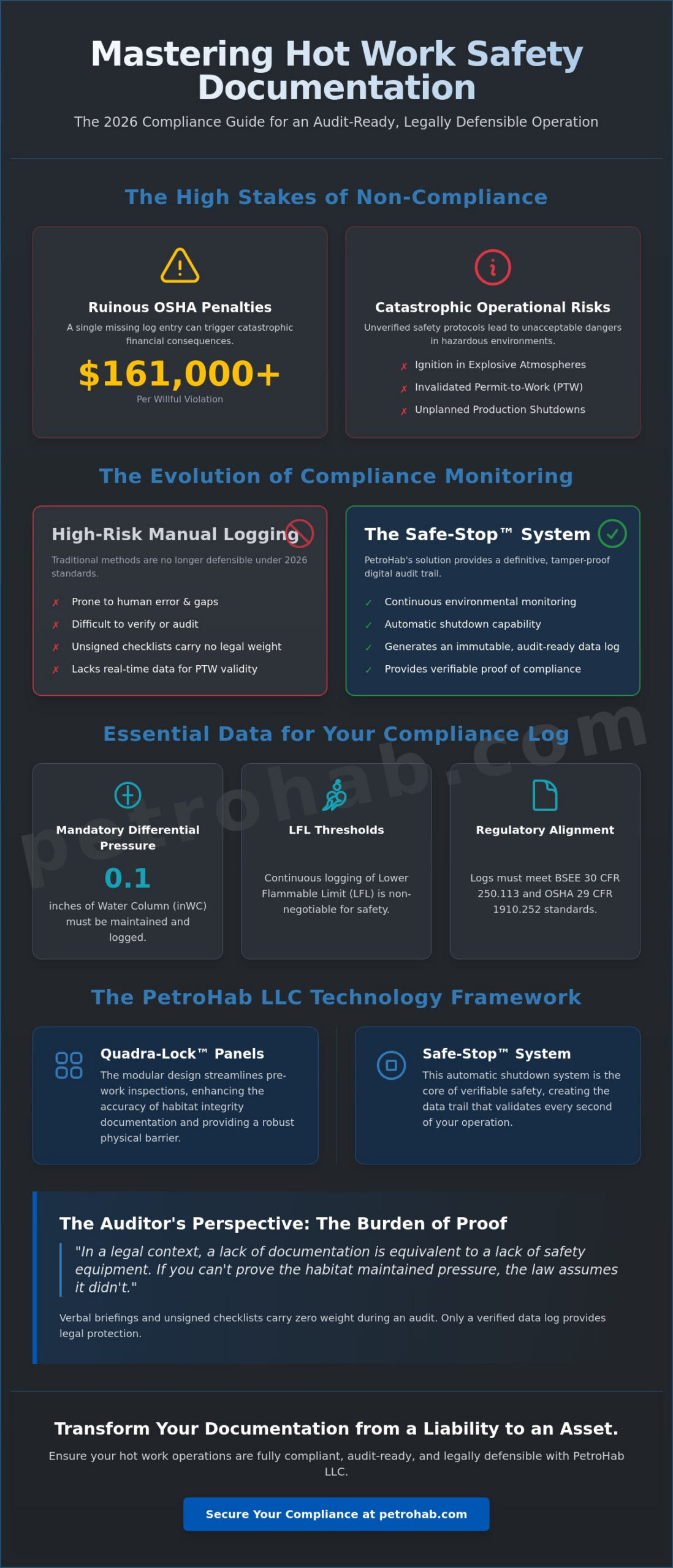
Inspectors from BSEE or OSHA don’t just look at the equipment; they scrutinize the history of that equipment. During a surprise site visit, the burden of proof rests on the safety manager to show engineering controls were active throughout the hot work. Administrative controls, like verbal briefings or unsigned checklists, carry zero weight during an audit. In a legal context, a lack of documentation is equivalent to a lack of safety equipment. If you can’t prove the habitat maintained a pressure of 0.1 inches of water column, the law assumes it didn’t. This failure can result in willful violation penalties exceeding $161,000 per instance, a risk PetroHab LLC helps eliminate through technical precision.
Integrating HWSE Logs into Corporate Safety Management Systems
Effective safety management requires bridging the gap between on-site technicians and head-office compliance officers. Standardizing reporting across multiple global assets ensures risk mitigation strategies stay consistent, regardless of location. When you integrate Hot Work Safety Enclosure (HWSE) logs into your corporate Safety Management System (SMS), you create a loop of continuous improvement. This data lets engineers identify trends, predict potential failure points, and refine protocols for future projects. PetroHab LLC transforms raw numbers into actionable intelligence that protects both the workforce and the corporate bottom line.
Regulatory Requirements for HWSE Record-Keeping in 2026
Regulatory landscapes in 2026 demand more than adherence; they demand granular, verifiable proof. For safety managers, the challenge of documenting hot work habitat safety compliance involves navigating a complex matrix of maritime and terrestrial mandates. Failure to maintain these records doesn’t just invite fines; it invalidates the legal authorization to perform hot work in hazardous areas. In high-stakes environments, PetroHab LLC ensures your documentation serves as the only evidence that engineering controls functioned as intended during a hazardous operation.
BSEE 30 CFR 250.113 defines the rigorous standards for offshore production waivers. This regulation is particularly stringent regarding the “10-foot rule,” which prohibits welding within 10 feet of a wellhead or production facility unless a waiver is granted. To secure and maintain this waiver, operators must provide documented evidence that the Hot Work Safety Enclosure (HWSE) maintains a continuous positive pressure barrier. This documentation must include pre-work pressure tests and continuous monitoring logs that prove the environment remained isolated from external fuel sources. Onshore, the framework is anchored by OSHA hot work safety regulations and the 2026 updates to NFPA 51B. These standards mandate that all combustible materials within 35 feet of the work site be relocated or protected. If relocation is impossible, the use of a pressurized habitat becomes the primary engineering control, and its functional integrity must be logged hourly.
Offshore Mandates: BSEE and Coast Guard Compliance
Offshore compliance requires specific logs for differential pressure within the habitat, ensuring it stays at or above the mandatory threshold. You must also document gas detector calibration and placement. Maritime inspectors look for evidence that sensors were positioned to intercept gas ingress based on prevailing wind patterns and deck layouts. Navigating the BSEE waiver process is impossible without these rigorous logs, which confirm that the internal atmosphere remained safe for the duration of the permit. PetroHab LLC provides the technical expertise to ensure these maritime records meet the highest scrutiny.
Onshore Standards: OSHA and NFPA Compliance
Refinery turnarounds require strict record-keeping of Lower Flammable Limit (LFL) thresholds. You must document that work ceased immediately if LFL levels reached the pre-set safety triggers. It’s equally vital to maintain records for fire-resistant material certifications, such as those for Quadra-Lock Panels, to prove the enclosure meets NFPA 701 standards. For those seeking to standardize these complex logs across global assets, consulting with a specialist on PetroHab LLC HWSE solutions can provide a streamlined compliance framework. Finally, always document the functionality tests of the Safe-Stop mechanism before each shift begins to ensure the automatic shutdown system is fully operational.
Automated vs. Manual Compliance Monitoring
Manual record-keeping in hazardous environments is a legacy practice that introduces unacceptable levels of risk. While a technician with a clipboard provides a visible presence, they can’t match the precision of digital sensors. Human observers often miss transient gas spikes that occur between scheduled readings. These gaps in data create a significant vulnerability when documenting hot work habitat safety compliance. If an incident occurs, a manual log offers little defense against the rigorous scrutiny of forensic investigators or regulatory bodies.
The Safe-Stop Automatic Shutdown System, engineered by PetroHab LLC, functions as a continuous, impartial sentinel. It eliminates the “pencil-whipping” phenomenon where logs are completed retrospectively rather than in real-time. By capturing data at high frequencies, these systems ensure that every fluctuation in differential pressure or gas concentration is recorded with a precise timestamp. This creates a tamper-proof digital audit trail that stands up to the strictest OSHA Hot Work Regulations. Real-time data visualization allows safety leads to intervene before a threshold is breached, moving the facility from a reactive posture to a proactive one.
Eliminating Operator Bias in Safety Logs
Manual logs are inherently subjective. An operator might dismiss a minor sensor flicker as a temporary anomaly, but an automated system records it as an objective data point. Digital logs provide the legal weight necessary during accident investigations by offering empirical evidence of the habitat’s internal state. This shift to automated monitoring streamlines the end-of-shift reporting process. Instead of transcribing handwritten notes, safety managers can export verified data sets directly into their corporate compliance software. This ensures that the information reaching the head office is identical to the conditions recorded on the deck.
The ROI of Automated Compliance Systems
Investing in automated hot work safety systems from PetroHab LLC yields significant dividends in operational efficiency. It reduces the man-hours previously dedicated to manual monitoring, allowing personnel to focus on higher-value technical tasks. Precision sensors also prevent the costly downtime associated with false alarms or unnecessary manual shutdowns. By maintaining a steady, compliant work environment, these systems pay for themselves through increased uptime and the total avoidance of regulatory fines. Reliability is the ultimate driver of profitability in heavy industry, and automation is the only way to guarantee it.
Essential Data Points for Your Hot Work Compliance Log
A compliance log is more than a chronological record; it’s a technical validation of the habitat’s engineering integrity. When documenting hot work habitat safety compliance, safety managers must capture specific metrics that prove the enclosure functioned as a reliable barrier against ignition. Vague entries like “pressure okay” are insufficient during a BSEE or OSHA audit. Every entry must be backed by quantifiable data that aligns with the facility’s Permit-to-Work requirements and international safety standards.
To maintain a robust safety trail, your compliance log must include these critical data points:
- Differential Pressure: Logged readings must confirm a minimum of 0.1 inches of water column (25 Pa) to ensure the positive pressure barrier is maintained.
- Lower Flammable Limit (LFL) Percentages: Documented atmospheric readings inside and outside the habitat, noting any levels that approach the 10 percent LFL threshold.
- Air Exchange Rates: Verification of ventilation efficiency to ensure the internal atmosphere remains breathable and free of welding fumes.
- Panel Integrity: Shift-based verification that all seals and connections are secure.
- Fire Watch Sign-offs: Documented presence of a fire watch for at least 30 minutes post-work, as mandated by NFPA 51B.
Monitoring Pressure and Gas Concentrations
The frequency of documentation is just as vital as the data itself. While automated systems provide continuous monitoring, the compliance log should capture hourly snapshots to verify that the Safe-Stop Automatic Shutdown System is receiving accurate inputs. You must also log the calibration dates of all ATEX-certified gas detectors. If a ‘Safe-Stop’ activation event occurs, the log must detail the cause, the duration of the shutdown, and the corrective actions taken to restore a safe environment. This level of detail transforms a simple log into a powerful tool for incident prevention and legal defense.
Enclosure Integrity and Maintenance Logs
Physical inspections are the second pillar of habitat safety. Visual inspection logs should detail the condition of fire-resistant materials and Petro-Lite panels at the start of every shift. It’s mandatory to document the secure connection of Quadra-Lock Panels to ensure that no pressure leaks compromise the enclosure’s integrity. Maintenance logs should also track the inventory and condition of ducting and ventilation hardware. Any wear or damage to the enclosure components must be recorded immediately, followed by evidence of replacement or repair. For a comprehensive overview of hardware requirements, you can explore PetroHab LLC HWSE configurations to ensure your site is equipped with the latest in compliant technology.
Optimizing Safety Audits with PetroHab LLC HWSE Solutions
PetroHab LLC HWSE solutions provide a definitive remedy for the complexities of modern safety audits. The modular architecture of these systems allows for rapid, standardized inspections that leave no room for ambiguity. When an inspector arrives on-site, the visual clarity of the Quadra-Lock Panels provides immediate reassurance of the system’s structural integrity. This engineering precision is the first step in documenting hot work habitat safety compliance, as it establishes a baseline of physical reliability that matches the digital logs generated by the Safe-Stop system. By starting with a foundation of physical excellence, you ensure that your audit trail is anchored in verifiable hardware performance.
The role of certified technicians from PetroHab LLC is paramount in this process. These professionals act as guardians of the audit trail, ensuring that every shift change and every atmospheric reading is recorded with technical accuracy. They bridge the gap between hardware performance and regulatory proof. By leveraging patented technology, operators can confidently exceed current hazardous environment standards. PetroHab LLC remains committed to delivering audit-ready safety enclosures that protect your personnel and your license to operate in the most demanding conditions.
The PetroHab LLC Advantage in Regulatory Audits
Inspectors favor the Quadra-Lock system because of its repeatable performance. Unlike custom-built, one-off habitats, these standardized panels offer predictable integrity that simplifies the verification process. On-site supervision by PetroHab LLC further strengthens this compliance posture. Having an expert manage the habitat documentation ensures that logs are never missing or incomplete. This level of oversight was recently validated when a live offshore asset faced a surprise audit. Because the team could immediately produce a comprehensive history of differential pressure and gas levels, work continued without interruption. This verifiable data trail demonstrated that the habitat remained a secure barrier against potential ignition, even under intense regulatory scrutiny.
Next Steps: Securing Your Compliance Trail
Optimizing your safety culture requires a commitment to both hardware and procedural excellence. Training your personnel on the PetroHab LLC documentation framework ensures that every team member understands their role in maintaining an audit-ready site. The next logical step involves integrating Safe-Stop data directly into your corporate safety dashboard. This allows head-office compliance officers to monitor habitat integrity across multiple assets in real-time, providing a global view of risk mitigation. Contacting PetroHab LLC for a comprehensive compliance and equipment audit is the most effective way to identify vulnerabilities before they lead to fines or accidents. Secure your operational uptime by choosing a partner that understands the granular details of documenting hot work habitat safety compliance.
Securing the Future of Industrial Safety Compliance
The transition toward a data-driven safety culture is now mandatory for high-hazard operations. You’ve seen how documentation serves as the primary engineering control that validates your physical barriers. By prioritizing automated monitoring over manual logs, you effectively eliminate the risk of human error and ensure your facility remains audit-ready under the stringent 2026 standards. This proactive approach transforms safety logs from a mere administrative requirement into a strategic asset for risk mitigation and operational continuity.
Mastering the process of documenting hot work habitat safety compliance is the ultimate safeguard for your personnel and high-value assets. PetroHab LLC supports this mission through patented Quadra-Lock technology and ATEX and IECEx certified shutdown systems that provide tamper-proof evidence of safety. With a global footprint and certified on-site supervisors, PetroHab LLC ensures your operations meet the highest regulatory benchmarks without compromising uptime. It’s time to move beyond simple compliance and embrace a standard of total operational reliability. Your commitment to rigorous documentation today prevents the catastrophic incidents of tomorrow.
Request a technical consultation on PetroHab LLC HWSE compliance today to fortify your safety protocols and secure your operational future.
Frequently Asked Questions
What is the minimum pressure required for a hot work habitat to be considered compliant?
A hot work habitat must maintain a minimum differential pressure of 0.1 inches of water column, which is equivalent to 25 Pa, relative to the external atmosphere. This positive pressure barrier is the primary engineering control that prevents the ingress of flammable gases into the workspace. Technicians must record this value hourly or utilize an automated system to ensure the environment remains isolated from potential fuel sources throughout the permit duration.
How long must hot work safety documentation be retained for legal purposes?
Retention periods vary by jurisdiction, but OSHA generally requires that safety records be kept for at least one year. However, for high-value assets and offshore environments, maintaining these records for at least five years is the industry benchmark for risk mitigation. This extended history provides a comprehensive audit trail that is vital during long-term liability assessments or forensic investigations following an unplanned site incident.
Does the use of an HWSE eliminate the need for a Fire Watch?
No, the implementation of a Hot Work Safety Enclosure does not remove the requirement for a dedicated Fire Watch. According to NFPA 51B, a fire watch must remain on-site during the operation and for at least 30 minutes after the work is completed. The enclosure acts as an engineering control, but the Fire Watch remains a critical administrative control for observing the surrounding area for secondary ignition risks.
What are the specific BSEE requirements for welding within 10 feet of a wellhead?
Under 30 CFR 250.113, welding within 10 feet of a wellhead or production facility requires a formal waiver and the use of a pressurized habitat. Documenting hot work habitat safety compliance in these scenarios involves proving that the atmosphere is continuously monitored for hydrocarbons. You must also demonstrate that the enclosure’s integrity is verified before ignition and maintained until all hot work activities have ceased on the asset.
Can automated gas detection systems replace manual logs in Zone 1 environments?
Automated systems like Safe-Stop are designed to replace manual logging by providing a continuous, tamper-proof digital record of atmospheric conditions. These systems eliminate human error and capture transient gas spikes that a technician might miss during periodic checks. While digital logs are highly effective for internal audits, always verify that your specific site safety plan doesn’t require a secondary physical signature for permit closure per local mandates.
How do I document the fire-resistance of the habitat panels?
Fire-resistance is documented by maintaining the manufacturer’s certification records for the specific materials used in the enclosure. For Quadra-Lock panels, you should include references to NFPA 701 or UL 214 compliance in your safety file. These certificates prove the panels can withstand the thermal stresses of welding and cutting operations, providing the necessary legal evidence of engineering suitability for use in hazardous industrial areas.
What happens if a habitat loses pressure during a welding shift?
If the internal pressure falls below the mandatory 0.1 inches of water column threshold, the Safe-Stop Automatic Shutdown System immediately terminates power to the welding equipment. This action prevents work from continuing in a compromised environment. You must document the exact time of the shutdown, the identified cause of the pressure loss, and the corrective measures taken to restore the barrier before work is allowed to resume.
Are digital compliance logs accepted by OSHA and BSEE inspectors?
Yes, digital logs are widely accepted by both OSHA and BSEE, provided the data is verifiable and protected against retrospective editing. Automated systems provide a level of technical precision that manual logs cannot replicate. When documenting hot work habitat safety compliance digitally, ensure that your data export formats are compatible with regulatory reporting requirements to facilitate a smooth and efficient audit process during surprise site visits.