Blog Posts
FSRU Welding Habitat Layout: Planning Access, Work Space, and Safety
An FSRU welding habitat layout is more than an enclosure footprint. Restricted deck space can make the proposed position, personnel access, escape routes, nearby equipment, and concurrent operations interdependent. Before installation begins, the layout needs to reflect the specific hot-work scope and the vessel arrangement at the work location.
Start with current site information: the repair location, relevant dimensions and obstructions, access routes, adjacent systems, and planned concurrent activities. Use those details to compare possible enclosure positions, map how personnel and materials will reach the work area, and identify interfaces with surrounding operations. Include pressurization and gas monitoring in the safety coordination, while following site procedures for the overall work plan.
This article explains what information to gather, how to assess enclosure position and access, and how to account for worksite interfaces during review. It also covers how modular Quadra-Lock panels support project-specific enclosure configurations. The aim is a layout that the project team can review before work begins, with personnel movement and operational constraints considered alongside the welding scope.
Key Takeaways
- Base the FSRU welding habitat layout on the defined hot-work scope and actual vessel arrangement.
- Show the enclosure entry, personnel routes, work boundaries, and nearby activity together in the drawing under review.
- Compare candidate positions using the same criteria so access and operational trade-offs are clear to the project team.
- Move from task definition to site review and readiness confirmation, with approved project documents governing the final arrangement.
- Consider how PetroHab’s patented Quadra-Lock panels can support project-specific enclosure configurations.
Why FSRU Welding Habitat Layout Starts with Vessel and Worksite Constraints
An FSRU welding habitat is an enclosure planned around a defined hot-work scope, such as a repair or maintenance task involving welding, grinding, or cutting. Its position depends on where the task must take place and how the worksite is arranged. Start the FSRU welding habitat layout with the vessel and job, rather than assuming a standard footprint will fit.
Deck geometry can restrict where an enclosure can be assembled or positioned. Nearby equipment, structural features, and established routes may limit the workable locations or affect how personnel and materials reach the work point. These constraints differ by vessel and task. A location that looks clear on a general arrangement drawing may not suit the actual repair once access, nearby operations, and planned work activities are considered.
The enclosure footprint is only one part of the space to plan. The drawing should also account for the entry, personnel movement, work materials, and surrounding area needed to carry out the task without obstructing other activities. Treating the footprint as the complete requirement can leave conflicts undiscovered until setup. Review the proposed position against project drawings, current site conditions, and approved procedures before settling on the arrangement.
What makes FSRU habitat layout different from a generic worksite?
Each FSRU has its own deck arrangement, so conditions at one work location cannot automatically be applied to another. Equipment, access routes, and nearby operations all affect which positions are practical. The repair task matters as well: the work point, workpiece, and planned activities shape the enclosure arrangement to assess. Layout planning brings these factors together instead of relying on a generic worksite template.
Which planning inputs should define the layout?
Gather enough job and site information to assess each proposed position against actual conditions. Bring these inputs to the planning review:
- Work scope: The repair or maintenance objective and the hot-work activities involved.
- Work location: The precise work point and relevant dimensions.
- Site information: Current drawings, deck arrangement, and access details.
- Nearby operations: Adjacent equipment and activities that could affect the enclosure position or personnel movement.
Drawings provide a planning reference, but they may not reflect every current obstruction or operational change. Compare them with site-review findings before selecting a position. If dimensions, route details, work boundaries, or information about adjacent operations are missing or uncertain, record the gap and resolve it during project planning. This keeps assumptions visible and gives reviewers a clear basis for assessing the proposed arrangement.
How Habitat Position, Access, and Work Boundaries Fit Together
Review position, access, and work boundaries as one arrangement. The enclosure needs to relate to the specific work point, while its entry and the routes personnel use need to fit the surrounding deck and ongoing activities. A plan showing only the enclosure outline can miss conflicts that affect how people approach the work or carry out the task.
Mark the entry point and intended personnel routes on the layout drawing. Compare them with site conditions, including nearby equipment, obstructions, and concurrent work. A route that looks clear on a drawing may be affected by conditions at the worksite, so review the proposed arrangement against the actual site. Avoid assuming universal clearance dimensions; use project-specific drawings and approved procedures to evaluate the available space.
Plan enclosure access and personnel movement
Trace how personnel will approach the entry, move between it and the work location, and use the surrounding area during the task. Consider whether equipment or simultaneous activities could intersect those routes. Mark identified constraints on the reviewed arrangement so the project team can resolve conflicts before finalizing the configuration.
For a practical review, show the enclosure outline, work point, entry location, personnel routes, and relevant nearby equipment together. Note openings or interfaces that may affect access or enclosure positioning. This gives reviewers a shared reference for discussing the proposal instead of relying on separate drawings or verbal assumptions.
Coordinate enclosure boundaries with the work scope
Set the enclosure extent according to the task rather than assuming a standard footprint. The workpiece shape, tool access, and planned activities all influence the boundary to review. Protrusions, penetrations, or interfaces with the workpiece can affect the panel arrangement and should be shown on the drawing where relevant. Compare the selected configuration with actual site conditions before accepting it for the work.
The reviewed drawing should make the relationship among boundaries, openings, work interfaces, and access routes clear. If an obstruction or interface remains uncertain, record it for resolution through project review and applicable procedures. PetroHab LLC’s pressurized welding habitat technology guide provides broader system context; the final arrangement remains specific to the worksite and task. For information about PetroHab LLC habitat solutions, visit PetroHab LLC.
Keep supplementary references separate from governing project documents. A technical reference can provide background, but it does not replace site review or approved procedures. A well-documented FSRU welding habitat layout makes access, interfaces, and work boundaries visible for coordinated review before work begins.
Compare FSRU Layout Options Against Access, Interfaces, and Operations
The position closest to the work point may seem efficient, but proximity alone does not establish that it is the best arrangement. Assess each candidate against personnel approach, nearby equipment, concurrent activity, setup practicality, and habitat interfaces. Comparing options against the same criteria makes trade-offs visible and helps the project team explain its preferred position.
Evaluate candidate positions without assuming a universal layout
Assess each feasible position against the vessel arrangement and requirements of the specific task. One position, for example, might shorten the route to the work point but conflict with an established access route. Another might provide a clearer approach but need closer review of adjacent operations. These are project-specific considerations, not fixed rules. Record the reasons for each preference and note assumptions that still require engineering or safety review.
| Criterion | Question for the project team | Layout implication |
|---|---|---|
| Work access | Can personnel approach the entry and work point along the planned route? | Show route constraints and any conflicts that need resolution. |
| Surrounding equipment | Do nearby equipment or vessel features affect the proposed position? | Compare candidate locations against the current site arrangement. |
| Concurrent operations | Could adjacent activities interact with the enclosure or its access? | Identify interfaces for coordinated operational review. |
| Setup practicality | Can the planned configuration be assembled at the proposed location? | Document limitations and assumptions for review before selection. |
| Monitoring interfaces | Where do monitoring and shutdown-system interfaces fit in the arrangement? | Include these interfaces in coordination with site procedures. |
Separate confirmed site facts from assumptions in the comparison record. Current drawings or a site review may establish equipment locations and route conditions. An unverified obstruction, access condition, or activity schedule remains an assumption until resolved. This distinction helps prevent an indicative layout from being treated as a validated arrangement.
Account for monitoring and operational interfaces
Include monitoring and shutdown-system interfaces in the layout discussion because their relationship to the habitat and work arrangement needs coordination. Safe-Stop monitors gas levels and pressure. These monitoring functions are part of the safety interface, but they do not replace applicable site procedures or project review. Include relevant interface locations and unresolved requirements in the comparison so they are considered as part of the placement decision.
Use the advanced hot work safety systems guide as background alongside project documents, not as a substitute for them. A sound FSRU welding habitat layout records the preferred position, the reasons for selecting it, and the assumptions that need resolution. PetroHab’s habitat systems are outlined in the habitat systems overview.
Plan an FSRU Welding Habitat Layout in a Reviewable Sequence
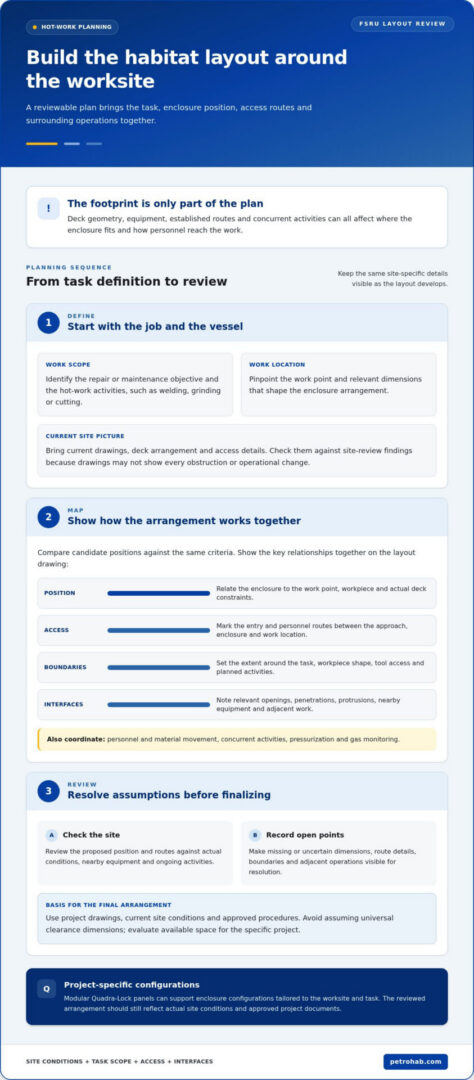
A clear planning sequence connects the hot-work task to vessel information, site conditions, operational interfaces, and the project’s authorization process. Engineering, operations, maintenance, and safety stakeholders each contribute relevant information. Engineering can assess the arrangement, operations can identify nearby activities, maintenance can clarify the task, and safety can review applicable controls and procedures.
Gather and document the layout inputs
Create a shared record before selecting a configuration. The FSRU welding habitat layout should show the task and the basis for the proposed position, not just the enclosure outline. Keep confirmed site information distinct from assumptions so reviewers can identify what needs follow-up.
- Define the task. Record the repair or maintenance scope, work location, and activities planned inside the habitat.
- Assemble site information. Gather relevant vessel drawings, access details, and information about surrounding or concurrent operations.
- Mark the arrangement. Show candidate positions, access routes, enclosure limits, and relevant work or system interfaces on the drawing.
- Flag uncertainties. Label assumptions clearly, state what information is missing, and assign each item for project-team review.
This record helps prevent assumptions from becoming unexamined design inputs. If a drawing conflicts with observed site conditions, capture the discrepancy for resolution. Keep revisions controlled so every stakeholder reviews the same proposed arrangement.
Review the proposed arrangement before work
Walk through the drawing with engineering, operations, maintenance, and safety stakeholders. Compare it with site conditions and applicable procedures, including access, interfaces, adjacent activity, and setup constraints. Resolve conflicts through the project’s review process rather than relying on field improvisation. If the task, site arrangement, or surrounding operations change, assess whether the proposed layout needs another review.
The final arrangement is governed by project drawings and approved procedures, along with the authorization process established for the work. A planning guide can provide context, but it does not set project-specific requirements. The global hazardous-environment standards guide offers broader background on standards considerations; apply the project’s own documentation to the FSRU work scope.
Before confirming readiness, make sure the review record identifies the selected position, the basis for selection, resolved conflicts, and any outstanding actions handled through the project process. Discuss project-specific habitat options with PetroHab in relation to the work scope and site conditions.
How PetroHab Supports Project-Specific FSRU Habitat Layout Planning
A habitat configuration needs to reflect the work scope and actual site conditions. PetroHab manufactures, leases, and sells modular Hot Work Safety Enclosures for the oil and gas industry. Its enclosure products can be considered alongside the proposed position, access, boundaries, and interfaces with nearby equipment or operations. The final FSRU welding habitat layout remains subject to project drawings and approved site procedures.
Connect modular configuration to the planned worksite
PetroHab’s patented Quadra-Lock panels use an interlocking design that supports modular enclosure configurations. Consider the proposed configuration in relation to the work location and vessel constraints. Panel arrangement needs to be reviewed alongside personnel access, the workpiece, and any enclosure interfaces. The appropriate configuration depends on the FSRU and hot-work task.
Bring the task and site information together when considering an enclosure arrangement. For example, an interface or obstruction near the work area may affect how the enclosure boundaries are arranged. Assess the configuration against the worksite rather than assuming that modularity removes the need for site-specific review.
Useful planning discussions can address:
- Work scope and location: What task will take place, and where is the work point?
- Access: How will personnel approach the habitat and reach the work area?
- Configuration: How do the enclosure boundaries relate to the workpiece and relevant interfaces?
- Site conditions: Which vessel features or adjacent activities could influence the proposed arrangement?
Include monitoring systems in the layout discussion
Safe-Stop is PetroHab’s automatic shutdown system, which monitors gas levels and pressure. Include its monitoring interfaces in project coordination so they can be considered alongside the habitat configuration and wider work arrangement. Monitoring supports the safety interface; it does not replace approved project procedures or independently determine the operational response.
During review, consider monitoring in the context of site conditions and established procedures. Document relevant interfaces and resolve project-specific questions through the appropriate review process. Keep system coordination connected to the proposed configuration rather than relying on generic assumptions about the vessel or task.
PetroHab offers modular habitat options and monitoring systems for project use. Contact PetroHab to discuss your FSRU work scope and habitat equipment requirements.
Carry Your Layout Review into the Next Project Decision
After reviewing the proposed arrangement, keep its basis visible as the project moves toward work preparation. A clear record of the selected configuration, unresolved items, and relevant approvals helps the team stay aligned if the work scope or site conditions change. Reassess changes through the project’s established review process rather than relying on an outdated drawing.
That continuity matters on an FSRU, where layout decisions need to remain connected to the actual task and vessel conditions. PetroHab has operated since 2011 and focuses on hot-work safety enclosures for the oil and gas industry. Treat the FSRU welding habitat layout as a working coordination document, not simply a placement sketch.
Ready to discuss habitat equipment for your project? Contact PetroHab about your FSRU welding habitat layout, and bring the work scope and relevant site information into the conversation.
Frequently Asked Questions
What does FSRU mean?
FSRU means Floating Storage and Regasification Unit. An FSRU is a vessel that receives and stores liquefied natural gas, then converts it back into gas for transfer to shore or another connected system. The vessel’s function and arrangement shape the operating environment for maintenance work. For habitat planning, identify the specific work location and nearby vessel systems rather than relying on the acronym alone to infer site conditions.
Can a welding habitat layout be standardized across FSRUs?
No single layout should be assumed to suit every FSRU or task. Even when work scopes appear similar, the vessel arrangement, workpiece, nearby equipment, and operational conditions may differ. A repeatable drawing format or review method can help teams compare proposals, but it does not replace checking the actual worksite. Treat previous layouts as references, not as approved arrangements for another vessel or job.
How should access be considered in an FSRU habitat layout?
Consider routine movement and the routes personnel may need if work conditions change. The drawing should make the habitat entry, approach, work position, and nearby obstructions clear to reviewers. Check whether people carrying tools or materials can use the planned route without interfering with adjacent activities. Keep routes clear in the field as required by project procedures, and review the arrangement again if site conditions change.
Does a pressurized habitat remove the need for other hot-work controls?
No. A pressurized habitat is one part of the worksite control strategy, not a replacement for project authorization or applicable hot-work procedures. The work team still needs to follow controls established for the location and task, including any monitoring, communications, or emergency arrangements specified by the site. Approved project documents govern how these measures work together; enclosure pressurization alone does not define the full operating plan.
What information is useful before planning an FSRU welding habitat layout?
Provide a clear task description, exact work location, relevant workpiece details, and current vessel drawings. Identify changes that may not appear in older drawings, such as temporary equipment or planned nearby work. Note the intended work activities and any known interfaces that could affect the enclosure or its operation. These inputs give the planning team a firmer basis for assessing the proposed arrangement and identifying questions that need resolution.
What happens if gas levels or habitat pressure become unsafe?
Follow the response steps established in the approved project procedures. PetroHab’s Safe-Stop Automatic Shutdown System monitors gas levels and pressure, but project procedures govern the operational response and any conditions for resuming work. Personnel should understand the applicable response arrangements before hot work begins. Do not assume an indication can be ignored or that monitoring replaces the site’s established controls; address uncertainty through the designated project review process.