
Blog Posts
Habitat Flooring and Non-Slip Requirements: A 2026 Selection Guide
One flooring specification can’t address every hot-work habitat risk. A surface that provides traction when dry may behave differently when wet or contaminated. The right choice also depends on hot-work exposure, cleaning methods, and site conditions. Assess habitat flooring and non-slip requirements against the actual task, not assumptions about a product label.
It’s reasonable to want a clear performance target, especially when a slip could disrupt work or put personnel at risk. But a test value or general recommendation isn’t automatically a requirement for every habitat, surface, or jurisdiction. The assessment should distinguish applicable rules from guidance and reflect the hazards workers may encounter.
This guide explains how to document a task-specific flooring assessment, evaluate traction under likely conditions, and consider heat exposure and cleanability. It also covers what to confirm with the site safety team and habitat supplier, including flooring specifications and interfaces. Before work begins, use a practical inspection and verification process to check that the selected surface matches the job and is suitable for use.
Key Takeaways
- Use a documented, task-specific assessment to define habitat flooring and non-slip requirements. A generic “non-slip” label alone doesn’t establish suitability.
- Set project criteria before comparing surfaces, then request evidence and record any gaps before acceptance.
- Compare proposed flooring by verified traction information, cleanability, durability, and compatibility with the work task.
- Inspect the floor, transitions, housekeeping, and access routes before hot work. Assign inspection roles and frequency in site procedures.
- Confirm flooring components, specifications, limitations, and interface requirements with the habitat supplier. Document approval responsibilities with the site team.
Habitat Flooring and Non-Slip Requirements: What the Assessment Must Cover
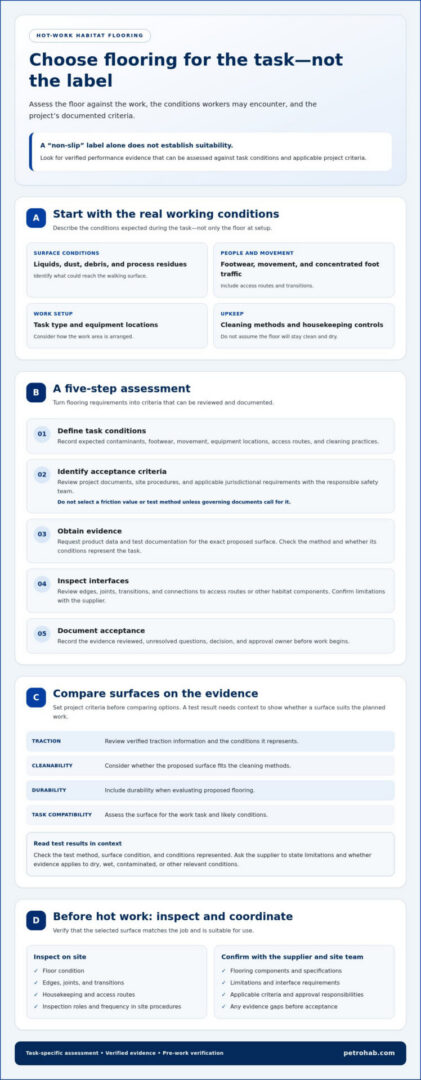
Assess a habitat floor against the work, the conditions workers will encounter, and the project’s documented criteria. Consider task suitability, traction evidence, floor condition, and applicable site, contractual, or regulatory requirements. A label such as “non-slip” isn’t enough on its own: it doesn’t say how performance was measured or establish that the surface suits a particular task.
Welding and grinding are examples of hot work activities that require a controlled work environment. Flooring is one part of the wider risk-control plan, alongside the habitat configuration and site procedures. For an overview of enclosure considerations, see the hot work safety enclosure guide. Confirm floor materials, test results, and interface details with the habitat supplier rather than assuming they’re included or suitable.
For a general explanation of safety flooring terminology, watch this video. It provides background information, not evidence that a particular floor meets your project criteria.
Which work conditions can affect traction?
Ask the site team to describe likely floor conditions during the task, not just at setup. Identify liquids, dust, debris, and process residues that could reach the walking surface. Consider how workers will move, what footwear they’ll use, where equipment will sit, and whether access routes or transitions create areas of concentrated foot traffic. Record expected conditions and housekeeping controls. Don’t assume the floor will stay clean and dry.
What does a non-slip requirement actually mean?
A meaningful requirement identifies a test method or acceptance criterion, the conditions it addresses, and who approved it. A broad supplier description doesn’t provide those details. Ask whether the criterion comes from the site owner, project documents, or an applicable authority. Then verify it against the governing documents and responsible safety team. Separate binding project or regulatory requirements from additional risk-control recommendations, and document which applies.
Working definition: “Non-slip” is a general description. Suitability is established by verified performance evidence assessed against task conditions and applicable project criteria. Use this distinction to make habitat flooring and non-slip requirements clear, traceable, and specific to the job.
How to Assess Flooring Performance Inside a Hot-Work Habitat
Assess the proposed surface in a defined sequence. This turns habitat flooring and non-slip requirements into verifiable project criteria rather than assumptions based on a product label.
- Define task conditions. Record expected contaminants, footwear, movement, equipment locations, access routes, and cleaning practices.
- Identify acceptance criteria. Review project documents, site procedures, and applicable jurisdictional requirements with the responsible safety team. Don’t select a friction value or test method unless the governing documents call for it.
- Obtain evidence. Request product data and test documentation for the exact proposed surface. Check which method was used and whether the test conditions represent the task.
- Inspect interfaces. Review edges, joints, transitions, and connections with access routes or other habitat components. Confirm any limitations with the supplier.
- Document acceptance. Record the evidence reviewed, unresolved questions, decision, and approval owner before work begins.
Test results need context. A reported value without the method, surface condition, and conditions represented may not show whether the floor suits the planned work. Ask the supplier to state any limitations and whether the evidence applies to dry, wet, contaminated, or other relevant conditions. Don’t treat results for a different surface or setup as proof for the proposed flooring.
What evidence should a safety manager request?
Request product information and test reports for the exact flooring surface under review. Check whether the documentation covers the conditions identified in the task assessment, and note any exclusions. For traceability, record the document source, revision, scope, and approval owner. If the evidence doesn’t address a likely condition, log the gap and resolve it with the supplier and site team before acceptance.
How should standards and site rules be checked?
Review contract requirements, site procedures, and jurisdictional rules with the responsible safety team. OSHA’s general requirements for walking-working surfaces address floor condition and hazards, but don’t provide a universal numerical slip-resistance threshold. Check references to OSHA, NFPA 51B, ATEX, or IECEx against the project’s governing documents. Don’t assume any one of them sets a habitat flooring criterion by itself.
For broader context, consult this hazardous-environment standards guide, then confirm applicability with the project’s safety authority. Ask the habitat supplier to verify available flooring specifications and interface requirements in writing. Acceptance belongs to the designated project approver, based on documented evidence and site criteria.
Comparing Habitat Flooring Options Without Assuming a Universal Best Surface
Compare proposed surfaces against the same task conditions and acceptance criteria. A smooth sheet surface, textured finish, or modular panel system may be considered for assessment, but none is automatically suitable. The choice depends on verified specifications, how the evidence was produced, and whether test conditions reflect the worksite. Treat these as categories to investigate, not confirmed PetroHab flooring products or recommendations.
Traction is only one factor. Review cleanability, expected wear and damage, inspection access, and compatibility with the habitat configuration. Hot-work material considerations need separate review. Consult the NFPA 51B hot work safety standard and project documents with the responsible safety team. Don’t infer a flooring specification from a general reference to a standard.
Which comparison criteria matter to the project?
Use a comparison record that connects each property to evidence and a project decision. Ask the supplier to confirm material compatibility, installation interfaces, and any stated limitations. If the work plan includes contamination or demanding cleaning, verify that the supporting information covers those conditions. Don’t assume the surface will retain its performance without that evidence.
| Criteria | Evidence requested | Project relevance | Unresolved questions |
|---|---|---|---|
| Traction | Test documentation for the exact proposed surface, including method and conditions | Compare against contamination scenarios identified by the site | Does the evidence represent the expected surface condition? |
| Cleanability | Supplier guidance on cleaning methods and limitations | Check fit with planned housekeeping and process residues | Could the cleaning method affect the surface or its performance? |
| Durability and condition | Product information and any documented limitations | Consider expected wear, damage tolerance, and inspection access | How will deterioration or damage be identified and addressed? |
| Task compatibility | Written confirmation of material and interface requirements | Check fit with equipment placement, access, and habitat configuration | Are there restrictions or interfaces requiring project approval? |
How can a comparison avoid misleading conclusions?
Compare evidence only when test methods and conditions are alike. Flag differences that prevent a direct comparison. A supplier label or isolated figure isn’t enough to rank options without supporting context. For habitat flooring and non-slip requirements, mark missing specifications as open items and request confirmation from the supplier or project approver instead of filling gaps with industry assumptions.
How to Inspect Flooring, Edges, and Access Routes Before Hot Work
A pre-use inspection checks whether the installed floor and surrounding access remain consistent with the approved work plan. The project team should define inspection frequency, responsible roles, acceptance criteria, and recordkeeping in site procedures. Coordinate flooring checks with the habitat inspection and hot-work authorization process so a change in floor condition is considered before work proceeds.
What should be checked before workers enter?
Inspect the walking surface and its interfaces, not just the central work area. Use a checklist such as this, adapted to the project’s documented criteria:
- Look for visible liquids, dust, debris, residue, or other contamination.
- Check for loose components, surface damage, wear, or uneven transitions at edges and access points.
- Confirm that access routes are clear and that planned work positions remain usable with equipment in place.
- Record each deficiency, the corrective action, and who confirmed acceptance before work proceeds.
Record the inspection in the site’s designated document or checklist. If a condition can’t be assessed against the acceptance criteria, refer it to the assigned approver. Don’t treat the absence of an obvious defect as proof of suitability. Clear records make the decision traceable and help the team apply habitat flooring and non-slip requirements consistently.
What changes require reassessment during work?
Conditions can change after the initial inspection. A spill, new debris, surface damage, altered equipment layout, or housekeeping issue may affect the floor or access route. Reassess against the approved work plan and follow site procedures for pausing or modifying work if conditions no longer meet the criteria. Resume only through the authorization process defined for the project.
Set inspection intervals and event-based triggers in advance. For example, the procedure can identify who checks the floor after a reported spill, who arranges corrective action, and who verifies the area before work resumes. The exact roles and frequency should come from site procedures, not an assumed universal schedule.
Floor condition is one part of the broader control system. For context on how checks fit alongside other controls, see the hot work safety systems guide. Confirm flooring specifications and interfaces with the habitat supplier, and align acceptance with the site safety team. To discuss habitat configuration, contact PetroHab about its hot-work enclosures.
Coordinate Habitat Flooring Requirements with the Supplier and Site Safety Team
Resolve responsibilities before mobilization. Project documents should identify who sets the flooring criteria, who approves the proposed arrangement, who inspects it, and where specifications and acceptance records are controlled. This avoids uncertainty during setup, especially if the supplier’s standard habitat arrangement doesn’t match the site’s access routes, equipment layout, or task conditions.
What should buyers ask a habitat supplier?
Request written answers for the specific habitat configuration under consideration. Don’t assume flooring is included or that a general product description confirms performance for your worksite. Ask the supplier to clarify:
- Which floor configuration is supplied or supported for this arrangement, and which components are included?
- What specifications and test evidence are available for the proposed surface, and what conditions do they represent?
- What installation details, limitations, and interface requirements apply?
- How do floor edges and access interfaces align with the planned worksite layout?
Compare the supplier’s responses with site criteria and task conditions. If evidence is unavailable or doesn’t address a relevant condition, record it as an open item and assign an owner to resolve it. The site safety team should confirm applicable requirements and approve acceptance. The supplier should confirm the habitat details within its scope.
How does PetroHab fit into the evaluation?
PetroHab manufactures, leases, and sells modular Hot Work Safety Enclosures, including pressurized welding habitats. Its confirmed offerings include Quadra-Lock Panels and Safe-Stop Automatic Shutdown Systems. These may inform wider habitat planning where relevant, but they don’t establish flooring specifications. Confirm the proposed floor arrangement, available documentation, and interfaces directly with the supplier.
Before mobilization, close out the evidence trail. A practical record should include:
- The approved flooring criteria and the documents that establish them
- Supplier confirmation of components, specifications, limitations, and interfaces
- Test documentation for the exact proposed surface, with its method and represented conditions
- Named approval and inspection roles, plus the controlled location for records
- Any unresolved items, assigned owners, and documented disposition
This process makes habitat flooring and non-slip requirements specific to the project and traceable through acceptance. Discuss your hot-work habitat requirements with PetroHab.
Make Flooring Acceptance Part of Mobilization Planning
A reliable flooring decision starts with the worksite, not a generic “non-slip” label. Define likely conditions, identify applicable project criteria, and request evidence that matches the exact proposed surface. Then inspect the floor, transitions, and access routes, document acceptance, and assign responsibility for checks during work.
These steps make habitat flooring and non-slip requirements traceable and task-specific. They also keep flooring in its proper role as one part of a wider hot-work control plan. Confirm floor specifications and interfaces directly with the habitat supplier. Don’t assume a dedicated flooring product or particular performance is included.
PetroHab manufactures, leases, and sells modular Hot Work Safety Enclosures, including pressurized habitats. Confirmed offerings include Quadra-Lock Panels and Safe-Stop automatic shutdown systems. To discuss how a habitat configuration may fit your project, discuss your hot-work habitat requirements with PetroHab.
With clear criteria, verified documentation, and assigned responsibilities, your team can move toward mobilization with a well-defined basis for acceptance.
Frequently Asked Questions
Is there one universal non-slip requirement for habitat flooring?
No. Habitat flooring has no single non-slip threshold that applies to every task, habitat, and jurisdiction. Requirements may come from applicable rules, contract documents, or site procedures, while additional criteria may be risk-control recommendations. In the United States, OSHA 29 CFR 1910.22 doesn’t set a numerical DCOF or PTV value. Confirm what governs the project with its safety team and document the applicable acceptance criteria.
How do I know whether habitat flooring is slip-resistant enough?
Assess habitat flooring and non-slip requirements against the actual task and conditions, not a general “non-slip” label. Request documentation for the exact proposed surface, including the test method and conditions represented. Check whether those conditions reflect expected liquids, dust, or residues. Then inspect the installed surface, edges, and access routes against project criteria, and have the designated site approver document acceptance before work begins.
Can a floor described as non-slip become slippery during hot work?
Yes. Liquids, dust, debris, process residues, wear, or cleaning products can affect traction, depending on the surface and conditions. A supplier’s broad description doesn’t prove how a floor will perform when contaminated or damaged. Identify likely contaminants with the site team, follow the approved housekeeping procedure, and reassess after spills or surface changes. If conditions no longer meet project criteria, follow site procedures for pausing or modifying work.
What flooring evidence should a habitat supplier provide?
Ask for product information and test documentation for the exact proposed flooring surface. The records should identify the test method, surface condition, and conditions represented, such as dry or wet use, along with any stated limitations. Request installation and interface details relevant to the habitat arrangement. Record the document source and revision, and confirm which components are included. If information is missing, ask the supplier to clarify it in writing.
Should I use a particular friction coefficient for habitat flooring?
Not unless the project documents or responsible safety authority confirm that the value and test method apply. ANSI A326.3-22 includes a DCOF benchmark of 0.42 for level interior spaces expected to be walked on when wet, but that figure isn’t a universal habitat-floor specification. Test conditions and surface type matter. Have the project team establish the applicable criterion and verify that supplier evidence matches it.
How often should habitat flooring be inspected?
Set the inspection frequency and responsible roles in site procedures. Don’t assume one interval suits every job. Define checks before workers enter and during work as the approved plan requires. Include event-based reassessment after spills, new debris, surface damage, changed equipment placement, or housekeeping concerns. Record deficiencies, corrective actions, and acceptance. Coordinate these checks with habitat inspections and the project’s hot-work authorization process.