Blog Posts
Hot Work Safety for FPSO Operations: A Technical Guide to Pressurized Isolation
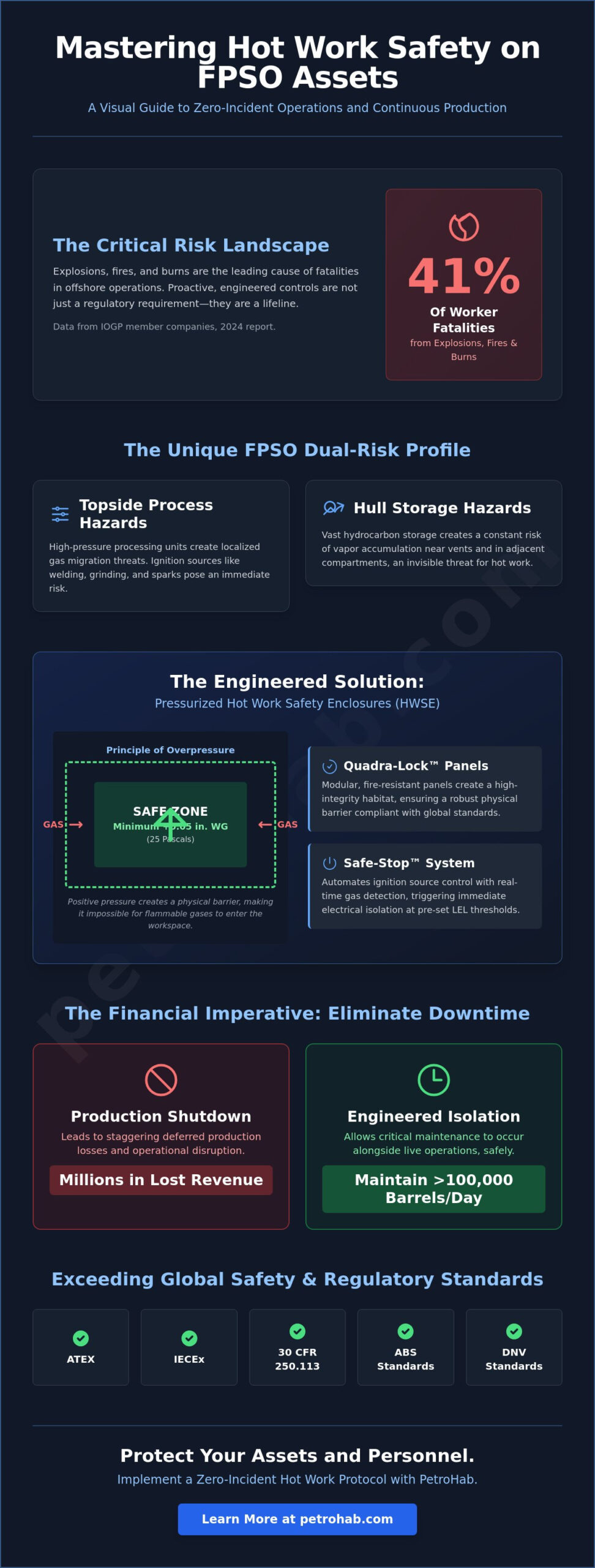
Explosions, fires, and burns accounted for 41% of the 32 worker fatalities reported by IOGP member companies in 2024. This data highlights the severe risk landscape when managing hot work safety for FPSO operations on live assets. You recognize that the high cost of production shutdowns is a constant pressure, especially when complex SIMOPS management makes every ignition source a potential catastrophe. Maintaining full production shouldn’t mean compromising on the integrity of your safety barriers.
You’ll learn to master the rigorous engineered controls and pressurized habitat protocols required to maintain a zero-incident environment. This guide examines how the technical synchronization of Quadra-Lock panels and Safe-Stop automated shutdown systems ensures absolute compliance with 2026 regulatory updates like 30 CFR 250.113. We’ll detail the specific pressurized isolation strategies that protect human life and high-value assets while meeting stringent ATEX and IECEx standards. By the end of this article, you’ll understand how to deploy these systems as an active guardian of your offshore site.
Key Takeaways
- Identify the unique dual-risk profile of FPSO assets where topside process hazards intersect with hydrocarbon-storing hulls to determine critical ignition sources.
- Implement engineered positive pressure protocols to maintain hot work safety for FPSO operations, allowing for essential maintenance without costly production shutdowns.
- Integrate Safe-Stop technology to automate ignition source control through real-time gas detection and immediate electrical isolation at specific LEL thresholds.
- Construct high-integrity pressurized habitats using modular Quadra-Lock panels designed for fire resistance and global ATEX/IECEx compliance.
- Establish a zero-incident culture by aligning Hot Work Safety Enclosures (HWSE) with rigorous Job Safety Analysis and Permit-to-Work workflows.
The FPSO Risk Profile: Why Hot Work Safety is Unique
FPSOs operate as hybrid industrial facilities, merging the high-pressure processing of a refinery with the massive storage capacity of a tanker. This specific configuration creates a volatile environment where Hot Work Safety is the primary defense against catastrophic ignition. Managing hot work safety for FPSO operations requires a deep understanding of how gas behaves at the interface of topside modules and cargo hulls. Ignition sources on these vessels aren’t just limited to the welding arc. They include grinding sparks, molten slag, and conductive heat transfer through steel bulkheads that can ignite vapors in adjacent compartments. Reliable barrier management is the only way to protect these high-value assets from the 182 fires reported in offshore environments during 2025.
To better understand this concept, watch this helpful video:
The regulatory landscape for offshore assets is increasingly stringent. The 2026 updates to 30 CFR 250.113 and the IOGP Life-Saving Rules emphasize that hot work must only occur when specific engineered barriers are in place. These regulations demand a formal permit-to-work system and documented risk assessments that account for the unique marine and process risks of the FPSO. Compliance with ABS and DNV standards is non-negotiable for operators seeking to maintain their license to operate in global waters.
Topside Process vs. Hull Storage Hazards
Processing units on the topside deck handle pressurized hydrocarbons, which leads to localized gas migration during maintenance activities. Volatile organic compounds (VOCs) frequently accumulate near cargo tank vents or pump room exhausts, creating an invisible threat that traditional methods can’t mitigate. Standard fire blankets lack the structural integrity to withstand sustained heat and don’t provide any protection against gas ingress. To maintain operational integrity, engineers must deploy pressurized habitats that provide physical separation and atmospheric control. These systems act as an active guardian, ensuring that the work environment remains isolated from external hydrocarbon hazards.
The Economic Impact of Production Shutdowns
The financial consequences of a full-platform shutdown are staggering. With many global FPSO units producing over 100,000 barrels per day, a single day of downtime represents a significant loss in deferred production. Engineered isolation prevents the need for these costly interruptions. Utilizing modular Quadra-Lock panels allows for the construction of high-integrity enclosures that meet rigorous safety standards. This approach balances safety-critical element (SCE) performance with the need for continuous operational uptime, allowing for live maintenance without the risk of process-wide ignition.
Engineered Barriers: The Mechanics of Pressurized Isolation
Hot work safety for FPSO operations relies on the fundamental principle of overpressure. By maintaining a constant internal pressure higher than the external atmosphere, usually at a minimum of 0.05 inches of water gauge, the habitat creates a physical impossibility for flammable process gases to enter the workspace. This engineered barrier is critical when working near cargo tank vents or processing modules. Adhering to Hot Work Regulations ensures that a competent person oversees these pressurized isolations, verifying that the enclosure maintains its integrity throughout the operation. It’s a calculated approach to risk that replaces hope with mechanical certainty.
A common oversight in offshore maintenance is the lack of communication between the habitat control system and the vessel’s Emergency Shutdown (ESD) levels. PetroHab systems bridge this gap. The Safe-Stop system is designed to interface directly with the FPSO’s ESD logic, ensuring that if a vessel-wide Tier 1 process safety event occurs, the habitat’s power and ignition sources are isolated instantly. This synchronization transforms the habitat from a passive enclosure into an active safety-critical element that responds to the broader platform environment. It’s not just about the bubble; it’s about how that bubble lives within the ship’s nervous system.
Quadra-Lock Panel Technology and Integrity
Quadra-Lock panels represent a significant evolution in hot work safety enclosures. Unlike legacy systems that rely on heavy, inflexible materials, these modular panels offer unrivaled durability and fire resistance. Their lightweight, interlocking design allows safety teams to construct habitats in the cramped, irregular spaces typical of an FPSO deck. Quadra-Lock is the gold standard for pressurized welding habitats. These panels are certified to ANSI/FM 4950 standards, providing high-integrity protection against molten slag and high-intensity arcs. For complex offshore projects, you can explore our modular habitat solutions to see how they fit your specific deck layout.
Ventilation and Air Quality Management
Maintaining air quality within a pressurized habitat is a dual-purpose requirement. It protects the worker and ensures the integrity of the positive pressure. Air intake must be sourced from certified safe areas on the platform, often located several meters away from potential leak points. PetroHab Air Ducting systems facilitate this by providing a continuous flow of fresh air. This constant air exchange mitigates the accumulation of hazardous welding fumes and prevents heat stress in tropical offshore environments. Every component, from the blowers to the sensors, must be ATEX or IECEx certified to ensure it doesn’t become an ignition source itself. Specialized seals are also required where the enclosure meets the uneven, non-slip surfaces of an FPSO deck. These seals prevent pressure loss and ensure the 0.05-inch water gauge threshold is never breached.
Automated Ignition Source Control and Monitoring
Physical barriers like Quadra-Lock panels provide the structural foundation for isolation, but true hot work safety for FPSO operations requires an intelligent layer of automated surveillance. This electronic safeguard acts as the brain of the habitat. It constantly analyzes the atmosphere for hydrocarbon ingress and pressure fluctuations. The integration of gas detection with automatic power disconnection provides a fail-safe mechanism that human observation cannot replicate. It ensures that if a hazard is detected, the ignition source is neutralized before an incident can occur. This proactive control is vital on a live FPSO where gas migration patterns are unpredictable.
Redundancy is a core requirement for safety-critical monitoring systems in offshore environments. PetroHab systems utilize dual-sensor arrays to eliminate single points of failure. These sensors monitor both the internal work environment and the external air intake. By maintaining a continuous digital watch over differential pressure, the system confirms the habitat remains a pressurized, controlled environment. If the pressure drops below the mandatory 0.05-inch water gauge, the system alerts the operator or triggers a shutdown. This prevents the habitat from becoming a trap for migrating process gases.
Safe-Stop Automatic Shutdown Protocols
The logic of the Safe-Stop system is defined by its immediate response to Lower Explosive Limit (LEL) thresholds. While some industry guidelines allow for higher limits, PetroHab mandates a 10% LEL threshold for total power isolation. This provides a 90% safety margin. If the sensors detect gas at this level, the Safe-Stop system triggers hard-wired relays to cut power to all welding equipment and tools within milliseconds. It doesn’t rely on software alone; it uses a physical break in the circuit. This system also interfaces with platform-wide ESD systems. This ensures that if the vessel enters a higher state of emergency, the habitat’s ignition sources are the first to be secured.
Sensor Calibration and Field Verification
Reliable monitoring is impossible without rigorous field verification. Every gas sensor must undergo a pre-operational bump test to confirm response times and sensitivity. This isn’t a suggestion; it’s a procedural requirement for maintaining the integrity of the hot work safety for FPSO operations. Manometers provide the visual and digital proof of positive pressure. These devices record pressure data to create a digital audit trail. This trail is essential for safety managers who must prove regulatory compliance during audits or following a SIMOPS review. Digital records replace manual logs, ensuring that the safety data is accurate, time-stamped, and tamper-proof.
Implementing a Zero-Incident Hot Work Protocol
Establishing a zero-incident culture requires more than advanced hardware. It demands a site-specific Job Safety Analysis (JSA) that accounts for the fluid nature of FPSO decks. Hot work safety for FPSO operations is only effective when the physical barriers are backed by a disciplined procedural framework. This starts with identifying every potential ignition source and flammable pathway before a single spark is generated. The 2022 IOGP Start Work Checks provide a useful baseline, but FPSO environments require a more granular focus on the interface between marine and process systems.
Integrating the Hot Work Safety Enclosure (HWSE) into the Permit-to-Work (PTW) flow is a critical step that ensures all stakeholders are aligned. The permit must explicitly state the habitat’s operating parameters, including required differential pressure and gas detector setpoints. Managing Simultaneous Operations (SIMOPS) is particularly challenging on an FPSO where production and maintenance occur in close proximity. The HWSE acts as a localized isolation point, allowing welding to proceed while adjacent process modules remain live. This coordination requires real-time communication between the Habitat Supervisor and the Central Control Room (CCR) to ensure that any change in vessel status immediately triggers a review of the hot work permit.
A dedicated Fire Watch and a Habitat Supervisor represent the final layers of defense. The Fire Watch must remain on duty for at least 30 minutes after the completion of hot work, as per industry standards like NFPA 51B (2024). Their role isn’t passive. They must be equipped to respond to alarms and manage the Safe-Stop interface if the automated systems require manual override or verification. You can contact our technical team to review your site-specific hot work protocols and ensure they meet these rigorous standards.
Pre-Operational Site Surveys
Pre-operational site surveys define the success of the isolation. Technicians must identify hazardous area classifications, distinguishing between Zone 1 and Zone 2 environments to determine the required ATEX certification levels for equipment. Verifying electrical isolation and Lockout/Tagout (LOTO) procedures ensures that no energy is inadvertently released into the habitat. On an FPSO, weather and sea state impact habitat stability. High winds or significant vessel motion can stress the seals of the Quadra-Lock panels, necessitating additional bracing or structural reinforcement to maintain the integrity of the pressurized environment.
Personnel Training and Competence
Training must move beyond basic compliance toward operational excellence. The complexity of pressurized habitats requires certified technicians who understand the granular details of gas migration and pressure differential physics. This expertise is a vital part of hot work habitat training, which serves as a cornerstone for any safety-first procurement strategy. Using unqualified personnel to manage these systems introduces an unacceptable level of risk to the asset. Every technician must be capable of conducting bump tests and verifying manometer readings before work begins.
Advancing FPSO Integrity with PetroHab Solutions
PetroHab stands as the definitive partner for global energy majors seeking to optimize hot work safety for FPSO operations. Our approach replaces generic safety equipment with engineered systems designed specifically for high-risk hydrocarbon environments. By prioritizing technical precision and risk mitigation, we enable operators to maintain production while conducting critical repairs. This commitment to operational excellence is why PetroHab is recognized as the gold standard in the offshore sector. We provide the mechanical certainty required to operate in the dual-risk environment of process topsides and cargo hulls.
The operational benefits of our patented technology are measurable. Modular configurations allow for rapid deployment in the congested topside areas of an FPSO, reducing the time required for setup and breakdown. This efficiency directly impacts turnaround schedules. In 2025, several major operators reported 15% reductions in maintenance downtime by utilizing our pressurized habitats instead of traditional shutdown methods. These savings are achieved without compromising the integrity of the safety barrier. Our systems act as an active guardian, protecting both human life and high-value assets during live operations.
Unrivaled Technology: Quadra-Lock and Safe-Stop
PetroHab systems don’t just meet international hazardous environment standards; they exceed them. Our Quadra-Lock panels and Safe-Stop systems are designed to operate in the most demanding offshore conditions, providing a level of protection that legacy systems cannot match. The modular nature of the Quadra-Lock panels allows for custom configurations that wrap around complex piping and structural obstructions on the main deck. For a technical deep dive into these components, consult our pressurized welding habitat guide. This integration of fire-resistant materials and automated ignition source control ensures that every habitat functions as a high-integrity safety-critical element.
Global Support for Offshore Operations
Our logistical reach ensures that technical expertise is available wherever your assets are located. With strategic operations in Houston, Dundee, and Brazil, PetroHab provides rapid response capabilities for global FPSO fleets. Our on-site supervision services provide an additional layer of reliability, as certified technicians oversee the installation and continuous monitoring of the habitat’s integrity. PetroHab acts as a critical safety partner, not just an equipment supplier, by integrating our expertise into your asset’s long-term integrity management strategy. This partnership model ensures that every hot work safety for FPSO operations project is executed with the meticulousness and sense of duty that offshore environments demand.
Secure Your Asset with Engineered Safety Solutions
The integration of pressurized isolation and automated monitoring transforms hot work from a high-risk liability into a manageable operational task. By deploying patented Quadra-Lock technology, you establish a high-integrity barrier that protects personnel and production uptime simultaneously. These ATEX and IECEx certified systems ensure that ignition source control is never left to chance, even during complex SIMOPS on live assets. Maintaining hot work safety for FPSO operations requires this level of technical precision and uncompromising safety advocacy.
PetroHab remains the global leader in this field, with active deployment hubs in Houston, the UK, and Brazil ready to support your maintenance schedules. Our role as an active guardian ensures that your facility meets the latest regulatory standards while avoiding the massive costs of deferred production. You can maintain a zero-incident record by choosing a partner that understands the granular details of offshore hazards. Contact PetroHab today to secure your FPSO hot work operations and ensure the continued integrity of your high-value assets.
Frequently Asked Questions
Is it safe to perform welding on a live FPSO?
Yes, welding is safe on a live FPSO when you utilize engineered controls like pressurized habitats to isolate ignition sources. These systems create a physical barrier between the welding arc and the hydrocarbon-rich environment. Hot work safety for FPSO operations is maintained by combining these barriers with automated gas detection and strict adherence to permit-to-work protocols, allowing production to continue without risk.
What is the standard pressure for a hot work safety enclosure?
The industry standard minimum pressure for a hot work safety enclosure is 0.05 inches of water gauge, which is approximately 12.5 Pascals. This specific overpressure ensures the internal atmosphere remains higher than the external environment. PetroHab systems continuously monitor this differential to confirm that flammable gases cannot physically enter the workspace during active maintenance.
How does the Safe-Stop system interact with the platform ESD?
The Safe-Stop system interfaces with the vessel’s Emergency Shutdown (ESD) system through hard-wired relays to facilitate instantaneous power isolation. If the platform triggers a general alarm or the habitat sensors detect hydrocarbons at 10% LEL, the system automatically cuts power to all tools. This synchronization ensures the habitat operates as a safety-critical element integrated into the vessel’s broader emergency logic.
Can pressurized habitats be used in Zone 1 hazardous areas?
Yes, PetroHab pressurized habitats are designed for deployment in both Zone 1 and Zone 2 hazardous areas. The enclosure establishes a localized controlled environment through positive pressure and fresh air exchange. All electrical components, including blowers and monitoring sensors, carry ATEX or IECEx certifications to ensure they don’t serve as ignition sources in these volatile locations.
What happens if gas is detected near the habitat air intake?
The Safe-Stop system triggers an immediate automated shutdown of all power within the enclosure the moment gas is detected at the intake. Sensors identify hydrocarbons before they can be drawn into the ducting, preventing the introduction of a flammable atmosphere to the work area. This fail-safe mechanism is a critical component of hot work safety for FPSO operations, providing a 90% safety margin relative to the LEL.
How long does it take to assemble a Quadra-Lock safety enclosure?
A standard 2m x 2m x 2m enclosure typically requires two certified technicians approximately 2 to 3 hours to fully assemble. The modular design of Quadra-Lock panels enables rapid construction in the confined and irregular spaces common on FPSO decks. This efficiency minimizes preparation time and allows maintenance teams to begin hot work sooner while maintaining total barrier integrity.
What certifications are required for offshore hot work habitats?
Offshore habitats must comply with ANSI/FM 4950 standards for fire resistance and utilize ATEX or IECEx certified electrical control systems. These certifications serve as the technical benchmark for quality and safety in the energy sector. PetroHab integrates these global standards into its hardware to ensure full compliance with the latest 2026 offshore safety regulations.
How does positive pressure prevent ignition in flammable atmospheres?
Positive pressure prevents ignition by utilizing the laws of physics to block the ingress of combustible gases. Air naturally flows from areas of high pressure to areas of low pressure; therefore, any breach in the enclosure results in air escaping outward. This outward flow makes it mechanically impossible for external vapors to enter the enclosure and reach the ignition source.