Blog Posts
Recertification Requirements for Welding Habitats: The 2026 Compliance Guide
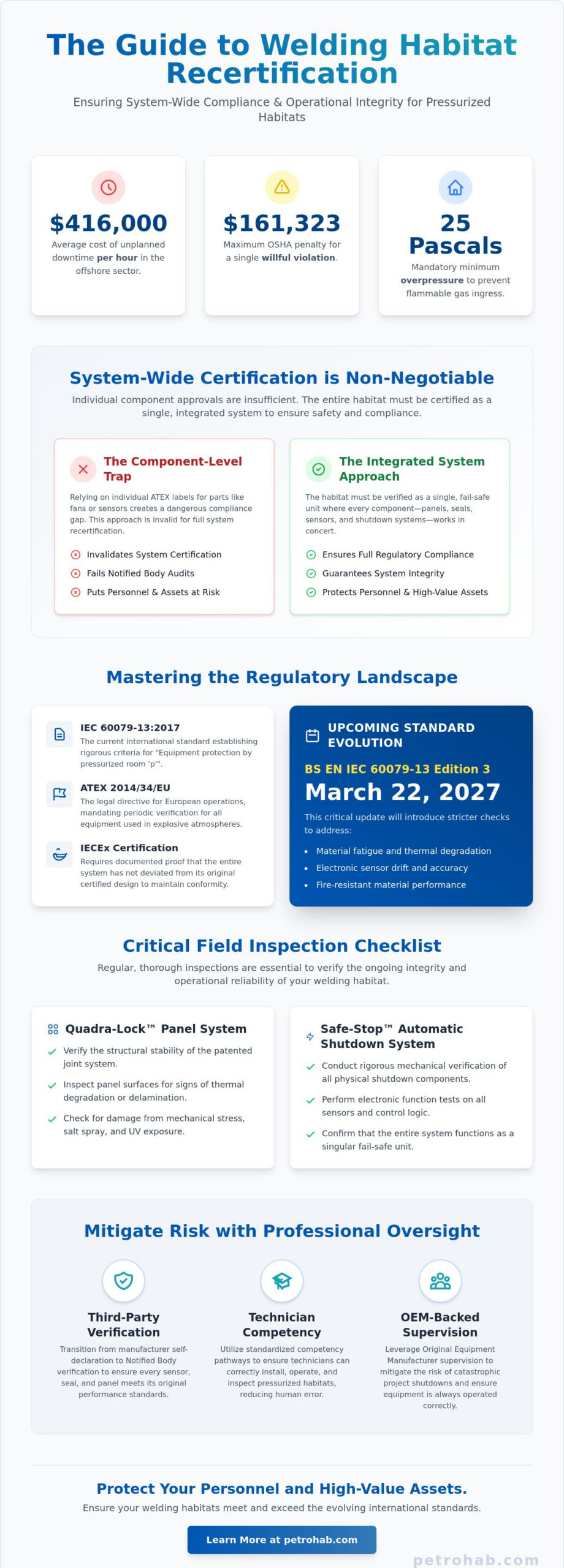
Unplanned downtime in the offshore energy sector costs an average of $416,000 per hour. This massive financial risk often stems from regulatory oversight rather than mechanical failure. Maintaining operational integrity requires a precise understanding of the current recertification requirements for welding habitats, as these protocols are the only barrier between a productive site and a costly shutdown. With OSHA willful violation penalties reaching $161,323, the stakes for your pressurized habitats have never been higher.
It’s understandable if the distinction between individual component approvals and total system certification feels unclear. You need a reliable framework to ensure your equipment survives harsh offshore environments while meeting IEC 60079-13:2017 standards. This guide clarifies the complex regulatory landscape of ATEX and IECEx to protect your personnel and high-value assets. We’ll detail the mandatory 25 Pascal overpressure requirements, the upcoming March 22, 2027, publication of BS EN IEC 60079-13 Edition 3, and the critical role of Quadra-Lock panels in maintaining system-wide compliance.
Key Takeaways
- Master the requirements of IEC 60079-13:2017 and prepare for the transition to Edition 3 in 2027 to maintain absolute regulatory alignment.
- Understand why individual component approvals fail to satisfy the full recertification requirements for welding habitats and how to secure system-wide compliance.
- Learn to identify thermal degradation and verify the structural stability of the patented Quadra-Lock joint system during critical field inspections.
- Ensure the operational reliability of Safe-Stop automatic shutdown systems through rigorous mechanical and electronic verification protocols.
- Discover how OEM-backed supervision and standardized technician competency pathways mitigate the risk of catastrophic project shutdowns.
Understanding International Standards for Welding Habitat Recertification
IEC 60079-13:2017 establishes the rigorous engineering criteria for “Equipment protection by pressurized room ‘p'”. This standard isn’t a static achievement but a continuous operational mandate. For safety managers, Understanding International Standards is the first step in mitigating ignition risks during hot work. These regulations ensure that a minimum overpressure of 25 Pascals is maintained to prevent flammable gas ingress. However, meeting the recertification requirements for welding habitats involves more than just verifying pressure. It demands a holistic evaluation of the system’s ability to function as a unified protective barrier in explosive atmospheres.
The following video demonstrates the fundamental principles of containment and air management essential for these systems:
Initial certification serves as a baseline for new hardware, but it can’t account for the cumulative effects of salt spray, UV exposure, and mechanical stress found in offshore deployments. Operating a non-recertified Petro-Habitat in an ATEX Zone 1 environment creates significant legal and physical liabilities. Regulatory bodies now demand a transition from manufacturer self-declaration toward third-party notified body verification to ensure that every sensor, seal, and panel remains within its original performance envelope.
The Core Regulatory Framework
The ATEX 2014/34/EU Directive provides the legal backbone for European operations, mandating that any equipment used in potentially explosive atmospheres must undergo periodic verification. In 2026, maintaining an IECEx Certificate of Conformity requires documented proof that the entire system, including the Safe-Stop automatic shutdown system, hasn’t deviated from its certified design. For North American sites, the intersection of NFPA 51B and equipment integrity creates a strict requirement for continuous monitoring. Standards are no longer satisfied by component-level checks; they require proof that the system acts as a singular, fail-safe unit.
Why Standards Evolve
Regulatory updates, such as the upcoming BS EN IEC 60079-13 Edition 3 scheduled for March 22, 2027, address critical issues like sensor drift and material fatigue. Recertification requirements for welding habitats have evolved to include stricter checks on fire-resistant materials. Modern environmental regulations in 2026 also influence the chemicals used in panel construction, necessitating regular audits of the Quadra-Lock panels to ensure they haven’t suffered thermal degradation or lost their structural stability. These updates ensure that the ignition prevention measures remain effective against the evolving hazards of modern energy production.
Component vs. System-Wide Recertification: Avoiding Compliance Gaps
Relying on individual ATEX component labels is a common but dangerous mistake. A certified fan or gas sensor doesn’t automatically mean the entire enclosure is compliant. The recertification requirements for welding habitats mandate that the system functions as a single, integrated unit. If one component, even a minor seal or a piece of ducting, fails to meet the unified standard, the entire Hot Work Safety Enclosure (HWSE) certification becomes invalid. This failure chain creates a compliance gap that puts personnel and high-value assets at risk.
A Notified Body doesn’t just look at serial numbers during an audit. They verify the integrity of the whole system under pressure. This process ensures that the interaction between the physical hardware and the monitoring software remains fail-safe. To maintain peak safety, engineers should consult the OSHA general requirements for welding to understand how these habitats fit into broader fire prevention protocols. Total system verification is the only way to guarantee the enclosure acts as an active guardian of your industrial site.
The ‘Tire vs. Vehicle’ Certification Logic
Think of it like a vehicle. You can have high-performance tires, but if the brakes don’t communicate with the sensors, the car isn’t safe. Similarly, a certified fan provides airflow, but it’s the integration between the gas detection systems and the Safe-Stop automatic shutdown logic that prevents disaster. During inspection, we verify that the Quadra-Lock panels maintain the required pressure seal as a system, not just as individual pieces of fabric. Every interconnecting part must demonstrate protection and control under operational stress.
Documentation Requirements
Compliance lives in the paperwork. Maintaining a Technical File as required by the IECEx 02 Certified Equipment Scheme is non-negotiable. This file must include the Manufacturer’s Declaration of Conformity for every specific deployment. Understanding the specific recertification requirements for welding habitats ensures your Technical File remains compliant with global standards. When you audit third-party recertification certificates, check for authenticity by verifying the Notified Body’s registration number. You can ensure your equipment remains audit-ready by utilizing pressurized welding habitats that strictly adhere to these unified documentation standards.
Technical Inspection Criteria for Quadra-Lock and Safe-Stop Systems
Technical recertification is a granular process. It moves beyond high-level compliance to the actual physical state of the hardware. The recertification requirements for welding habitats mandate a rigorous inspection of every structural and electronic component. This ensures the enclosure remains an active guardian against ignition hazards. Technicians must identify signs of thermal degradation and microscopic pinholes in the fabric. These defects compromise the enclosure’s ability to contain sparks and slag. Even minor abrasions can lead to containment failure under pressure.
Calibrating gas detection probes and manometers to 2026 precision standards is a critical technical hurdle. These instruments provide the data that drives the automated safety response. If calibration isn’t precise, the most advanced hardware cannot perform its protective role effectively. We focus on the mechanical and electronic interfaces that ensure the system reacts to hazards in real time.
Structural Integrity of Quadra-Lock Panels
Mechanical verification of the patented Quadra-Lock joint system ensures structural stability during high-pressure operations. The interlocking channels must be free from warping or chemical corrosion that could compromise the seal. Inspectors must conduct a high-intensity light test to identify any thinning or cracking in the fire-retardant panel coatings. We also verify the elasticity and sealing capability of panel gaskets after they’ve endured extreme temperature exposure.
- Channel Alignment: Verify that interlocking mechanisms engage without excessive force or gaps.
- Material Assessment: Check for delamination in the fire-resistant layers that could allow heat transfer.
- Seal Integrity: Confirm that gaskets return to their original shape after compression to prevent pressure loss.
Safe-Stop Logic and Sensor Verification
Functional testing of the Safe-Stop automatic shutdown system is a non-negotiable step in the recertification process. This system serves as the brain of the habitat, managing both gas detection and pressure maintenance. We simulate gas ingress to test the 0.1-second shutdown response time, ensuring that all ignition sources are isolated before a hazardous atmosphere can develop. Testing the backup power supply and alarm sequences within the hot work safety systems ensures the enclosure remains functional even during site power failures.
- Response Time: Measure the interval between gas detection and power isolation to confirm it meets 2026 safety benchmarks.
- Electrical Integrity: Ensure all ATEX-certified electrical connections are free from oxidation and wear.
- Alarm Verification: Confirm that both audible and visual alarms activate immediately upon a loss of 25 Pascal overpressure.
The Recertification Timeline: Frequency and Field Inspection Protocols
Compliance is a moving target. Recertification requirements for welding habitats aren’t just about dates on a calendar; they’re about the physical reality of the hardware. For offshore hardware, the 2026 industry standard for a ‘Major Inspection’ typically occurs every 12 months. However, project-specific conditions often dictate more frequent audits. If a habitat has been idle for more than 48 hours or has undergone any modification, a full re-inspection against a certified checklist is mandatory before hot work resumes. Daily pre-shift inspections are the baseline, but they don’t replace the need for monthly deep-dive maintenance protocols.
Managing equipment logs is essential for proving continuous compliance to facility HSE managers. These logs should document every pressure test and seal verification. They act as a legal shield during audits. Without a documented history of maintenance, even the most advanced Hot Work Safety Enclosure (HWSE) can be deemed non-compliant, leading to immediate project shutdowns. It’s the responsibility of the site lead to ensure these records are accurate and accessible.
Determining Your Recertification Schedule
Environmental stressors accelerate equipment wear in ways that standard schedules can’t always predict. H2S exposure, high UV index, and salt spray don’t just age the panels; they compromise the chemical bonds of the fire-retardant coatings. Decommissioning a Petro-Habitat requires a post-use ‘integrity check’ before it enters storage. This ensures that any damage sustained during the project is identified and rectified immediately. Scheduling these deep-dive maintenance protocols during refinery turnarounds is a strategic move. It minimizes operational downtime while ensuring the Quadra-Lock panels remain structurally sound for the next deployment.
- Annual Audits: Required for full third-party certification of the integrated system.
- Project-Based Checks: Mandatory when moving equipment between different hazardous zones.
- Post-Event Inspections: Necessary after extreme weather or physical impact to the enclosure.
The Role of the Competent Person
The ‘Competent Person’ is a specific designation under OSHA and international standards. This individual must possess the authority to stop work and the technical knowledge to identify hazards. In the context of HWSE, this means completing the standardized 4-stage competency pathway. Technicians must progress from basic awareness through installation and inspection to reach lead technician status. Facility HSE managers now regularly verify a technician’s ‘Training Passport’ to ensure they’re qualified for HWSE maintenance. This passport serves as proof that the technician understands the specific recertification requirements for welding habitats and the Safe-Stop logic.
Ensure your site remains compliant and safe by deploying pressurized welding habitats that meet these rigorous 2026 inspection standards.
Professional Supervision: Ensuring Compliance for Pressurized Welding Habitats
The value of OEM-backed recertification for pressurized welding habitats cannot be overstated. While understanding the recertification requirements for welding habitats is essential, technical knowledge must be paired with on-site authority to be effective. Professional supervision bridges the gap between theoretical standards and real-world application. It ensures that every pressurized unit integrates seamlessly into the facility’s Permit-to-Work (PTW) system. This integration closes the safety loop. It ensures that hot work only proceeds when the habitat is verified as fully operational. Without this expert verification, the risk of ignition remains a constant threat to offshore personnel.
Leveraging PetroHab LLC Expertise
OEM-backed recertification provides a level of assurance that third-party generalists often fail to deliver. Our on-site supervision and training programs ensure 100% compliance by embedding technical expertise directly into your project team. PetroHab LLC supervisors monitor the structural integrity of the Quadra-Lock panels and the logic of the Safe-Stop system throughout the deployment lifecycle. Modular hot work safety enclosures are designed for rapid, transparent inspection. This design allows for efficient verification without delaying critical path activities. One offshore operator recently reduced turnaround delays by 15% through the use of pre-certified habitat deployment and dedicated on-site oversight from PetroHab LLC. They avoided the common pitfalls of equipment degradation and documentation gaps.
Your Path to 2026 Compliance
Safety managers must maintain a rigorous approval process before authorizing hot work. A final checklist should include verification of the technical file, confirmation of the 25 Pascal overpressure baseline, and a physical audit of all panel joints. Adhering to the recertification requirements for welding habitats protects both personnel and high-value assets from unpredictable ignition risks. If your current fleet requires a status update, you should initiate a formal review immediately. This proactive approach prevents the risk of non-compliance and the associated penalties for willful violations. PetroHab LLC acts as your critical safety partner in this high-stakes environment. We invite you to contact PetroHab LLC today to schedule a professional recertification audit for your HWSE equipment. Ensure your operations meet the highest global safety standards for pressurized habitats.
Securing Future Operational Continuity
Adherence to the latest international standards is a non-negotiable requirement for high-stakes industrial environments. True compliance requires moving beyond component labels to verify the integrity of the entire integrated system, particularly as the industry prepares for the 2027 update to BS EN IEC 60079-13. By prioritizing system-wide audits and professional supervision, safety managers eliminate the risk of operational disruptions and personnel hazards. Meeting the rigorous recertification requirements for welding habitats transforms your hardware into a reliable, long-term safety asset.
PetroHab LLC provides the technical precision necessary to navigate these complex regulatory hurdles. Our IEC 60079-13 compliant protocols and patented Quadra-Lock technology verification ensure your enclosures meet the highest safety benchmarks. With a global network of certified safety technicians, we help you maintain total control over your hot work environments. Take the final step in your compliance journey and Request a technical consultation for equipment recertification today. Protecting your workforce and high-value assets is a continuous duty that demands uncompromising expertise. PetroHab LLC is ready to partner with you in achieving safety excellence.
Frequently Asked Questions
How often does a welding habitat need full third-party recertification?
Full third-party recertification typically occurs every 12 months as part of a major inspection protocol. Standard practice also dictates a thorough re-inspection if the habitat remains idle for more than 48 hours or undergoes any structural modification. These recertification requirements for welding habitats ensure that the system’s ability to maintain 25 Pascals of overpressure hasn’t been compromised by environmental stressors or mechanical wear.
Can I perform habitat recertification in-house or do I need a notified body?
Daily pre-shift inspections are performed in-house by a certified Competent Person who has completed the 4-stage technician pathway. However, formal system-wide recertification for ATEX or IECEx compliance requires verification by the original equipment manufacturer or a Notified Body. This third-party audit is essential for maintaining the legal validity of your Hot Work Safety Enclosure in high-risk Zone 1 environments.
What is the difference between ATEX and IECEx recertification requirements?
ATEX recertification is a mandatory legal requirement for operations within the European Union under Directive 2014/34/EU. IECEx is a global certification scheme that facilitates international trade of equipment for explosive atmospheres. While both rely on the IEC 60079-13 standard, ATEX specifically requires a Notified Body to issue an E.U. Type Examination Certificate for Zone 1 habitats to ensure total compliance.
Does the Safe-Stop system need to be calibrated every time it is deployed?
You must verify the calibration of the Safe-Stop system before every deployment to ensure operational precision. This process includes testing the gas detection probes and manometers against known reference points. Regular calibration guarantees that the 0.1-second shutdown response time remains active. This protects your facility from potential ignition events caused by gas ingress or a sudden loss of internal pressure.
What are the red flags that indicate a Quadra-Lock panel needs replacement?
Red flags include visible thermal degradation, delamination of fire-resistant layers, or pinholes identified during a high-intensity light test. You should also inspect the Quadra-Lock interlocking channels for warping or corrosion that prevents a flush seal. If the panel gaskets fail to return to their original shape after compression, they can no longer maintain the required internal pressure and require immediate replacement.
Is recertification mandatory for habitats used in Zone 2 hazardous areas?
Recertification is mandatory for habitats in Zone 2 to ensure the equipment continues to mitigate ignition risks effectively. Although Zone 2 presents a lower statistical probability of explosive atmospheres, the recertification requirements for welding habitats still mandate proof of overpressure maintenance and sensor reliability. Neglecting these standards in Zone 2 can lead to willful violation penalties and increased liability during an incident.
What documentation should I receive after a successful equipment recertification?
You should receive an updated Technical File and a Manufacturer’s Declaration of Conformity that reflects the current state of the entire system. Successful recertification also provides specific inspection certificates for the Safe-Stop logic and structural integrity of the enclosure. These documents serve as your primary evidence of compliance during facility HSE audits and regulatory inspections by government bodies.
How does equipment recertification impact my project’s insurance premiums?
Maintaining current recertification documentation acts as a primary risk mitigation factor that can positively influence insurance assessments. Insurers prioritize sites that demonstrate a rigorous commitment to safety through the use of certified pressurized habitats. By proving that your equipment meets IEC 60079-13 standards, you reduce the insurer’s liability exposure. This often results in more favorable premium structures or the avoidance of coverage exclusions.