Blog Posts
Welding Fume Extraction Requirements for Habitats: The 2026 Engineering Guide
What if your safety enclosure is actually concentrating the very hazards it was designed to contain? In the offshore energy sector, the margin for error in atmospheric control is zero. Engineers often find that standard ventilation tactics fail when applied to pressurized environments, where every cubic foot of air removed must be precisely accounted for. Meeting the strict welding fume extraction requirements for habitats requires a rigorous understanding of fluid dynamics and safety compliance.
You understand that protecting personnel from carcinogenic fumes is mandatory, but you can’t risk the pressure drops that trigger a Safe-Stop shutdown. It’s a delicate balance between maintaining a breathable atmosphere and ensuring the enclosure remains a barrier against external flammable gases. This 2026 engineering guide provides the definitive strategy for integrating high-volume extraction within a PetroHab LLC Hot Work Safety Enclosure without compromising the 25 Pascal pressure threshold. We’ll analyze specific CFM calculations, 2024 NFPA 51B standards, and the deployment of Quadra-Lock panels to ensure a compliant, fail-safe hot work environment.
Key Takeaways
- Navigate the 2026 regulatory landscape, including OSHA 1910.252 and NFPA 51B, to maintain absolute compliance in hazardous offshore environments.
- Master the precise engineering formulas for calculating CFM and air changes per hour to meet welding fume extraction requirements for habitats.
- Identify how to achieve laminar flow through strategic ducting placement, ensuring efficient particulate removal without disrupting the habitat’s internal pressure.
- Understand the role of Quadra-Lock panels in maintaining the critical 25 Pascal positive pressure seal during high-volume air exchange operations.
- Establish a definitive pre-work inspection routine to verify seal integrity and prevent the accidental ingress of flammable gases during extraction.
The Critical Intersection of Fume Extraction and Habitat Pressure
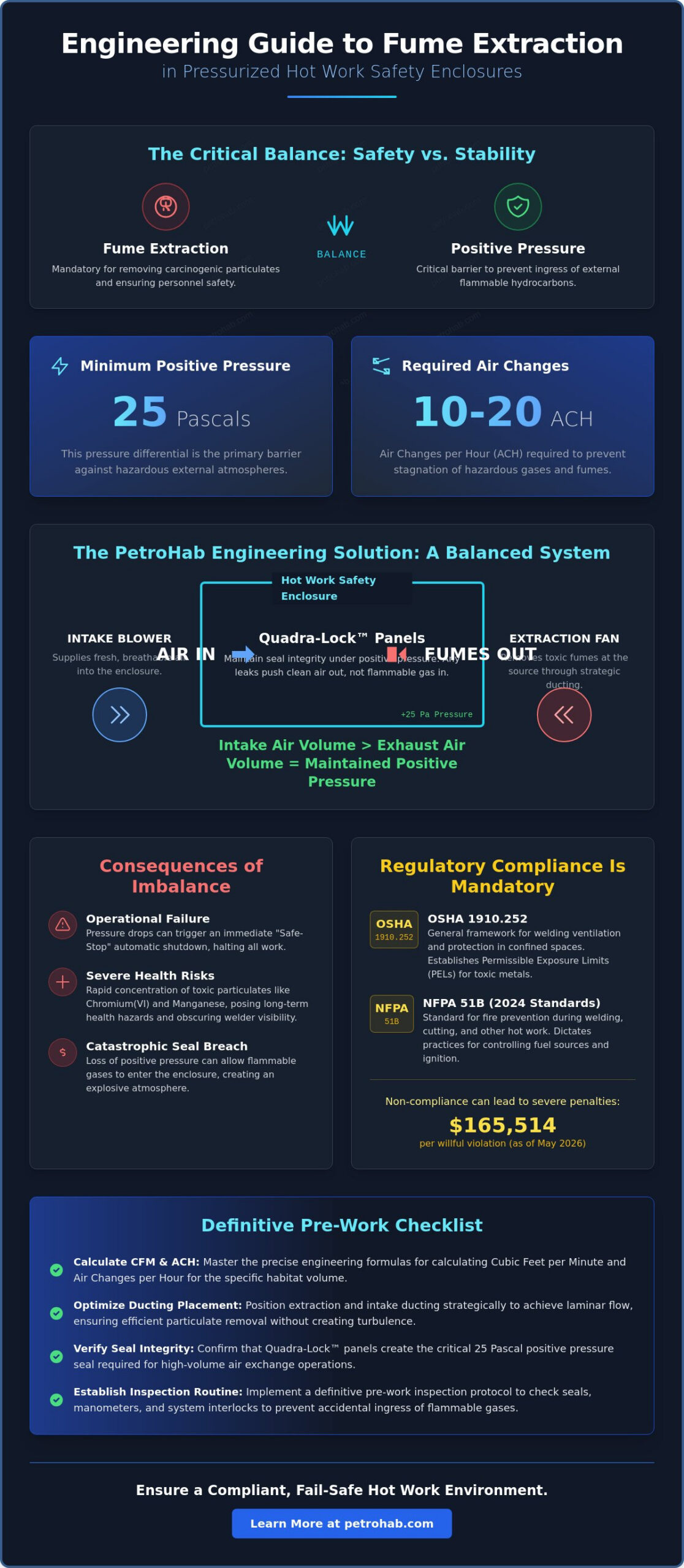
Effective fume extraction within a PetroHab LLC Hot Work Safety Enclosure (HWSE) represents a specialized engineering challenge. Unlike standard industrial settings, a pressurized habitat operates under a dual mandate. It must remove toxic particulates at the source while simultaneously maintaining a positive pressure of at least 25 Pascals (0.1 inches of water gauge). This pressure differential is the primary barrier preventing the ingress of flammable hydrocarbons from the external environment. Failure to synchronize these two systems can lead to a Safe-Stop automatic shutdown or, worse, a breach in the atmospheric seal.
Meeting the welding fume extraction requirements for habitats requires moving beyond simple air displacement. Standard workshop ventilation relies on general exhaust fans that pull air from a broad area. In a confined, pressurized zone, an unmanaged exhaust fan acts as a vacuum that can quickly equalize internal and external pressures. This creates a dangerous condition where the habitat loses its protective “bubble.” Engineers must instead implement a balanced ventilation strategy where the volume of air extracted is strictly calibrated against the volume of fresh air introduced by the intake blowers.
To better understand the mechanics of effective particulate removal in confined spaces, watch this technical overview:
The role of Air Changes per Hour (ACH) is central to this calibration. In hot work zones, safety protocols typically demand 10 to 20 ACH to prevent the stagnation of hazardous gases. Achieving this within a modular enclosure built from Quadra-Lock panels requires precise ducting placement. If the ACH is too low, fumes accumulate; if the extraction velocity is too high without compensated intake, the positive pressure integrity fails. Proper welding processes and safety management dictate that these systems must be interlocked to ensure the habitat remains a controlled environment at all times.
The Physics of Pressurized Containment
Maintaining the 25 Pascal standard is a non-negotiable safety requirement for PetroHab LLC systems. Extraction fans are powerful tools that can inadvertently create negative pressure if the intake system isn’t sized correctly. A balanced system ensures that the intake blower slightly exceeds the exhaust rate. This surplus of air creates the necessary outward force against the Quadra-Lock panels, ensuring that any minor leaks result in air escaping the habitat rather than flammable gases entering it. Engineers must monitor these levels using high-precision manometers to prevent atmospheric destabilization.
Health Risks of Inadequate Extraction in Habitats
In the confined volume of a pressurized habitat, toxic particulates reach dangerous concentrations rapidly. OSHA maintains strict Permissible Exposure Limits (PELs) because metals like Chromium(VI) and Manganese pose severe long-term health risks. Without localized extraction, these fumes can create a “chimney effect” where heat carries particulates upward, only for them to cool and settle back into the welder’s breathing zone. This buildup doesn’t just threaten health; it severely degrades visibility. When a welder’s sight is obscured by a dense fume cloud, the risk of manual errors and physical accidents increases exponentially.
Regulatory Requirements: OSHA, NFPA, and International Standards
Regulatory adherence isn’t a suggestion; it’s the baseline for industrial survival. In the offshore and heavy industry sectors, failing to meet the welding fume extraction requirements for habitats carries severe consequences, including OSHA penalties that can reach $165,514 per willful violation as of May 2026. Compliance starts with understanding the technical overlap between environmental containment and respiratory protection. Safety managers must ensure that ventilation strategies don’t just exist on paper but are actively integrated into the habitat’s operational logic.
OSHA 1910.252 provides the general framework for ventilation during welding, but for pressurized habitats, engineers must look closer at OSHA Standard 1926.353. This standard mandates mechanical ventilation when welding is performed in confined spaces or where the work area contains structural barriers that obstruct cross-ventilation. In a pressurized habitat, the walls themselves are these barriers. Therefore, local exhaust ventilation (LEV) isn’t just a recommendation; it’s a requirement to keep iron oxide fumes below the 5 mg/m³ 8-hour time-weighted average. For more complex projects, utilizing a PetroHab LLC Hot Work Safety Enclosure (HWSE) allows for a controlled environment where these standards can be met with engineering precision.
OSHA Compliance for Confined and Enclosed Spaces
As of February 2026, OSHA maintains specific Permissible Exposure Limits (PELs) for hazardous metals. For instance, Chromium(VI) is capped at 5 µg/m³. In the restricted volume of a habitat, these levels can be exceeded in minutes without high-efficiency LEV. Operators must implement continuous air quality monitoring as part of their Permit-to-Work (PTW) protocols. It’s vital to distinguish between general mechanical ventilation, which refreshes the entire space, and LEV, which captures contaminants at the arc. Both must work in tandem to ensure the atmosphere remains within Threshold Limit Values (TLVs).
NFPA 51B and the Role of HWSE
The 2024 edition of NFPA 51B remains the definitive standard for fire prevention during hot work. It traditionally requires a 35-foot clear radius around welding activities to mitigate fire risks. However, a pressurized habitat effectively modifies these boundaries by containing sparks and slag within a certified fire-rated structure. This modification is only valid if the ventilation system doesn’t compromise the enclosure’s positive pressure. If extraction fails, the buildup of combustible gases or toxic fumes must trigger an immediate cessation of work via an automatic shutdown system.
International operations face additional scrutiny. The UK’s Health and Safety Executive (HSE) continues to enforce the reclassification of mild steel welding fumes as carcinogenic, requiring LEV regardless of the task duration. For habitats deployed in European waters, ATEX directives govern the ignition-prevention components of the extraction system. Integrating these requirements into a unified PTW system ensures that safety managers can verify both the 25 Pascal pressure seal and the extraction flow rates before any arc is struck. Using modular Quadra-Lock panels allows for the strategic integration of ventilation ports without compromising the certified integrity of the habitat.
Calculating Air Changes and CFM for Pressurized Enclosures
Engineering the ventilation for a pressurized habitat requires a departure from standard workshop calculations. In a typical welding shop, exhaust systems operate in an open atmosphere where air replenishment is passive. Within a PetroHab Hot Work Safety Enclosure (HWSE), the system is closed. You must solve for air quality while simultaneously maintaining the 25 Pascal pressure threshold. Failing to balance these variables leads to either a toxic atmosphere or a total loss of the pressure seal, both of which trigger an immediate work stoppage.
The primary metric for safety is Cubic Feet per Minute (CFM), derived from the required Air Changes per Hour (ACH). For most welding applications, a rate of 10 to 20 ACH is necessary. To determine your target CFM, use the following formula: CFM = (Enclosure Volume in Cubic Feet × Desired ACH) / 60. If you are operating a 10′ x 10′ x 8′ habitat (800 cubic feet) and require 20 ACH for high-parameter MIG welding on stainless steel, your system must move 267 CFM. This calculation must be adjusted upward if the welding involves materials with low Permissible Exposure Limits, such as galvanized steel or alloys containing manganese.
Maintaining the “Pressure vs. Extraction” balance is the most critical technical hurdle. If your extraction fan pulls 300 CFM but your intake blower only provides 280 CFM, the habitat will quickly transition to negative pressure. This breach allows external gases to enter, compromising the entire safety protocol. To prevent this, the intake volume must always exceed the exhaust volume. A surplus of 10% to 15% on the intake side typically ensures the 0.1 inches of water gauge (iwg) requirement is met while extraction is active.
Ducting configuration also dictates actual performance. Long runs of flexible ducting or sharp bends create static pressure, which significantly degrades the blower’s rated CFM. For maximum efficiency, engineers should use the largest possible diameter ducting and keep the run as straight as possible. Every 90 degree turn can reduce airflow by as much as 15%, potentially dropping your welding fume extraction requirements for habitats below the legal safety limit.
Determining Minimum Airflow Velocity
Volume alone doesn’t guarantee particulate capture. You must also maintain a minimum capture velocity at the weld arc. Industry standards suggest a target of 100 linear feet per minute (fpm) to effectively pull fumes into the extraction hood. Safety managers should measure this velocity directly at the hood face using an anemometer. Simultaneously, use a manometer to verify that the high-volume suction hasn’t caused the internal pressure to dip below the 25 Pascal minimum. If the pressure fluctuates, you must increase the intake blower speed to compensate.
Advanced Airflow Modeling
Modular configurations using Quadra-Lock panels allow for custom habitat shapes, but these designs can create stagnant “dead zones” where fumes accumulate. Advanced airflow modeling suggests placing the intake at a low point on one side of the habitat and the extraction point at a high point on the opposite side. This creates a cross-flow or “laminar flow” effect. Positioning extraction arms directly over the source capture point is the most effective way to manage the extraction-to-intake ratio, ensuring particulates are removed before they can disperse into the wider enclosure volume.
Operational Best Practices for Habitat Ventilation Systems
Operational excellence in pressurized environments requires a shift from theoretical calculation to rigorous field execution. Every hot work shift must begin with a comprehensive pre-work inspection to verify that the extraction system doesn’t compromise the habitat’s seal integrity. Safety personnel must confirm that the 25 Pascal positive pressure remains stable while the extraction fans are active. Meeting the welding fume extraction requirements for habitats isn’t just about the equipment; it’s about the procedural discipline of the crew and the precision of the setup.
Strategic placement of intake and exhaust ducting is non-negotiable for maintaining a breathable atmosphere. Intake blowers should deliver fresh air at a low point in the habitat, while the exhaust hood should be positioned at the highest point opposite the intake. This configuration promotes laminar flow, which effectively pushes contaminants away from the welder’s breathing zone and toward the extraction port. Without this cross-ventilation strategy, toxic particulates can swirl in stagnant eddies, lead to a rapid buildup of hexavalent chromium or manganese, and obscure the welder’s field of vision.
Maintenance schedules for auxiliary components must be strictly enforced to prevent system-wide failures. Spark arrestors require daily cleaning to ensure that metal particulates don’t restrict airflow or create a fire hazard within the ducting. Simultaneously, HEPA filters must be monitored via differential pressure gauges. A sudden spike in pressure across the filter indicates saturation, which will drop your extraction velocity below the required 100 linear feet per minute at the arc. If your current ventilation setup lacks these integrated monitoring controls, contact our engineering team to discuss a compliant, high-performance strategy.
Ducting and Seal Management
All ducting used in hazardous zones must be flame-retardant and certified for high-temperature exposure. When routing these lines through hot work safety enclosures, engineers must use specialized penetration ports to prevent pressure loss. Every connection point in the Quadra-Lock panels must be inspected for gaps. It’s critical to avoid sharp bends in the ducting; every 90 degree turn increases static pressure and forces the extraction motor to work harder, which can lead to premature equipment failure and reduced capture efficiency.
Monitoring and Alarm Integration
The ventilation circuit should never operate in isolation. It must be digitally integrated with advanced hot work safety systems that monitor both gas levels and airflow status. If the extraction rate drops or gas sensors detect hydrocarbons, the system must trigger visual and audible alarms immediately. Emergency shutdown protocols should be hard-coded into the Safe-Stop logic, ensuring that the welding power source is killed the moment the ventilation parameters fall outside of the safe operating window.
PetroHab LLC Engineering: Optimizing Airflow with Quadra-Lock Habitats
PetroHab LLC engineering addresses the inherent contradictions of pressurized hot work by treating the habitat as a dynamic pressure vessel rather than a static room. Achieving the welding fume extraction requirements for habitats requires a structural integrity that standard modular systems cannot provide. The cornerstone of this capability is the Quadra-Lock panel system. These panels utilize a specialized interlocking mechanism that minimizes air bypass. This ensures that the positive pressure generated by intake blowers isn’t wasted through panel seams. An airtight foundation allows for higher extraction velocities without compromising the 25 Pascal safety margin established in previous sections.
PetroHab LLC Air Ducting is specifically engineered to integrate with these habitats. Unlike generic flexible hoses, our ducting is designed for high-volume hazardous zone extraction. It features flame-retardant materials and reinforced structures that resist collapse under high static pressure. By utilizing dedicated, reinforced penetration ports within the Quadra-Lock panels, engineers can position exhaust hoods at the precise point of fume generation. This source capture approach reduces the overall CFM load required to maintain a breathable atmosphere. It optimizes both safety and energy efficiency across the job site.
Modular Precision with Quadra-Lock Panels
- Pressure Retention: The Quadra-Lock design creates a superior environmental seal. This prevents the vacuum effect that often occurs when powerful extraction units are introduced to less robust enclosures.
- Customizing Enclosure Dimensions: Modularity allows for the exact scaling of the habitat to the work area. This simplifies the calculation of Air Changes per Hour (ACH) and prevents the formation of unventilated dead zones.
- Integrating Extraction Ports: Specialized panels allow for the secure insertion of ventilation ducting without degrading the ANSI/FM 4950 fire resistance rating of the structure.
The Integrated PetroHab LLC Solution
A truly compliant hot work environment requires the synchronization of containment, ventilation, and monitoring. PetroHab LLC habitats are designed for seamless compatibility with the Safe-Stop Automatic Shutdown System. This integration ensures that if the extraction-to-intake ratio deviates or if gas detection units identify external hydrocarbons, the welding power source is instantly de-energized. This fail-safe loop is the ultimate safeguard for high-value assets and personnel in volatile environments.
Our commitment extends beyond equipment delivery. PetroHab LLC provides global support and certified training to ensure that your safety managers can execute complex ventilation strategies in the field. In a recent offshore platform turnaround, PetroHab LLC systems achieved 100% air quality compliance while maintaining a constant pressure threshold, even during heavy MIG welding operations. We invite you to request a technical consultation to determine the specific configuration required for your next hazardous zone project.
Securing Operational Excellence in Pressurized Hot Work
Implementing a robust ventilation strategy is the final step in ensuring a fail-safe hot work environment. You’ve seen how critical it is to balance the extraction-to-intake ratio to preserve the 25 Pascal pressure seal. By adhering to the 2026 welding fume extraction requirements for habitats, safety managers can effectively mitigate the risks of toxic particulate buildup while maintaining strict compliance with OSHA and NFPA 51B standards. Precision in airflow management is what separates a compliant site from a hazardous one.
PetroHab LLC offers a definitive solution that combines patented Quadra-Lock technology with Safe-Stop automatic shutdown integration. This synergy ensures that your containment system and ventilation circuit work as a unified safety barrier. Our systems maintain global compliance, meeting ATEX and IECEx standards for the most hazardous offshore environments. Reliability in heavy industry is built on technical precision and an uncompromising commitment to risk mitigation. We provide the engineering controls necessary to protect your most valuable assets.
Request a Quote for PetroHab LLC Pressurized Habitats and Extraction Systems to secure a precision-engineered ventilation solution for your next project. We’re ready to help you protect your personnel and high-value assets with the industry’s most resilient equipment. Your safety is our primary mission.
Frequently Asked Questions
What is the minimum CFM required for a standard 2×2 meter welding habitat?
A standard 2×2 meter enclosure with a 2 meter height requires approximately 100 CFM to achieve 20 air changes per hour. This volume ensures that particulates are removed before they reach hazardous concentrations. You must calibrate your intake blower to provide a slightly higher volume to maintain the 25 Pascal pressure seal required for safety.
How do I maintain positive pressure while using a high-powered fume extractor?
Maintaining positive pressure requires your intake blower’s volume to exceed the fume extractor’s exhaust rate by 10% to 15%. This surplus ensures the habitat remains pressurized even while the extraction system is active. Use high-precision manometers to monitor these levels in real time and prevent the ingress of flammable gases from the external environment.
Are standard industrial fume extractors safe for use in ATEX Zone 1 environments?
Standard industrial fume extractors are not safe for ATEX Zone 1 environments unless they carry specific explosive-atmosphere certifications. Most general-purpose units contain non-spark-proof motors and switches that act as ignition sources. For hazardous zones, you must use extraction units that are ATEX or IECEx certified to prevent catastrophic ignition during hot work operations.
Does OSHA require a specific type of filter for welding in habitats?
OSHA mandates that employers maintain air quality below Permissible Exposure Limits (PELs) rather than specifying a single filter brand. However, high-efficiency HEPA filters are the industry standard for meeting welding fume extraction requirements for habitats. These filters effectively capture microscopic particulates like hexavalent chromium that standard filters might allow to recirculate within the confined space.
How often should air quality be tested inside a pressurized enclosure?
Air quality testing must occur before any hot work begins and continue throughout the work shift. While initial gas tests verify the atmosphere is clear, continuous electronic monitoring is required to detect the buildup of toxic fumes or the ingress of hydrocarbons. This real-time data is critical for ensuring the safety of personnel inside the enclosure and maintaining a compliant safety strategy.
What happens to the habitat pressure if the fume extraction system fails?
If the fume extraction system fails while the intake blower is still active, internal pressure will typically rise. While the pressure seal remains intact, toxic fumes will rapidly accumulate to dangerous levels. Your Safe-Stop Automatic Shutdown System should be configured to kill welding power immediately upon the loss of extraction airflow to prevent respiratory injury to the welder.
Can I use natural ventilation for hot work in a modular enclosure?
Natural ventilation is not an option for pressurized modular enclosures engineered by PetroHab LLC. These systems rely on a controlled, airtight environment created by Quadra-Lock panels to maintain positive pressure. Opening the structure for natural airflow would equalize the pressure with the external environment, allowing flammable gases to enter and violating the core safety protocols of the habitat.
What are the specific requirements for extracting fumes when welding stainless steel in a habitat?
Extracting fumes from stainless steel welding requires a higher capture velocity due to the presence of hexavalent chromium. OSHA sets the PEL for Cr(VI) at a strict 5 µg/m³ over an 8-hour period. You must utilize localized exhaust ventilation positioned directly at the arc to ensure these carcinogenic particulates are captured before they disperse into the habitat’s atmosphere.