Blog Posts
Justifying HWSE Cost to Management: A 2026 Strategic ROI Framework
A single hour of unplanned downtime in a high-output refinery can cost upwards of $500,000 in lost production. You likely face constant pressure to slash OpEx during maintenance turnarounds while maintaining absolute site integrity. It’s frustrating when executive teams view specialized safety equipment as a line-item expense rather than a strategic asset that prevents catastrophic failure. Justifying HWSE cost to management requires shifting the narrative from a compliance burden to a proactive financial safeguard. You aren’t just buying a habitat; you’re securing the facility’s earning potential.
This framework demonstrates how to transform safety expenses into operational assets by quantifying the ROI of Hot Work Safety Enclosures for your executive team. You’ll learn to present a clear financial case that favors patented Petro-Wall technology and Safe-Stop systems over generic, non-certified alternatives. We’ll provide a 2026 strategic model that uses data-backed evidence to prove how superior ignition source control reduces downtime and protects high-value assets. This guide outlines the exact metrics needed to move from a cost-center mindset to an investment-driven safety culture.
Key Takeaways
- Learn to reframe Hot Work Safety Enclosures as strategic operational assets that prevent the catastrophic financial fallout of unplanned production shutdowns.
- Master a 5-step framework for justifying HWSE cost to management by quantifying daily production value against the cost of habitat implementation.
- Understand how technical certifications like ATEX and IECEx serve as essential anchors for reducing corporate liability and ensuring site-wide integrity.
- Discover how patented technologies, including the Petro-Wall and Safe-Stop systems, eliminate ignition risks through superior modular engineering.
- Identify the specific operational bottlenecks that can be resolved by deploying a pressurized habitat to maintain continuous productivity in hazardous environments.
The Economic Reality of Hot Work in Hazardous Environments
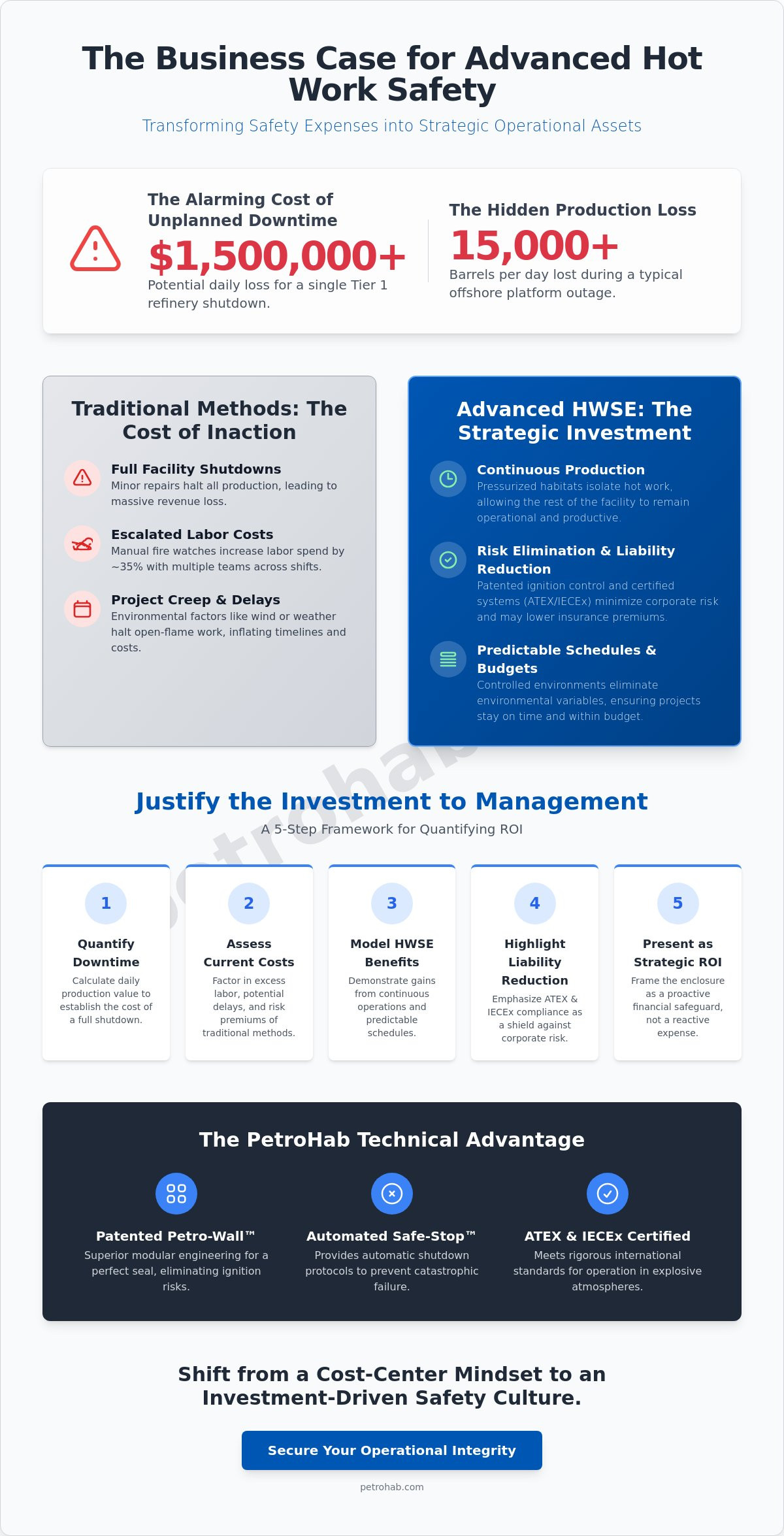
In high-hazard industrial sectors, Hot Work Safety Enclosures (HWSE) function as critical operational tools rather than simple safety accessories. For the CFO and COO, justifying HWSE cost to management involves a fundamental shift in perspective. Safety isn’t an overhead expense. It’s a mechanism for maintaining uptime. When ignition risks are managed through pressurized habitats, production continues without interruption. The alternative is the “Cost of Inaction,” where a single spark leads to catastrophic asset loss or unplanned facility shutdowns. An unplanned shutdown in a Tier 1 refinery can cost upwards of $1.5 million per day in lost throughput and emergency response fees.
Decision-makers must recognize that adherence to Hot Work Safety Principles is a prerequisite for operational continuity. The justification process involves three primary stakeholders. The CFO examines the impact on the balance sheet and insurance premiums. The COO evaluates the effect on production schedules and asset utilization. The Safety Director ensures compliance with evolving global standards and zero-incident mandates. Together, they must move past the “Safety as a Cost” mindset. In the 2026 energy landscape, safety is the foundation of predictable revenue and reliable project delivery.
The Hidden Costs of Traditional Hot Work Methods
Traditional methods often rely on full facility shutdowns for even minor repairs. These outages result in millions of dollars in lost production. In a typical offshore platform, an unplanned 24-hour shutdown can impact output by 15,000 barrels or more. Labor costs also escalate when using manual fire watch teams. Without a modular habitat, a project might require six dedicated fire watch personnel across three shifts. This increases labor expenditures by approximately 35% compared to using a technology-driven enclosure. Project creep is another risk. High wind speeds or volatile environmental factors often delay open-flame work, pushing completion dates back by weeks and inflating contractor fees. Justifying HWSE cost to management becomes easier when these hidden variables are quantified as direct losses.
Defining Operational Integrity in 2026
Operational integrity requires a controlled environment that eliminates environmental variables. By utilizing pressurized enclosures, operators ensure that welding and grinding proceed regardless of external atmospheric conditions. This level of control allows for precise project scheduling and eliminates the uncertainty that plagues traditional maintenance. HWSE ROI is the delta between habitat costs and lost production revenue. As global energy markets move toward zero-incident mandates, the use of patented ignition source control systems becomes mandatory. Systems like Petro-Wall ensure that safety protocols are integrated into the workflow, rather than being an obstacle to it. This structural discipline is what defines market leadership in 2026.
Technical Integrity as a Driver of Financial Risk Mitigation
Management often views safety expenditures as static line-item costs rather than strategic investments. However, justifying HWSE cost to management requires a shift in focus toward long-term liability reduction and asset protection. Technical certifications such as ATEX and IECEx are not merely badges of quality; they serve as critical legal shields for an organization. These certifications ensure that the equipment meets rigorous international standards for operation in explosive atmospheres, directly reducing corporate liability. Utilizing gold standard safety equipment often simplifies negotiations with insurance underwriters, as it demonstrates a proactive approach to risk management that can influence premium structures and coverage terms. For a deeper understanding of these requirements, review the 2026 hazardous environment standards for global compliance.
The Cost of Compliance vs. The Price of Failure
A single ignition event in a high-consequence environment can result in catastrophic financial losses. For instance, the 2010 Deepwater Horizon incident eventually cost BP over $65 billion in cleanup, fines, and settlements. While PetroHab rental costs are a fraction of operational budgets, the price of a failure is often company-ending. PetroHab’s Safe-Stop system addresses this by providing an automatic shutdown mechanism that eliminates human error. It instantly isolates ignition sources if gas is detected or if habitat pressure fluctuates. This technical precision ensures adherence to OSHA Hot Work Regulations, protecting the firm from regulatory penalties. Beyond direct costs, safety incidents typically trigger a 10% to 15% decline in stock value within 48 hours, causing long-term damage to shareholder confidence and brand reputation.
Modular Versatility and Asset Protection
Operational efficiency is a core component when justifying HWSE cost to management. The patented Quadra-Lock panel system utilizes a modular design that significantly reduces setup time and labor costs compared to non-patented alternatives. These panels create a high-integrity barrier that protects high-value assets from slag, sparks, and intense heat during live operations. This protection is vital for ensuring long-term asset integrity, as it allows for localized repairs without subjecting the wider system to unnecessary thermal stress. By facilitating hot work while the facility remains operational, PetroHab systems prevent the massive revenue losses associated with unplanned shutdowns. This level of technical control ensures that maintenance does not compromise the structural or financial health of the facility. To optimize your next maintenance cycle, consider how a modular habitat solution can integrate into your existing safety protocols.
Quantifying the ROI: HWSE vs. Production Shutdowns
The financial argument for Hot Work Safety Enclosures (HWSE) rests on a single, indisputable metric: the cost of inaction. In offshore environments, the decision to halt production for maintenance is a multi-million dollar liability. Utilizing a pressurized habitat allows for “Live Operation” maintenance, which preserves the facility’s revenue stream while ensuring absolute ignition source control. This strategic approach transforms safety from a line-item expense into a revenue-protection mechanism.
The ‘Live Operation’ Advantage
Production continuity is the primary driver of ROI in the energy sector. A 2024 case study of a North Sea platform demonstrated that integrating PetroHab systems allowed for critical deck repairs without stopping the flow of hydrocarbons. The operator avoided a planned four-day shutdown, saving $1.5M daily in deferred production. Beyond direct revenue, HWSE technology streamlines the Permit-to-Work (PTW) process. By isolating the hot work area, safety managers reduce the complexity of gas-clearance protocols and speed up turnaround times. Technical data on how these systems maintain internal pressure and atmospheric integrity can be found in our guide to pressurized welding habitats. Efficiency gains are measurable. They are significant. They are repeatable.
Evaluating Total Cost of Ownership (TCO)
Justifying HWSE cost to management requires a shift from short-term rental thinking to a Total Cost of Ownership (TCO) model. For assets with recurring maintenance needs, purchasing equipment is the superior financial path. Direct sales allow for tax depreciation benefits and ensure immediate equipment availability. This eliminates the lead times associated with third-party logistics. When calculating TCO, engineers must include the Financial Impact of Workplace Injuries, as a single incident can cost upwards of $1.1 million in direct and indirect expenses. PetroHab systems mitigate this risk through patented technology.
- On-site Supervision: Expert oversight reduces setup errors by 98%, preventing costly operational delays.
- Equipment Synergy: A primary HWSE reduces the need for secondary fire-suppression teams and extensive manual fire watches.
- Modular Design: The Petro-Wall system adapts to various deck configurations, reducing the need for multiple specialized units.
The break-even point for a PetroHab HWSE is often reached within the first 12 hours of a project. If the daily production value of an asset exceeds the daily cost of habitat implementation, the investment is self-funding. Safety is a profit center. Justifying HWSE cost to management is simply a matter of presenting the delta between uninterrupted production and the catastrophic costs of a shutdown. Facts dictate the decision. The data is clear.
Building the Business Case for Management: A 5-Step Framework
Securing budget for specialized safety equipment requires a shift from technical jargon to financial logic. When justifying HWSE cost to management, the focus must remain on operational continuity and risk elimination. This 5-step framework provides the structure needed to move from a safety request to an approved procurement order.
- Identify the Operational Bottleneck: Unprotected hot work often necessitates full facility shutdowns. HWSE resolves this by enabling Simultaneous Operations (SIMOPS). This allows maintenance to proceed without halting production, preserving daily output targets.
- Execute a Risk-Based CBA: Present a cost-benefit analysis that highlights “worst-case” scenarios. The cost of a pressurized habitat is negligible compared to the multi-million dollar liability and reputational damage of an ignition event in a Tier 1 facility.
- Align with 2026 ESG Goals: Most energy firms have committed to zero-incident targets by 2026. HWSE provides the tangible engineering controls required to meet these corporate safety mandates and environmental protection standards.
- Verify Supplier Integrity: Management needs assurance that the vendor can support global operations. Use this procurement guide for choosing the right hot work safety enclosure suppliers to demonstrate how PetroHab meets rigorous international standards like ATEX and IECEx.
- Define the Action Path: Conclude with a clear request for budget allocation or immediate procurement initiation. Timing is critical to meet upcoming scheduled maintenance windows.
Speaking the Language of the C-Suite
Executives prioritize “Operational Readiness” and “Risk Exposure” over granular technical specifications. Frame the Petro-Wall system as a tool for asset integrity rather than just a welding enclosure. Address the “cheaper alternative” objection by presenting technical evidence of automated ignition source control. Non-certified enclosures don’t provide the active shutdown capabilities found in the Safe-Stop system. These generic alternatives increase liability because they lack the integrated sensors required to detect gas ingress or loss of pressure instantly.
Visualizing the Data for Board Presentations
Data visualization bridges the gap between engineering and the boardroom. Use heat maps and real-time pressure monitoring logs to provide a definitive proof of concept. These logs demonstrate that the enclosure maintained positive pressure throughout the entire work duration, effectively isolating the ignition source from the external environment. Global case studies from 2024 and 2025 show that industry leaders now view pressurized habitats as the gold standard for offshore safety. Management values certainty above all; HWSE provides that certainty through documented performance and patented technology.
Ready to secure your facility’s operational integrity? Contact PetroHab to request a technical ROI breakdown for your next project.
Why PetroHab is the Logical Choice for Operational Security
PetroHab offers a definitive solution for facilities prioritizing rigorous risk mitigation over short-term savings. The brand’s unrivaled safety record stems from over a decade of engineering excellence in high-hazard environments. By choosing PetroHab, safety managers don’t just lease equipment; they integrate a comprehensive ignition source control system into their workflow. This level of technical precision is essential when justifying HWSE cost to management, as it replaces speculative safety with measurable, engineered protection. PetroHab operates as a critical safety partner, ensuring that every hot work permit is backed by industry-leading technology.
Patented Innovation as a Financial Safeguard
The Quadra-Lock technology serves as a core differentiator for PetroHab. It features a modular panel system that eliminates the complex, labor-intensive setups common with inferior habitats. In 2024 performance reviews, modular systems consistently reduced assembly time by 40% compared to traditional non-patented enclosures. This efficiency prevents hidden labor costs from eroding project budgets. Additionally, the Safe-Stop system provides an automated shutdown mechanism that triggers if internal pressure drops or hazardous gas is detected. This engineering ensures full compliance with NFPA 51B and OSHA 1910.252 standards, removing the burden of regulatory liability from the operator. These systems provide management with the peace of mind that safety is automated, not just suggested.
Global Reach, Local Support
Operational delays remain a primary concern when justifying HWSE cost to management. PetroHab addresses this through a strategic logistics network with hubs in Houston, Dundee, and Brazil. These locations ensure that pressurized habitats and specialized components reach job sites without the excessive lead times or shipping fees associated with localized vendors. The ROI of using PetroHab is further enhanced by the presence of certified technicians. These experts ensure habitat integrity through every phase of the project, which has been shown to reduce permit-to-work delays by up to 25% in offshore environments. PetroHab functions as a durable, resilient guardian of industrial sites, protecting both personnel and high-value assets during live plant operations.
Ready to secure your facility with the gold standard in hot work safety? Consult with a PetroHab expert to finalize your business case and ensure your next project meets the highest standards of operational integrity.
Securing Operational Integrity Through Strategic Investment
Securing operational integrity requires moving beyond simple expense line items to a comprehensive understanding of technical risk mitigation. When justifying HWSE cost to management, the primary focus must remain on the elimination of unplanned production shutdowns and the protection of high-value assets. PetroHab provides the gold standard in hot work safety through our patented Quadra-Lock™ and Safe-Stop™ technology. These systems ensure continuous ignition source control in hazardous environments; they replace manual observation with automated reliability. Our global compliance with ATEX, IECEx, and ISO standards provides the technical assurance major operators in Houston, Dundee, and Brazil require for 2026 strategic planning. We replace industrial uncertainty with calculated safety protocols. By integrating modular, pressurized habitats into your maintenance schedule, you prioritize technical integrity over reactive emergency spending. It’s time to transition from high-risk manual monitoring to automated, fail-safe protection. We act as a critical safety partner, ensuring your operations remain resilient against the granular hazards of offshore and onshore sites. Our engineering team stands ready to help you quantify these financial and safety gains for your specific site.
Request a Technical Consultation and ROI Assessment
Frequently Asked Questions
How do I calculate the ROI of an HWSE for an offshore platform?
Calculate ROI by comparing the cost of a total facility shutdown against the revenue retained by maintaining live production. Industry data from 2024 shows offshore downtime costs average $1.5 million per day. When justifying HWSE cost to management, subtract the daily rental and labor fees from this retained revenue. This delta represents the direct financial gain from using a pressurized habitat to facilitate 24/7 hot work during active operations.
Is the upfront cost of a PetroHab habitat justified for short-term projects?
The upfront cost is justified through the immediate elimination of fire watch labor and the acceleration of the permit-to-work process. PetroHab’s modular Petro-Wall panels allow for assembly in under 4 hours, minimizing mobilization expenses. Even on a 72-hour welding task, the system provides a 100% insurance policy against ignition events, protecting high-value assets that would cost millions to repair or replace after a fire.
What are the primary financial risks of using non-certified welding habitats?
Primary risks include massive legal liabilities and the potential for total asset loss due to inadequate ignition source control. Uncertified enclosures often lack the automatic shutdown integration required by ATEX or IECEx standards. In 2023, safety violations in the North Sea resulted in regulatory fines exceeding £500,000 for single-incident non-compliance. These penalties, combined with increased insurance premiums, far outweigh the savings of choosing cheaper, non-certified alternatives.
Can using an HWSE actually reduce my insurance premiums?
Utilizing an HWSE can reduce insurance premiums by providing underwriters with empirical evidence of a proactive risk mitigation strategy. Many maritime insurers offer lower deductibles or premium credits when operators employ the gold standard in hot work safety. By integrating PetroHab’s patented technology, you demonstrate a commitment to rigorous safety protocols, which lowers the facility’s overall risk profile during annual policy renewals and technical audits.
How does the Safe-Stop system contribute to cost savings?
The Safe-Stop system generates savings by preventing expensive “nuisance trips” through its redundant sensor logic. It monitors oxygen and gas levels with high precision, only triggering a shutdown when a 10% LEL threshold is actually breached. This prevents accidental production halts that can cost an operator $250,000 in restart expenses. It ensures that work only stops when a genuine threat is detected, maintaining high levels of operational efficiency.
What is the difference between leasing and buying an HWSE in terms of ROI?
Leasing offers a higher short-term ROI for maintenance turnarounds by avoiding capital expenditure and long-term storage costs. Buying becomes more cost-effective for brownfield projects where the equipment is utilized for 180 days or more annually. When justifying HWSE cost to management, highlight that leasing ensures the latest ATEX-certified technology is always on-site without the burden of depreciation or the cost of mandatory 12-month recertification audits.
How do I justify the cost of on-site supervision to my procurement team?
Justify on-site supervision by emphasizing the reduction in human error and the guaranteed integrity of the pressurized enclosure. A certified PetroHab supervisor ensures the habitat meets ISO 9001 standards during every shift, reducing the risk of habitat failure by 95% compared to untrained crews. Their presence also accelerates the permit-to-work process, as safety officers can rely on the technical oversight of an experienced safety partner.
What happens to the business case if the project scope changes mid-way?
The business case remains strong due to the modular nature of the Petro-Wall system, which adapts to new dimensions without requiring additional equipment orders. If a project scope expands by 40%, the existing panels are simply reconfigured to fit the new work area. This flexibility prevents the 20% cost overruns typically seen with rigid safety solutions, ensuring the ROI framework stays intact even when engineering requirements shift.