Blog Posts
LNG Plant Maintenance Safety Protocols: The 2026 Engineering Guide
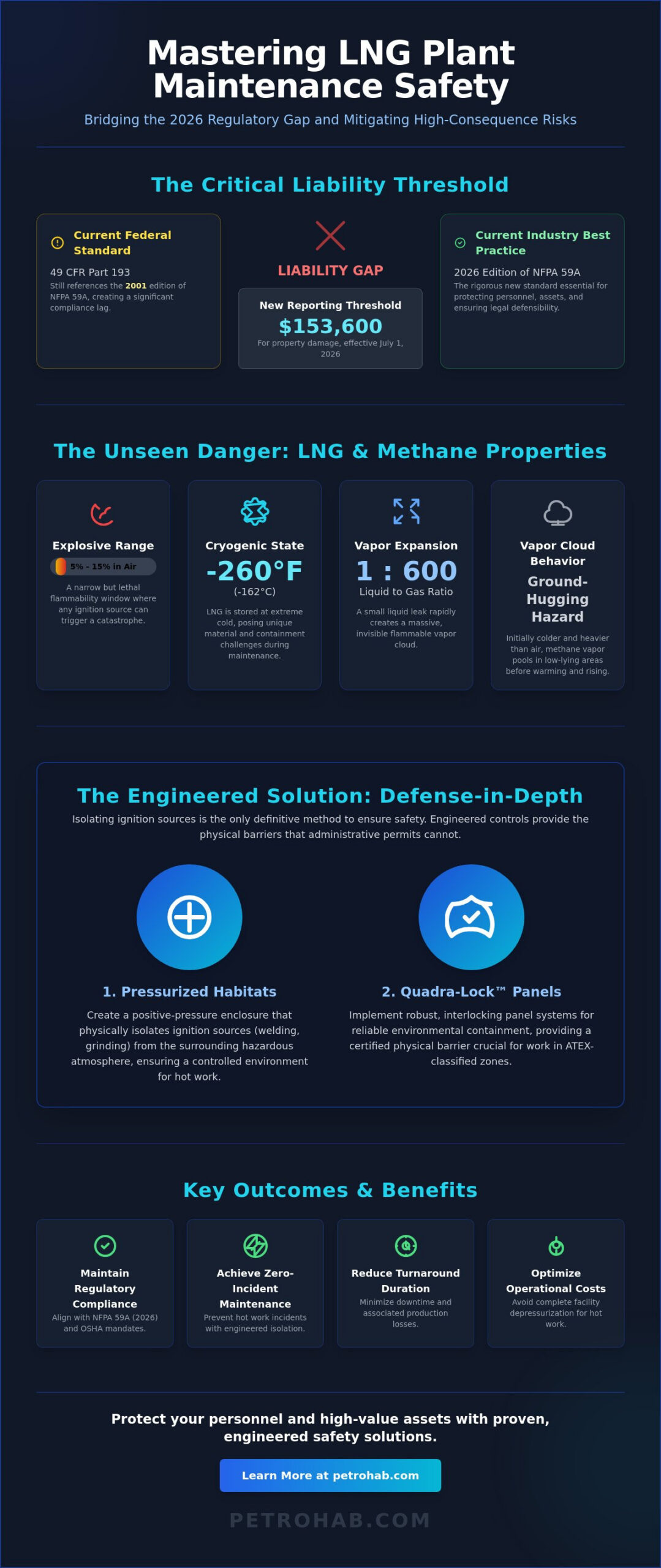
The gap between PHMSA’s current 49 CFR Part 193 and the rigorous 2026 edition of NFPA 59A creates a liability threshold that safety managers cannot ignore. With the property damage reporting threshold increasing to $153,600 on July 1, 2026, the margin for error during high-consequence maintenance is non-existent. Implementing advanced LNG plant maintenance safety protocols is the only definitive method to protect personnel and high-value assets from the risks of methane vapor clouds.
You face relentless pressure to minimize turnaround duration while managing a lagging regulatory landscape. This guide provides a technical roadmap to master these protocols, ensuring full alignment with NFPA and OSHA mandates. We’ll examine how to isolate ignition sources in hazardous zones using Quadra-Lock panels and pressurized habitats. This approach facilitates zero-incident maintenance cycles and maintains operational continuity in the most demanding environments.
Key Takeaways
- Identify and mitigate the specific risks associated with methane’s 5% to 15% explosive range and cryogenic phase changes during maintenance.
- Align operational procedures with the 2026 NFPA 59A updates and 49 CFR Part 193 Subpart G to maintain strict regulatory compliance.
- Implement a “Defense-in-Depth” strategy by utilizing pressurized enclosures to effectively isolate ignition sources from hazardous atmospheres.
- Integrate Quadra-Lock panels into your LNG plant maintenance safety protocols to ensure reliable environmental containment in ATEX-classified zones.
- Reduce turnaround duration and costs by conducting essential hot work safely without requiring complete facility depressurization.
Understanding the High-Stakes Hazards of LNG Plant Maintenance
Maintenance in LNG facilities is an exercise in extreme risk management. Methane possesses a narrow but lethal flammability range between 5% and 15% concentration in air. Within this window, any ignition source triggers a deflagration or detonation. Traditional hot work permits rely on administrative controls, but these fail when physical conditions shift rapidly. Relying on paper-based LNG plant maintenance safety protocols without engineered isolation is a critical oversight that leaves assets vulnerable to catastrophic failure.
The transition from cryogenic liquid to gaseous methane adds a layer of complexity. A comprehensive overview of Liquefied Natural Gas (LNG) confirms that the substance is stored at approximately -260°F. If containment is lost during maintenance, the resulting phase change creates a massive volume of flammable vapor. This rapid expansion demands proactive ignition control rather than reactive gas detection. Proper safety planning must account for the fact that methane becomes lighter than air only as it warms, meaning initial leaks create ground-hugging hazards.
To better understand the necessity of following rigorous procedures in these environments, watch this safety brief:
The Physics of LNG Vapor Clouds
When LNG spills, it rapidly absorbs heat from the environment. This causes the liquid to expand at a ratio of 1:600. One gallon of liquid becomes 600 gallons of gas. These vapor clouds are initially heavier than air due to their extreme cold, causing them to hug the ground and accumulate in low-lying areas. Visual cues are deceptive. While a white fog often forms due to condensed atmospheric moisture, the actual flammable methane cloud may extend far beyond the visible mist. Understanding these pressure-volume relationships is vital for establishing exclusion zones that actually protect personnel. Without physical barriers, a vapor cloud can migrate into maintenance areas undetected by the naked eye.
Common Maintenance Ignition Sources
Facility turnarounds introduce a concentrated density of ignition risks. Welding, grinding, and torch cutting generate slag and sparks that travel significant distances. Beyond these obvious culprits, electrical repairs on non-classified equipment and static discharge during high-flow purging operations pose silent threats. The economic stakes are higher than ever in the 2026 market. Effective July 1, 2026, the PHMSA property damage reporting threshold stands at $153,600. A single incident doesn’t just risk lives; it triggers intense regulatory scrutiny and millions in lost production. Engineered solutions like Quadra-Lock panels provide the physical barrier necessary to maintain safety where permits alone fail. This technical isolation is the only way to ensure that a maintenance spark doesn’t meet a wandering vapor cloud.
Navigating Regulatory Frameworks: NFPA 59A and 49 CFR Part 193 Compliance
Compliance in 2026 requires safety managers to navigate a significant regulatory lag. While 49 CFR Part 193 remains the enforceable federal standard, it still references the 2001 edition of NFPA 59A. However, the industry has moved to the 2026 edition of NFPA 59A, which became effective on December 9, 2025. Safety managers must bridge this gap to ensure LNG plant maintenance safety protocols meet current best practices while satisfying DOT/PHMSA audits. Relying on outdated standards during a turnaround introduces unacceptable legal and operational risks.
Subpart G of 49 CFR Part 193 mandates that every operator follow a written maintenance manual. This isn’t a suggestion; it’s a federal requirement. OSHA 1910.119 (Process Safety Management) further complicates this by requiring rigorous hot work permit systems and mechanical integrity programs. When performing repairs, documenting that ignition sources were physically isolated by Quadra-Lock panels and pressurized systems is just as important as the isolation itself. Hardware-based records provide the objective evidence regulators demand during inspections, proving that the facility adhered to established LNG plant maintenance safety protocols throughout the maintenance cycle.
NFPA 59A (2026 Edition) Key Updates
The 2026 edition introduces expanded requirements for electrical area classification and ignition source control. It specifically emphasizes the need for active protection when hot work occurs near storage tanks or impoundment areas. The standard now recognizes active pressurized containment as a primary method for mitigating risk in these high-consequence zones. Mandatory distance requirements for hot work have also been refined to account for modern vapor dispersion modeling, pushing for physical isolation over mere distance whenever possible.
The DOT/PHMSA Compliance Landscape
Effective July 1, 2026, the property damage reporting threshold for gas incidents is $153,600. This increase reflects the rising economic impact of even minor containment losses. Aligning company SOPs with these evolving federal safety studies requires a shift from passive monitoring to active control. Bridging international IECEx standards with domestic PHMSA requirements ensures that hardware like pressurized habitats remains compliant across global operations. Technical precision in documentation is the final pillar of compliance. Automated shutdown systems that log pressure differentials and gas detection levels create a non-repudiable safety record that satisfies both Subpart G and PSM requirements.
Ignition Source Control: The Technical Superiority of Pressurized Habitats
Technical isolation is the cornerstone of modern LNG plant maintenance safety protocols. While gas detection systems alert personnel to danger, they don’t prevent the ignition of a migrating vapor cloud. Pressurized Hot Work Safety Enclosures (HWSE) establish a physical barrier that renders atmospheric hazards irrelevant to the work being performed inside. This “Defense-in-Depth” strategy ensures that even if a primary containment failure occurs elsewhere in the facility, the internal welding arc or grinding spark remains isolated within a controlled environment. It’s a proactive approach that eliminates the risk of an ignition event before it can begin.
Maintaining a constant positive pressure is the primary mechanism of protection. By keeping the internal pressure higher than the external atmosphere, the habitat forces air out through any microscopic gaps, preventing flammable gases from entering. Manometers provide a visual confirmation of this differential, while automatic monitoring systems ensure the integrity of the enclosure remains within engineering tolerances. For a more comprehensive look at how these systems function in hazardous zones, consult our Definitive Guide to Hot Work Safety Enclosures. This methodology represents the industry benchmark for high-risk maintenance.
Modular Quadra-Lock Panel Technology
The structural integrity of an enclosure depends on its individual components. Quadra-Lock panels utilize a modular design that allows for rapid assembly around complex piping, valves, and structural steel common in LNG plants. These panels are manufactured from fire-resistant materials that meet ANSI/FM 4950 standards, ensuring they can withstand continuous exposure to sparks and slag without compromising the seal. The interlocking nature of the Quadra-Lock system creates a gas-tight environment that adapts to the specific geometry of the maintenance site. This flexibility provides a level of protection that generic tarps or non-pressurized barriers cannot match, especially when working near cryogenic storage systems.
The Safe-Stop Automatic Shutdown System
If the physical barrier is the shield, the Safe-Stop Automatic Shutdown System is the sentry. This technology monitors the environment for both pressure loss and gas ingress. If gas levels reach a 20% Lower Explosive Limit (LEL) threshold, or if the internal pressure drops below the required safety margin, the system isolates power to the ignition source in milliseconds. This rapid response is critical when managing the high-velocity expansion of methane. By integrating Safe-Stop with existing plant emergency shutdown (ESD) systems, safety managers create a unified protection network. This integration ensures that LNG plant maintenance safety protocols are not just isolated procedures but are deeply embedded into the facility’s broader safety architecture.
Implementing a Zero-Incident Hot Work Protocol in LNG Facilities
Execution of LNG plant maintenance safety protocols transitions from theoretical planning to physical implementation during the turnaround phase. This process begins with a precise ATEX zone classification. Identifying these hazardous areas, specifically Zones 0, 1, or 2, allows safety managers to determine the exact level of isolation required for specific tasks. Following this assessment, technicians deploy Quadra-Lock panels to construct the habitat. These interlocking components adapt to the irregular surfaces of LNG piping and cryogenic valves, ensuring a gas-tight seal that administrative controls simply cannot provide.
Validation is the next non-negotiable step. Before any spark is generated, the environment must undergo rigorous pressure testing. This confirms that the internal atmosphere maintains a positive pressure differential relative to the external facility. Certified technicians remain on-site to monitor these levels throughout the entire hot work cycle. Their presence ensures that the integrity of the habitat is never compromised by shifting environmental conditions or mechanical vibrations. This level of technical oversight is what differentiates a standard maintenance task from a zero-incident operation.
The Permit-to-Work (PTW) Integration
Regulatory compliance hinges on the synchronization of habitat logs with the master maintenance permit. Every pressure reading and gas detection event must be documented to satisfy OSHA and PHMSA audit requirements. The Fire Watch assumes a specialized role when a pressurized habitat is in use. Beyond traditional spark observation, they act as the primary liaison between the habitat team and the broader facility. For a detailed breakdown of these operational requirements, consult our guide on Advanced Hot Work Safety Systems.
Emergency and Contingency Planning
A robust safety protocol accounts for the unexpected. If the Safe-Stop system detects a loss of pressure or gas ingress, the protocol mandates an immediate, millisecond-fast shutdown of all ignition sources. Communication chains between the habitat team and the central control room must be tested and verified before work starts. Vapor cloud mitigation strategies, such as water curtains or steam lances, should be pre-staged near the work area as a secondary layer of protection. Post-work inspections conclude the cycle, ensuring site integrity before habitat decommissioning. To enhance your facility’s resilience, integrate our Petro-Habitats into your next maintenance schedule.
Optimizing Facility Turnarounds with PetroHab HWSE Technology
The economic viability of an LNG facility depends on its uptime. Traditional turnarounds often require total system blowdowns, leading to significant product loss and environmental impact. Implementing advanced LNG plant maintenance safety protocols through the use of PetroHab HWSE technology allows for “live” maintenance. This means welding and grinding can occur in proximity to operational lines because the ignition source is physically isolated. By avoiding full plant depressurization, operators save millions in lost production and nitrogen purging costs.
Safety managers must decide between leasing and purchasing enclosures based on their specific project lifecycle. Purchasing provides a long-term asset for routine repairs and smaller maintenance cycles, ensuring the equipment is always on-site. Conversely, leasing offers a scalable solution for massive turnaround events without the burden of long-term storage or maintenance of the hardware. Regardless of the acquisition model, the use of Quadra-Lock panels ensures that every enclosure remains gas-tight and fire-resistant. This flexibility allows for a tailored approach to risk mitigation that fits the facility’s specific budgetary and operational needs.
Turnaround Economics in the LNG Sector
The ROI of habitat-enabled maintenance is measured in recovered production hours. By performing work in simultaneous zones, engineers reduce the “Critical Path” duration of the entire turnaround. This efficiency minimizes flare volumes, which is vital as environmental regulations tighten throughout 2026. Every hour saved from the flare stack represents both a financial gain and a reduction in the facility’s carbon footprint. Using pressurized habitats transforms safety from a regulatory hurdle into a tool for operational excellence. It’s a calculated strategy that protects the bottom line while protecting the workforce.
Partnering for Global LNG Safety
Personnel competence is the final link in the safety chain. PetroHab provides on-site supervision through certified technicians who understand the granular details of habitat deployment in ATEX zones. This expertise is available globally, supporting facilities from the energy hubs of Houston to emerging terminals in Brazil and the United Kingdom. Future-proofing your facility means adopting technology that exceeds the 2026 NFPA 59A standards. We don’t just provide equipment; we act as a critical safety partner for the world’s most complex energy assets.
To secure your next maintenance cycle with technical isolation, Request a consultation for your 2026 LNG turnaround today.
Advancing Safety Excellence in 2026 LNG Operations
Mastering LNG plant maintenance safety protocols requires a shift from passive monitoring to active, engineered containment. This guide has detailed the necessity of technical isolation to manage methane’s 5% to 15% explosive range while ensuring full alignment with the 2026 NFPA 59A updates. By prioritizing physical barriers over administrative permits, safety managers eliminate the risk of ignition in high-consequence zones. This approach doesn’t just protect personnel; it optimizes turnaround economics by reducing the critical path duration and avoiding costly facility depressurization.
PetroHab provides the rigorous engineering required for these high-stakes environments. Our patented Quadra-Lock technology and ATEX/IECEx compliant Safe-Stop systems deliver a definitive technological remedy to hazardous conditions. With global support offices in the United States, Brazil, and the UK, we’re positioned to act as your critical safety partner across all international operations. It’s time to redefine your facility’s resilience through meticulous risk mitigation and operational discipline.
Secure your LNG facility with PetroHab Hot Work Safety Enclosures and ensure your next maintenance cycle is defined by technical precision and uncompromising protection.
Frequently Asked Questions
What is the primary safety protocol for LNG hot work?
The primary safety protocol for LNG hot work is the technical isolation of ignition sources within a pressurized environment. This methodology prioritizes physical separation over administrative permits alone. By establishing a controlled atmosphere, operators ensure that the 5% to 15% flammability range of methane doesn’t interact with maintenance sparks. These LNG plant maintenance safety protocols are essential for protecting high-value assets and personnel during complex turnarounds.
How do pressurized habitats prevent explosions in LNG plants?
Pressurized habitats prevent explosions by maintaining a positive pressure differential relative to the external atmosphere. This constant outflow creates a physical barrier. It prevents flammable methane vapors from entering the enclosure. Even if a leak occurs nearby, internal pressure forces the gas away from the ignition source. This “Defense-in-Depth” strategy provides a definitive technological remedy to the risks associated with ground-hugging vapor clouds.
Are PetroHab enclosures compliant with NFPA 59A standards?
PetroHab enclosures are fully compliant with the 2026 edition of NFPA 59A. They meet the updated requirements for active ignition control and environmental containment in hazardous zones. Our engineering aligns with the industry’s latest standards that became effective on December 9, 2025. This ensures that your facility maintains full regulatory alignment while utilizing the most advanced pressurized habitat technology available in the energy sector.
What happens if gas is detected near the hot work area?
The Safe-Stop system initiates an immediate, millisecond-fast shutdown of all power to the work area if gas is detected at the 20% LEL threshold. This automated response eliminates the ignition source before the gas concentration reaches a dangerous level. Technicians then follow established evacuation procedures while the control room manages the broader facility response. This rapid isolation is a critical component of modern LNG plant maintenance safety protocols.
Can hot work be performed while an LNG plant is operational?
Hot work can be performed while an LNG plant is operational if pressurized enclosures are utilized for isolation. This “live” maintenance approach avoids the economic and environmental costs of a total plant depressurization. By isolating the specific work area, operators can complete essential repairs without interrupting the primary production flow. This methodology significantly reduces turnaround duration and minimizes the volume of gas sent to the flare stack.
What is the role of the Safe-Stop system in LNG maintenance?
The Safe-Stop system serves as the automated safety sentry for the pressurized habitat. It continuously monitors both the internal pressure and the presence of flammable gases in the vicinity. If it identifies a loss of pressure or gas ingress, it isolates the power supply to all maintenance equipment in milliseconds. This system provides a non-repudiable safety record and ensures that human error can’t override critical safety thresholds during a turnaround.
How do Quadra-Lock panels differ from traditional welding blankets?
Quadra-Lock panels offer a structural, gas-tight seal that traditional welding blankets can’t achieve. While blankets only provide a passive barrier against sparks and slag, Quadra-Lock panels are engineered to maintain a pressurized environment. They’re manufactured from fire-resistant materials that meet ANSI/FM 4950 standards. This modular technology allows for the construction of rigid enclosures that adapt to complex piping while excluding flammable vapors from the work area.
What training is required for personnel using HWSE in LNG zones?
Personnel using HWSE must undergo specialized training in pressurized habitat operation and hazardous area safety. This training covers the technical setup of Quadra-Lock panels, the integration of Safe-Stop systems, and the interpretation of manometer readings. Workers must also be proficient in ATEX/IECEx zone classifications and emergency response procedures. It’s the only way to ensure that every technician on-site is competent to manage the high-stakes environment of an active LNG facility.