
Blog Posts
Integrating Shutdown Systems with Welding Habitats: The 2026 Engineering Guide
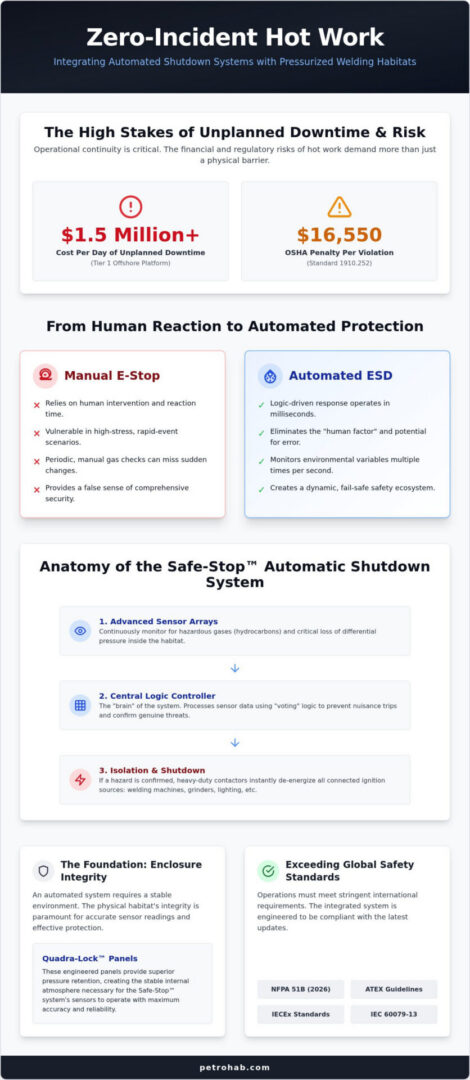
A single day of unplanned production downtime on a Tier 1 offshore platform can exceed $1.5 million. You recognize that maintaining operational continuity while performing hot work in hazardous zones is a calculated risk that requires more than just a physical barrier. Simply deploying a pressurized enclosure isn’t enough to guarantee safety against hydrocarbon ignition. Integrating shutdown systems with welding habitats transforms a passive enclosure into a dynamic, logic-driven safety ecosystem. This integration removes the human factor; it ensures that any loss of pressure or detection of gas results in an immediate, automatic cessation of work.
This guide details the technical requirements for achieving zero-incident hot work operations while remaining compliant with the 2026 updates to NFPA 51B and ATEX guidelines. You’ll learn how the Safe-Stop Automatic Shutdown System serves as the essential brain of your PetroHab LLC habitats, monitoring environmental variables in real time. We’ll examine the engineering behind Quadra-Lock panels for pressure retention and the specific protocols required to meet the latest IEC 60079-13 standards. By the end of this technical overview, you’ll have a clear roadmap for maximizing uptime without compromising the safety of your personnel or high-value assets.
Key Takeaways
- Understand the critical distinction between a manual emergency stop and a logic-driven ESD designed to isolate ignition sources automatically.
- Identify the technical parameters for integrating shutdown systems with welding habitats to ensure immediate protection against gas ingress or pressure loss.
- Learn how Quadra-Lock panels facilitate consistent internal pressure, providing the stable environment necessary for Safe-Stop sensor accuracy.
- Navigate the 2026 updates to ATEX, IECEx, and NFPA 51B standards to ensure your hot work operations meet stringent international safety requirements.
- Establish rigorous operational protocols for commissioning automatic shutdown systems and managing on-site safety through certified supervision.
Defining the Emergency Shutdown System (ESD) for Industrial Hot Work
An Emergency Shutdown System (ESD) in the context of hot work is a specialized, automated safety layer. It functions by isolating potential ignition sources immediately upon the detection of hazardous vapors or a critical loss of differential pressure. Unlike a standard process shutdown, an ESD for hot work focuses specifically on the localized environment where sparks or heat are generated. This technology is the cornerstone of a modern hot work safety enclosure strategy, providing a definitive remedy to the risks inherent in volatile atmospheres.
A frequent misconception in safety management is that a manual Emergency Stop (E-Stop) provides sufficient protection. This is incorrect. An E-Stop requires human intervention and a fast reaction time, which is often impossible in high-stress scenarios. Integrating shutdown systems with welding habitats introduces a logic-driven response that operates in milliseconds. It eliminates the “human factor” by using sensors to monitor the environment continuously. If gas levels reach a pre-set threshold, the system de-energizes all equipment before an ignition can occur.
To better understand the operational mechanics of these systems, watch this technical overview:
Ignition Source Control vs. Process Shutdown
The ESD system targets the specific electrical loads used during maintenance. This includes welding machines, grinders, and internal lighting systems. By employing the “fail-safe” principle, the system ensures that every connected device defaults to a de-energized state if a trip occurs or if the system loses power itself. Manual gas monitoring cannot compete with this level of precision. While a technician might check for gas every thirty minutes, integrating shutdown systems with welding habitats allows for environmental checks multiple times per second. This ensures environmental containment is never compromised by human error or slow detection.
The High Stakes of Hot Work in Zone 1 and Zone 2
Operating in Zone 1 or Zone 2 environments involves the constant threat of hydrocarbon release. As of January 2026, OSHA penalties for serious violations of hot work standards (1910.252) have reached $16,550 per instance. Beyond regulatory fines, the economic consequences are severe. Unplanned downtime for a Tier 1 offshore platform can exceed $1.5 million per day. ESD systems act as a critical safeguard, allowing essential repairs to proceed without a full facility blowdown. They provide the technical reliability needed to protect high-value assets and, most importantly, the lives of the personnel on-site.
Anatomy of a Hot Work ESD: The Safe-Stop Mechanism
The Safe-Stop Automatic Shutdown System represents the 2026 benchmark for ignition prevention in high-risk industrial sectors. It functions as the centralized intelligence for Petro-Habitats, moving beyond simple switches to a sophisticated logic-driven architecture. The engineering involved in integrating shutdown systems with welding habitats focuses on four primary components: advanced sensor arrays, a logic controller, isolation hardware, and real-time monitoring interfaces. By continuously analyzing environmental data, the system ensures that hot work only proceeds when the atmosphere is demonstrably safe.
A critical feature of the Safe-Stop system is its use of “voting” logic. The controller processes inputs from multiple sensors simultaneously. By comparing these data points, the system distinguishes between a genuine atmospheric hazard and a localized sensor anomaly or failure. This prevents nuisance trips, which are a significant concern for safety managers; unplanned downtime can cost an industrial facility $500,000 per day. When a valid threat is detected, heavy-duty contactors within the isolation hardware instantly disconnect power to all non-certified equipment, including welding machines and grinders.
Environmental Monitoring and Gas Detection
Strategic sensor placement is the most effective way to address gaps in traditional gas monitoring. When integrating shutdown systems with welding habitats, LEL gas detectors are positioned at the air intake of the pressurization unit. This placement detects hydrocarbons or H2S before they can enter the enclosure. Internal sensors provide a redundant layer of protection for the work area. The system is calibrated with dual thresholds: a low-level gas detection triggers a cautionary visual alarm, while reaching a higher LEL percentage initiates a full system trip. This tiered approach allows technicians to investigate minor fluctuations without immediately halting production.
Pressure Sensing and Habitat Integrity
Maintaining a positive pressure environment is the first physical line of defense against gas ingress. The Safe-Stop system monitors the overpressure inside the enclosure relative to the exterior atmosphere. Differential pressure is the primary barrier against external gas ingress. If fan flow rates drop or a breach in the enclosure panels occurs, the sensors detect the loss of buoyancy and trigger the ESD logic. This ensures that the internal environment remains isolated from the surrounding hazardous zone. For facilities looking to upgrade their current protocols, the Safe-Stop Automatic Shutdown System provides the technical reliability required for modern compliance.
Integrating Enclosure Integrity with Shutdown Logic
The efficacy of an Emergency Shutdown System depends entirely on the physical stability of the containment area. While the Safe-Stop provides the logic, pressurized welding habitats provide the controlled environment necessary for sensor precision. Without a rigid, airtight enclosure, differential pressure sensors can’t establish a reliable baseline. This makes the physical construction of the habitat an active component of the safety logic, rather than a passive backdrop. Integrating shutdown systems with welding habitats requires a seamless interface between the structural hardware and the electronic monitoring suite to prevent the ingress of flammable gases.
Quadra-Lock Technology and Pressure Retention
The patented Quadra-Lock panel system serves as the foundation for pressure retention. These panels are engineered with interlocking joints that minimize air leakage, which is a prerequisite for maintaining the overpressure needed to repel external gases. If an enclosure uses inferior fastening methods, fluctuating pressure levels can trigger nuisance trips or mask a genuine breach. Structural integrity ensures that ESD sensor data remains accurate and actionable. For instance, a significant breach in panel containment, such as a dislodged seal or a compromised joint, causes an immediate drop in internal pressure. The Safe-Stop system detects this deviation within milliseconds and executes a full isolation of all ignition sources, protecting the facility from potential catastrophe.
Ventilation Control and Air Quality
Air quality management inside the habitat is vital for both personnel safety and ignition prevention. The system must maintain specific Air Changes Per Hour (ACPH) to dilute welding fumes and prevent the accumulation of internal contaminants. The Safe-Stop system maintains a continuous feedback loop with the habitat’s ventilation fans, acting as an active guardian of the work zone. It monitors fan performance and ducting pressure to ensure the air supply remains unobstructed. If a ventilation fan fails or an air duct becomes blocked, the ESD system recognizes the reduction in airflow and immediately de-energizes the work zone. Integrating PetroHab air ducting with the Safe-Stop system ensures that the entire airflow path is monitored. This provides a holistic approach to environmental control that manual checks simply can’t replicate in a high-stakes industrial environment. By maintaining the protected work area through continuous monitoring of habitat seals and panel joints, the system ensures the internal atmosphere remains within safe operating parameters at all times.
Regulatory Compliance: ATEX, IECEx, and NFPA 51B
Compliance with hazardous environment standards is the baseline for any operation in the energy sector. As of January 2026, the 6th Edition of the ATEX 2014/34/EU Guidelines has clarified digital documentation requirements, making real-time data logging more critical than ever. Integrating shutdown systems with welding habitats ensures that every hot work session adheres to these rigorous international frameworks. For Zone 1 operations, every component within the Safe-Stop system, from the sensors to the logic controller, must carry full ATEX or IECEx certification to prevent the hardware itself from becoming an ignition source.
The 2026 updates to NFPA 51B, the Standard for Fire Prevention During Welding, Cutting, and Other Hot Work, mandate strict fire watch protocols and permit requirements. Safe-Stop technology fulfills these mandates by providing an automated layer of protection that supplements the required 60-minute fire watch. The system generates comprehensive audit trails. These digital data logs provide objective proof of atmospheric stability and pressure retention, which are essential for Permit-to-Work (PTW) close-outs and internal safety reporting. This transparency transforms safety from a checklist into a verifiable engineering record.
Safety Integrity Levels (SIL) for Hot Work
A safety system is only as reliable as its Probability of Failure on Demand (PFD). In the North Sea and the Gulf of Mexico, SIL 2 or SIL 3 ratings are the expected benchmarks for ESD units deployed on offshore platforms. Achieving these levels requires redundant architectures and self-diagnostic capabilities. PetroHab systems meet these rigorous reliability standards by ensuring that the Safe-Stop logic can identify internal component failures before they compromise the site. This technical resilience ensures that the primary safety layer remains active even during prolonged maintenance windows.
Zone Classifications and Equipment Suitability
Risk mitigation requires matching ESD hardware to the specific Zone 0, 1, or 2 environment. Within a habitat, gas detection arrays must utilize Intrinsically Safe (IS) wiring to ensure that low-voltage signals cannot generate a spark. This level of engineering is vital when integrating shutdown systems with welding habitats in Brazilian waters or other global jurisdictions with strict regulatory oversight. Ensuring global compliance means your equipment is ready for deployment across diverse regulatory landscapes without modification. If you need to ensure your site meets these 2026 standards, contact PetroHab for a technical consultation on habitat integration.
Operational Implementation: Deploying a Safe-Stop System
Successful deployment begins before any arc is struck. Commissioning hot work safety systems requires a methodical approach to ensure every logic gate and sensor is operational. Integrating shutdown systems with welding habitats is a precision task that demands a verified field deployment checklist. This process moves beyond simple assembly; it establishes the active protection layer that secures the entire work site and ensures that all safety logic is synchronized with the physical enclosure.
Step-by-Step Commissioning of the Safe-Stop System
The deployment sequence starts with the strategic positioning of the main control unit outside the hazardous area. Technicians then connect the sensor umbilical, ensuring all connections are secured for Zone 1 operations. A “dry run” shutdown test is a mandatory prerequisite. During this test, operators simulate an atmospheric hazard to verify that the logic controller successfully isolates all tools and cuts power instantly. Once isolation is confirmed, the team sets baseline pressure levels. These levels are calibrated to the specific habitat configuration and fan speed to maintain the required overpressure throughout the shift.
Training and Personnel Competency
Technical training is vital for anyone serving as a habitat technician in hazardous environments. Competency involves more than just monitoring a screen; it requires a deep understanding of the system’s response logic. Personnel must be able to interpret alarm codes, troubleshoot sensor anomalies, and manage emergency restart procedures without hesitation. This expertise ensures that the “human factor” supports, rather than compromises, the automated safety layer. For facilities without in-house specialists, you can contact PetroHab for expert on-site supervision and training services to ensure your team meets international competency standards.
Long-term reliability is maintained through strict maintenance protocols. Sensors require regular calibration and bump testing to verify their sensitivity to LEL and H2S levels. These inspection schedules must be documented to comply with the digital audit trail requirements established by modern safety regulations. The PetroHab advantage provides flexibility in how these systems are integrated into your fleet. Whether you lease high-spec safety hardware for short-term maintenance shutdowns or purchase systems for permanent installation, the engineering remains uncompromising. This ensures that every project, regardless of scale, is protected by the industry’s most resilient ignition prevention technology.
Advancing Safety Through Logic-Driven Engineering
The evolution of hot work safety in 2026 demands a shift from passive containment to active, logic-driven prevention. You’ve seen how integrating shutdown systems with welding habitats provides the millisecond response times required to eliminate ignition risks in hazardous zones. By combining the structural resilience of Quadra-Lock panels with the diagnostic intelligence of the Safe-Stop system, safety managers can maintain operational continuity without compromising personnel protection. Compliance with updated ATEX and NFPA 51B standards is no longer just a regulatory hurdle; it’s a verifiable engineering achievement that safeguards high-value assets and lives.
PetroHab remains a critical partner in this mission, offering patented Safe-Stop technology through global rental and sale availability. Our commitment extends beyond hardware to include certified technical supervision and on-site training, ensuring your team is fully equipped for zero-incident operations. Don’t leave your site’s safety to manual monitoring. Secure your site with PetroHab’s Safe-Stop Automatic Shutdown System and establish a new benchmark for industrial excellence. Your commitment to rigorous safety protocols today ensures a resilient and productive future for your facility.
Frequently Asked Questions
What is the difference between an emergency shutdown system and an emergency stop?
An Emergency Shutdown System (ESD) is an automated safety layer that operates via logic-driven sensors, whereas an Emergency Stop (E-Stop) requires manual operator intervention. The ESD provides continuous environmental monitoring, triggering isolation based on gas detection or pressure loss. E-Stops are designed for immediate mechanical hazards rather than atmospheric ignition prevention. Integrating shutdown systems with welding habitats ensures that ignition sources are neutralized in milliseconds without relying on human reaction times during a hydrocarbon release.
How does the Safe-Stop system detect gas leaks during hot work?
The Safe-Stop system utilizes a dual-sensor array to monitor gas concentrations and differential pressure simultaneously. LEL gas detectors are strategically placed at air intakes to identify flammable vapors before they enter the enclosure. Internal sensors provide redundant monitoring within the work area. If gas levels reach a pre-set threshold or if internal pressure drops below the required overpressure, the system executes a fail-safe shutdown of all non-certified electrical equipment.
Is an ESD system required for hot work in Zone 2 environments?
Yes, an ESD system is mandatory for hot work in Zone 2 environments to ensure compliance with the 2026 updates to NFPA 51B and international safety standards. Zone 2 carries the risk of flammable gases being present during abnormal operations. Using a logic-driven shutdown system provides the necessary technical barrier to isolate ignition sources automatically. This prevents a localized spark from escalating into a catastrophic ignition, maintaining the integrity of the site’s safety ecosystem.
What happens to the welding equipment when the emergency shutdown is triggered?
All connected welding equipment is instantly de-energized when the emergency shutdown is triggered. The Safe-Stop logic controller activates heavy-duty contactors that cut power to welding machines, grinders, and lighting systems within the habitat. These tools default to a de-energized, fail-safe state. Work cannot resume until the system is manually reset by a certified technician after the atmosphere is confirmed safe and the enclosure integrity is restored.
How often do ESD gas sensors need to be calibrated in the field?
ESD gas sensors require daily bump testing before each shift to verify their response to known gas concentrations. Full calibration schedules typically follow a 90-day cycle or as specified by the site’s Permit-to-Work (PTW) protocols. Regular maintenance ensures sensor accuracy and prevents nuisance trips caused by sensor drift. Documenting these tests is essential for maintaining the digital audit trail required by the latest ATEX guidelines for industrial documentation.
Can the Safe-Stop system be integrated with existing offshore fire and gas systems?
The Safe-Stop system is designed for seamless integration with existing offshore fire and gas (F&G) architectures. It can be interfaced to communicate its status to the central control room, allowing site managers to coordinate emergency responses. This holistic approach ensures that the habitat’s local safety logic remains synchronized with the facility’s broader safety systems. Integrating shutdown systems with welding habitats in this manner provides a comprehensive, site-wide protection strategy for high-stakes maintenance.
What is the typical reaction time of an automatic shutdown system for hot work?
The reaction time of an automatic shutdown system is measured in milliseconds. This rapid response is critical because hydrocarbon ignitions occur almost instantaneously upon contact with a spark. By the time a human operator recognizes a hazard, it’s often too late to intervene. The Safe-Stop system monitors the environment continuously, executing isolation protocols at a speed that manual monitoring can’t match, thereby preserving personnel safety and high-value assets.
Does the PetroHab Safe-Stop system meet ATEX and IECEx standards for 2026?
Yes, the PetroHab Safe-Stop system is fully certified to meet the latest ATEX and IECEx standards for 2026. This includes adherence to the 6th Edition ATEX 2014/34/EU Guidelines regarding digital safety instructions and hardware reliability. Every component is engineered for deployment in Zone 1 and Zone 2 environments globally. This certification serves as a linguistic anchor for quality, ensuring that our systems provide uncompromising protection on offshore platforms and onshore refineries.