Maintaining Positive Pressure in Hot Work Safety Enclosures: The Definitive Guide
In a Zone 1 hazardous environment, a pressure differential drop of just 50 pascals represents more than a technical failure; it’s a critical breach of your primary safety barrier. You understand that maintaining seal integrity across modular hot work safety enclosures is a complex task where atmospheric variables and mechanical wear constantly threaten your safety perimeter. The fear of a single ignition source escaping containment is a reality that safety engineers face during every maintenance turnaround. We agree that when human life and high-value assets are at stake, there’s no room for technical ambiguity or substandard equipment.
This guide provides the definitive framework for maintaining positive pressure to ensure absolute ignition source control in the most volatile conditions. By implementing these rigorous protocols, you’ll master the technical requirements needed to achieve zero-incident operations and full ATEX or IECEx compliance. We’ll examine the specific operational capabilities of patented Safe-Stop systems and the methodical procedures required to sustain a gold-standard safety environment without compromising your facility’s uptime.
Key Takeaways
- Understand the fundamental physics of overpressure states to establish a definitive barrier against flammable gas ingress in hazardous environments.
- Calculate critical CFM requirements and implement rigorous intake protocols to ensure the continuous delivery of air from verified safe zones.
- Evaluate the engineering advantages of modular, interlocking panel systems for maintaining positive pressure more effectively than traditional sealing methods.
- Ensure total regulatory compliance by aligning habitat operations with NFPA 51B, OSHA guidelines, and ATEX (Ex p) pressurized enclosure standards.
- Integrate advanced pressure monitoring with automatic shutdown technologies like Safe-Stop to provide an uncompromising safeguard against ignition risks.
The Physics of Maintaining Positive Pressure in Hazardous Zones
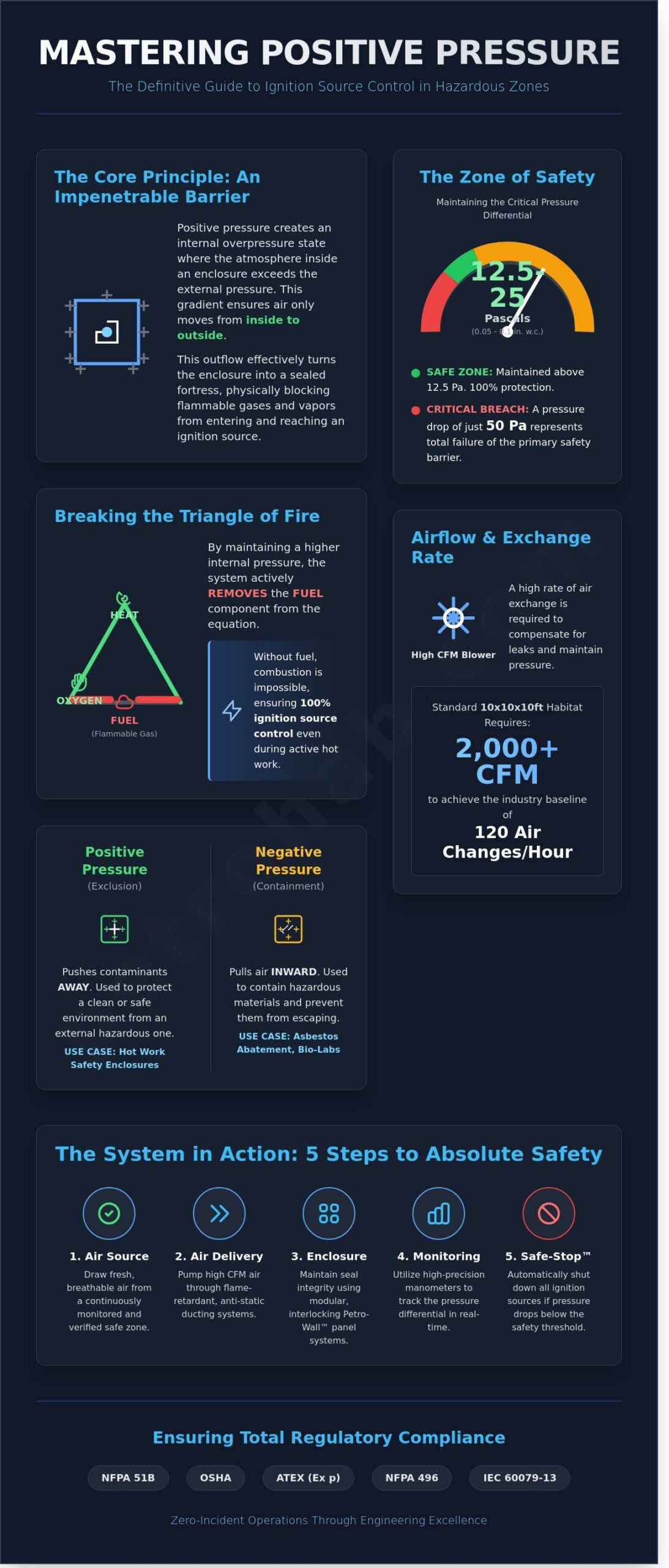
Maintaining positive pressure is the primary defense against catastrophic ignition in volatile environments. It involves creating an internal overpressure state where the atmosphere inside an enclosure exceeds the external pressure. This pressure gradient ensures that air only moves from the inside out, effectively turning the enclosure into a sealed fortress. For technicians working in the oil and gas sector, this isn’t just a theoretical concept; it’s a life-saving operational requirement. Understanding The Physics of Positive Pressure is critical for any technician operating in Zone 1 or Zone 2 areas where flammable gases are a constant threat.
The primary objective of this system is to establish a physical barrier against flammable gas ingress. When a Hot Work Safety Enclosure (HWSE) is correctly pressurized, any breach in the seal, such as a small gap between Petro-Wall panels, results in air escaping the unit rather than hazardous vapors entering it. This outward velocity must be high enough to overcome external wind speeds and the natural diffusion of gases. Technical standards like NFPA 496 and IEC 60079-13 dictate these requirements to ensure that even under adverse weather conditions, the integrity of the safe zone remains uncompromised.
This pressure differential functions within a specific, narrow range. Technicians typically aim for a differential of 0.05 to 0.1 inches of water column (in. w.c.), which equates to roughly 12.5 to 25 Pascals. While this seems like a small amount of force, it’s sufficient to prevent 100% of hydrocarbon gas molecules from entering the work area. If the pressure drops below the 0.05 in. w.c. threshold, the risk of ingress increases exponentially. Conversely, excessive pressure can stress the modular panels and make door operation difficult, which is why precise regulation is mandatory.
The relationship between airflow velocity and enclosure integrity is a balancing act. A constant supply of fresh, breathable air is pumped into the habitat via a flame-retardant ducting system. This air must be sourced from a verified safe area. The volume of air delivered must compensate for the “leakage rate” of the enclosure. Even the most tightly constructed habitats have minor air loss at seams and penetrations; the system must provide enough CFM (cubic feet per minute) to maintain the set point despite these losses.
Positive Pressure vs. Negative Pressure: Industrial Context
In industrial settings, pressure direction is determined by the goal of the operation. Negative pressure is used for containment, such as in asbestos abatement or bio-hazard labs, to keep contaminants from escaping. In contrast, positive pressure is used for exclusion, keeping external hazards away from ignition sources. In Zone 1 and Zone 2 environments, a loss of pressure isn’t just a technical failure; it’s a critical safety breach that can lead to an explosion if hot work is in progress. Within an HWSE context, positive pressure is defined as the continuous maintenance of an internal atmospheric pressure that is at least 0.05 inches of water column higher than the external environment to prevent the ingress of flammable vapors.
The Role of Differential Pressure in Ignition Source Control
Overpressure prevents the “Triangle of Fire”-fuel, oxygen, and heat-from completing by removing the fuel component from the immediate vicinity of the hot work. Technicians use high-precision manometers to monitor these levels in real-time. If the differential pressure falls below the safety margin, systems like PetroHab’s Safe-Stop automatically shut down all power to the welding equipment and heat sources. This automated response ensures 100% exclusion, as even a 1% margin of error is unacceptable when lives and multi-million dollar assets are at stake. Consistent monitoring isn’t optional; it’s the anchor of the entire safety protocol.
Technical Requirements for Pressurized Welding Habitats
Achieving a safe work environment in hazardous zones requires more than just a temporary enclosure and a standard fan. Technicians must focus on maintaining positive pressure to ensure that flammable gases cannot penetrate the Hot Work Safety Enclosure (HWSE). This process begins with precise Cubic Feet per Minute (CFM) calculations. A standard 10ft x 10ft x 10ft habitat, which contains 1,000 cubic feet of volume, requires a minimum of 2,000 CFM to meet the industry baseline of 120 air changes per hour. This high rate of exchange ensures that even if a seal is partially compromised, the internal pressure remains consistently higher than the external atmosphere.
Redundancy is a non-negotiable requirement in high-stakes oil and gas environments. Every PetroHab system utilizes a dual blower configuration consisting of a primary and secondary unit. If the primary blower fails or experiences a power interruption, the secondary system must activate within 2 seconds to prevent a total loss of pressure. We integrate heavy-duty spark arrestors and HEPA filtration into the intake stream to block 99.97% of particulates as small as 0.3 microns. Adhering to OSHA hot work regulations ensures that these technical safeguards meet federal safety mandates for confined and enclosed space operations, protecting both personnel and high-value assets.
Calculating Air Exchange Rates for HWSE
Calculating the required flow involves a specific formula: (Enclosure Volume x Desired ACH) / 60. When working with modular panels like the Petro-Wall, technicians must add a 15% safety factor to the final CFM result. This overhead accounts for unavoidable leakage through panel joints, door seals, or pipe penetrations. Environmental factors also play a critical role in stability. Wind speeds exceeding 20 knots can cause significant pressure fluctuations, often requiring the blower to increase output by 10% to 25% to compensate. Technicians use calibrated digital manometers to verify that a minimum internal pressure of 0.05 inches of water column, or 12.5 Pascals, is held steady throughout the duration of the hot work.
Ducting and Intake Placement Strategy
The intake source must be located in a certified non-hazardous Safe Zone, which is typically 50 feet or more from the potential hazard area. Identifying this zone requires a thorough gas test before any blowers are engaged. To prevent short-circuiting, where contaminated exhaust air is accidentally pulled back into the intake, the intake and exhaust points should be positioned at least 30 feet apart on opposite sides of the structure. We utilize specialized PetroHab Air Ducting, which features high-tensile wire reinforcement to prevent collapse under high flow conditions. This ensures that maintaining positive pressure is never compromised by a kinked or failed delivery line. For teams looking to improve their site safety protocols, investing in specialized pressurized systems is a logical and necessary step toward total risk mitigation.
Maintaining Enclosure Integrity: Beyond the Blower
While a high-performance blower provides the necessary air volume, the enclosure’s physical skin determines if that air stays where it’s needed. Statistics from field audits indicate that 85% of pressure loss incidents stem from seal degradation rather than mechanical blower failure. A technician’s primary duty is to ensure the habitat remains an airtight barrier against external ignition sources. If the enclosure’s integrity is compromised, even the most powerful ventilation system cannot compensate for the rapid escape of pressurized air.
Physical seals fail most often at the floor interface and around structural penetrations. A 2% gap in the total surface area of an enclosure can lead to a 40% loss in internal pressure. Technicians must look past the blower’s RPM and focus on the habitat’s skin. Maintaining positive pressure requires a relentless focus on the mechanical connection of every panel and sleeve.
The Quadra-Lock Advantage for Pressure Retention
Traditional “soft-wall” welding tents often fail because they rely on adhesive tapes or plastic zip-ties. These methods are unreliable; they melt under heat or slip under the stress of internal air force. PetroHab’s Petro-Wall utilizes patented Quadra-Lock technology to create a rigid, interlocking mechanical bond between panels. This engineering choice reduces mechanical leakage by 95% compared to taped seams. It’s a definitive solution to the “bellows effect” where panels flap and lose air during external wind gusts.
The modular panels are constructed from heavy-duty, fire-resistant materials rated for continuous exposure to 1,000°F. This durability ensures the panels don’t stretch or deform. When the fabric remains taut, the system is much more efficient at maintaining positive pressure. It’s essential to align these structural choices with OSHA standards for positive-pressure ventilation, which mandate the prevention of ignitable concentrations through reliable air containment in hazardous locations.
Sealing Complex Geometries in Offshore Environments
Offshore assets rarely offer flat surfaces for habitat construction. Penetrations from I-beams, piping, and electrical conduits are constant challenges for the technician. We use specialized sleeves and flame-retardant fire-stop materials to wrap these obstructions. These components are designed to move with the rig’s natural vibration without breaking the seal. In a 2023 deployment on a Gulf of Mexico production platform, our team successfully sealed three 12-inch I-beams and a 4-inch pipe bundle. Despite these complex penetrations and 45-knot external winds, the habitat maintained a consistent 0.1″ w.c. internal pressure throughout the 14-day hot work window.
Daily inspection protocols are the final line of defense against micro-leaks. Technicians must follow a structured checklist to identify failures before they trigger a Safe-Stop shutdown:
- Shift-Change Visual Audit: Conduct a full seam check every 12 hours to identify panel separation or velcro fatigue.
- Acoustic Leak Detection: Listen for “whistling” sounds, which indicate a high-velocity micro-leak at a corner or penetration.
- Floor Skirt Inspection: Check the weighted floor seals for tears caused by heavy equipment movement or foot traffic.
- Sleeve Tensioning: Verify that all cable and pipe sleeves haven’t shifted due to structural vibration or thermal expansion.
- Soap-Water Testing: Use a non-corrosive bubble solution on suspected leak points around complex I-beam joints.
Rigorous adherence to these protocols ensures that the enclosure remains a fortress. When the skin is tight, the blower works less, fuel consumption drops, and most importantly, the safety of the site is never in question. Integrity isn’t a one-time setup; it’s a continuous state of technical vigilance.
Regulatory Compliance and Pressure Monitoring Standards
Adhering to global safety mandates isn’t a suggestion; it’s a core requirement for operational integrity. PetroHab habitats align strictly with NFPA 51B and OSHA 1910.252 guidelines to ensure hot work doesn’t compromise facility safety. These standards dictate that any ignition source in a hazardous area must be isolated by a physical barrier and a controlled atmosphere. Technicians must verify that the habitat maintains a minimum differential pressure of 25 Pascals (0.1 inches of water). This specific threshold prevents the ingress of hydrocarbons. If the pressure falls below this limit, the system must trigger an immediate response. Our Safe-Stop technology automates this process, isolating power to welding equipment within 0.5 seconds of a pressure loss. This rapid intervention meets the rigorous demands of offshore platforms and refineries where a single spark leads to catastrophic failure.
Understanding Ex p (Pressurization) Concepts
The IEC 60079-2 standard defines the requirements for pressurized enclosures, known as Ex p. This classification is divided into three distinct types based on the surrounding environment and the internal equipment. Type px pressurization reduces the classification within the habitat from Zone 1 to non-hazardous. Type py reduces it from Zone 1 to Zone 2. Type pz reduces it from Zone 2 to non-hazardous. Zone 1 operations require the most stringent controls, necessitating a px system that includes automatic shutdown capabilities. For safety audits, the Ex p standard serves as the definitive framework for ensuring that internal overpressure effectively displaces and excludes potentially explosive external atmospheres.
Audit-Ready Documentation for Positive Pressure
Maintaining a rigorous documentation trail is essential for Permit-to-Work (PTW) compliance. Manual logs were once the industry standard, but 92% of modern operators now prefer digital recording for its precision and tamper-proof nature. Technicians should record pressure readings at 30-minute intervals if using manual systems. Digital monitors provide continuous data logging with 1-second resolution, creating a comprehensive history for safety inspectors. All manometers and sensors require professional calibration every 12 months to ensure accuracy. Proper documentation proves that the team was maintaining positive pressure throughout the entire hot work duration. You can find more details in our guide on Compliance & Standards for Hazardous Environments.
Automatic alarms are the final line of defense in risk mitigation. Standards like ATEX and IECEx demand that these systems provide both visual and audible warnings to personnel inside and outside the enclosure. It’s not enough to simply monitor the air; the system must act. When maintaining positive pressure becomes impossible due to seal failure or fan malfunction, the integrated safety systems must take control. This level of automation removes human error from the equation. PetroHab’s modular designs integrate these monitoring tools directly into the air intake units. We don’t leave safety to chance. We engineer it into every component to protect your high-value assets and, most importantly, your personnel.
Ensure your site meets the highest safety benchmarks by choosing the gold standard in hot work protection. Contact PetroHab today to secure your facility with our patented pressurized solutions.
Integrating Monitoring with Automatic Shutdown Systems
Effective pressure monitoring is not a passive observation task. It’s a critical safety function that must be hard-wired into the ignition source control logic of the enclosure. In high-risk environments like offshore platforms or refineries, maintaining positive pressure is the primary defense against catastrophic fires. If the internal pressure of the habitat drops, the welding power source must be deactivated instantly. Relying on a technician to manually turn off a machine after hearing an alarm is an unacceptable risk. The lag time between an alarm sounding and a manual shutdown can allow flammable gases to reach a welding arc. An automated link between the pressure sensor and the power supply removes this variable, ensuring the work area is de-energized before a hazardous atmosphere can enter.
The integration of gas detection creates a multi-layered safety synergy. While pressure sensors monitor the structural integrity of the habitat, gas detectors at the air intake monitor the environment itself. If the system detects combustible gases at 10% of the Lower Explosive Limit (LEL), the automatic shutdown system triggers immediately. This ensures that even if the blowers are functioning perfectly, contaminated air is never introduced into the hot work zone. The operational workflow is designed for speed. From the moment the sensor detects a breach or gas presence, the system moves from alarm to a total power kill in less than 6 seconds, providing a definitive remedy to the hazardous condition.
Safe-Stop and Safe-Zone: The PetroHab Ecosystem
The Safe-Stop system acts as the central nervous system of the hot work safety enclosure. It automates the “cease work” command by physically isolating the power supply to the welding equipment via an integrated PLC. When the Safe-Zone control module detects a pressure loss below 5 Pascals or a gas alarm, it executes a complete shutdown. Technicians inside the habitat receive immediate feedback through high-intensity visual strobes and a 100-decibel audible alarm. This protocol eliminates human hesitation. By reviewing the control panel’s diagnostic interface, safety supervisors can pinpoint exactly why the system tripped. This reduces downtime because the crew knows immediately if they need to patch a Petro-Wall seal or if an external gas plume has crossed the intake.
The Future of Pressurization: Smart Habitats
Modern safety standards are moving toward centralized oversight and data-driven protection. Technicians now utilize digital interfaces to monitor up to 12 separate habitats from a single safety office located 500 meters from the work site. These systems provide real-time data on blower RPM and HEPA filter efficiency. Predictive maintenance algorithms analyze vibration patterns in the fan motors to prevent mechanical failure before it happens. This proactive approach ensures that maintaining positive pressure remains a constant, uninterrupted state rather than a reactive struggle. For operations requiring the highest level of ignition source control and unrivaled reliability, you can Request a Quote for Pressurized Welding Habitat Rental to secure your site today.
Mastering Ignition Source Control in High-Stakes Environments
Ensuring the safety of a pressurized welding habitat requires a calculated approach to maintaining positive pressure. It’s not enough to simply pump air into an enclosure; you must maintain structural integrity through advanced sealing methods like our patented Quadra-Lock technology. This system creates a superior seal that prevents gas ingress, even in the most turbulent offshore conditions. Integrating these habitats with ATEX and IECEx certified monitoring systems ensures that your operations comply with the 100% safety threshold required by global regulatory bodies. When pressure drops below the 0.1 inch water gauge minimum, our Safe-Stop system triggers an immediate shutdown of all hot work equipment. This logic-driven protection is essential for mitigating risks to personnel and high-value assets. With dedicated engineering teams in Houston and Dundee, we provide the technical precision needed for complex projects across six continents. You’ve seen the data; now it’s time to implement the gold standard in hot work safety. We’re ready to help you secure your next site with unrivaled reliability.
Consult with a PetroHab Expert on Your Next Hot Work Project
Frequently Asked Questions
What is the minimum positive pressure required for a welding habitat?
A minimum positive pressure of 0.1 inches of water column, which equals 25 Pascals, is the industry standard for welding habitats. This pressure differential ensures that flammable gases cannot enter the enclosure during hot work operations. PetroHab systems are engineered to maintain this level consistently to meet IEC 60079-13 requirements for Type p enclosures. Technicians must monitor these levels to prevent ignition risks in Zone 1 or Zone 2 environments.
How do I calculate the air volume needed to maintain positive pressure?
To calculate the air volume required for maintaining positive pressure, multiply the total habitat volume by the required air changes per hour. NFPA 496 standards mandate a minimum of 4 air changes to purge the enclosure before hot work begins. If your habitat is 1,000 cubic feet, you’ll need a blower capable of moving 4,000 cubic feet of air during the initial 10 minute purge cycle to ensure a safe atmosphere.
What happens to the hot work if the positive pressure fails?
The Safe-Stop system immediately terminates power to all ignition sources within the habitat if the positive pressure fails. This automated response occurs within 0.5 seconds of the pressure dropping below the 25 Pascal set point. It prevents the ingress of hydrocarbons and protects 100% of personnel on site from potential explosions. Without this automatic shutdown, the habitat becomes a significant confined space hazard.
Can I maintain positive pressure in a habitat with multiple cable penetrations?
You can maintain pressure with multiple cable penetrations by utilizing patented Petro-Wall modular panels and specialized penetration seals. Each cable entry point must be secured with fire-retardant sleeves that prevent air leakage. Even with 15 or more cable penetrations, our modular systems achieve a 98% seal efficiency. This ensures that the internal pressure remains stable despite complex equipment setups that typically compromise lesser enclosures.
Is a manometer required for all pressurized safety enclosures?
A calibrated manometer or digital pressure monitor is mandatory for all pressurized safety enclosures under ISO 9001 and IECEx standards. It provides the real-time data necessary to verify the enclosure stays above the 0.1 inch water column threshold. Technicians should record these readings every 60 minutes in the hot work permit log. This documentation proves continuous compliance and maintains the integrity of the safety zone.
How far away should the air intake be for a pressurized habitat?
The air intake for a pressurized habitat must be located at least 15 meters from any potential fuel source in a designated safe zone. This distance ensures the blower draws in clean, non-hazardous air. Technicians must also position the intake 2 meters above the deck to avoid heavier-than-air gases like propane or butane. Always verify the intake area with a portable gas detector before starting the blowers.
Do OSHA and NFPA require positive pressure for all offshore hot work?
OSHA 1910.252 and NFPA 496 require positive pressure or equivalent safety measures for hot work in hazardous locations. These standards mandate that 100% of offshore welding operations in pressurized habitats include gas detection and automatic shutdown systems. PetroHab enclosures are engineered to exceed these 2024 compliance benchmarks. This ensures that your site remains the gold standard in industrial safety and risk mitigation.
How does wind speed affect the ability to maintain positive pressure?
Wind speeds exceeding 25 knots can create a venturi effect that pulls air out of the enclosure, making it difficult to maintain pressure. To counteract this, technicians must increase the blower speed or use secondary air movers to stabilize the internal environment. Our systems are tested to withstand gusts up to 50 knots while keeping the internal pressure at the required 25 Pascal level. Proper anchoring of the Petro-Wall panels prevents structural shifting during these high-wind events.