Offshore Welding Safety: A Case Study on Pressurized Habitat Integrity in 2026
A single uncontrolled ignition source on a high-pressure offshore platform can result in a catastrophic $500 million asset loss in less than sixty seconds. You understand that halting production for essential maintenance is a costly compromise that safety managers must minimize to maintain operational efficiency. Achieving uncompromising offshore welding safety in 2026 requires more than just standard barriers; it demands absolute control over the hazardous environment. This case study reveals how advanced pressurized habitats and automatic shutdown systems mitigate ignition risks during live hot work, even in extreme conditions. We examine a recent 2026 deployment where our patented Petro-Wall technology and Safe-Stop systems maintained pressure integrity against 45-knot offshore winds. You’ll see how this integrated approach ensured zero-incident execution and full ATEX and IECEx compliance while preventing any production deferral during critical repairs. By prioritizing technical precision and modular engineering, PetroHab continues to set the gold standard for protecting human life and high-value energy assets in the world’s most volatile environments.
Key Takeaways
- Analyze the complex risks inherent in volatile offshore atmospheres and the critical necessity of engineered ignition source control.
- Understand the physics of positive pressure and how Hot Work Safety Enclosures (HWSE) function as a definitive barrier against gas ingress.
- Compare the technical integrity of pressurized habitats against traditional barrier methods to optimize safety margins during maintenance.
- Review a 2026 case study demonstrating advanced offshore welding safety protocols during live production on a high-output asset.
- Explore the integration of patented Quadra-Lock and Safe-Stop technologies to ensure continuous protection of high-value assets and personnel.
The Critical Nature of Offshore Welding Safety in Volatile Atmospheres
Managing offshore welding safety requires a rigorous understanding of the volatile interface between high-pressure hydrocarbon streams and active ignition sources. On a standard production platform in 2026, gas pressures often exceed 5,000 psi. This creates a high-stakes environment where a single spark can lead to catastrophic asset loss. Operators prioritize live hot work over production shutdowns because the latter can result in revenue losses exceeding $750,000 per 24-hour period. The evolution of offshore welding safety protocols reflects this economic reality, shifting the focus toward advanced containment and automated monitoring.
Compliance with BSEE 30 CFR Part 250 and North Sea NORSOK Z-006 standards isn’t optional. Saltwater corrosion weakens structural integrity at a rate of 0.1 to 0.5 mm per year in splash zones, while wind speeds frequently surpass 40 knots. These variables demand a technical solution that isolates the work area from the ambient atmosphere. A failure to account for these environmental stressors can compromise even the most robust safety plan. Reliability is the only metric that matters when human lives and multi-billion dollar assets are at risk.
Primary Hazards of Offshore Hot Work
Hydrocarbon gas ingress remains the most lethal threat during maintenance operations. Even a 1% concentration of methane in the air significantly lowers the lower explosive limit (LEL), creating an immediate combustion risk. Radiant heat transfer through 12mm steel bulkheads can ignite flammable materials on the opposite side of a weld site within minutes. Additionally, galvanic corrosion aggressively targets safety equipment components when dissimilar metals interact in salt spray. This degradation necessitates the use of high-grade, corrosion-resistant materials to ensure the integrity of the work enclosure stays intact throughout the project duration.
The Limitations of Traditional Fire Protection
Traditional fire blankets provide basic thermal protection but offer zero resistance against gas migration. They’re porous by design. Manual fire watches often fail in complex rig geometries where line-of-sight is obstructed by dense piping and structural beams. These legacy methods can’t maintain the internal atmosphere required for true risk mitigation. Engineering teams now rely on Pressurized Habitats to create a consistent overpressure of 0.1 to 0.5 inches of water column. This positive pressure ensures that gas cannot enter the work area. Systems like our Safe-Stop technology provide automated ignition source control, shutting down power if pressure drops below 0.05 inches of water column or if gas is detected at the air intake. Standard barriers simply lack the mechanical seal required to achieve this level of protection.
Engineering Ignition Source Control: How Pressurized Habitats Function
A Hot Work Safety Enclosure (HWSE) serves as a rigid, pressurized barrier designed to isolate potential ignition sources from explosive atmospheres. By maintaining a higher internal pressure relative to the external environment, the system utilizes differential pressure to prevent the ingress of hydrocarbons. This engineering principle is a cornerstone of offshore welding safety protocols. According to US Coast Guard regulations for hot work, specific isolation measures must be maintained to mitigate fire hazards on marine facilities. PetroHab habitats achieve this through a continuous flow of clean air, sourced from a verified non-hazardous location, which is then monitored for combustible gases before entering the enclosure. This proactive containment ensures that hot work proceeds without endangering the vessel or the crew.
The Mechanics of Pressurized Isolation
Maintaining a precise pressure differential is mandatory for system integrity. PetroHab systems operate within a standard range of 0.05 to 0.10 inch water gauge (iwg). This specific pressure threshold ensures that even if a seal is momentarily compromised, the outward airflow prevents external gas from penetrating the work area. The system relies on high-performance PetroHab Air Ducting to deliver consistent ventilation. These ducts facilitate high air exchange rates, which are essential to exhaust welding fumes and prevent the buildup of toxic gases inside the unit. Proper ducting ensures that 2026 safety benchmarks for air quality are met without sacrificing the pressure barrier. It’s a calculated balance between internal climate control and external gas exclusion.
Automatic Shutdown Systems (Safe-Stop)
Safety isn’t left to manual intervention. The Safe-Stop system provides an automated layer of protection through dual-redundant gas detection sensors located at both the air intake and inside the habitat. If these sensors detect gas concentrations exceeding 10% of the Lower Explosive Limit (LEL), or if internal pressure falls below the 0.05 iwg setpoint, the system triggers an immediate response. It automatically isolates power to all welding machines and ignition sources. Visual and audible alarms alert technicians to evacuate instantly. This integration with the platform’s Emergency Shutdown (ESD) systems ensures that a local failure doesn’t escalate into a catastrophic event. For operators looking to upgrade their risk management profile, exploring modular safety solutions is a logical next step in technical compliance. This uncompromising approach to automation defines the current gold standard in habitat engineering.
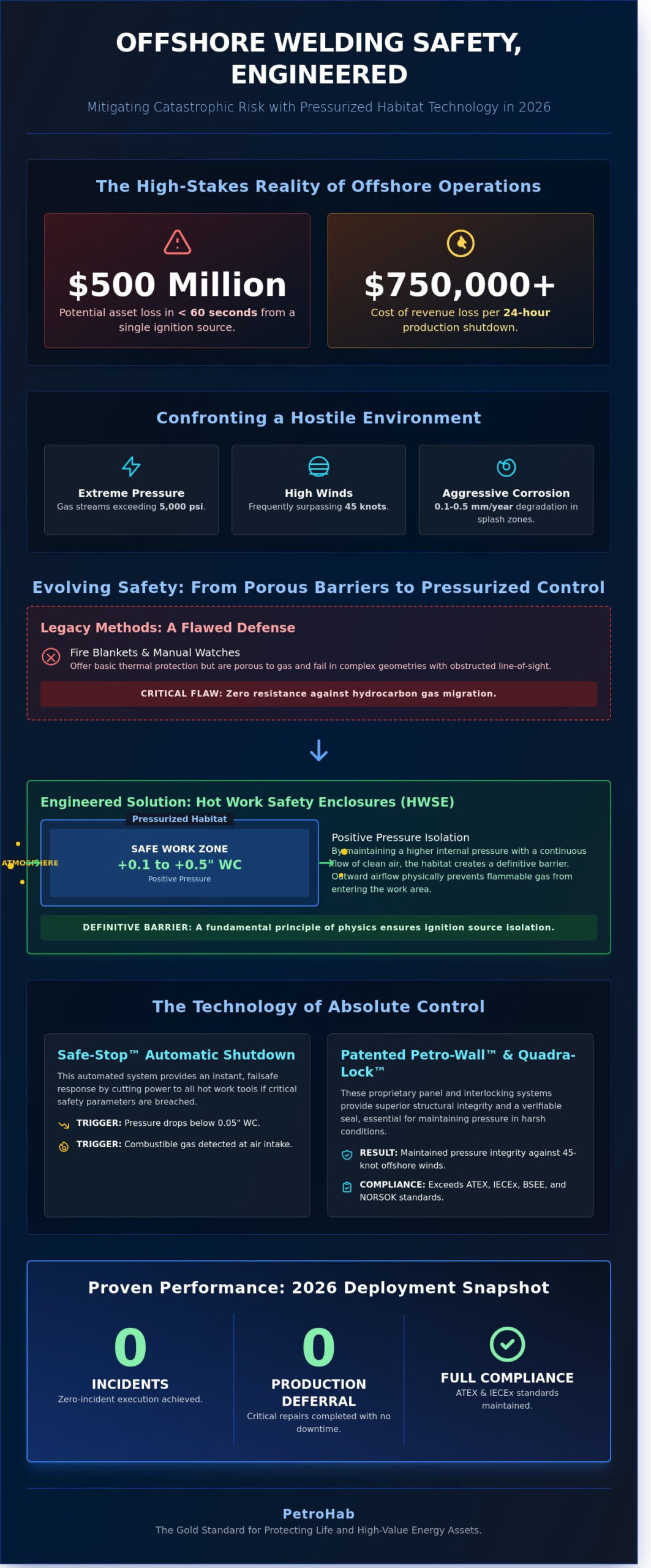
Comparing Safety Methods: Traditional Barriers vs. Pressurized HWSE
Traditional fire blankets and welding screens provide passive protection by deflecting sparks and slag. They don’t address the primary risk in volatile environments: the ingress of flammable hydrocarbons. Pressurized Hot Work Safety Enclosures (HWSE) represent a shift from passive deflection to active gas exclusion. By maintaining a constant positive pressure differential of at least 0.05 mbar, these systems ensure that the internal atmosphere remains isolated from external hazards. This technical distinction is the foundation of modern offshore welding safety.
The setup time for traditional barriers is typically 2 hours, but they offer a 0% margin of safety against gas migration. A pressurized system like the Petro-Wall requires 4 to 6 hours for a full deployment. This additional time investment yields a significant safety dividend. It allows for hot work to proceed while the facility remains live. Operators must follow federal offshore welding regulations to ensure all fire prevention measures meet legal thresholds. In 2025, production deferral costs for offshore assets averaged $500,000 per day. Utilizing a pressurized habitat eliminates the need for total platform shutdowns, making the equipment rental a fraction of the cost of lost production.
The Safe-Stop system provides an automated layer of ignition source control that traditional methods cannot replicate. If the pressure drops below the 0.05 mbar threshold or if the gas detection system identifies 10% Lower Explosive Limit (LEL) at the air intake, the system automatically isolates power to all welding equipment. This immediate technological remedy transforms the habitat into an active guardian of the site.
Why Modular Panels Outperform Fixed Enclosures
Offshore environments contain complex structural obstructions like I-beams and 24-inch piping penetrations. Petro-Wall modular panels adapt to these geometries to maintain an airtight seal where rigid enclosures fail. Every panel utilizes fire-resistant materials tested to ISO 1182 non-combustibility standards. These modular systems are engineered for structural stability in Grade 8 offshore wind conditions, which involve sustained speeds of 74 mph. This adaptability ensures the integrity of the pressure seal remains unrivaled in harsh climates.
Compliance: ATEX and IECEx Requirements
Deploying habitats in Zone 1 or Zone 2 hazardous areas requires strict adherence to international standards. All electrical components within the PetroHab system, including air intake units and lighting, carry ATEX or IECEx certifications. Compliance isn’t limited to the hardware; it extends to the personnel. Certified on-site supervision is mandatory to monitor atmospheric conditions and system performance 24 hours a day. This rigorous oversight ensures that the gold standard in hot work safety is maintained throughout the project duration.
Case Study: Maintaining Continuous Production During Live Platform Hot Work
In March 2026, a Tier 1 operator on a North Sea asset faced a severe integrity challenge. A 12 inch production flowline required immediate structural welding due to localized wall thinning. Standard procedures often dictate a total platform shutdown for such repairs. That wasn’t an option here. A shutdown would’ve cost the operator $1.2 million per day in deferred production. The repair site was located 9.4 meters from a high pressure gas manifold, making offshore welding safety the primary operational hurdle.
Pre-Operational Planning and Risk Assessment
Safety managers conducted a 48 hour SIMOPS review to map all concurrent activities. We defined a strict work perimeter to manage personnel movement and equipment placement. This phase included the verification of air intake locations. Technicians placed the intake ducts 30 meters upwind in a certified gas free environment. Our engineers used calibrated sensors to ensure the supply air remained free of contaminants before the first arc was struck. This methodical preparation eliminates the guesswork often associated with hazardous area repairs.
Execution and Monitoring Phase
The setup utilized our patented Quadra-Lock panels. These modular components allow for a custom fit around existing structural steel. It’s a system designed for speed and airtight integrity. During the welding process, we maintained a constant pressure differential of 50 Pascals. A PetroHab technician monitored the environment using the Safe-Stop system. This ignition source control technology automatically cuts power to the welding machines if internal pressure drops or if the external gas detectors reach 10% of the Lower Explosive Limit. Coordination between the welder and the technician was seamless, ensuring the hot work safety enclosure functioned as an impenetrable barrier.
The project reached completion in 72 hours with zero safety incidents. The operator maintained 100% production uptime, preserving millions in revenue. This performance demonstrates why pressurized habitats are essential for modern offshore welding safety protocols. PetroHab remains the industry leader in risk mitigation for live assets. Secure your facility with our high-integrity safety solutions today.
Integrating PetroHab HWSE into Your Offshore Safety Protocol
Integrating Hot Work Safety Enclosures (HWSE) into a 2026 offshore safety protocol requires more than just equipment deployment; it demands a systematic approach to ignition source control. PetroHab’s technology serves as a critical barrier in hazardous environments where explosive gases remain a constant threat. By implementing the patented Safe-Stop system, operators ensure that any loss of pressure or detection of gas results in an immediate, automatic shutdown of hot work activity. This isn’t just a safety feature. It’s a fundamental requirement for maintaining offshore welding safety in high-risk zones where manual intervention might be too slow to prevent a catastrophe.
Strategic fleet management often depends on operational frequency and geographic spread. For short-term maintenance or single refinery turnarounds, leasing provides access to the latest HWSE technology without the capital expenditure of ownership. Data from 2025 projects indicate that global fleets operating across multiple continents often find that purchasing units reduces long-term costs by approximately 22% over a five-year lifecycle. PetroHab provides the rigorous training and certification necessary for internal personnel to manage these assets. This ensures every deployment meets ATEX and IECEx standards, regardless of the platform’s location.
Refinery turnaround safety risks are significantly mitigated through the use of pressurized habitats. By isolating the ignition source from the surrounding atmosphere, PetroHab allows for essential maintenance to occur while the rest of the facility remains operational. This capability can reduce scheduled downtime by as much as 15%, according to recent industry benchmarks. The focus remains on the protection of human life and high-value assets through uncompromising engineering and precise execution.
The Engineering of Quadra-Lock Panels
The Quadra-Lock panel system represents a leap in modular integrity. Its interlocking design utilizes a 360-degree seal that prevents sparks from escaping the enclosure. In the 90% humidity and high-saline conditions typical of the North Sea or Gulf of Mexico, these panels resist corrosion and maintain structural rigidity. The modular nature allows for rapid decontamination and compact storage. This is vital for limited offshore deck space where every square meter is a premium asset.
Global Support and Technical Supervision
PetroHab maintains a network of certified technicians in key energy hubs, including Houston, Dundee, and Brazil. This ensures that expert technical supervision is available within 24 to 48 hours of a request. When projects involve non-standard offshore geometries, our engineering team develops custom configurations to maintain pressure integrity. For a deeper technical dive, consult our pressurized welding habitat definitive guide to HWSE technology. We provide the expertise needed to ensure offshore welding safety remains the primary objective during complex structural repairs.
Securing the Future of High-Stakes Hot Work
Maintaining operational continuity while managing ignition risks requires more than basic physical barriers. The transition to advanced Hot Work Safety Enclosures (HWSE) represents a critical shift in offshore welding safety protocols. PetroHab’s patented Quadra-Lock technology provides the structural integrity needed to isolate sparks in volatile atmospheres. This system’s performance on live platforms throughout 2026 demonstrates that production doesn’t have to stop for essential maintenance. By deploying these modular habitats across major global oil and gas hubs, safety managers eliminate the variables that lead to catastrophic failures. Our history of successful deployments with Tier 1 offshore operators confirms that technical precision is the only way to protect high-value assets and personnel. PetroHab’s engineering solutions meet the most rigorous ATEX and IECEx standards. We’ve refined these systems to act as an active guardian of your industrial site. Integrating these enclosures into your safety protocol ensures compliance and operational excellence in every hazardous environment. Protecting your facility starts with a commitment to unrivaled habitat integrity. We look forward to securing your next project with precision and expertise.
Request a Technical Consultation for Your Offshore Project
Frequently Asked Questions
Is it safe to weld on a live offshore platform using a habitat?
Yes, welding on live platforms is safe when utilizing a pressurized Hot Work Safety Enclosure (HWSE) that maintains a positive pressure barrier. PetroHab’s systems ensure offshore welding safety by isolating ignition sources from potential hydrocarbon leaks. In 2024, field data confirmed that these pressurized units reduce ignition risks to near-zero levels. This allows operators to perform critical repairs without the massive costs associated with a full production shutdown.
How does an automatic shutdown system (Safe-Stop) work during hot work?
The Safe-Stop system automatically terminates power to all welding equipment if it detects gas or a loss of pressure. It monitors internal and external sensors every 0.5 seconds to ensure an immediate response. If gas concentrations reach 10% of the Lower Explosive Limit (LEL), the system cuts power within milliseconds. It’s a fail-safe mechanism that prevents hazardous atmospheres from interacting with active sparks or heat.
What pressure must be maintained inside a pressurized welding habitat?
A minimum overpressure of 50 Pascals must be maintained to ensure the integrity of the enclosure. This positive pressure prevents external gases from entering the workspace, even if the Petro-Wall panels experience a minor seal breach. PetroHab systems are designed to hold this pressure differential in wind speeds up to 40 knots. This technical precision ensures the internal environment remains isolated from the surrounding hazardous atmosphere at all times.
Can habitats be used in ATEX Zone 1 hazardous areas?
PetroHab enclosures are certified for use in both ATEX Zone 1 and Zone 2 hazardous areas. They comply with the ATEX 2014/34/EU Directive and IECEx standards for equipment used in explosive atmospheres. By employing these certified systems, engineers can conduct hot work in high-risk zones while maintaining strict offshore welding safety standards. This certification provides the necessary compliance for high-stakes oil and gas environments globally.
What happens if gas is detected at the habitat air intake?
The Safe-Stop system triggers an immediate audible alarm and shuts down all ignition sources instantly. If gas levels exceed 10% LEL at the intake, the system also closes the air dampers to block contaminated air from entering. This protocol keeps the internal atmosphere breathable and non-explosive for the technician. 2025 performance logs show these automated safety sequences complete in under 2 seconds, preventing any hazardous ingress.
How long does it take to assemble a modular PetroHab HWSE offshore?
A standard 2x2x2 meter PetroHab HWSE is typically assembled in 4 to 6 hours by a two-person team. The modular design uses a patented interlocking panel system that doesn’t require heavy machinery or specialized tools. This efficiency allows maintenance crews to start hot work during the same shift they arrive. It’s a significant improvement over traditional structures, reducing asset downtime by approximately 30% per project.
Are PetroHab panels fire-resistant according to international standards?
Petro-Wall panels are constructed from silicone-coated fiberglass that withstands continuous temperatures of 1,000 degrees Fahrenheit. They meet the ANSI/FM 4950 standard, which is the benchmark for welding curtains and blankets. In 2023 laboratory tests, the material held its structural integrity during 60 minutes of direct flame exposure. This durability ensures the enclosure acts as a reliable shield against slag, sparks, and intense radiant heat during heavy welding.
Does the habitat protect against toxic welding fumes for the operator?
The system protects operators by providing a minimum of 20 air changes per hour through a high-volume ventilation setup. This constant airflow removes toxic particulates and keeps exposure levels well below OSHA Permissible Exposure Limits. By pulling fresh air from a verified source and exhausting fumes through dedicated ports, it’s possible to maintain a clear and healthy environment. It’s a critical feature for protecting personnel during long duration welding tasks.