Blog Posts
Positive Pressure Habitat Leak Detection: Ensuring HWSE Integrity in 2026
What if the primary barrier between your hot work and a catastrophic ignition event isn’t just a physical panel, but a precisely managed volume of air? You recognize that in hazardous Zone 1 and Zone 2 environments, maintaining the integrity of a Hot Work Safety Enclosure (HWSE) is a non-negotiable requirement for operational safety. The risk of hydrocarbon ingress during welding or grinding operations demands a rigorous approach to environmental containment. Maintaining site safety requires more than just basic ventilation; it demands a sophisticated strategy for positive pressure habitat leak detection that identifies structural vulnerabilities before they lead to emergency shutdowns.
In this article, you’ll learn the technical protocols and engineering standards required to detect and prevent pressure loss in these critical systems. We’ll examine how PetroHab LLC utilizes patented Quadra-Lock technology and the Safe-Stop automatic shutdown system to ensure 100% uptime and total isolation of ignition sources. By implementing these advanced protocols, safety managers can establish a transparent audit trail for compliance while protecting personnel and high-value assets in high-stakes industrial settings.
Key Takeaways
- Understand the fundamental engineering required to maintain internal overpressure and repel flammable gases in hazardous environments.
- Identify the most common failure points in pressurized enclosures, from panel-to-panel interfaces to complex structural penetrations.
- Learn how to integrate digital manometers with the Safe-Stop system to automate gas detection and pressure monitoring.
- Discover the essential operational protocols, such as bubble tests and daily inspections, required for effective positive pressure habitat leak detection.
- Explore the mechanical advantages of patented Quadra-Lock technology in creating airtight, modular seals for high-stakes hot work.
What is Positive Pressure Habitat Leak Detection?
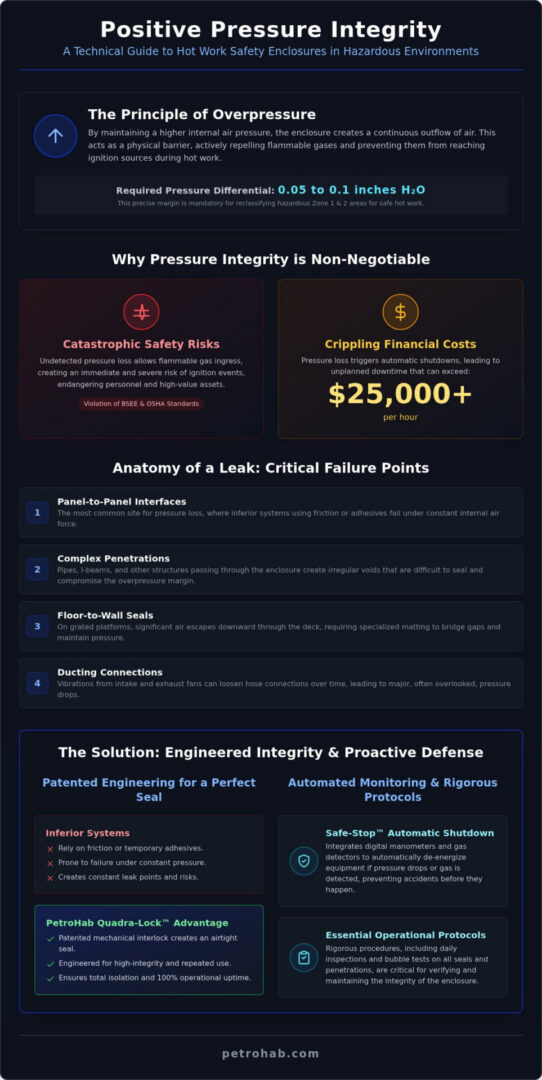
Positive pressure habitat leak detection is the technical process used to identify and mitigate structural breaches in a Hot Work Safety Enclosure (HWSE). This methodology relies on maintaining an internal air pressure that is consistently higher than the surrounding atmosphere. By creating a controlled pressure differential, typically between 0.05 and 0.1 inches of water column, the system ensures that air only moves outward from the workspace. This constant outflow acts as a mechanical barrier, repelling flammable gases and hazardous vapors that could otherwise penetrate the enclosure and reach an ignition source.
Maintaining this differential is a mandatory requirement for operations in ATEX Zone 1 and Zone 2 environments. Effective positive pressure habitat leak detection provides the verified seal necessary to reclassify a hazardous area for hot work. Without rigorous monitoring of this pressure barrier, the enclosure’s ability to protect personnel and high-value assets is compromised, rendering the safety classification void.
The Physics of Overpressure and Gas Exclusion
The success of gas exclusion depends on the air velocity at any potential leak site. If a seam or penetration point is compromised, the internal air must exit with enough force to overcome the diffusion of external hydrocarbons. This requires a precise calculation between the intake fan’s Cubic Feet per Minute (CFM) and the total volume of the Pressurized Welding Habitat. High-volume fans are designed to compensate for minor air loss, but they cannot replace the need for a high-integrity seal. The overpressure principle is the primary mechanical barrier that ensures internal air always displaces external hazardous atmospheres, as detailed in the concept of a Positive pressure enclosure.
Consequences of Undetected Pressure Loss
When pressure loss occurs without detection, the safety margin of the entire operation vanishes. The immediate risk is the ingress of flammable gases into the welding area, which can lead to catastrophic ignition events. Regulatory bodies like BSEE and OSHA enforce strict compliance standards; any failure to maintain pressure integrity can result in immediate intervention and costly work stoppages. Beyond the legal risks, pressure loss triggers automatic safety systems that de-energize equipment. While these systems prevent accidents, the resulting unplanned downtime can cost operators upwards of $25,000 per hour. Maintaining a leak-proof seal with Quadra-Lock panels is the standard protocol for PetroHab LLC to ensure both safety and operational continuity.
Identifying Critical Leak Points in Pressurized Enclosures
Achieving a reliable seal requires an engineering mindset that anticipates air migration at every junction. The most common site for pressure dissipation is the panel-to-panel interface. In inferior systems, these joins rely on friction or temporary adhesives that fail under the constant stress of internal air force. Effective positive pressure habitat leak detection begins by inspecting these seams, alongside complex pipe penetrations and structural I-beams that transit the habitat wall. These irregular shapes create voids that, if left unsealed, allow the internal atmosphere to bleed out, compromising the overpressure margin. Proper containment isn’t just an operational preference; it’s a requirement to meet OSHA’s welding safety standards regarding fire prevention and ventilation.
Technicians must also prioritize the following areas during initial setup and daily inspections:
- Floor-to-wall seals: On grated offshore platforms, air escapes downward through the deck. Specialized matting is required to bridge these gaps.
- Pipe penetrations: Any process piping passing through the enclosure creates a potential leak path that must be packed with fire-resistant materials.
- Ducting connections: Air intake and exhaust hoses are under constant vibration. These connections can loosen over time, leading to significant pressure drops.
Sealing Complex Penetrations and Geometries
Irregular geometries demand modular flexibility. Fire-resistant pillows and specialized gaskets allow technicians to pack voids around live process equipment. This enables hot work to proceed without interrupting production, provided the seal maintains the necessary differential. Precision in these areas prevents the “whistling” effect of high-velocity air leaks that often signal a pending system shutdown. For engineers overseeing long-term maintenance, selecting a pressurized habitat designed for structural rigidity is the most effective way to minimize these vulnerabilities.
The Vulnerability of Traditional Modular Joins
Traditional modular joins often rely on velcro or zipper-based systems. These components degrade rapidly in high-heat or salt-spray environments, leading to chronic pressure loss. Mechanical locking mechanisms, such as the patented Quadra-Lock system, provide a superior alternative. By creating a rigid, interlocking seal, these panels eliminate the sagging and gapping common in fabric-based enclosures. This mechanical integrity is essential for long-term projects where seal degradation could otherwise lead to repeated, costly downtime. You shouldn’t settle for temporary fixes when technical precision is available.
Monitoring Systems and Automatic Shutdown Integration
Digital manometers provide the granular data necessary for effective positive pressure habitat leak detection. These instruments measure the differential between the internal workspace and the hazardous exterior with precision down to 0.01 inches of water column. While physical seals like Quadra-Lock panels provide the mechanical barrier, the monitoring system provides the technical verification. To ensure total site safety, these pressure monitors must integrate directly with gas detection sensors capable of identifying Lower Explosive Limits (LEL), Hydrogen Sulfide (H2S), and Oxygen levels. This integration creates a comprehensive safety envelope where the habitat doesn’t just repel gas but actively monitors for its presence at the air intake.
Industry standards now mandate redundancy through dual-sensor arrays. If a single sensor fails or drifts out of calibration, the secondary unit maintains the safety integrity of the enclosure. This prevents false positives that cause unnecessary downtime and, more importantly, eliminates single points of failure in the detection chain. By Identifying Critical Leak Points through constant pressure monitoring, operators can maintain a layered defense that exceeds basic regulatory requirements. The system acts as a persistent sentinel, ensuring that hot work only proceeds when the environment is fully controlled.
Safe-Stop™: The Fail-Safe for Pressure Integrity
The Safe-Stop™ automatic shutdown system serves as the active guardian of the hot work area. It functions as a sophisticated power management hub that connects directly to welding machines and other ignition sources. When the system detects a pressure drop below the pre-set threshold, typically 0.05 inches of water column, it triggers an immediate response. We distinguish between a Low Pressure warning, which alerts technicians to check seals, and a Critical shutdown, which severs all power to the work tools within milliseconds. This entire system is ATEX and IECEx certified, ensuring it can be deployed safely in Zone 1 or Zone 2 areas without becoming a hazard itself.
Data Logging and Compliance Reporting
Modern safety management relies on immutable data. The monitoring systems within a PetroHab LLC Hot Work Safety Enclosure (HWSE) log every pressure fluctuation and gas detection event. This digital record is indispensable for Permit-to-Work (PTW) audits and BSEE inspections. Technicians use these logs to identify slow-leak trends, minor pressure losses that might indicate the gradual degradation of a seal or a loose ducting connection. Addressing these trends early prevents emergency shutdowns. In the high-stakes environment of offshore production, having a clear, digital audit trail provides the transparency required to satisfy both internal safety boards and international regulators.
Operational Protocols for Maintaining Pressure Integrity
The implementation of positive pressure habitat leak detection protocols begins long before the first arc is struck. A rigorous commissioning process starts with a ‘Bubble Test’ where technicians apply a surfactant solution to every Quadra-Lock panel seam and penetration seal. Any escaping air creates visible bubbles, pinpointing minor leaks that might otherwise bypass digital sensors. For larger volumes, smoke testing provides visual confirmation of the overpressure principle; it shows exactly where air is exiting the structure. These tests ensure the habitat maintains its integrity under operational stress and provides a documented baseline for safety audits.
Daily inspection routines must focus on high-traffic entry points and air ducting connections. Because these areas are subject to physical wear and vibration, they’re the most likely locations for pressure loss. Technicians must also manage air ducting to ensure there are no kinks or obstructions that could restrict the positive pressure flow. Training personnel on the Importance of Manometers in Pressurized Habitats is essential. Every worker should know how to read the pressure differential to prevent the 30% increase in risk associated with improper habitat setup by untrained staff.
Pre-Work Site Surveys and Habitat Commissioning
Before construction, a comprehensive site survey maps all potential leak paths, including complex geometries like valve stems and cable trays. Technicians establish a baseline pressure reading in a ‘cold’ state to verify the enclosure’s performance before introducing heat. This step integrates the habitat into broader Hot Work Safety Systems. It ensures that every safety layer, from gas detection to automatic shutdown, is synchronized and functioning within the specified parameters for the 2026 regulatory environment.
Emergency Response to Pressure Loss
When a pressure alarm activates, welding personnel must immediately cease all work and extinguish ignition sources. The Safe-Stop system will have already de-energized the equipment, but manual verification remains a critical safety step. Technicians then troubleshoot common leak sources, such as dislodged pillows or loose ducting, while the habitat remains under operational pressure. Re-commissioning only occurs after the pressure differential is restored and a full gas test confirms the absence of hydrocarbons. To ensure your site meets these rigorous standards, consider deploying our pressurized welding enclosures for your next high-risk project.
Engineering for Integrity: The PetroHab Quadra-Lock Advantage
Quadra-Lock panels represent a paradigm shift in environmental containment. While generic enclosures rely on overlapping fabrics or temporary fasteners, this system utilizes a mechanical interlocking design that creates a superior seal. This engineering choice directly addresses the core challenge of positive pressure habitat leak detection by minimizing the number of potential failure points in the structure. The result is a robust, airtight barrier that maintains consistent overpressure even in the high-wind environments typical of offshore platforms. You don’t have to worry about the sagging or gapping common in traditional systems.
The modularity of our Pressurized Welding Habitat allows for custom configurations that adapt to the specific geometry of your work site. Whether you’re enclosing a single flange or a complex manifold, the panels lock together to form a rigid structure. This rigidity prevents the “ballooning” effect common in fabric habitats, which often stresses seams and leads to chronic air loss. For operators prioritizing long-term asset integrity and 100% uptime, PetroHab remains the definitive partner for Hot Work Safety Enclosures.
The Quadra-Lock Panel Design
The interlocking mechanism provides a tortuous path for air, effectively preventing air bypass at the seams. Each panel is constructed from high-grade, fire-resistant materials that support the structural integrity of the entire enclosure. These properties ensure that the habitat remains resilient under extreme thermal stress and mechanical impact. Because the panels are fully interchangeable, technicians can perform rapid repairs or reconfigure the layout without compromising the seal. This interchangeability reduces maintenance time and ensures that positive pressure habitat leak detection remains a manageable, proactive process rather than a reactive crisis.
Global Support and Technician Training
Engineering excellence is only effective when paired with expert deployment. We provide on-site supervision to ensure maximum habitat uptime and total compliance with international safety standards. Our certified training programs empower your personnel to master leak detection technology, from initial commissioning to daily monitoring. Choosing between leasing and purchasing depends on your project’s duration and frequency. Leasing offers the strategic advantage of always utilizing the latest, most strictly maintained equipment. This ensures your safety protocols never fall behind the technological curve, protecting both your personnel and your high-value assets.
Securing the Future of Industrial Hot Work
Maintaining the integrity of a Hot Work Safety Enclosure requires a transition from reactive monitoring to proactive engineering. You’ve seen how the combination of mechanical locking systems and automated shutdown technology creates a layered defense against ignition risks. By identifying critical leak points and adhering to strict commissioning protocols, operators can achieve the goal of 100% uptime without compromising safety. Effective positive pressure habitat leak detection isn’t just about sensors; it’s about the fundamental structural seal that prevents gas ingress in the first place.
As regulatory requirements for BSEE and ATEX compliance evolve toward 2027, the reliability of your safety systems becomes your most valuable operational asset. Utilizing patented Quadra-Lock sealing technology and Safe-Stop automatic shutdown protection ensures that your site remains a benchmark for safety excellence. These systems provide the technical precision and global ATEX/IECEx compliance necessary for high-stakes energy and industrial projects.
We invite you to Contact PetroHab for a Technical Consultation on HWSE Integrity to evaluate your current containment strategies. Our team of experts is ready to help you implement the most durable and resilient safety solutions available. You can move forward with absolute confidence in your site’s protection.
Frequently Asked Questions
How does a positive pressure habitat detect a leak?
A positive pressure habitat detects a leak by utilizing high-precision digital manometers that continuously measure the pressure differential between the enclosure and the exterior. Any drop below the pre-set threshold, typically 0.05 inches of water column, indicates a breach in the seal. This real-time positive pressure habitat leak detection ensures that the mechanical barrier remains intact, preventing the ingress of flammable hydrocarbons into the hot work area.
What is the minimum pressure required for a hot work safety enclosure?
The industry standard for the minimum differential pressure in a hot work safety enclosure is 0.05 inches of water column. This specific overpressure level provides sufficient force to maintain a continuous outward airflow at potential leak sites. Maintaining this baseline is essential for ATEX and IECEx compliance, as it creates the primary physical barrier required to isolate ignition sources from hazardous Zone 1 or Zone 2 atmospheres.
Can a Safe-Stop system detect gas leaks outside the habitat?
The Safe-Stop system is designed to detect gas leaks outside the habitat by integrating sensors at the primary air intake. These sensors monitor for Lower Explosive Limits (LEL), H2S, and O2 levels in the ambient air before it is pressurized and delivered to the enclosure. If hazardous concentrations are identified, the system triggers an automatic shutdown of all ignition-producing equipment to prevent external gases from being drawn into the workspace.
What happens if the habitat loses pressure during a welding operation?
If an enclosure loses pressure during welding, the Safe-Stop automatic shutdown system immediately severs power to the welding machine and all other ignition sources. This rapid response eliminates the risk of fire or explosion if flammable gases enter the compromised space. Technicians must then conduct a full inspection of the Quadra-Lock panels and penetration seals to restore the required pressure differential before work can safely resume.
Are Quadra-Lock panels compatible with all industrial penetrations?
Quadra-Lock panels are engineered for modularity, making them compatible with virtually all industrial penetrations. Technicians use a combination of interlocking panels and specialized fire-resistant pillows to seal around complex geometries like I-beams, valve stems, and process piping. This flexibility ensures a tight seal regardless of the site’s structural complexity. It allows for effective positive pressure habitat leak detection even when working around live equipment that cannot be shut down.
How often should pressure sensors be calibrated in an HWSE?
Pressure sensors in an HWSE should undergo calibration before every new deployment to ensure technical precision. For long-term projects, sensors require periodic verification according to the site’s safety management system and ISO 9001 protocols. Regular calibration prevents sensor drift, which could otherwise lead to false positives or a failure to identify a genuine pressure loss. Maintaining calibrated records is also vital for Permit-to-Work audits and safety inspections.
What is the difference between a PWE and an HWSE regarding leak detection?
Regarding leak detection, there is no functional difference between a Pressurized Welding Enclosure (PWE) and a Hot Work Safety Enclosure (HWSE). Both systems rely on the same fundamental principle of overpressure to identify and mitigate breaches. The terminology often varies by region or specific operator, but the engineering requirements for monitoring pressure differentials and integrating automatic shutdown systems remain consistent across both designations to ensure total environmental containment.
Can leak detection systems be used in ATEX Zone 1 environments?
Leak detection systems can be utilized in ATEX Zone 1 environments if the components are specifically certified for such use. All PetroHab systems, including the Safe-Stop hub and associated pressure sensors, carry international ATEX and IECEx certifications. This ensures that the monitoring equipment itself does not become an ignition source while operating in hazardous areas. Using certified hardware is a non-negotiable requirement for maintaining the safety integrity of the entire industrial site.