Blog Posts
Pressurized Habitat for Pipeline Hot Tapping: Ensuring Safety in Live Intervention
What if the choice between production uptime and personnel safety was no longer a compromise? In the high-stakes environment of live-line intervention, the threat of ignition during welding is a constant variable that requires a definitive technological remedy. You understand that even a minor containment failure can lead to catastrophic incidents and regulatory non-compliance. Maintaining operational continuity while expanding pipeline capacity is an essential economic driver, yet it must never come at the expense of life or asset integrity.
This article explores how a pressurized habitat for pipeline hot tapping provides a controlled environment to isolate ignition sources, ensuring a zero-incident execution. We will analyze the mechanics of overpressure, the engineering behind Quadra-Lock Panels, and the role of PetroHab LLC in delivering global safety excellence through automated monitoring and rigorous containment protocols. By understanding the integration of the Safe-Stop system and specialized fire-resistant materials, you can ensure that your next hot work operation meets the highest international standards for risk mitigation and asset protection.
Key Takeaways
- Understand the principle of positive pressure containment and how it maintains a controlled environment to isolate ignition sources during live-line welding.
- Identify the essential international engineering standards, such as IEC 60079-13 and ANSI/FM 4950, that govern the construction of high-integrity hot work safety enclosures.
- Master the deployment protocol for a pressurized habitat for pipeline hot tapping, including mandatory site surveys and ultrasonic wall thickness verification.
- Evaluate the advantages of modular technologies like Quadra-Lock Panels for ensuring rapid assembly and structural integrity in complex industrial configurations.
- Learn how to integrate automated safety systems like the Safe-Stop Automatic Shutdown System to provide real-time protection against environmental hazards.
The Critical Role of Pressurized Habitats in Pipeline Hot Tapping
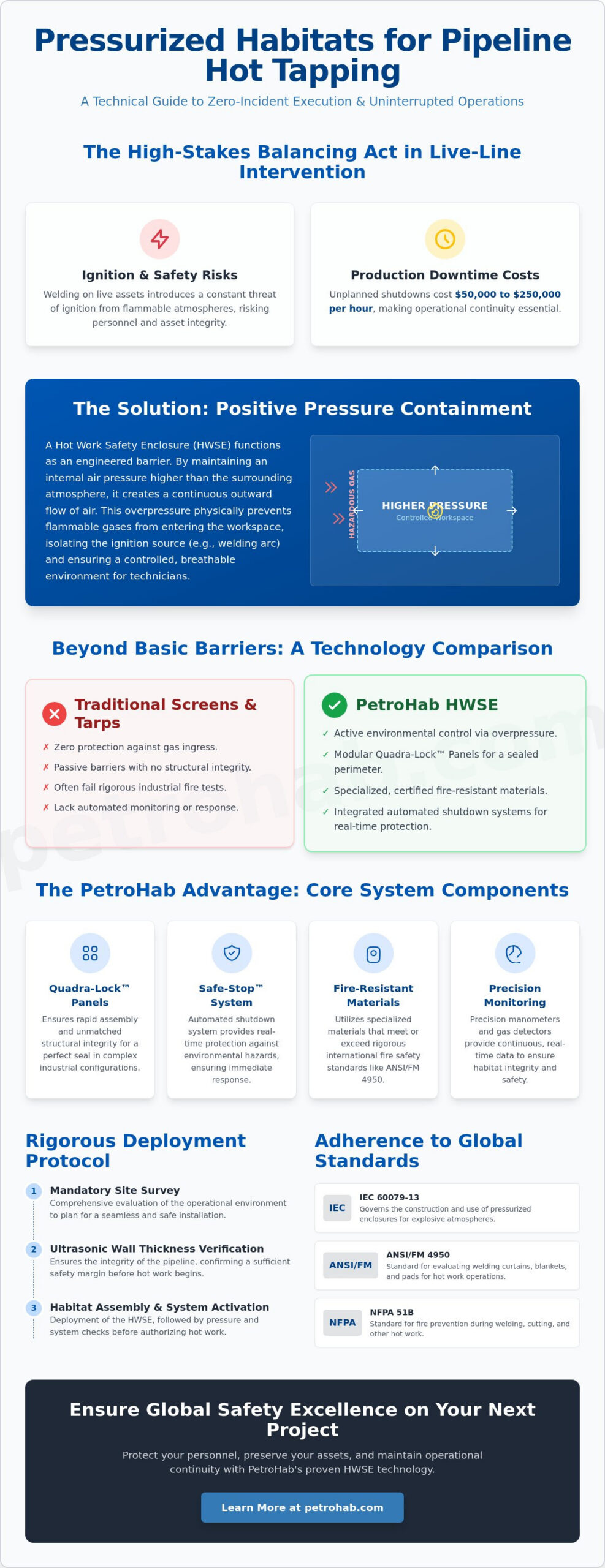
A Hot Work Safety Enclosure (HWSE) functions as a sophisticated barrier system, engineered to isolate ignition sources from flammable atmospheres. When performing modifications on live assets, a pressurized habitat for pipeline hot tapping serves as the critical safeguard. It maintains a controlled environment where the internal pressure exceeds the external ambient pressure. This mechanical differential ensures that even if a leak occurs nearby, hazardous gases cannot penetrate the work area. By establishing a Positive pressure enclosure, operators can execute welding procedures on pressurized vessels containing hydrocarbons without halting production. Welding on live pipelines introduces the risk of burn-through or hydrogen cracking. The habitat provides the controlled environment necessary for precision monitoring, ensuring that the mechanical cut is performed within a verified safety margin. This method transforms a volatile environment into a stabilized workspace, protecting personnel and high-value equipment.
To better understand the technical execution of this process, watch this helpful video:
Why Traditional Welding Screens are Insufficient
Standard welding screens or non-pressurized tarps offer zero protection against gas ingress. They are passive barriers that lack the structural integrity to withstand industrial environments; they also fail to provide automated response capabilities. Basic PVC materials and standard tarps often fail rigorous industrial fire tests, such as those defined by ANSI/FM 4950. Without continuous gas detection and the ability to maintain overpressure, a simple screen cannot prevent a flammable mixture from reaching the welding arc. Professional enclosures like the PetroHab Hot Work Safety Enclosure utilize specialized materials and Quadra-Lock Panels to ensure a sealed, fire-resistant perimeter. These systems move beyond simple shielding to active environmental control, ensuring that the primary barrier remains intact regardless of external conditions.
Operational Continuity vs. Risk Mitigation
The economic impact of a pipeline shutdown is often prohibitive. Reports from 2025 indicate that unplanned downtime costs between $50,000 and $250,000 per hour. Utilizing a pressurized habitat for pipeline hot tapping eliminates the need for costly blowdowns and purging cycles. This technology facilitates the issuance of “Hot Work” permits in high-risk areas by meeting the requirements of NFPA 51B. It allows for the expansion of capacity or the installation of new branch connections while the asset remains fully operational. The habitat acts as the primary barrier between the welding arc and the external atmosphere. This prevents the ingress of hydrocarbons and ensures that the work environment meets strict regulatory compliance standards. The deployment of a managed HWSE ensures that operational continuity is never sacrificed for safety. It provides a definitive technological remedy for the hazards associated with live-line intervention.
The Mechanics of Positive Pressure Containment
The efficacy of a pressurized habitat for pipeline hot tapping relies on the mechanical principle of overpressure. By maintaining an internal pressure higher than the surrounding atmosphere, the system creates a physical barrier of air. This outward flow prevents external flammable gases from entering the workspace where the ignition source is present. Engineers typically target a specific pressure differential to ensure habitat integrity. Precision manometers provide real-time data on this differential; they serve as the primary diagnostic tool for the enclosure’s seal. If the pressure drops below the calibrated threshold, the risk of gas ingress increases. Continuous monitoring is a non-negotiable requirement for live intervention.
Air intake systems pull from a verified source of breathable, gas-free air. This continuous supply is essential for maintaining the required Air Changes per Hour (ACH). High ACH rates facilitate the extraction of welding fumes and prevent heat buildup, ensuring that the atmosphere remains within health limits. According to EPA guidelines on hot tapping, using these controlled environments is a critical part of modern pipeline maintenance strategies. It’s a method that prioritizes environmental protection and personnel safety over traditional, riskier venting practices.
Integrating Automatic Shutdown Systems
The core of the habitat’s safety logic is the Safe-Stop Automatic Shutdown System. This technology monitors gas concentrations through high-sensitivity sensors located both inside and outside the enclosure. If the system detects a loss of overpressure or the presence of hydrocarbons, it triggers an immediate power isolation to all welding equipment. It’s a definitive remedy that removes the ignition source before a hazardous mixture can accumulate. By using automated safety interlocks, operators reduce the risk of human error during high-stakes hot work.
Air Ducting and Ventilation Strategy
A strategic ventilation plan is critical for the success of a pressurized habitat for pipeline hot tapping. Air ducts must be positioned far from potential leak sources to prevent the intake of contaminated air. Within the enclosure, the airflow is directed to clear the welding plume without creating turbulence that could destabilize the internal pressure. Spark arrestors are integrated into the exhaust ports to prevent hot particles from escaping the habitat. These mechanical safeguards, combined with the use of high-quality pressurized habitats, ensure the operation remains under absolute control.
Engineering Standards for Hot Tapping Habitats
Adherence to international safety benchmarks is a prerequisite for any pressurized habitat for pipeline hot tapping deployed in high-risk environments. To ensure operational safety, all electrical components must maintain ATEX and IECEx certifications, guaranteeing they won’t act as ignition sources in explosive atmospheres. These standards are critical for work in Zone 1 and Zone 2 hazardous areas, where the presence of flammable gases is a constant operational variable. By meeting these rigorous engineering requirements, PetroHab LLC provides a certified barrier that protects both personnel and high-value assets during live intervention. These standards complement the mechanical overpressure principles discussed earlier, ensuring a redundant safety architecture.
Quadra-Lock Technology: Modular Integrity
The structural reliability of an enclosure is defined by its ability to maintain a gas-tight seal under mechanical stress. Quadra-Lock Technology utilizes a patented interlocking panel system designed to minimize potential leakage points. This modular approach is essential for fitting the habitat around complex pipeline geometries, such as T-junctions and valves. By replacing inferior panel designs with the precision of Quadra-Lock, engineers ensure that the overpressure threshold remains stable even in high-wind conditions. This engineering precision provides the structural integrity required for both onshore and offshore applications, ensuring the enclosure remains a durable guardian of the site.
Material Science in HWSE Construction
The fabrics used in the construction of a PetroHab LLC Hot Work Safety Enclosure are engineered for extreme thermal resistance. Utilizing silicone-coated fiberglass, these materials meet ANSI/FM 4950 standards for fire resistance, ensuring they can withstand sparks and molten metal without compromising the habitat’s integrity. Each panel undergoes rigorous testing for tensile strength and durability to ensure long-term performance in corrosive environments. For a detailed technical analysis of these systems, consult Pressurized Welding Habitats: The Definitive Guide to HWSE Technology. These materials represent the cutting edge of ignition prevention technology, providing the heat resistance necessary for safe welding on live assets.
Operational Protocol: Deploying HWSE for Hot Tapping
The operational success of a pressurized habitat for pipeline hot tapping depends on a disciplined, multi-stage deployment protocol. Before any hardware is staged, technicians conduct an initial site survey to identify the optimal enclosure footprint. Ultrasonic wall thickness testing is mandatory at the designated hot tap location to confirm the pipeline’s structural suitability for welding. Once the data confirms the pipe’s integrity, the team erects the modular PetroHab LLC Hot Work Safety Enclosure around the work area. This process involves securing Quadra-Lock Panels to form a rigid, gas-tight perimeter. After physical assembly, the team commissions the Safe-Stop Automatic Shutdown System. This phase requires verifying that the internal overpressure reaches the calibrated setpoint and that the gas sensors are communicating with the power isolation unit.
Continuous monitoring is the hallmark of a professional intervention. Throughout the welding and boring process, technicians track gas levels and pressure differentials in real time. If the system detects a breach or an external gas release, the Safe-Stop system provides an immediate technological remedy by isolating all ignition sources. This proactive approach eliminates the reliance on human reaction times during a critical failure. After the hot tap is completed and the new connection is verified, a final post-work inspection is conducted. Only then is the enclosure decommissioned and the site returned to standard operational status.
Pre-Installation Safety Checks
Rigorous pre-installation checks prevent atmospheric hazards from compromising the workspace. Technicians must verify the placement of the air intake, ensuring it’s located in a verified area free from potential hydrocarbon releases. The integrity of all Quadra-Lock seals is inspected before pressurization begins; even a minor gap can compromise the necessary overpressure threshold. Finally, the team tests the automatic shutdown response time. The Safe-Stop system must demonstrate the ability to isolate power to welding equipment within seconds of a detected pressure loss. These checks ensure the system is fully prepared to act as an active guardian of the site.
Integration with Hot Tapping Machines
The habitat must accommodate the specific dimensions of the hot tapping machine, including the boring bar and its housing. Technicians ensure sufficient clearance for the operator to manipulate the equipment safely within the enclosure. The interface where the habitat wall meets the pipeline is secured using fire-resistant sleeves to maintain the pressure seal. Coordination between the habitat technician and the hot tap operator is essential; they must synchronize their activities to ensure that pressure levels remain stable during mechanical movements. To implement these high-level safety protocols at your facility, consider the PetroHab LLC Hot Work Safety Enclosure (HWSE) for your next live-line project.
The PetroHab Advantage: Global Safety Excellence
PetroHab operates with a singular focus: the elimination of workplace accidents in hazardous environments. Our pressurized habitat for pipeline hot tapping represents the industry benchmark for ignition prevention and environmental containment. We recognize that safety managers require more than just equipment; they need a partner who understands the granular details of industrial hazards. Our systems are engineered to provide a definitive technological remedy for the risks associated with live intervention. This commitment to safety excellence ensures that personnel and high-value assets remain protected throughout the duration of every project.
The flexibility of the PetroHab Hot Work Safety Enclosure (HWSE) makes it suitable for both onshore and offshore pipeline projects. Whether you’re managing a remote facility or a complex offshore platform, our modular systems adapt to the specific mechanical requirements of the site. We maintain global availability through comprehensive leasing and sale options, supporting international operations with consistent engineering standards. To ensure the highest level of reliability, we provide certified on-site supervision and specialized technician training. This approach ensures that every deployment follows rigorous procedural protocols and maintains the integrity of the containment system at all times.
Reducing Turnaround Times and Costs
Efficiency in heavy industry is measured by the ability to execute safety protocols without causing unnecessary delays. PetroHab systems minimize the physical footprint of hot work operations, allowing other site activities to continue safely in parallel. The rapid assembly and disassembly of Quadra-Lock Panels significantly reduce the time required for setup and decommissioning. This modularity allows for precision fitting around complex geometries; it’s a design that ensures the habitat is ready for operation in a fraction of the time required by traditional methods. For a comprehensive look at modern safety standards, read The Definitive Guide to Hot Work Safety Enclosures (HWSE) in 2026. These efficiency gains translate directly into lower operational costs and improved project timelines.
Compliance as a Competitive Advantage
Top-tier operators choose PetroHab because we provide a level of engineering that exceeds basic regulatory requirements. Our commitment to international standards ensures that every pressurized habitat for pipeline hot tapping we deploy acts as a durable guardian of asset integrity. By integrating the Safe-Stop Automatic Shutdown System and Quadra-Lock technology, we offer a level of risk mitigation that unverified systems cannot match. Choosing PetroHab is an investment in long-term asset protection and operational reliability. It’s a decision that instills confidence in both regulatory bodies and internal stakeholders. Contact PetroHab for a pressurized welding habitat quote today to secure your facility’s next live-line intervention.
Advancing Safety in Live Pipeline Interventions
Maintaining 100% uptime while managing hazardous hot work requires a rigorous engineering approach. You’ve seen how a pressurized habitat for pipeline hot tapping creates a controlled atmosphere that prevents gas ingress and protects personnel. By integrating ATEX/IECEx certified monitoring systems with patented Quadra-Lock technology, operators can execute modifications on live assets without the financial burden of a total shutdown. These systems don’t just shield the work; they actively monitor the environment to provide a definitive technological remedy against ignition risks. Each deployment ensures that the primary barrier between the welding arc and the external atmosphere remains uncompromised.
Reliability in the field comes from a combination of superior material science and disciplined operational protocols. PetroHab provides global support from our strategic hubs in Houston, Brazil, and the UK to ensure your projects meet the highest international safety standards. Our commitment to zero-accident industrial environments means you don’t have to choose between productivity and protection. Request a Quote for Pressurized Habitat Rental to secure your next live intervention. We look forward to partnering with your team to achieve operational excellence through uncompromising safety and technical precision.
Frequently Asked Questions
What is a pressurized habitat used for in pipeline hot tapping?
A pressurized habitat for pipeline hot tapping is a specialized engineering control used to isolate ignition sources from flammable atmospheres during live intervention. It creates a controlled environment that allows for welding and boring procedures while the pipeline remains fully operational. This technology eliminates the need for costly blowdowns and purging cycles, maintaining asset integrity and production continuity throughout the modification process.
How does positive pressure prevent explosions during welding?
Positive pressure creates a physical air barrier by maintaining a higher internal pressure than the surrounding environment. This outward airflow ensures that external hazardous gases cannot penetrate the enclosure. If a leak occurs nearby, the pressure differential prevents flammable mixtures from reaching the welding arc, providing a definitive technological remedy against ignition in high-risk industrial sites.
What is the difference between a welding habitat and a standard enclosure?
A pressurized welding habitat is an active safety system, whereas a standard enclosure is a passive barrier. Habitats feature gas-tight seals, continuous gas monitoring, and automated shutdown logic. Standard screens or tarps lack the structural integrity and overpressure capabilities required to prevent gas ingress in hazardous Zone 1 and Zone 2 environments, leaving personnel and assets vulnerable.
Does PetroHab provide ATEX certified equipment for hot tapping?
Yes, PetroHab provides equipment that meets the most rigorous international safety standards. All electrical systems, including lighting, ventilation, and monitoring units, carry ATEX and IECEx certifications. These certifications ensure that the equipment is safe for deployment in explosive atmospheres, providing reliability and compliance for safety managers and engineers operating in heavy industry.
How does the Safe-Stop system enhance pipeline intervention safety?
The Safe-Stop system enhances safety by removing the reliance on human reaction times during a critical event. It continuously monitors internal and external gas concentrations and pressure levels. If a breach or hydrocarbon detection occurs, the system automatically isolates power to the welding equipment. This action immediately removes the ignition source from the hazard before an accident can occur.
Can Quadra-Lock panels be used for offshore hot tapping operations?
Quadra-Lock panels are specifically engineered for the rigorous demands of offshore pipeline projects. Their interlocking design provides the structural integrity needed to withstand high-wind loads and corrosive marine environments. The modular nature of these panels allows technicians to create a secure, gas-tight seal around complex platform geometries and tight workspaces where traditional barriers fail.
What training is required to operate a pressurized habitat?
Operation requires specialized training in the deployment and monitoring of Hot Work Safety Enclosures (HWSE). Personnel must master risk assessment, pressure differential management, and the technical calibration of the Safe-Stop system. PetroHab provides certified on-site supervision and technician training to ensure that all safety protocols are executed with technical precision and unwavering commitment to safety.
Is it possible to rent a pressurized habitat for a short-term project?
Yes, operators can rent a pressurized habitat for pipeline hot tapping to support short-term maintenance or emergency repairs. PetroHab maintains global availability through leasing and sale options from strategic hubs in Houston, Brazil, and the UK. This flexibility ensures that top-tier safety technology is accessible for any project duration, regardless of the geographical location or operational scale.