Blog Posts
Risk Assessment for Grinding vs. Welding: A Practical Comparison
A grinding job and a welding job may both create sparks, but they do not have the same exposure profile. A useful risk assessment for grinding vs welding distinguishes hazards such as abrasive fragments and airborne dust from welding’s arc radiation, fumes, gases, and electrical risks.
That distinction matters even when both tasks fall under a shared hot-work procedure. Controls suited to one job may leave gaps in the other, and hazards can change with the material, equipment condition, ventilation, nearby work, or work-area layout.
This comparison explains how grinding and welding risks differ and what to assess before work begins. It covers task-specific hazards, exposure pathways, and controls selected for the actual worksite, including how site procedures and changing conditions affect the assessment. It also explains when a modular, pressurized Hot Work Safety Enclosure may fit as an engineered control within a project-specific hot-work plan. The practical goal is to assess the work being done, not just the label “hot work.”
Key Takeaways
- A risk assessment for grinding vs welding should record each task separately, even when both appear in the same work package.
- Trace each hazard from its source to who or what it can reach, then match controls to the exposure pathway.
- Compare controls by the hazards they address. Neither grinding nor welding is automatically lower risk in every situation.
- Reassess when materials, equipment, nearby operations, or worksite conditions change, and communicate revised controls before work continues.
- Consider whether a PetroHab Hot Work Safety Enclosure belongs in the project-specific control plan, alongside the required task assessment.
Risk Assessment for Grinding vs. Welding: What Is Shared and What Differs?
A risk assessment evaluates the hazards created by a specific job, who or what may be exposed, the potential consequences, and the controls needed to reduce risk. It should reflect the work method and conditions rather than apply a generic hot-work list without considering how each hazard can reach workers or nearby assets. The principles behind risk assessment provide a foundation, but the assessment must be grounded in the worksite.
Grinding and welding can share ignition sources, hot material, fire potential, electrical equipment, noise, and work-area hazards. That overlap is a starting point, not a reason to give both tasks identical hazard lists or controls.
Shared hot-work risks come from heat, ignition, equipment, and the work environment. Task-specific exposures depend on how each process produces energy, particles, fumes, or radiation.
Which hazards can grinding and welding share?
Both activities can introduce heat and sparks that may ignite nearby combustible material. Hot workpieces, powered equipment, cables, and noise can also create hazards, depending on the setup. Consider the condition and placement of tools, the workpiece, access routes, ventilation, and the location of other personnel.
Conditions around the task can change exposure. Grinding near an open equipment bay, for example, may send particles toward a worker or surface. Welding beside stored materials or simultaneous maintenance work may create different ignition or access concerns. Treat these as prompts for a site inspection, not universal outcomes. Identify what is present, where sparks or heat could travel, and which operations could interact.
Why does the work method change the assessment?
Grinding creates hazards through abrasive contact. Account for the tool, the selected wheel or accessory, the workpiece, and the direction particles may travel. Consider whether the task involves removing material overhead, working close to other personnel, or producing dust that could spread beyond the immediate work position. Each condition affects who or what may be exposed.
Welding has a different set of process exposures. The arc can expose workers to intense light and radiation, while the welding process can produce fumes. Consider the process and material, the worker’s position, and how fumes and arc exposure could affect people nearby. Hot workpiece surfaces and ignition potential also remain relevant.
Separate task hazards from environmental hazards. Particle direction is tied to the grinding method; a nearby combustible item is a site condition that could affect either task. For a work package containing both activities, name each task and assess its exposure pathways, then evaluate shared conditions such as adjacent work, equipment, and materials. This makes the risk assessment for grinding vs welding specific enough to guide controls without assuming one task’s checklist covers the other.
How Grinding and Welding Create Different Exposure Pathways
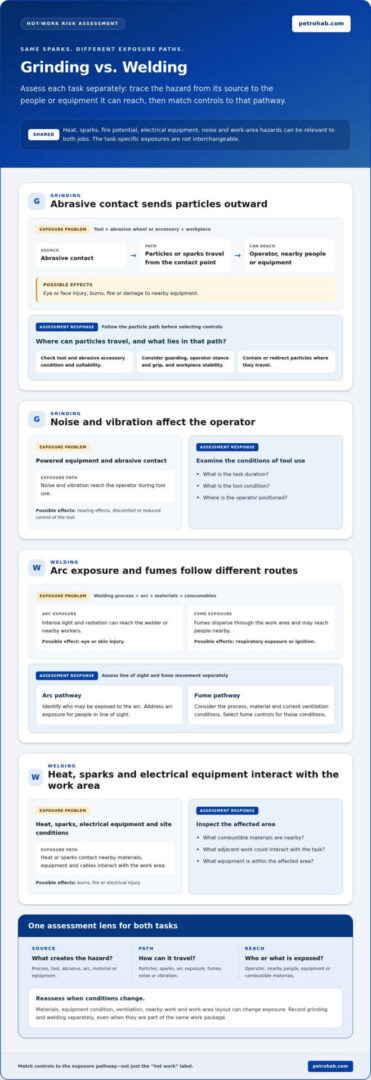
A combined hot-work checklist can identify hazards without showing how each task exposes people or equipment. Compare the source, path, and potential consequence for the actual method, then use the assessment prompts to guide a site inspection. The table is a starting framework, not a substitute for evaluating equipment, materials, and worksite conditions.
| Task | Hazard source | Exposure pathway | Possible consequence | Assessment prompt |
|---|---|---|---|---|
| Grinding | Tool, abrasive wheel or accessory, workpiece | Particles or sparks travel from the contact point toward the operator, nearby people, or equipment | Eye or face injury, burns, fire, or damage to nearby equipment | Where can particles travel, and what lies in that path? |
| Grinding | Abrasive contact and powered equipment | Noise and vibration reach the operator during tool use | Hearing effects or discomfort and reduced control of the tool | What are the task duration, tool condition, and operator position? |
| Welding | Selected welding process, arc, materials, and consumables | Arc exposure reaches the welder or nearby workers; fumes disperse through the work area | Eye or skin injury, respiratory exposure, or ignition | Who may be exposed, and how do fumes move under current ventilation conditions? |
| Welding | Heat, sparks, electrical equipment, and work environment | Heat or sparks contact nearby materials; equipment and cables interact with the work area | Burns, fire, or electrical injury | What combustible materials, adjacent work, and equipment are within the affected area? |
Choose controls based on the identified exposure pathways: contain or redirect particles where they travel, address arc exposure for people in line of sight, and select fume controls for the process, material, and ventilation conditions. A control for one route may not manage another. Restricting access to the immediate welding position, for example, does not by itself control fumes that move beyond it.
What should the assessor examine during grinding?
Inspect the grinding tool and abrasive wheel or accessory for condition, suitability to the task, and effective guarding. Consider the operator’s stance and grip, the workpiece’s stability, and whether the grinding angle directs particles toward people, equipment, openings, or combustible material. Include eye and face exposure, noise, vibration, and contact with hot material. Assess the full particle and spark path, not just the operator’s position.
What should the assessor examine during welding?
Identify the welding process, base materials, and consumables before evaluating fume and heat exposure. Assess arc exposure for the welder and nearby workers, ventilation and fume movement, electrical equipment, combustible materials, and adjacent work. Conditions can differ between work locations or shift as nearby operations change. Match each measure to the exposure identified rather than assuming one control addresses every process or site condition.
For projects considering a contained work area, PetroHab’s pressurized hot-work enclosure systems can be evaluated as part of the site-specific control plan.
Grinding vs. Welding Risk: Compare Controls Without Assuming One Is Always Safer
Neither grinding nor welding has a fixed risk ranking. A short grinding task with a clear particle path may present a different profile from welding in a poorly ventilated area. Change the material, equipment condition, work position, or nearby activity, and the comparison can change. A risk assessment for grinding vs welding should compare actual exposures and consequences, not rank task names in isolation.
Evaluate controls by how directly they address each identified hazard. Apply the hierarchy of controls: consider eliminating or substituting the hazard where practicable, then engineering measures, work practices, and personal protective equipment. No single measure should be treated as removing every risk. PPE, for example, may reduce an individual’s exposure but will not by itself prevent sparks from reaching combustible material.
How should assessors compare control effectiveness?
For each hazard, identify the people or assets exposed, the pathway, and the control intended to interrupt it. Separate controls by function so gaps are visible:
- Equipment safeguards: Check guards and equipment condition for grinding, and assess welding equipment and cables for the task and work area.
- Work practices: Define work boundaries, access, task sequencing, and coordination with nearby operations.
- Monitoring and ventilation: Select measures according to the exposure being assessed, such as airborne contaminants or changing area conditions.
- Emergency response: Establish how workers will raise an alarm and respond to foreseeable incidents under site procedures.
Compare the residual risk after controls are applied, while recognizing that conditions and control performance can change. The assessment must follow current site procedures and applicable jurisdictional requirements. For the engineering-control option, the hot work safety enclosure guide can help frame where a pressurized enclosure may fit within a project-specific plan.
When can surrounding conditions change the risk picture?
A confined or hazardous area can introduce conditions that are not captured by examining the tool or welding process alone. Consider ventilation, possible changes in gas conditions, nearby equipment, access, and simultaneous work. Monitoring and work-area management should reflect the hazards identified and the site’s procedures. Verify applicable hazardous-area requirements for the project jurisdiction; a general checklist cannot replace that review.
For example, imagine grinding or welding inside a storage tank while other work takes place nearby. The tank is a scenario, not a universal template. The assessment must account for the specific task, atmosphere, access, ventilation, equipment, and adjacent operations. A control suitable for one activity may not address the other’s exposures. Reassess if conditions change, and update the work plan before proceeding.
Where containment is under consideration, PetroHab’s modular, pressurized Hot Work Safety Enclosures can be evaluated as one engineered control within the project plan. Their suitability depends on the identified hazards and site requirements, not on a general assumption that every hot-work task needs an enclosure.
How to Build a Task-Specific Risk Assessment for Grinding or Welding
A practical assessment follows the work from planning through completion. For a work package that includes both grinding and welding, write separate task descriptions and assess each method on its own terms. Shared location hazards can be recorded across the package, but keep task-specific exposures and controls distinct. This helps workers and supervisors see which measures apply at each stage.
What information belongs in the assessment?
Record enough detail to connect each hazard to an exposure and a control. The risk assessment for grinding vs welding should describe the actual job, not just name the process.
- Define the task and sequence. State whether the work involves grinding, welding, or both. Describe the order of operations, work location, and intended work area.
- Identify equipment and materials. Note the tools or welding process, abrasive accessory where applicable, workpiece, materials, and consumables. Include relevant equipment conditions and how the setup will be used.
- Map hazards and exposure. Identify potential sources, who may be exposed, how exposure could occur, and credible consequences. Include workers, nearby personnel, equipment, and other assets that may be affected.
- Select and record controls. Tie each control to the hazard it addresses. Document work practices, equipment safeguards, PPE, monitoring, and ventilation as applicable. State who is responsible for implementing and communicating each measure.
- Coordinate with site arrangements. Record relevant site procedures, permit-to-work interfaces, monitoring needs, adjacent operations, and emergency response arrangements. Verify applicable requirements for the project jurisdiction and current site procedures.
- Brief the people involved. Communicate task boundaries, hazards, controls, roles, and the conditions that require work to stop and the assessment to be reviewed.
Be precise. “Control sparks” is less useful than identifying the material or equipment at risk, the path sparks could take, and the measure intended to interrupt that path. Likewise, a fume control should correspond to the process, materials, and ventilation conditions assessed.
When should the assessment be reviewed?
Review the assessment before work starts and whenever the task, work area, equipment, materials, or surrounding operations change. A new nearby activity could affect access or exposure; a change in ventilation could alter how fumes move. If a new hazard appears or a selected control is not working as intended, pause and reassess under site procedures before continuing. Communicate revised controls to affected personnel.
A pressurized Hot Work Safety Enclosure may be considered as an engineered control within a project-specific plan, but it does not replace task assessment, site procedures, or review of changing conditions. To explore advanced hot work safety systems for industrial work planning, visit PetroHab.
Where a PetroHab HWSE Fits in a Grinding or Welding Risk Assessment
A Hot Work Safety Enclosure (HWSE) can serve as an engineered control when an assessment identifies hot-work exposures that could affect personnel, equipment, or surrounding operations. It does not replace the task-specific assessment, site procedures, or other controls. The assessor still needs to determine whether an enclosure fits the work method, location, materials, and changing conditions.
PetroHab’s HWSE products include the Petro-Habitat™, Petro-Shield™, and Petro-Lite™. All habitats use patented Quadra-Lock® panel interlocking technology (U.S. Patent Nos. 9,545,775 and 9,517,609). Their panels are made from U.S.-made premium silver/gray silicone-coated fiberglass cloth, ANSI/FM 4950 certified, and can withstand continuous temperatures of 1,000 °F (over 500 °C). PetroHab stands almost alone in offering its patented and certified habitat systems for either lease or sale.
How do habitat features relate to identified hot-work hazards?
PetroHab habitats are modular, portable, fire-retardant, and designed for pressurized operation. These characteristics may be relevant where the assessment calls for a defined enclosure around hot work. Consider the identified hazards and planned work, including whether the activity is grinding, welding, or both, and how workers, equipment, and nearby operations may be affected.
Automatic shutdown systems are ATEX- and IECEx-certified (IEC 60079-13) and monitor differential pressure and gas levels. Optional oxygen and/or carbon-dioxide detectors are available. The Safe-Stop Safety Shutdown System (SSS) provides immediate shutdown in unsafe conditions. Evaluate these features against the project’s identified hazards and site requirements. An enclosure or shutdown system does not replace determining applicable hot-work and hazardous-area requirements or maintaining the controls set out in site procedures.
What PetroHab facts support a project discussion?
PetroHab manufactures, leases, sells, and maintains Hot Work Safety Enclosures, and provides training programs for assembly, disassembly, and maintenance of habitats and shutdown systems. Its automatic shutdown systems are ATEX- and IECEx-certified (IEC 60079-13), and the Safe-Stop Safety Shutdown System provides immediate shutdown in unsafe conditions. PetroHab reports well over a million incident-free man-hours. These details can inform a project discussion, but the assessment must still establish how a habitat and its shutdown system relate to the specific work plan and exposure pathways.
As part of the risk assessment for grinding vs welding, document why an enclosure is being considered, which task or tasks it will support, and how it integrates with the project’s controls. Align the selected habitat and shutdown system with the work scope and site procedures. Discuss your project requirements with PetroHab to evaluate its pressurized habitat systems for the planned hot work.
Put the Assessment to Work at the Jobsite
A written assessment has value only when it informs decisions at the point of work. Use the risk assessment for grinding vs welding to support a clear pre-job briefing. Workers should understand which controls apply to their task, who is responsible for them, and what change requires a pause and review. Keep the assessment accessible to the people performing and supervising the work.
Treat the plan as active. Confirm the work area and control arrangements before starting, communicate changes as they arise, and record updates through the site’s established procedures. This keeps the assessment connected to real conditions rather than leaving it as a static document.
For projects considering an enclosure as part of the hot-work control plan, discuss your hot-work enclosure requirements with PetroHab. A clear project discussion can align enclosure considerations with the work scope and site requirements. Contact PetroHab to discuss its pressurized Hot Work Safety Enclosures for your planned industrial hot work.
Frequently Asked Questions
Can one risk assessment cover both grinding and welding?
Yes. One assessment package can cover both tasks if it clearly distinguishes each activity, its hazards, and its controls. In a risk assessment for grinding vs welding, separate entries help prevent a grinding control from being assumed to cover welding exposures, or vice versa. If work moves from grinding to welding, include the sequence and transition conditions, such as where hot material or grinding residue remains before the next task begins.
Is grinding always considered hot work?
Not universally. Grinding can create sparks and heat, so many site procedures treat it as hot work, but classification depends on the applicable site rules and jurisdictional requirements. Before work begins, identify how the specific grinding task is classified under the facility’s permit process. For example, grinding in a designated workshop may be handled differently from grinding near process equipment or combustible materials.
What happens if gas levels or pressure change during hot work?
Follow the site’s response procedure and stop or suspend work as directed if monitored gas levels or enclosure pressure move outside established operating conditions. Do not resume solely because readings return to normal. Determine why they changed, confirm the required conditions are restored, and obtain authorization through the site process. A ventilation interruption or nearby process activity, for example, may require reassessing the work area before restart.
Can a pressurized habitat be used for grinding as well as welding?
Yes. PetroHab Hot Work Safety Enclosures are designed for industrial hot work that includes grinding as well as welding. Whether a pressurized habitat fits a particular grinding job depends on the task, particle and spark paths, location, surrounding operations, and project requirements. Specify which activity will take place inside the habitat and ensure the work plan addresses the tools, materials, and personnel involved.
Does a hot-work enclosure replace a risk assessment or permit?
No. An enclosure may be one element of the control plan, but it does not determine whether the task is authorized or whether additional measures are needed. Complete the assessment and follow the applicable site permit process and jurisdictional requirements. A change in the workpiece or nearby operations, for example, may introduce hazards that the enclosure alone does not address, so review the planned controls.
When should a grinding or welding assessment be updated?
Update it when a change could affect exposure or control effectiveness. Examples include changing the grinding accessory, switching welding materials or consumables, relocating the work, altering ventilation, or adding nearby work. A control suited to the original setup may no longer address the revised conditions. Follow site procedures to pause, reassess, communicate revisions to affected workers, and establish authorization before the changed task proceeds.