Blog Posts
Temporary Pressurized Enclosure Standards: A 2026 Compliance Guide
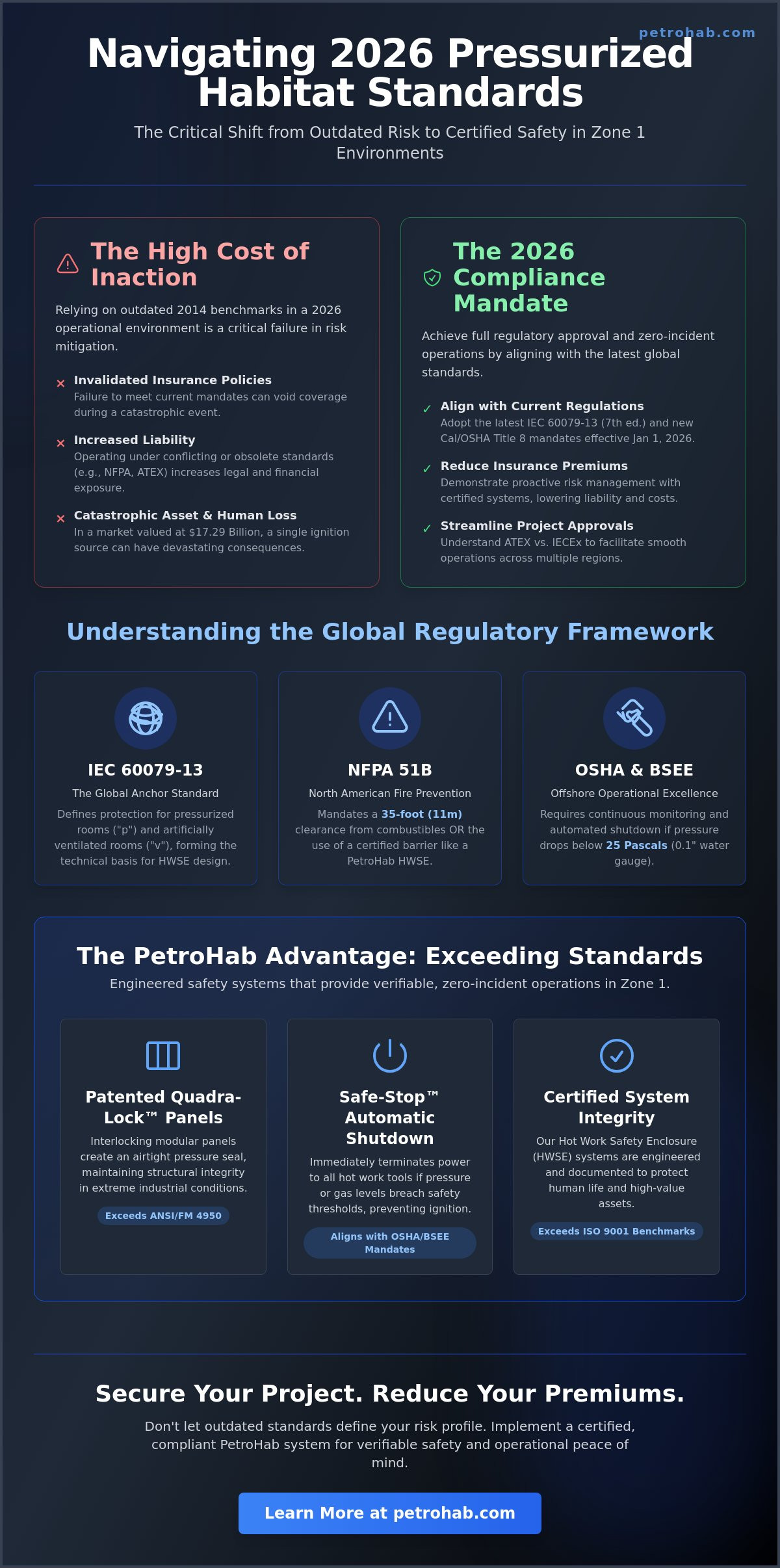
Relying on 2014 safety benchmarks for pressurized habitats in 2026 is a critical failure in risk mitigation that can invalidate your offshore insurance policy. With the hazardous area equipment market reaching $17.29 billion this year, the margin for error has vanished. You recognize that managing conflicting temporary pressurized enclosure standards like NFPA and ATEX remains the most taxing component of your safety protocol. It’s a high-stakes environment where a single ignition source leads to catastrophic asset loss and human cost.
This guide serves as your definitive technical reference for achieving full regulatory approval and zero-incident operations. We’ll detail how to align your site with the latest IEC 60079-2 7th edition and the new Cal/OSHA Title 8 CCR mandates that took effect on January 1, 2026. You’ll learn how the integration of patented Quadra-Lock panels and the Safe-Stop automatic shutdown system provides the modular integrity required for the most demanding Zone 1 environments. We’ll provide the clarity you need to secure your project and reduce insurance premiums through certified safety systems.
Key Takeaways
- Master the nuances of IEC 60079-13 and NFPA 51B to ensure your hot work operations remain compliant with 2026 global safety mandates.
- Understand the mechanical integrity of modular panel joints and how Quadra-Lock technology maintains airtight pressure seals under extreme industrial conditions.
- Identify critical differences between ATEX Directive 2014/34/EU and IECEx certification to streamline multi-region project approvals and reduce insurance liability.
- Establish precise ignition source control by integrating automated shutdown protocols that align with current temporary pressurized enclosure standards for gas and pressure monitoring.
- Discover how the engineering specifications of the PetroHab HWSE system exceed ISO 9001 benchmarks to protect human life and high-value assets in Zone 1.
Global Regulatory Framework for Temporary Pressurized Enclosures
Global regulatory frameworks for temporary pressurized enclosure standards are anchored by the IEC 60079-13 standard, which specifically addresses the protection of equipment by pressurized rooms “p” and artificially ventilated rooms “v”. Unlike permanent pressure vessels governed by ASME codes, a PetroHab Hot Work Safety Enclosure (HWSE) is an engineered safety system designed for rapid deployment in explosive atmospheres. Compliance requires a rigorous understanding of how these modular structures isolate ignition sources from hydrocarbons. The legal landscape is defined by the ATEX Directives in Europe and the Class/Division or Zone systems in North America. These regulations ensure that any electrical or thermal energy generated during welding or grinding is contained within a controlled environment. Achieving this level of integrity involves more than just physical barriers; it necessitates a technological remedy that includes automated gas detection and pressure monitoring.
To better understand the structural concepts behind these modular systems, watch this overview of pressurized wall applications:
A robust Permit-to-Work (PTW) system acts as the operational foundation for compliance. It bridges the gap between technical standards and real-world execution. Every hot work permit must verify that the enclosure’s internal pressure exceeds external atmospheric pressure by at least 25 Pascals (0.1 inches of water gauge) before work begins. This isn’t just a recommendation; it’s a critical safety barrier that prevents the ingress of flammable gases. When the PTW system is integrated with certified hardware, it creates a documented trail of safety that’s essential for regulatory audits and insurance verification.
NFPA 51B: The North American Standard for Fire Prevention
NFPA 51B establishes the criteria for fire prevention during welding, cutting, and other hot work. It mandates a 35-foot (11-meter) clearance from combustibles or the use of certified flame-resistant barriers. A PetroHab habitat utilizing Quadra-Lock panels fulfills these requirements by creating a localized environment where ignition sources are physically isolated. Documentation for site audits must include fire watch logs and evidence that the enclosure materials meet ANSI/FM 4950 standards. These records prove the habitat’s effectiveness as a “Safe Area” equivalent in otherwise hazardous locations.
OSHA and BSEE Requirements for Offshore Operations
The Bureau of Safety and Environmental Enforcement (BSEE) and OSHA enforce strict protocols for offshore platforms. As of the April 28, 2026, amendments to 29 CFR Part 1926, employers must ensure that “Entry Employers” conduct mandatory site surveys. For pressurized habitats, this means enclosure technicians must be certified to monitor for hydrocarbon ingress continuously. If the pressure differential drops below the 0.1-inch water column threshold, the Safe-Stop automatic shutdown system must immediately terminate power to all hot work tools to prevent an explosion. This automated response is the gold standard for maintaining operational excellence in high-stakes environments.
Technical Standards for Habitat Integrity and Modular Design
Engineering a temporary habitat requires a departure from the static assumptions of permanent vessels. While containerized solutions offer A60 fire ratings, they lack the modularity required to navigate complex offshore geometries. Achieving compliance with temporary pressurized enclosure standards hinges on the technical synergy between material science and mechanical seal integrity. Flexible habitat panels must be constructed from high-grade silicone-coated fiberglass cloth, verified to ANSI/FM 4950 standards. This material ensures that the enclosure withstands the thermal stresses of continuous welding while maintaining the structural resilience necessary for corrosive, high-wind environments. Each panel is engineered to resist degradation from UV exposure and salt-laden atmospheres, ensuring the habitat remains a reliable guardian of the work site throughout the project lifecycle.
Modularity introduces potential failure points at every junction. Traditional habitats utilize zippers or hook-and-loop fasteners, which are prone to mechanical degradation and gas bypass. PetroHab addresses this risk through a technological remedy that prioritizes seal consistency across the entire assembly. By eliminating these weak points, safety managers can ensure that the internal environment remains isolated from external hydrocarbon hazards. This transition from basic fabric covers to an engineered safety system is what defines the 2026 approach to hot work risk management. It’s a calculated move to replace unpredictable variables with repeatable, certified performance.
Quadra-Lock Technology: Redefining Modular Enclosure Integrity
The patented Quadra-Lock panel attachment system represents a significant shift in habitat engineering. Unlike legacy systems, Quadra-Lock utilizes an interlocking mechanism that creates a continuous, gas-tight barrier. This design was granted US Patent No. 9,517,609 in December 2016, specifically to address the integrity gaps found in zippered habitats. These panels provide the necessary structural rigidity to withstand offshore pressure differentials without compromising the modularity required for rapid deployment. The result is a robust enclosure that effectively eliminates the risk of gas ingress at the seams.
Positive Pressure and Airflow Standards
Maintaining the internal atmosphere is governed by strict aerodynamic protocols. According to IEC 60079-2:2014, the system must maintain a minimum overpressure of 0.1 to 0.5 inches of water (25 to 125 Pascals). This positive pressure acts as a physical shield against flammable gas ingress. Beyond pressure, the system must achieve a specific number of air changes per hour (ACH) to remove welding fumes and ensure respiratory safety. Precise manometer calibration is mandatory; a 5% deviation in readings can lead to a safety shutdown. This level of precision ensures that the habitat functions as an active safety component rather than a passive barrier. For tailored advice on these technical requirements, you can consult our team regarding pressurized welding enclosures.
Comparing International Standards: ATEX vs. IECEx for Habitats
Navigating the dual requirements of ATEX and IECEx is a prerequisite for any global safety manager. While both frameworks rely on the IEC 60079 series, they serve different legal and operational functions. ATEX Directive 2014/34/EU is a mandatory legal requirement for equipment sold or used within the European Union. It focuses on Essential Health and Safety Requirements (EHSR) and requires a Notified Body for certification of Category 2 equipment. Conversely, IECEx is a voluntary international scheme that facilitates the global movement of equipment by providing a Certificate of Conformity recognized by 33 member countries. For a PetroHab Hot Work Safety Enclosure (HWSE), achieving dual certification is the only way to ensure temporary pressurized enclosure standards are met across diverse jurisdictions like the North Sea and the Gulf of Mexico.
The distinction between these standards becomes critical when evaluating the individual components of a habitat. Every auxiliary system, including air intake blowers, internal lighting, and gas detection sensors, must carry its own certification. For instance, a blower used in a Zone 1 environment must be Category 2 ATEX certified or have an IECEx protection level of “db” (flameproof) or “eb” (increased safety). Using non-certified components within a pressurized habitat nullifies the entire system’s compliance and introduces unacceptable ignition risks. PetroHab ensures that every component, from the Safe-Stop system to the lighting, meets these stringent requirements to maintain the integrity of the work environment. This methodical approach to component selection is what defines a professional safety partner.
ATEX Zone Classifications and Habitat Suitability
Zone classifications dictate the required protection level for any temporary structure. Zone 1 represents an area where an explosive atmosphere is likely to occur in normal operation; Zone 2 is an area where it’s not likely to occur. A habitat engineered for Zone 1 must utilize Category 2 equipment and feature more robust ignition source control. Understanding these nuances is essential for project planning and risk assessment. You can find detailed breakdowns of these requirements in our Hazardous Environment Standards: The 2026 Guide. Proper classification ensures that the Quadra-Lock panels and associated hardware are deployed in configurations that match the specific hazard profile of the site.
IECEx Certification for Global Interoperability
Multinational oil and gas operators favor IECEx because it simplifies the procurement process across international borders. Instead of re-certifying equipment for every new country, the IECEx Certificate of Conformity provides a standardized verification of safety. This consistency is vital for ignition source control systems like Safe-Stop, which must perform predictably regardless of geographical location. PetroHab maintains a multi-region certification strategy, ensuring that our pressurized habitats comply with UL/CSA standards in North America while simultaneously meeting ATEX and IECEx requirements. This rigorous approach eliminates the administrative burden on safety managers and guarantees that temporary pressurized enclosure standards are upheld to the highest degree of technical precision.
Operational Standards for Ignition Source Control
Active monitoring is the functional heart of any hot work safety protocol. While the physical integrity of Quadra-Lock panels provides the barrier, the electronic control systems serve as the active guardian of the work site. Modern temporary pressurized enclosure standards require a seamless integration between gas detection and pressure monitoring hardware. This isn’t a passive setup. It’s a dynamic safety loop where the system constantly validates the environment against pre-set safety parameters. If any variable deviates from the certified range, the system must act without human intervention to neutralize potential ignition sources. Precision is the baseline for these operations, as even a momentary lapse in pressure can allow hydrocarbon ingress in Zone 1 environments.
Automatic shutdown protocols are governed by strict time-to-stop requirements. When the internal pressure falls below the 0.1-inch water column threshold, or gas levels reach 10% of the Lower Flammable Limit (LFL), the system must isolate power to all hot work tools within milliseconds. This rapid response prevents sparks or high-temperature surfaces from coming into contact with potentially explosive atmospheres. For a deeper analysis of these integrated technologies, consult our A Comprehensive Guide to Advanced Hot Work Safety Systems. These protocols ensure that the habitat remains a controlled environment even during equipment failure or sudden external gas releases.
Safe-Stop: Standards for Automatic Shutdown Systems
The Safe-Stop system is certified to IEC 60079-13:2017, the gold standard for pressurized rooms. It utilizes fail-safe logic to monitor redundant gas sensors and pressure manometers simultaneously. If the system loses signal from a sensor or detects a pressure drop, it defaults to a shutdown state. Visible and audible alarms must exceed 100 decibels to ensure workers are alerted immediately, even in high-noise offshore environments. This uncompromising logic eliminates the risk of human error during critical safety events.
Gas Detection and Air Intake Standards
Standard sensor positioning is critical for effective monitoring. ATEX-certified gas detectors must be placed at the primary air intake to ensure that the air being pumped into the enclosure is clean. Internal sensors provide a secondary layer of protection, monitoring for any localized gas pockets. Calibration isn’t optional; sensors require bump tests before every shift and full calibration every 90 days to maintain accuracy. These intervals ensure that the temporary pressurized enclosure standards for gas detection are met throughout the project’s duration. Deploy the Safe-Stop Automatic Shutdown System to ensure your site meets these rigorous benchmarks.
The PetroHab Advantage: Exceeding Enclosure Standards
PetroHab defines the gold standard in hot work safety by exceeding the baseline requirements established by international regulatory bodies. While many providers treat ISO 9001 as a final destination, we view it as a minimum starting point for operational excellence. Our PetroHab Hot Work Safety Enclosure (HWSE) incorporates engineering redundancies that surpass current temporary pressurized enclosure standards, providing a resilient barrier against hydrocarbon ingress in high-stakes environments. This commitment to technical precision ensures that every deployment protects both human life and high-value assets without compromise. We don’t just follow standards; we engineer the benchmarks that the industry eventually adopts. Our approach replaces unpredictable variables with a definitive technological remedy.
The engineering superiority of the Quadra-Lock system is evident in its unrivaled seal integrity. Traditional habitats often fail at the seams due to mechanical wear, but our patented interlocking panels eliminate these vulnerabilities. This innovation allows for seamless integration into Zone 1 applications where risk levels are highest. For a comprehensive look at these systems, read The Definitive Guide to Hot Work Safety Enclosures. By utilizing Quadra-Lock technology, operators reduce the mechanical failures that lead to hot work permit delays, keeping projects on schedule while maintaining absolute control over ignition sources.
Patented Innovation and Safety Leadership
PetroHab’s leadership is anchored in real-world results across the North Sea and the Gulf of Mexico. In these regions, our technology has successfully mitigated ignition risks during complex offshore operations where gas-prone environments are the norm. The December 2016 granting of US Patent No. 9,517,609 for the Quadra-Lock system solidified our role as an active guardian of industrial sites. Modularity is the future of temporary pressurized enclosure standards because it allows for rapid, adaptable deployment in restricted spaces. This flexibility doesn’t come at the expense of safety; it enhances it by ensuring a precise fit for every unique structural challenge on the platform.
Global Support and Technical Training
Equipment integrity is only as effective as the personnel operating it. PetroHab maintains global service hubs to ensure that every HWSE and Safe-Stop system remains in peak condition regardless of its location. We provide rigorous technical training for client personnel, ensuring they’re certified to manage standard-compliant operations. This pedagogical approach transforms our customers into critical safety partners who understand the granular details of risk mitigation. Our technicians provide on-site supervision to verify that every seal and sensor meets our uncompromising expert criteria. To ensure your next project meets all 2026 regulatory requirements, Contact PetroHab for a Compliance Consultation today.
Securing Your 2026 Hot Work Compliance Strategy
Maintaining compliance with evolving temporary pressurized enclosure standards requires an uncompromising commitment to technical precision. The 2026 regulatory landscape, defined by updated IEC 60079-2 protocols and mandatory Cal/OSHA site surveys, leaves no room for outdated equipment. You’ve seen how integrating patented Quadra-Lock technology ensures modular integrity that traditional zippered habitats cannot match. By pairing this structural resilience with the redundant Safe-Stop automatic shutdown system, you establish a fail-safe environment for high-stakes offshore and onshore projects.
Our ATEX and IECEx compliant systems are engineered to exceed international safety benchmarks, providing the reliability needed to mitigate catastrophic risks. Achieving zero-incident operations is a calculated result of choosing the right safety partner. Secure your assets and protect your personnel by deploying the most advanced hot work safety technology available.
Request a Quote for Standard-Compliant Pressurized Habitats and ensure your next project meets the highest global safety requirements. We look forward to supporting your operational excellence.
Frequently Asked Questions
What is the minimum positive pressure required for a welding habitat?
A welding habitat must maintain a minimum overpressure of 0.1 inches of water gauge, which equals 25 Pascals. This specific threshold is mandated by temporary pressurized enclosure standards like IEC 60079-13 to prevent hydrocarbon ingress. Maintaining this pressure differential ensures the internal atmosphere remains isolated from external explosive hazards throughout the duration of the hot work.
Are all temporary pressurized enclosures ATEX certified?
Certification isn’t universal and depends entirely on the manufacturer’s engineering rigor. Only systems that have been verified by a Notified Body to meet Directive 2014/34/EU carry the ATEX mark. PetroHab HWSE systems are ATEX certified for Category 2 and 3 environments, ensuring they meet the essential health and safety requirements for high-stakes European operations.
How does NFPA 51B apply to pressurized enclosures?
NFPA 51B establishes the criteria for fire prevention by requiring the isolation of ignition sources during welding or cutting. Pressurized habitats serve as an engineered solution to fulfill the Safe Area requirement when work occurs within 35 feet of combustibles. Using Quadra-Lock panels ensures the enclosure meets the flame-resistance standards mandated by this North American regulation.
What happens if a habitat loses pressure during hot work?
The Safe-Stop automatic shutdown system immediately terminates power to all welding equipment if pressure drops below the 0.1-inch water column threshold. This fail-safe protocol prevents sparks from existing in a non-pressurized environment. It’s a critical component of temporary pressurized enclosure standards designed to neutralize ignition risks within milliseconds of a mechanical barrier breach.
Can temporary pressurized enclosures be used in Zone 0?
Pressurized enclosures are strictly intended for Zone 1 and Zone 2 applications. Zone 0 environments involve a continuous presence of explosive gases, which requires specialized protection levels that temporary structures aren’t designed to provide. PetroHab technology focuses on converting Zone 1 and 2 areas into controlled work environments for safe industrial maintenance and asset protection.
What standards govern the gas detection systems used in habitats?
Gas detection hardware must comply with IEC 60079-29-1 for performance and IEC 60079-0 for general explosive atmosphere requirements. These standards ensure that sensors accurately detect flammable gases at 10% of the Lower Flammable Limit. PetroHab integrates these certified sensors into the Safe-Stop system to provide continuous, reliable monitoring of the air intake and internal atmosphere.
How often should manometers in pressurized enclosures be calibrated?
Manometers require a bump test before every work shift to verify operational accuracy. A full technical calibration must occur every 90 days or as specified by the manufacturer’s maintenance schedule. Meticulous record-keeping of these calibration intervals is essential for passing BSEE or OSHA site audits on offshore platforms and ensuring the habitat’s integrity remains unquestioned.
Does IECEx certification replace the need for ATEX in Europe?
IECEx doesn’t replace ATEX within the European Union. While IECEx provides a global certificate of conformity recognized in 33 countries, ATEX remains a mandatory legal requirement for equipment used in EU member states. PetroHab maintains dual certification to ensure our habitats are compliant in both European markets and international jurisdictions that recognize the voluntary IECEx scheme.