Blog Posts
The Hidden Costs of Hot Work Safety: A 2026 Financial Guide for Oil & Gas
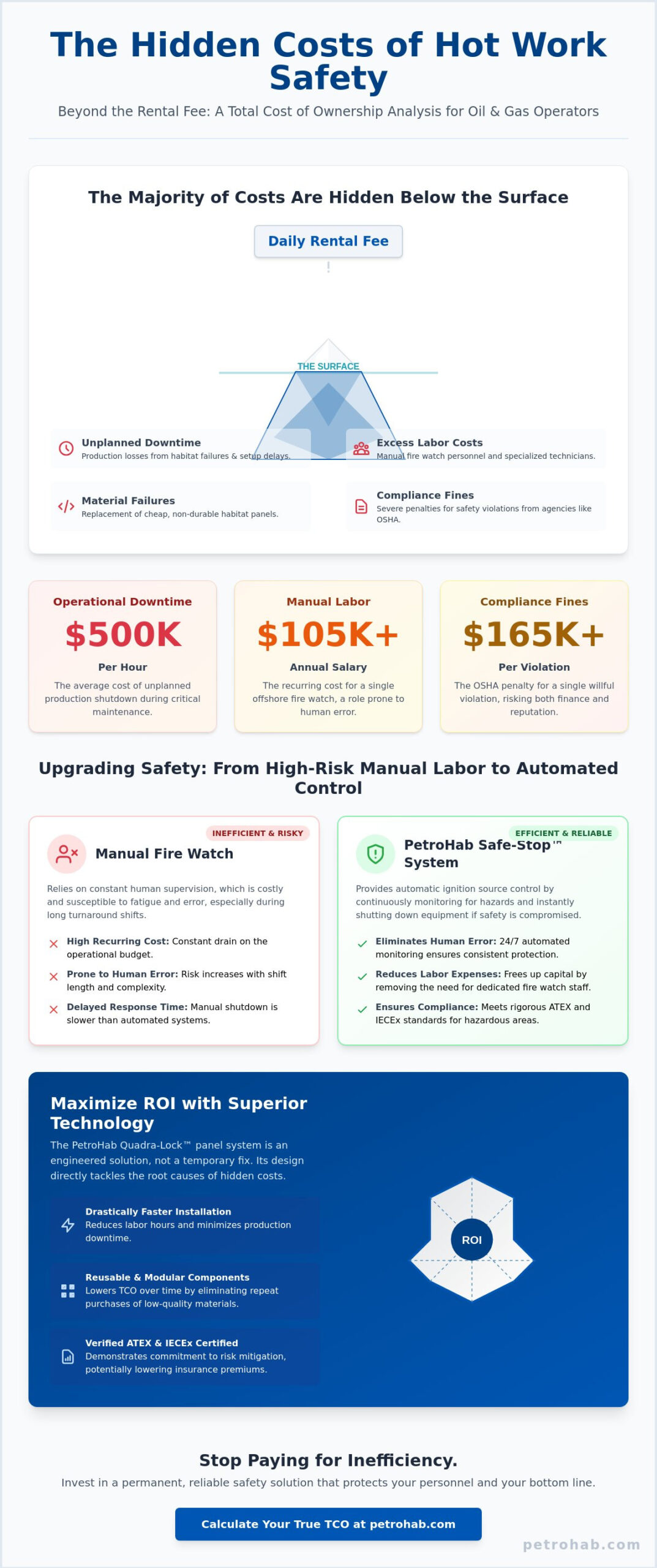
Did you know that for an oil and gas operator in 2026, the cost of unplanned downtime now averages between $200,000 and $500,000 per hour? While safety remains the absolute priority, many managers realize that the daily rental rate of an enclosure is rarely the most expensive line item. You’re likely already struggling with the hidden costs of hot work safety, from the $105,577 annual salary required for a single offshore fire watch to the $165,514 penalties OSHA now levies for willful violations. These financial drains often stem from low-quality habitat failures and inefficient manual monitoring during critical refinery turnarounds.
We understand that protecting high-value assets requires more than just compliance; it demands operational excellence. This guide provides a framework to identify and mitigate the labor and compliance expenses that inflate your total cost of ownership. You’ll discover how implementing automated systems like Safe-Stop and modular technologies like the Quadra-Lock can drastically reduce downtime. We’ll also provide the technical data you need to prove ROI and transition from high-cost rentals to permanent, reliable safety solutions that safeguard your personnel and your bottom line.
Key Takeaways
- Identify the hidden costs of hot work safety by calculating Total Cost of Ownership (TCO), accounting for logistics, training, and long-term asset maintenance beyond simple rental fees.
- Quantify how efficient habitat deployment minimizes operational downtime, preventing production losses that can reach $500,000 per hour during critical maintenance windows.
- Evaluate the financial benefits of replacing manual fire watch personnel with automated ignition source control systems like Safe-Stop to eliminate human error and recurring labor expenses.
- Mitigate the risk of severe regulatory penalties and catastrophic ignition events by ensuring all hot work operations strictly adhere to the latest ATEX and IECEx standards.
- Leverage modular technology like the Quadra-Lock system to maximize ROI through reusable components and significantly faster installation times during refinery turnarounds.
Beyond the Rental Fee: Understanding the Total Cost of Ownership (TCO)
Financial managers often focus on the daily rental rate of a Hot Work Safety Enclosure (HWSE). This narrow view ignores the hidden costs of hot work safety that accumulate throughout a project’s lifecycle. True economic analysis requires looking past the sticker price to evaluate how a system performs under operational pressure. Selecting a habitat based solely on the lowest bid often triggers a chain reaction of secondary expenses. These include unplanned maintenance, slower installation speeds, and increased risk profiles that drive up the final invoice.
It’s vital to distinguish between general environmental heat stress management and specialized hot work safety protocols. While the pending 2026 OSHA Heat Injury and Illness Prevention Standard addresses worker hydration and acclimatization, industrial hot work safety centers on technical ignition source control. Preventing a catastrophic event in a Zone 1 or Zone 2 area requires pressurized habitats that function as engineered barriers. When these systems fail due to poor build quality, the cost isn’t measured in medical claims alone; it’s measured in the $200,000 to $500,000 hourly loss associated with unplanned facility shutdowns.
To better understand the financial implications of safety equipment selection, watch this helpful video:
Direct vs. Indirect Safety Expenditures
Leasing and rental fees for modular systems represent the most visible direct costs. However, mobilization to remote offshore or onshore sites often introduces significant logistical overhead. If a system is bulky or difficult to transport, freight costs can quickly eclipse the rental savings. On-site supervision and technician training fees are also critical factors. Systems that require specialized, third-party contractors for every adjustment increase the hidden costs of hot work safety by tying up project schedules and adding to the total headcount during a turnaround.
The Price of Hardware Integrity
Cheap habitats often utilize generic PVC alternatives that lack the durability required for high-intensity welding environments. These materials degrade under UV exposure and thermal stress, leading to frequent replacements. In contrast, the longevity of Quadra-Lock panels allows for repeated reuse across multiple projects without compromising the pressurized seal. High-integrity hardware also influences your financial standing with insurers. Utilizing patented technology and systems with verified ATEX or IECEx certifications demonstrates a commitment to risk mitigation that can lead to lower premiums. Reliability isn’t just a safety metric; it’s a fiscal strategy. Total Cost of Ownership is the sum of procurement, operation, and risk-adjusted failure costs.
Quantifying Operational Downtime and Production Losses
In the oil and gas sector, time is the most expensive commodity. Unplanned downtime during a refinery turnaround costs between $200,000 and $500,000 per hour, according to 2026 Siemens data. While direct equipment costs are visible, the hidden costs of hot work safety often manifest as lost production minutes. Every hour spent troubleshooting a failing enclosure or waiting for a complex setup is an hour of lost revenue. Reliability isn’t just about safety; it’s about maintaining the operational rhythm of the facility. Compliance with OSHA hot work regulations requires rigorous monitoring, but poor equipment choices often lead to unnecessary work stoppages.
Setup and Decommissioning Efficiency
Efficiency starts long before the first spark. Non-modular systems often require complex, labor-intensive assembly that delays the Permit-to-Work (PTW) issuance. Modular Quadra-Lock panels accelerate the PTW process by allowing for rapid configuration and inspection. In contrast, traditional systems can trap crews in extended assembly cycles, where high labor rates for specialized technicians quickly inflate the project budget. For a deeper look at hardware specifications, consult The Definitive Guide to Hot Work Safety Enclosures (HWSE) in 2026. Minimizing these “pre-work” hours is essential for keeping turnarounds on schedule and within budget.
The Cost of Habitat Failure
Habitat integrity is non-negotiable in pressurized environments. Leakage isn’t just a safety risk; it’s a financial drain. If a habitat loses positive pressure during a live flare operation, work stops immediately. High-quality seals and rigid panel construction prevent gas ingress, ensuring that welding operations continue without interruption. When a seal fails, the hidden costs of hot work safety include the hourly cost of a suspended welding crew and the potential for a full site evacuation.
False positives in gas detection triggers also contribute to these losses. Low-quality automatic shutdown systems that lack precision can misinterpret environmental fluctuations as hazardous gas presence. These “phantom” triggers force immediate power cuts to welding equipment, requiring a full safety re-evaluation before work resumes. Selecting engineered safety enclosures with integrated, high-precision sensing reduces these interruptions. By maintaining absolute pressure integrity and accurate monitoring, operators avoid the cascading costs of production halts and project overruns.
Labor Inefficiencies: Manual Monitoring vs. Automatic Shutdown Systems
Relying on manual labor for fire watch operations introduces significant, recurring hidden costs of hot work safety. While a human presence is often seen as a standard precaution, it’s a variable expense that scales poorly with project size. In April 2026, the average onshore fire watch in a refinery earns approximately $15.66 per hour, but these costs escalate dramatically in offshore environments. An offshore fire watch professional commands an average annual salary of $105,577 according to ZipRecruiter data. When you factor in the requirement for 24/7 coverage across multiple shifts, the labor burden for a single hot work permit can exceed the cost of the safety equipment itself within weeks.
Beyond the direct wages, the “Human Factor” represents a latent financial risk. Boredom and fatigue during 12-hour shifts lead to monitoring lapses that manual oversight cannot fully mitigate. These lapses increase the probability of an ignition event, and the cost of injuries in the oil and gas industry remains a primary driver of budget overruns. Automated systems don’t suffer from attention decay. The Safe-Stop system remains the gold standard in hot work safety, ensuring that ignition source control is maintained with mathematical precision.
The Hidden Salary of a Fire Watch
Calculating the true burden of manual monitoring requires accounting for more than just base pay. Each fire watch requires specific certifications to meet hazardous environment standards, including training for gas detection and emergency response. You must also account for mobilization, housing, and insurance for every additional person on site. Extended project timelines multiply these labor costs exponentially. Comparing these recurring expenditures to the one-time integration of a pressurized welding habitat reveals a clear path to lower Total Cost of Ownership.
Safe-Stop Technology: ROI through Automation
The Safe-Stop Automatic Shutdown System acts as a definitive safeguard, providing a level of reliability that manual monitoring cannot match. By integrating ATEX and IECEx certified gas detection, the system automatically terminates power to welding equipment if hazardous gases are detected or if habitat pressure drops. This automation significantly reduces the headcount required for safe operations. It also generates a digital audit trail. These automated safety logs are essential for demonstrating compliance during OSHA inspections and can help lower insurance liability. For a detailed technical breakdown, read A Comprehensive Guide to Advanced Hot Work Safety Systems in 2026. Transitioning to automated monitoring turns a recurring labor liability into a one-time capital investment with a measurable ROI.
The High Price of Compliance Failures and Safety Incidents
Regulatory oversight in the energy sector has reached a new peak in 2026. OSHA announced updated penalty rates in January 2026, setting serious violations at $16,550 and willful or repeated violations at $165,514 per instance. These figures represent only the surface of the hidden costs of hot work safety. A single ignition event in a Zone 1 or Zone 2 area triggers immediate work stoppages, federal investigations, and potential litigation that can exceed millions of dollars. The financial burden of a safety breach extends far beyond the incident site, affecting corporate valuation and long-term contract eligibility.
Regulatory Fines and Legal Liabilities
Utilizing non-certified enclosures represents a direct breach of most corporate insurance policies. If an incident occurs inside a habitat lacking verified technical standards, insurers often deny coverage, leaving the operator liable for all damages. For a comprehensive breakdown of requirements, see Hazardous Environment Standards: The 2026 Guide to Global Compliance. Compliance isn’t just a legal obligation; it’s a financial shield against catastrophic liability.
The “Brand Damage” following a major industrial safety breach is often the most significant unquantified cost. Major operators have historically seen their stock prices drop by 10% to 15% following publicized safety failures. This loss of investor confidence, combined with the potential for a full suspension of a social license to operate, makes future project approvals difficult and expensive. When safety is compromised, the cost is not just a fine; it is the future of the enterprise. Protecting human life and high-value assets requires an uncompromising commitment to hardware integrity.
Global Standards as a Cost-Saving Tool
Managing disparate safety protocols across global operations in Houston, Dundee, and Brazil increases administrative overhead and procurement complexity. PetroHab’s global footprint allows operators to standardize on Quadra-Lock technology across all regions. This consistency reduces the hidden costs of hot work safety by streamlining spare parts inventory and simplifying technician training across different continents. Utilizing a single, trusted safety partner ensures that every site maintains the same gold standard in hot work safety, regardless of local regulatory nuances.
Standardizing on modular components means that a technician in the North Sea uses the same assembly logic as a technician in the Gulf of Mexico. This reduces the likelihood of installation errors that lead to costly project delays. By centralizing procurement with an expert who understands the granular details of offshore and onshore hazards, companies can lower their logistical burden. Ensure your facility meets these rigorous 2026 requirements by implementing certified pressurized habitats today.
Strategic Procurement: Maximizing ROI with Modular HWSE Technology
Maximizing the return on investment for safety equipment requires a shift from reactive purchasing to strategic procurement. While previous sections detailed the hidden costs of hot work safety related to labor and downtime, the final stage of cost mitigation lies in hardware selection. Modular systems offer a level of fiscal flexibility that traditional, fixed-size enclosures cannot match. By treating safety enclosures as long-term assets rather than disposable project expenses, operators can stabilize their maintenance budgets and ensure consistent protection across diverse site geometries.
The Modularity Advantage
The Quadra-Lock system provides a distinct financial advantage through its modular architecture. These interchangeable panels allow for rapid reconfiguration, ensuring the habitat fits precisely around complex piping or structural obstructions without requiring custom fabrication. This adaptability reduces storage and transport costs by up to 30% compared to bulkier, non-modular alternatives. Because the panels are constructed from high-grade, fire-resistant materials designed for harsh offshore environments, they maintain their integrity over hundreds of deployment cycles. This reusability directly lowers the total cost of ownership by amortizing the initial capital expenditure over multiple years of operation.
Selecting the Right Partner
Evaluating a supplier based solely on a “per day” rental rate is a common procurement error that often leads to budget overruns. A low daily rate frequently masks deficiencies in technical support or equipment reliability. When selecting a partner, safety managers should prioritize providers who offer 24/7 technical assistance and maintain a global inventory. This ensures that if a critical component is damaged during a turnaround, a replacement is dispatched immediately, preventing the $500,000-per-hour production losses discussed earlier. For a detailed evaluation framework, consult our article on Choosing the Right Hot Work Safety Enclosure Suppliers.
The “Lease vs. Buy” decision is a pivotal factor in long-term facility maintenance. For companies with frequent hot work requirements, the trend in 2026 is moving toward the purchase of modular, reusable systems. While renting a habitat can cost tens of thousands for a single repair, purchasing a medium industrial system—typically priced between $8,000 and $25,000—provides a clear path to ROI within a few projects. Use the following checklist to evaluate your safety partners:
- Technical Certification: Does the equipment carry verified ATEX and IECEx certifications?
- Integrated Automation: Is the enclosure compatible with automatic shutdown systems like Safe-Stop?
- Logistical Efficiency: Are the components modular (Quadra-Lock) to minimize freight and storage footprints?
- Global Availability: Can the supplier support operations in Houston, the North Sea, and Southeast Asia simultaneously?
PetroHab remains the gold standard in hot work safety because our systems are engineered to eliminate the hidden costs of hot work safety at every level. We provide the technical precision required for high-stakes environments and the modularity needed for operational efficiency. By standardizing on our patented technologies, you secure a critical safety partner dedicated to the protection of human life and high-value assets.
Optimizing Your 2026 Hot Work Budget
Managing industrial risk in 2026 requires more than just meeting minimum compliance. It demands a technical strategy that addresses the hidden costs of hot work safety, from the $105,577 annual offshore fire watch salary to the $500,000 hourly losses of unplanned downtime. Transitioning to automated ignition source control and modular hardware isn’t just a safety choice; it’s a calculated financial decision that protects your bottom line and your personnel. By identifying these invisible drains on capital, you can stabilize your maintenance budget and ensure project timelines remain intact.
PetroHab provides the engineering precision needed to secure high-value assets across the globe. With our patented Quadra-Lock technology and ATEX and IECEx certified systems, we offer unrivaled reliability from Houston to Dundee. Our experts are ready to help you move away from high-cost rentals and inefficient manual monitoring toward a model of operational excellence. Request a customized ROI analysis for your next hot work project and see how technical integrity drives long-term savings. We look forward to supporting your mission to eliminate workplace accidents in even the most hazardous environments.
Frequently Asked Questions
What are the most common hidden costs in hot work safety?
The most frequent hidden costs of hot work safety include unplanned operational downtime, excessive logistical overhead, and the recurring salary burden of manual fire watch personnel. While procurement managers often focus on daily rental rates, these indirect expenses typically account for the majority of a project’s total safety budget. Inefficient habitat setup times and the need for specialized technicians further inflate the final cost of operation.
How does an automatic shutdown system save money compared to manual fire watch?
Automatic shutdown systems like Safe-Stop eliminate the requirement for dedicated fire watch personnel, who command an average annual offshore salary of $105,577 according to 2026 ZipRecruiter data. Unlike human monitors, automated systems provide 24/7 coverage without fatigue, reducing the probability of an ignition event. This automation transforms a variable labor expense into a one-time capital investment, providing a clear and measurable return on investment through reduced headcount.
Is it more cost-effective to rent or buy a hot work safety enclosure?
Purchasing an enclosure is generally more cost-effective for facilities with frequent maintenance requirements. Medium industrial systems typically cost between $8,000 and $25,000, whereas renting a habitat for multiple repairs can quickly exceed tens of thousands in fees. For operators managing recurring refinery turnarounds, owning modular equipment eliminates the ongoing logistical and administrative costs associated with third-party rental agreements.
How much does downtime cost during a refinery turnaround?
Unplanned downtime in the oil and gas industry is estimated to cost between $200,000 and $500,000 per hour based on 2026 Siemens data. These staggering losses occur when hot work operations are suspended due to habitat failure or gas detection triggers. Utilizing high-integrity pressurized enclosures is a critical financial strategy to ensure that production resumes according to the project schedule, avoiding the $42 million average annual loss reported by some major energy firms.
Do modular habitats like those using Quadra-Lock panels reduce labor costs?
Yes, the modular design of Quadra-Lock panels significantly reduces the labor hours required for setup and decommissioning. Because the panels are interchangeable and easy to configure around complex piping, teams spend less time on assembly and more time on the actual hot work. This increased efficiency accelerates the Permit-to-Work process, allowing for faster project completion and lower overall technician fees during critical maintenance windows.
What is the financial impact of using non-ATEX certified equipment in Zone 1?
Using non-certified equipment in a Zone 1 hazardous area exposes an operator to OSHA fines of $165,514 per willful violation as of January 2026. Beyond regulatory penalties, non-compliant hardware can lead to the denial of insurance claims in the event of an accident. The hidden costs of hot work safety failures also include significant brand damage and a potential loss of investor confidence, which often results in a 10% to 15% drop in corporate valuation.
Can pressurized habitats reduce insurance premiums for oil and gas companies?
Implementing pressurized habitats and automated ignition source control demonstrates a commitment to unrivaled safety standards that insurers often reward with lower premiums. By utilizing ATEX and IECEx certified systems, operators provide empirical proof of risk mitigation. This proactive approach to safety reduces the actuarial probability of a catastrophic event, making the facility a more attractive risk for global insurance underwriters.
How does PetroHab minimize mobilization and transport costs?
PetroHab utilizes patented Quadra-Lock technology to minimize the physical footprint of its safety enclosures during transit. These modular panels are designed to stack efficiently, reducing transport and storage volumes by approximately 30%. This compact logistical profile is essential for offshore operations where deck space is limited and mobilization costs for bulky equipment can be prohibitively expensive.