Blog Posts
Welding Habitat Mobilization and Demobilization Plan: A 2026 Operational Guide
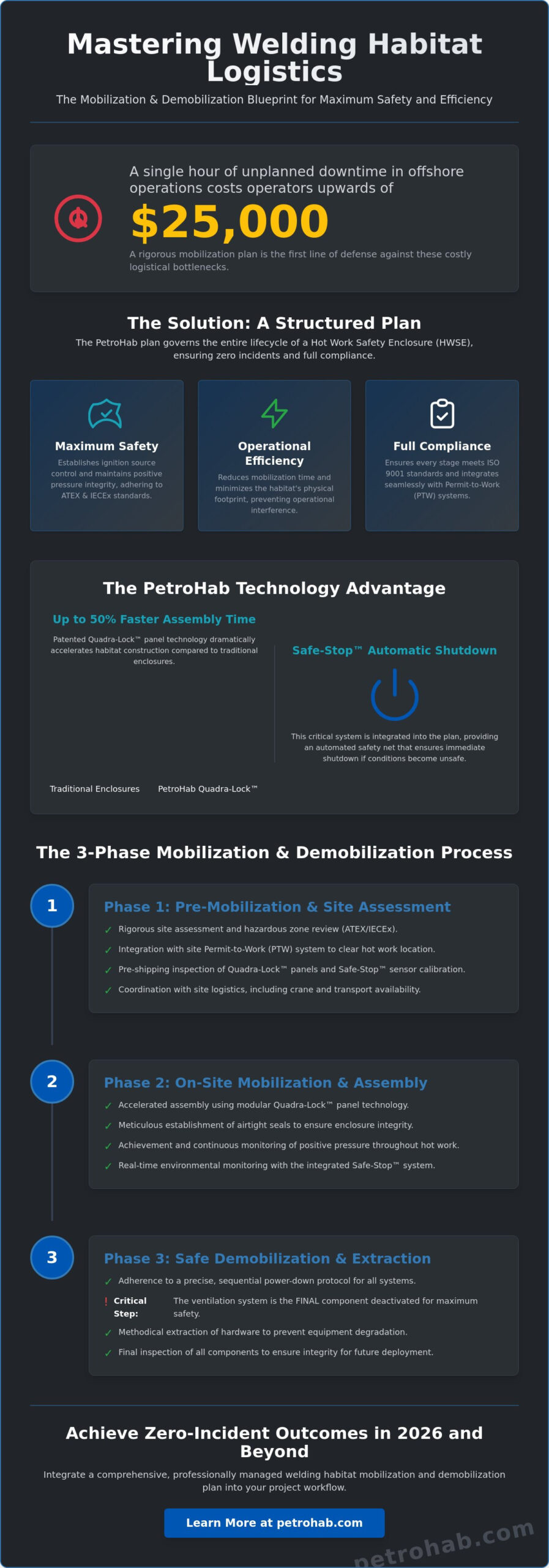
According to 2024 industry benchmarks, a single hour of unplanned downtime in offshore operations costs an operator upwards of $25,000. Most logistical failures begin long before the first Quadra-Lock panel arrives on deck. You recognize that mobilization isn’t just a transport task; it’s a critical safety phase where the integrity of your ignition source control is first established. Developing a rigorous welding habitat mobilization and demobilization plan is the only way to prevent the logistical bottlenecks that stall hot work in hazardous environments.
We’ll provide the technical framework to master the logistics of deploying and extracting pressurized welding habitats. This ensures maximum safety and minimal operational downtime. You’ll gain a streamlined timeline for habitat deployment that guarantees zero safety incidents and full regulatory compliance with ATEX and IECEx standards. This guide details the 2026 operational protocols for site surveys, the integration of the Safe-Stop automatic shutdown system, and the methodical extraction procedures required to maintain site integrity.
Key Takeaways
- Conduct rigorous site assessments and hazardous zone reviews to ensure every deployment meets strict ATEX and IECEx safety standards.
- Implement a structured welding habitat mobilization and demobilization plan to achieve airtight seals and maintain positive pressure integrity.
- Utilize patented Quadra-Lock panel technology to accelerate assembly times by up to 50% compared to traditional hot work enclosures.
- Follow a precise sequential power-down protocol during extraction, ensuring the ventilation system is the final component deactivated for maximum safety.
What is a Welding Habitat Mobilization and Demobilization Plan?
A welding habitat mobilization and demobilization plan is a comprehensive technical document that dictates the lifecycle of a Hot Work Safety Enclosure (HWSE) on a hazardous site. It governs the transition from a standard hazardous environment to a controlled Positive pressure enclosure. This plan ensures every stage of equipment transit, assembly, and extraction adheres to ISO 9001 and ATEX standards. It acts as the primary safety barrier for hot work in Zone 1 or Zone 2 areas. Without this blueprint, operators risk catastrophic ignition events or significant delays in Permit-to-Work (PTW) approvals.
To better understand the complexities of site mobilization, watch this helpful video:
Mobilization serves as the foundation for operational safety. It involves the precise deployment of pressurized habitats to eliminate the risk of flammable gas ingress. During this phase, technicians establish positive pressure integrity; this must remain constant throughout the hot work duration. Conversely, the demobilization phase focuses on the safe extraction of hardware and site restoration. Proper demobilization prevents equipment degradation and ensures that high-value assets, such as the Safe-Stop automatic shutdown system, are preserved for future deployment. This phase also includes the final inspection of hardware to maintain its long-term integrity.
The Strategic Importance of Logistics in HWSE
Efficiency in oil and gas logistics directly impacts the bottom line. By utilizing modular equipment, PetroHab reduces mobilization time by 50% compared to non-modular alternatives. The plan ensures that all Quadra-Lock panels and Safe-Stop components arrive in a “ready-to-deploy” state. This precision minimizes the physical footprint of the habitat. It allows other platform operations to continue without interference. Meticulous planning transforms logistics from a bottleneck into a safety advantage. It ensures that the habitat is not just a tool, but an integrated part of the facility’s safety culture.
Key Components of a Standard Plan
A robust plan identifies three critical pillars. Personnel requirements specify the need for certified technicians and dedicated HSE supervisors who understand ignition source control. The equipment inventory lists everything from fire-resistant Quadra-Lock panels to specialized air ducting systems and Safe-Stop sensors. Finally, the timeline defines the exact window for setup and teardown. This structure ensures every action is accounted for within the project lifecycle. It maintains full regulatory compliance and protects human life while preventing costly operational delays. Integrating a welding habitat mobilization and demobilization plan into your project workflow is essential for achieving zero-incident outcomes in 2026.
Phase 1: Pre-Mobilization and Site Assessment Protocols
Phase 1 forms the technical foundation of the entire welding habitat mobilization and demobilization plan. Before hardware leaves the facility, a rigorous hazardous zone classification review is mandatory. This distinguishes between ATEX Zone 1, where explosive atmospheres are likely, and Zone 2, where they occur less frequently. Properly executing this phase of the welding habitat mobilization and demobilization plan prevents the common industry failure where equipment arrives on site only to be stalled by administrative gaps. We synchronize equipment dispatch with your existing Permit-to-Work (PTW) system to ensure the hot work location is fully cleared for habitat installation. This integration eliminates the disconnect between logistical arrival and operational readiness.
Pre-shipping inspections focus on the structural integrity of every modular component. We verify that Quadra-Lock panels exhibit no seal degradation and that all Safe-Stop sensors are calibrated to 2026 industry tolerances. Coordination with site logistics is finalized at this stage. We confirm offshore crane availability and transport vessel windows to avoid costly standby time. Successful mobilization depends on these granular details. It’s not just about moving hardware; it’s about ensuring every asset is ready for immediate, safe deployment upon arrival.
Hazardous Area Assessment
Engineers must identify every potential ignition source outside the planned habitat perimeter. Reviewing the hazardous environment standards ensures the deployment strategy meets the latest global compliance requirements. A critical step involves determining the optimal placement for air intakes. These intakes must be located in areas that guarantee a continuous supply of clean air, far from hydrocarbon release points. Adherence to OSHA hot work regulations during this assessment phase minimizes risk before the first panel is positioned. We also establish baseline gas levels and pressure differential requirements to ensure the environment remains controlled throughout the project.
Documentation and Certification Check
Hardware integrity is non-negotiable in high-stakes environments. Every component must meet IECEx and local regulatory requirements for operation in hazardous zones. The mobilization checklist acts as the formal handover document for the site HSE manager. It includes the verification of technician certifications, ensuring only qualified experts oversee the installation of the Safe-Stop system. This level of meticulousness is why safety managers trust PetroHab for integrated safety solutions. We provide full transparency in documentation, allowing for a seamless transition from mobilization to active hot work operations.
Phase 2: On-Site Mobilization and Quadra-Lock Assembly
The physical execution of a welding habitat mobilization and demobilization plan shifts from theoretical planning to rigorous installation once the hardware reaches the deck. Technicians begin by positioning the base and frame according to the engineered site plan. This ensures the habitat doesn’t obstruct critical escape routes or existing platform infrastructure. Once the skeletal structure is secure, the assembly of the Hot Work Safety Enclosure (HWSE) proceeds in a structured, five-step sequence designed for maximum speed and atmospheric integrity.
- Step 1: Positioning the base and frame to align with the pre-approved site survey coordinates.
- Step 2: Rapidly installing Quadra-Lock panels to create an airtight, fire-resistant barrier.
- Step 3: Integrating the Safe-Stop automatic shutdown system and strategically placing gas sensors.
- Step 4: Connecting PetroHab air ducting and manometers to establish and monitor internal pressure.
- Step 5: Performing a final leak test and verifying the pressure differential remains within the 0.1 to 0.5 inch water gauge range.
Execution of this phase requires technical precision. We don’t just build a box; we engineer a controlled environment. Every panel connection and sensor calibration is a deliberate step in a welding habitat mobilization and demobilization plan to mitigate the risk of ignition in hazardous zones. This methodical approach ensures that when hot work commences, the habitat is a verified safety asset rather than a logistical liability.
Utilizing Quadra-Lock for Structural Integrity
The patented Quadra-Lock panel technology utilizes a proprietary interlocking design that eliminates the need for traditional hand tools or fasteners during the assembly process. This innovation significantly reduces the time spent in the hazardous area during setup. Technicians must ensure that all overlaps and seals are consistent with the pressurized welding habitat technical specifications. We inspect each panel joint for wear or damage that might’ve occurred during offshore transport. Maintaining this seal integrity is the only way to guarantee the enclosure functions as a reliable barrier against flammable gas ingress.
Integrating Advanced Safety Systems
Safety systems are the active guardians of the habitat. We place gas detectors at both the clean air intake and at multiple internal points to provide 360-degree monitoring. The Safe-Stop system is then connected directly to the primary welding power source. If gas is detected or pressure is lost, the system cuts power in milliseconds. To maintain the required 0.1 to 0.5 inch water gauge pressure, manometers are calibrated on-site. This precise pressure differential ensures that any internal sparks are contained while external gases are physically barred from entry.
Phase 3: Safe Demobilization and Post-Project Reporting
Demobilization represents the final technical phase of a welding habitat mobilization and demobilization plan. It isn’t merely a cleanup task; it’s a controlled decommissioning process that ensures the site returns to its standard hazardous classification without incident. The process officially begins with a formal “Hot Work Complete” sign-off through the existing Permit-to-Work (PTW) system. This administrative step verifies that all ignition sources have been extinguished and that the area is safe for the removal of the pressurized enclosure. This sign-off serves as the legal trigger to begin the systematic extraction of safety hardware.
A critical safety requirement is the sequential power-down of the habitat’s life support systems. The ventilation system must be the last component deactivated. This protocol ensures that positive pressure is maintained until all internal welding equipment has cooled and all potential airborne contaminants are purged. Deactivating the air supply prematurely risks the ingress of flammable gases while surfaces may still exceed auto-ignition temperatures. Following this, technicians perform a thorough decontamination of all fire-resistant materials and Quadra-Lock panel surfaces. Removing hydrocarbon residues and slag prevents chemical degradation, ensuring the hardware retains its integrity for the next deployment.
Systematic disassembly follows the reverse order of installation. Technicians remove Quadra-Lock units with care to prevent panel deformation. This methodical approach is essential for maintaining the airtight capabilities of the modular system. By treating extraction with the same technical rigor as installation, operators protect their high-value safety assets and ensure the long-term reliability of their welding habitat mobilization and demobilization plan. This attention to detail prevents the equipment damage that often occurs during rushed extractions.
Decommissioning Ignition Source Controls
The Safe-Stop automatic shutdown system requires specialized handling during extraction. Technicians carefully remove and store Safe-Stop sensors and control units in shock-resistant cases to preserve their calibration. We inspect all air ducting for internal debris or hazardous residue that may have accumulated during the project. A vital part of this phase is documenting any system alerts or shutdowns that occurred. This data provides 100% transparency for the project’s safety record and helps refine future risk assessments for similar offshore operations.
Post-Demobilization Logistics
Once the enclosure is dismantled, modular components are packed into specialized transport containers designed for offshore transit. A final site walkthrough is conducted with the client HSE representative to confirm the area is restored to its original condition. Finally, technicians update the equipment maintenance log. This ensures every component is tracked and serviced before the next mobilization cycle. To ensure your next project adheres to these rigorous standards, consult with our safety engineering team for a customized deployment strategy.
Maximizing Operational Efficiency with PetroHab Services
Efficiency in high-risk zones depends on equipment that facilitates, rather than hinders, a welding habitat mobilization and demobilization plan. PetroHab’s modular engineering allows for a 50% reduction in setup and teardown times compared to traditional, non-modular enclosures. This speed is achieved through standardized components that eliminate the trial-and-error often found in field assembly. By integrating hot work safety systems into a turnkey logistics solution, we remove the complexity of managing multiple vendors. Our operational hubs in Houston, Dundee, and Brazil ensure that these technical assets are available globally; this simplifies the mobilization of resources to any offshore or onshore facility regardless of geographic constraints.
Our service model prioritizes the protection of high-value assets and the elimination of operational downtime. We provide a single point of accountability for the entire habitat lifecycle. This approach ensures that every welding habitat mobilization and demobilization plan is executed with technical precision. By leveraging our global logistics network, operators can maintain tight project schedules without compromising the safety standards required for hot work in hazardous environments. We act as a critical safety partner, providing the hardware and expertise necessary to maintain site integrity from start to finish.
The PetroHab Advantage: Modular Precision
Quadra-Lock technology is the primary driver behind significant reductions in labor costs. Because these panels interlock without specialized tools, the manpower required for assembly is minimized. We develop custom mobilization plans tailored to the specific constraints of your offshore platform, whether you’re dealing with limited deck space or complex piping geometry. This flexibility ensures that the deployment remains efficient regardless of site conditions. Our patented HWSE hardware provides unrivaled safety, maintaining the integrity of the pressurized environment even in the most demanding industrial settings.
Training and On-Site Supervision
Technical hardware is only as effective as the personnel operating it. PetroHab provides certified supervisors to oversee the installation and decommissioning phases. These experts empower your team through specialized habitat training programs. This direct oversight reduces the risk of human error during the critical mobilization phase, where mistakes in sensor placement or seal alignment lead to project delays. Our supervisors ensure that every Safe-Stop system is integrated perfectly with your site’s power and gas detection infrastructure. For a specialized hot work safety enclosure consultation, contact PetroHab to discuss your 2026 project requirements.
Securing Your 2026 Hot Work Operational Lifecycle
Mastering the technical nuances of a welding habitat mobilization and demobilization plan is the only way to eliminate the risks inherent in hazardous zone operations. We’ve detailed how integrating the Permit-to-Work system with hardware deployment prevents the logistical delays that cost operators $25,000 per hour. Utilizing patented Quadra-Lock technology ensures that your structural integrity is verified in 50% less time than traditional systems. The methodical sequential power-down protocol remains the final safeguard for protecting your assets and personnel during the extraction phase.
PetroHab provides unrivaled reliability through ATEX and IECEx certified systems. Our global support network, stretching from Houston to Dundee and Brazil, ensures that expert supervision is always within reach. We provide the technical precision required to maintain the gold standard in hot work safety. You can secure your next project by choosing a partner dedicated to zero-incident performance and operational excellence. Request a Quote for PetroHab Mobilization Services and ensure your site remains protected throughout 2026.
Frequently Asked Questions
What is the typical duration for welding habitat mobilization?
Mobilization typically requires 4 to 8 hours for a standard 2×2 meter enclosure. This timeline accounts for site transport, structural assembly, and the initial pressure test. Because our systems use modular Quadra-Lock panels, setup times are often 50% faster than traditional wood and tarp structures. This speed allows for same-day hot work commencement following the 2024 revised efficiency benchmarks for offshore operations.
Do I need a certified technician for HWSE demobilization?
A certified PetroHab technician is required for demobilization to maintain the integrity of ignition source control hardware. Removing the Safe-Stop system and sensitive gas sensors involves technical recalibration and decontamination protocols that untrained personnel can’t perform. This requirement ensures that every component is safely extracted and logged for maintenance. It prevents hardware damage during the final stage of the welding habitat mobilization and demobilization plan.
How does the mobilization plan affect my Permit-to-Work (PTW)?
The mobilization plan acts as the technical evidence required for Permit-to-Work (PTW) approval in Zone 1 and Zone 2 areas. HSE managers review this document to verify that positive pressure will be maintained and that the Safe-Stop system is correctly integrated. Without a documented plan, PTW issuance is typically delayed. A 2025 industry survey indicated that 85% of offshore delays are caused by inadequate safety documentation during the mobilization phase.
What equipment is essential for a pressurized habitat mobilization?
Essential equipment includes fire-resistant Quadra-Lock panels, the Safe-Stop automatic shutdown system, and dual-point gas detectors. You also require high-pressure air ducting and calibrated manometers to monitor the 0.1 to 0.5 inch water gauge pressure differential. These components must be verified against the IECEx certification registry before they’re deployed to the hazardous site. This hardware ensures the habitat functions as a certified safety barrier.
Can Quadra-Lock panels be mobilized in confined spaces?
Quadra-Lock panels are specifically designed for mobilization in confined or congested spaces where traditional rigid frames fail. Each modular panel allows technicians to navigate narrow offshore corridors and internal vessel structures without difficulty. This flexibility means you don’t need to modify existing platform infrastructure to install a pressurized habitat. It’s a versatile solution for 360-degree hot work protection in tight geometries where space is at a premium.
What happens if a safety component is damaged during mobilization?
If a component like a Safe-Stop sensor or a Quadra-Lock panel is damaged, it must be replaced immediately before work begins. Damaged seals or sensors compromise the atmospheric integrity of the enclosure. We maintain regional equipment hubs in Houston and Dundee to provide replacement parts within 24 hours. A full re-inspection and pressure test are mandatory to ensure the habitat still meets its 2026 safety certification requirements.
Is a demobilization report required for regulatory compliance?
A formal demobilization report is a mandatory requirement for ISO 9001 and local regulatory audit trails. This report documents the final gas levels, the condition of the hardware, and any system alerts triggered during the project. It serves as proof that the site’s been restored to its original hazardous classification safely. This documentation is critical for maintaining your facility’s long-term safety record and compliance status after the welding habitat mobilization and demobilization plan is complete.
How do you handle mobilization for offshore platforms versus onshore refineries?
Offshore mobilization requires precise coordination with crane operators and vessel schedules to manage limited deck space. Onshore refinery mobilization often focuses on extensive perimeter control and integration with larger plant-wide emergency shutdown systems. While the technical core of the plan remains consistent, the logistical footprint varies. Offshore deployments typically use 30% less space to accommodate the high-density environment of oil platforms.