Blog Posts
ATEX vs IECEx: A 2026 Comparison for Hot Work Safety Enclosures
Can your current hot work safety enclosure withstand a rigorous 2026 compliance audit in both the North Sea and the South China Sea? The distinction between ATEX and IECEx isn’t just a matter of geography. It’s a critical factor in legal liability and operational continuity. You understand the frustration of deciphering complex technical markings to ensure your pressurized welding habitats are fit for specific hazardous zones. PetroHab LLC, with its innovative Quadra-Lock technology, ensures that your physical containment maintains its integrity during high-risk operations. It’s a high-stakes environment where a single oversight leads to costly project delays or catastrophic safety failures.
This article provides the technical clarity you need to master the regulatory differences between ATEX and IECEx in the current 2026 landscape. You’ll learn how to verify equipment compliance for global operations and understand the legal liability differences between regional and international certifications. We’ll analyze the impact of the latest IEC 60079-0 Edition 8.0 requirements, compare the legal enforcement of European versus international schemes, and demonstrate how pre-certified equipment minimizes operational downtime.
Key Takeaways
- Distinguish between the mandatory legal requirements of the ATEX directive within the European Economic Area and the voluntary, international framework of the IECEx system.
- Understand the specific roles of Notified Bodies and Ex Certification Bodies in validating the safety and compliance of pressurized welding habitats.
- Master the technical nomenclature of equipment markings and zone classifications to verify that habitats are correctly specified for Zone 1 or Zone 2 environments.
- Recognize how the integration of the Safe-Stop system with Quadra-Lock technology ensures both structural compliance and reliable pressure retention in hazardous environments.
- Implement a dual-certification strategy to facilitate global equipment mobility and protect your organization against legal liability during rigorous safety audits.
Understanding ATEX and IECEx in Hazardous Industrial Environments
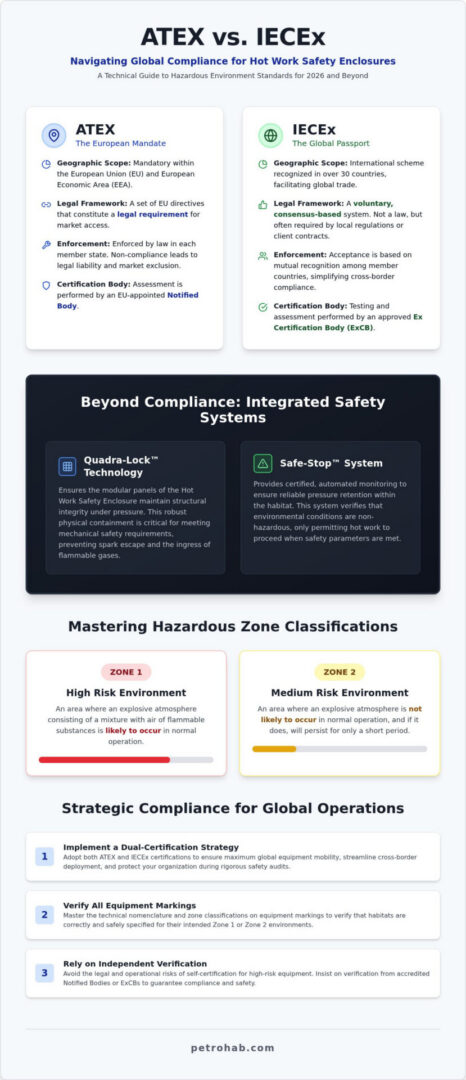
In high-risk industrial sectors, safety is not a variable. It is a constant requirement. The ATEX directive is a mandatory legal framework for equipment used in explosive atmospheres within the European Union. You can access a comprehensive ATEX directive overview to understand its specific legal applications across the European Economic Area. Conversely, the IECEx system provides a voluntary international certification framework recognized in over 30 countries globally. Both standards share a singular, critical objective: the prevention of ignition in Zone 1 and Zone 2 environments during hot work operations. For safety managers, these certifications provide the only verifiable proof that equipment is engineered to withstand the volatile conditions of a refinery or offshore platform.
The Role of Standards in Hot Work Safety
Offshore environments present unique hazards where a single spark can lead to disaster. Standards mitigate these risks by enforcing rigorous testing protocols. Safety managers have transitioned from local practices to these global harmonized standards to ensure consistency across international fleets. A pressurized welding habitat requires more than just electrical certification for its internal sensors. It needs mechanical certification for the enclosure itself. Quadra-Lock technology ensures that the modular panels maintain structural integrity under pressure. This prevents the escape of sparks and the ingress of flammable gases. The durability of Quadra-Lock technology is a primary factor in meeting these mechanical safety requirements for pressurized habitats.
Hot Work Safety Enclosures (HWSE) and Compliance
Modular enclosures must adhere to strict hazardous environment standards to allow for global deployment without repeated local testing. The effectiveness of a Hot Work Safety Enclosure (HWSE) relies on maintaining a positive pressure environment. This protocol creates a physical barrier against external flammable gases. It effectively isolates the ignition source from the surrounding atmosphere. For a deeper dive into these regulatory requirements, consult our Hazardous Environment Standards Guide. Integrating certified monitoring systems like the Safe-Stop system ensures that hot work only proceeds when environmental conditions are verified as non-hazardous. Compliance is the foundation of operational reliability.
The Technical Divergence: Geographic Scope and Legal Frameworks
ATEX represents a legal mandate within the European Union and the European Economic Area. Any manufacturer intending to sell or deploy equipment in these regions must comply with these directives. Conversely, the IECEx international certification system operates as a voluntary, consensus-based scheme. It facilitates global trade by providing a standardized testing and certification process recognized in over 30 countries. While ATEX is a regional law, IECEx serves as a global passport for industrial equipment. This distinction is vital for safety managers who oversee international fleets.
A dangerous misconception exists regarding self-certification for Hot Work Safety Enclosures. While some low-risk equipment categories allow for a manufacturer’s declaration, HWSE systems intended for Zone 1 or Zone 2 environments typically require the involvement of a Notified Body. Independent verification ensures that the mechanical integrity and monitoring systems function as intended under extreme stress. Utilizing Quadra-Lock technology provides a verified structural foundation that survives the rigorous physical testing required by these independent bodies. Relying on unverified self-certification increases legal exposure and operational risk.
Geographic Considerations for Offshore Platforms
Fleet managers often face logistical hurdles when moving assets between the North Sea and the Gulf of Mexico. ATEX is sufficient for European waters, but global asset mobility requires IECEx certification to satisfy the safety protocols of international operators. Post-Brexit, the UKCA marking now applies to the UK market. It largely mirrors ATEX technical requirements but necessitates separate administrative sign-off by a UK Approved Body. In the Brazilian offshore market, adherence to Petrobras standards often mandates specific certifications that go beyond basic regional requirements. Dual-certified habitats ensure that your assets remain productive regardless of the maritime border.
Legal Liability and Safety Audits
Presenting the wrong documentation during a third-party safety audit can immediately halt operations. The burden of proof differs significantly between the two frameworks. ATEX relies on the EU Declaration of Conformity (DoC) issued by the manufacturer. IECEx requires a Certificate of Conformity (CoC) that is publicly accessible and verifiable in the central IECEx database. Managing documentation for Pressurized Welding Habitats requires meticulous record-keeping. You must ensure every component, from the pressure sensors to the Quadra-Lock technology panels, meets the specific zone requirements. If you need to verify your equipment’s suitability for international deployment, you can consult with our technical safety experts to ensure total compliance.
Certification Processes: Notified Bodies vs. Approved Certification Bodies
The path to certification requires the involvement of specialized third-party organizations. For ATEX compliance, a Notified Body (NB) is an entity designated by an EU member state to assess whether a product meets essential health and safety requirements. In the IECEx framework, this role is filled by an Ex Certification Body (ExCB). These organizations perform the heavy lifting of technical verification. They don’t simply review design documents; they audit the manufacturing facility and its quality management systems. This ensures that every habitat produced is identical to the prototype that passed the initial laboratory tests.
Manufacturing excellence is verified through ongoing audits. ATEX requires a Quality Assurance Notification (QAN), while IECEx mandates a Quality Assessment Report (QAR). As of 2026, these factory audits typically cost between $2,000 and $5,000 annually. These assessments are critical for identifying deviations in the production line that could compromise safety. If a manufacturer fails to maintain these standards, their certificates are suspended, and their equipment is no longer fit for hazardous environments. Reliability is built on this continuous cycle of scrutiny.
Product Assessment and Testing
Individual components of a Hot Work Safety Enclosure (HWSE) must survive extreme conditions. Testing includes rigorous thermal endurance and impact resistance evaluations specifically for Zone 1 environments. The 2026 update to IEC 60079-0 Edition 8.0 has expanded the standard operational ambient temperature range to -20°C to +60°C. Equipment must now be marked accordingly to ensure it operates within these verified limits. Quadra-Lock technology is fundamental to this integrity. The interlocking panels are tested to ensure they maintain a pressurized seal even after sustaining high-energy impacts. Additionally, the Safe-Stop Automatic Shutdown System undergoes logic failure testing. It’s engineered to respond within milliseconds to pressure loss or gas detection, ensuring the immediate termination of all ignition-capable activities.
Maintenance of Certification
A safety certificate isn’t a permanent asset. It’s a snapshot of a manufacturer’s compliance at a specific point in time. Its validity depends entirely on the most recent factory audit. On-site supervisors play a vital role in maintaining this compliant status. They must be trained to recognize the specific markings required by both ATEX and IECEx. They must also ensure that Quadra-Lock technology panels are assembled according to the certified design. Incorrect assembly or the use of non-certified spare parts can void the certification of the entire habitat. Technical precision during installation is just as important as the engineering behind the product itself.
Navigating Zone Classifications and Equipment Marking for Habitats
The ATEX coding string provides a definitive roadmap for equipment suitability in explosive atmospheres. Every certified habitat must display the CE mark alongside the hexagonal Ex symbol. This is followed by the equipment group and category. For the energy sector, Group II equipment is standard for surface operations. Category 2 equipment is engineered for Zone 1, where a hazardous atmosphere is likely to occur during normal operation. Category 3 is reserved for Zone 2, where such atmospheres are unlikely or infrequent. Understanding these markings is the first step in verifying that your equipment meets the legal requirements of your specific site.
Technical precision extends to temperature classes and gas groups. Temperature classes, ranging from T1 to T6, define the maximum surface temperature the equipment can reach. For welding safety, this ensures the habitat’s external surfaces do not become an ignition source for specific gases. Gas groups IIA, IIB, and IIC categorize the volatility of the surrounding environment, with IIC being the most volatile. Your habitat ventilation and monitoring protocols must align with these specific classifications to maintain operational safety. Ignition prevention is a matter of calculated engineering, not estimation.
Non-Electrical Ignition Sources
ATEX 2014/34/EU specifically addresses non-electrical ignition sources, including mechanical sparks and static electricity. In modular enclosures, the physical integrity of the barrier is the primary defense. Quadra-Lock technology plays a critical role in maintaining this mechanical integrity. The patented interlocking design ensures environmental separation between the hot work activity and the external hazardous atmosphere. It prevents the mechanical generation of sparks from panel friction and ensures that static buildup is managed through proper grounding of the structural components. Air ducting systems must also be verified to ensure they do not introduce hazards through friction or the intake of contaminated air during pressurized operations.
Zone 1 vs. Zone 2 Applications
Selecting the correct infrastructure depends on the zone classification of the work area. In Zone 1 operations, a pressurized habitat is often mandatory to provide a verified barrier against likely gas ingress. The Hot Work Safety Enclosures Guide details how these systems function in high-risk areas. By integrating the Safe-Stop Automatic Shutdown System, operators can effectively declassify the internal volume for hot work. If the system detects a loss of pressure or the presence of gas, it immediately terminates power to the welding equipment. This technological remedy ensures that safety is maintained even if external conditions change. To secure your site with certified infrastructure, request a technical specification from PetroHab.
Beyond Compliance: Integrating Certified Systems into PetroHab HWSE
Achieving regulatory compliance is the baseline for industrial safety. PetroHab extends this foundation by integrating ATEX and IECEx certified sensors into a cohesive monitoring framework. The Safe-Stop system acts as the central intelligence of the habitat. It continuously analyzes environmental data to ensure that hot work only occurs under verified conditions. This integration transforms a simple enclosure into a sophisticated safety instrument. Quadra-Lock technology provides the necessary structural integrity to maintain the pressurized environment that these sensors monitor. Without a reliable physical seal, even the most advanced sensors cannot fulfill their function.
Selecting between rental and purchase options depends on the specific scope of your hazardous area project. For short-term refinery turnarounds, rental systems provide immediate access to the latest certified technology. For long-term offshore assets, purchasing a customized Petro-Habitat ensures that your site is always ready for urgent maintenance. Both options provide the same level of rigorous technical protection. You must choose the model that best aligns with your operational lifecycle and budgetary constraints.
The Safe-Stop Advantage
The Safe-Stop system utilizes automatic shutdown logic to manage risk without human intervention. It monitors both internal pressure and the presence of flammable gases in real-time. If the internal pressure drops below the required threshold or gas is detected at the intake, the system terminates power to all ignition sources within seconds. Redundancy is built into these certified monitoring systems to prevent false alarms that lead to costly operational delays. PetroHab technicians provide on-site supervision during deployment to verify that the habitat configuration meets the precise requirements of the local safety audit. This expert oversight ensures that the equipment functions as a definitive technological remedy against industrial hazards.
Operational Excellence and ROI
Using globally recognized and pre-certified safety habitats directly influences your project’s return on investment. Certified systems reduce refinery turnaround times by streamlining the permitting process and minimizing the risk of safety-related work stoppages. The cost of non-compliance is far higher than the investment in high-quality infrastructure. Fines, legal liabilities, and project delays can jeopardize the financial viability of a project. Quadra-Lock technology ensures that the habitat remains durable and resilient throughout the project lifecycle. This durability reduces maintenance costs and ensures that the enclosure remains fit for purpose in the most demanding environments. To ensure your site meets the highest global standards, consult with PetroHab on your next hazardous area project.
Securing Global Operations with Certified Infrastructure
Mastering the technical and regulatory nuances between ATEX and IECEx ensures your pressurized habitats remain compliant across international borders. These frameworks provide the necessary verification to protect personnel and high-value assets in volatile Zone 1 and Zone 2 environments. Integrating these standards into your safety protocols isn’t just a legal requirement. It’s a definitive technological remedy against the risk of catastrophic ignition. Patented Quadra-Lock technology serves as the structural foundation for this compliance, maintaining the positive pressure required to isolate hot work from hazardous external gases. When combined with the Safe-Stop automatic shutdown system, these enclosures provide a redundant layer of protection that minimizes operational downtime during critical refinery turnarounds.
PetroHab offers the global compliance expertise needed to navigate complex safety audits in the US, UK, and Brazil. By selecting pre-certified infrastructure, you ensure that your site adheres to the latest 2026 standards for ignition prevention and environmental containment. Your commitment to safety excellence starts with selecting equipment engineered for the highest industrial standards. Request a Quote for ATEX/IECEx Compliant Habitat Rental to secure your next hazardous area project. Protect your workforce with reliable, certified containment systems.
Frequently Asked Questions
What is the main difference between ATEX and IECEx?
ATEX is a mandatory legal requirement for equipment used in hazardous areas within the European Union. Conversely, the IECEx system is a voluntary international certification scheme recognized in over 30 countries. While both frameworks utilize the same technical standards from the IEC 60079 series, ATEX is a regional directive focused on EU law, whereas IECEx facilitates global trade by providing a standardized process for international certification and asset mobility.
Is IECEx certification accepted in the United States?
Major oil and gas operators in the United States widely recognize IECEx certification, particularly for offshore projects and international equipment leasing. While the US primarily follows NEC and UL standards, IECEx is often used as a benchmark for verifying the safety of industrial equipment. Many safety managers prefer dual-certified habitats to ensure they meet both international safety benchmarks and specific regional requirements for high-stakes industrial environments.
Do pressurized welding habitats need to be ATEX certified?
A pressurized welding habitat must be ATEX certified if it’s operated within the European Economic Area. This certification ensures that all components, including the Quadra-Lock technology panels and monitoring systems, meet Essential Health and Safety Requirements. For Zone 1 environments, this compliance is verified by an independent Notified Body, providing safety managers with the verifiable documentation required to satisfy rigorous third-party safety audits during refinery turnarounds.
Can I use ATEX certified equipment in an IECEx required zone?
ATEX certification alone is typically insufficient for zones that specifically mandate IECEx compliance. Although the technical testing protocols are often identical, the legal frameworks remain distinct. An IECEx-required zone necessitates a Certificate of Conformity verifiable through the official IECEx database. To ensure global mobility and avoid project delays, manufacturers often seek dual certification, allowing the same habitat to be deployed in both European and international jurisdictions without modifications.
How do I identify if my HWSE is compliant for Zone 1?
Verify the equipment marking string located on the habitat nameplate to confirm Zone 1 compliance. For ATEX, look for Category 2G markings, while IECEx requires an Equipment Protection Level of Gb. These codes confirm the habitat has successfully undergone rigorous thermal and impact testing for areas where gas is likely to occur. You should always verify the certificate number against official databases to ensure the enclosure is fit for its intended environment.
What are the manufacturer responsibilities under the ATEX 1999/92/EC directive?
The 1999/92/EC directive focuses on workplace safety and the employer’s duty to protect personnel. Manufacturers must provide equipment that allows employers to fulfill these obligations effectively. This includes delivering detailed technical instructions and ensuring the enclosure maintains its structural integrity. The primary objective is to control all ignition sources and prevent explosive atmospheres from contacting hot work activities, ensuring a reliable barrier is maintained throughout the entire duration of the project.
How does the Safe-Stop system interact with hazardous area certifications?
The Safe-Stop system incorporates ATEX and IECEx certified sensors to provide continuous environmental monitoring. It acts as the active guardian of the enclosure, ensuring that all ignition-capable equipment is automatically shut down if pressure is lost or gas is detected. This system ensures the habitat operates within the strict parameters defined by its hazardous area certifications. It provides a definitive technological remedy that bridges the gap between mechanical containment and active functional safety.
Why is Quadra-Lock technology important for compliance?
Quadra-Lock technology is essential for compliance because it provides the mechanical integrity required for pressurized enclosures under ATEX and IECEx standards. The interlocking panel design ensures a reliable seal that prevents spark emission and gas ingress. This structural durability is verified through rigorous impact and pressure testing. Without the reliable containment provided by Quadra-Lock technology, the habitat could not maintain the positive pressure environment necessary to be certified for use in Zone 1.