ATEX Zone Classifications: A Technical Guide for Hot Work Safety in 2026
A single ignition source in an incorrectly classified zone often results in catastrophic failures that exceed $15 million in asset loss and irreparable damage to a firm’s safety reputation. You likely recognize that the margin for error in hazardous environments is non-existent. The pressure to align with ATEX Directive 2014/34/EU and Directive 1999/92/EC is mounting as we approach the 2026 regulatory cycle. Mastering ATEX zone classifications is no longer just a compliance exercise; it’s a fundamental requirement for the protection of human life and high-value assets.
This technical guide provides the expertise needed to navigate the complexities of Zone 0, 1, and 2 environments, ensuring your permit-to-work (PTW) approvals are backed by rigorous data. You’ll learn to execute zero-incident hot work by integrating patented ignition source control systems and pressurized habitats into your operational workflow. We’ll examine the critical distinctions between gas and dust numbering systems and provide a structured framework for maintaining site integrity during essential maintenance.
Key Takeaways
- Gain a technical understanding of the criteria used to define ATEX zone classifications for gas, vapor, and dust hazards in industrial environments.
- Learn how Hot Work Safety Enclosures (HWSE) effectively isolate ignition sources to allow for critical maintenance in hazardous areas without compromising site integrity.
- Explore the integration of continuous gas detection and the Safe-Stop system to provide an automated, fail-safe layer of protection for personnel and assets.
- Discover how patented Quadra-Lock panel technology ensures the air-tight enclosure integrity required to meet rigorous global compliance standards.
- Master the strategic protocols necessary to maintain operational continuity while performing essential hot work in high-risk, volatile atmospheres.
What are ATEX Zone Classifications? Defining Hazardous Atmospheres
ATEX, derived from the French “Atmosphères Explosibles,” establishes the mandatory framework for managing risks in environments where flammable gases, mists, vapors, or combustible dusts exist. Since the initial implementation of these standards in 1994, the system has become the global benchmark for industrial safety in high-stakes sectors. The core purpose of ATEX zone classifications is to quantify the specific likelihood and duration of an explosive atmosphere. This rigorous assessment isn’t a mere suggestion; it’s the technical foundation of every ignition source control strategy on a modern job site.
Accurate zoning allows safety managers to move beyond guesswork. By defining the frequency of hazardous conditions, operators can determine exactly which equipment is permissible in a given area. PetroHab habitats are engineered to interact with these classifications, providing a definitive technological remedy that isolates ignition sources from the surrounding atmosphere. Without this precise categorization, hot work operations in refineries or offshore platforms introduce variables that no responsible engineer can accept. Reliability in these environments depends on the protection of human life and the preservation of high-value assets through strict compliance.
The Legal Framework: ATEX 114 vs. ATEX 153
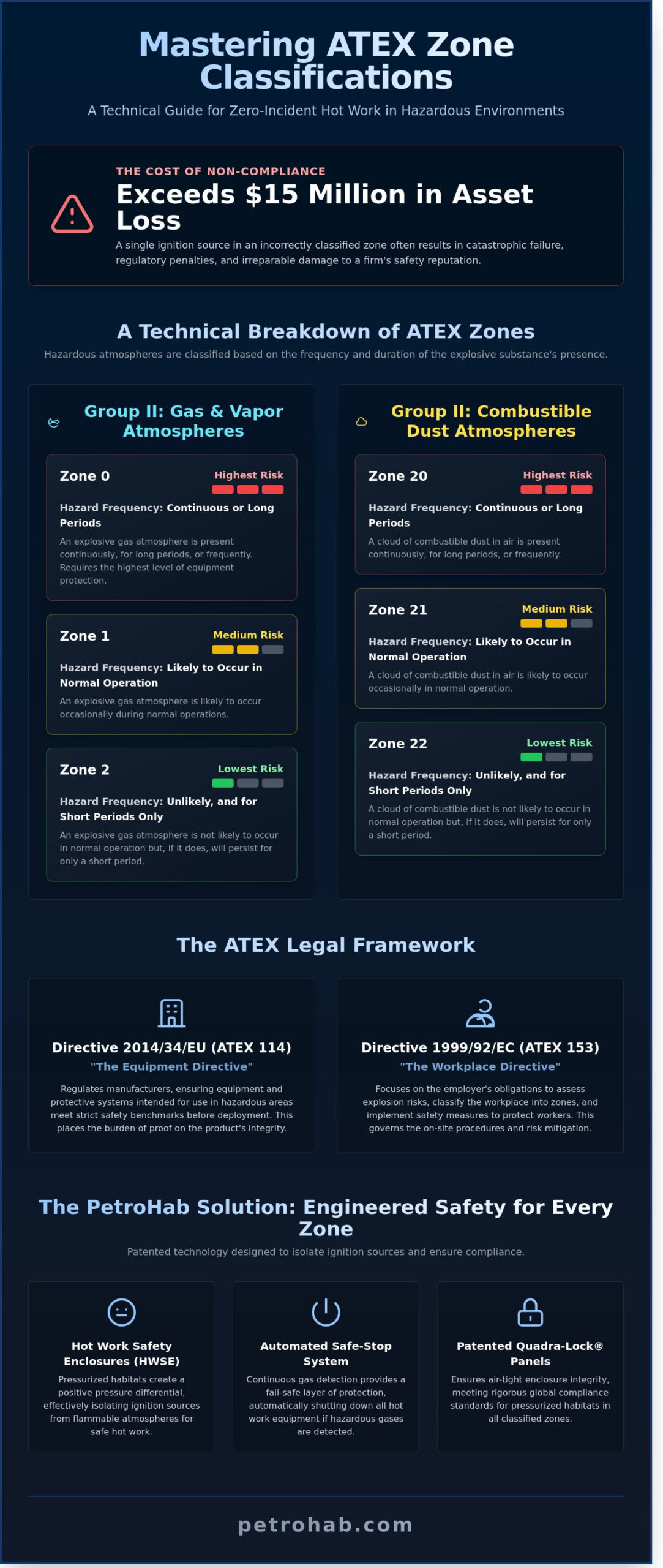
The regulatory landscape is split into two distinct directives that govern how safety is managed. Directive 2014/34/EU, commonly referred to as ATEX 114, regulates the requirements for equipment manufacturers. It ensures that every component within a PetroHab system, from the modular Petro-Wall panels to the integrated Safe-Stop systems, meets stringent safety benchmarks before it’s deployed. This directive places the burden of proof on the manufacturer to demonstrate equipment integrity.
Directive 1999/92/EC, known as ATEX 153, focuses on the employer’s obligations. It mandates that site operators assess explosion risks and classify the workplace into zones. These directives collectively govern the use of pressurized habitats on-site. Employers must ensure that any hot work conducted within a hazardous area is supported by a pressurized enclosure that maintains a positive pressure differential, effectively preventing the ingress of flammable hydrocarbons.
Global Standards: ATEX vs. the North American Class/Division System
While ATEX is the standard across Europe, North American operations have traditionally utilized the NEC 500 Class/Division framework. The primary difference lies in granularity. ATEX zones 0, 1, and 2 provide a more nuanced breakdown of risk compared to the broader Division 1 and 2 categories. For example, Zone 0 represents a continuous hazard, whereas Division 1 encompasses both intermittent and continuous risks. PetroHab designs for global compliance, ensuring our technology meets or exceeds the requirements of both regulatory regimes.
In 2026, the industry is witnessing a 15% annual increase in the adoption of the IECEx system for international offshore operations. This shift toward a unified international standard simplifies the movement of equipment across borders. Whether a project is governed by ATEX or the Class/Division system, the goal remains the same: the total mitigation of risk through engineered control. PetroHab remains the gold standard in hot work safety by providing solutions that are as durable and resilient as the habitats we manufacture.
A Technical Breakdown of Gas, Vapor, and Dust Zones
ATEX Directive 1999/92/EC mandates a clear distinction between Group I and Group II equipment categories. Group I governs underground mining operations where methane and combustible coal dust pose a constant threat. Group II applies to all other surface industrial sites, including the offshore platforms and refineries where PetroHab provides unrivaled protection. Within Group II, engineers must calculate the frequency and duration of hazardous atmospheres to assign the correct ATEX zone classifications. This calculation isn’t subjective; it’s a rigorous assessment based on EN 60079-10-1 for gases and EN 60079-10-2 for dust.
The interaction between zone classifications and temperature classes (T-ratings) is a primary pillar of ignition source control. A T4 rating, for example, limits the maximum surface temperature of any component to 135°C. Even if hardware is certified for Zone 1, it’s unsafe if the T-rating doesn’t account for the specific auto-ignition temperature of the gases present. This technical synergy ensures that even during a mechanical failure, the equipment won’t become a heat-based ignition source. PetroHab’s modular systems maintain this integrity by integrating pressurized habitats that isolate hot work from these volatile variables.
Hardware requirements for dust zones differ fundamentally from those for gas. While gas protection often focuses on flame paths and energy limitation, dust protection prioritizes Ingress Protection (IP) ratings and surface temperature management. Dust layers act as thermal insulators. They can cause heat to build up to dangerous levels on motor housings or light fixtures, leading to smoldering or secondary explosions. Effective risk mitigation requires systems that prevent dust accumulation while monitoring for atmospheric changes. You can evaluate your specific site requirements by reviewing our pressurized habitat specifications to ensure compliance with 2026 standards.
Gas and Vapor Classifications: Zones 0, 1, and 2
Zone 0 defines areas where an explosive atmosphere is present continuously or for more than 1,000 hours per year. These are typically the interiors of storage tanks or vent pipes. Zone 1 identifies areas where hazards are likely to occur during normal operation, usually between 10 and 1,000 hours per year. Zone 2 represents locations where explosive atmospheres are unlikely or persist for less than 10 hours annually, often occurring only during equipment failure or leakages.
Combustible Dust Classifications: Zones 20, 21, and 22
Zone 20 applies to environments where dust clouds exist for over 1,000 hours per year, such as inside dust containment silos. Zone 21 covers areas where dust is likely to be present occasionally in normal operation, representing a moderate risk level. Zone 22 is reserved for areas where dust clouds are unlikely to occur or will only persist for a short time. Our Safe-Stop technology provides an essential layer of defense in these zones by automatically shutting down hot work if pressure differentials fluctuate.
Performing Hot Work in Classified ATEX Zones
Introducing an ignition source into a hazardous area creates an immediate conflict with safety protocols. In environments defined by ATEX zone classifications, the presence of flammable gases or vapors means that a single spark can lead to catastrophic asset loss. Hot work, such as welding or grinding, is traditionally the most dangerous activity performed in these sectors. To mitigate this, engineers utilize a Hot Work Safety Enclosure (HWSE) to isolate the ignition source from the volatile atmosphere. This technology transforms a localized area into a controlled, non-hazardous environment where work can proceed without halting production.
The integrity of this controlled environment depends on positive pressure. By maintaining an internal pressure higher than the surrounding atmosphere, the system ensures that air only moves from the inside out. This prevents the ingress of flammable hydrocarbons. While these systems are unrivaled in Zone 1 and Zone 2, it’s a hard rule that Zone 0 prohibits hot work entirely. The continuous presence of explosive gases in Zone 0 represents a risk level that even the most advanced pressurized habitat cannot safely override.
Habitat Engineering for Zone 1 and Zone 2
PetroHab utilizes pressurized welding habitats to effectively downgrade the classification of a specific work area. To ensure absolute safety, our systems maintain a minimum overpressure of 0.1 inches of water, which is equivalent to 25 Pascals. This pressure differential is monitored by the Safe-Stop system, which automatically shuts down power to all tools if pressure falls below the set threshold. The enclosure itself is constructed from Petro-Wall panels. These panels are engineered from high-grade, fire-resistant materials that withstand temperatures exceeding 1,000 degrees Celsius, ensuring the habitat remains a resilient barrier against flying sparks and molten slag.
Ignition Source Control and the Permit-to-Work System
Ignition source control serves as the primary defense in Zone 1 by ensuring that no heat-producing activity can proceed without a verified, non-hazardous atmosphere. This control isn’t a standalone feature; it’s a critical component of the facility’s broader Permit-to-Work (PTW) system. Within the framework of ATEX zone classifications, the level of gas monitoring must be continuous and redundant. PetroHab integrates habitat integrity with the facility’s safety management by linking gas detection sensors directly to the habitat’s control logic. This creates a multi-layered defense strategy:
- Continuous monitoring of the intake air for flammable gases.
- Automatic tool isolation via the Safe-Stop system upon detection of 10% Lower Explosive Limit (LEL).
- Visual and audible alarms to alert the entire deck of a breach in integrity.
This methodical approach ensures that human life and high-value assets remain protected throughout the duration of the maintenance window.
Risk Mitigation: Monitoring and Automatic Shutdown Systems
Maintaining the integrity of a pressurized habitat requires more than physical barriers. It demands active, continuous monitoring of the atmosphere to prevent ignition in hazardous areas. PetroHab’s systems integrate advanced gas detection with automated shutdown logic to ensure safety in environments governed by ATEX zone classifications. This technological approach replaces human fallibility with rigorous, sensor-driven oversight.
Automated Ignition Source Control
The Safe-Stop system acts as the central control hub for the entire enclosure. It provides a fail-safe layer of protection by monitoring internal and external atmospheric conditions in real-time. If the system detects a breach or gas ingress, it immediately cuts power to all welding equipment and ignition sources. This automated response eliminates the 60% of safety incidents typically attributed to human error or delayed reaction times during manual shutdown procedures. By using hard-wired safety interlocks, the system ensures that hot work can’t proceed unless the environment is verified as non-hazardous.
PetroHab’s engineering philosophy prioritizes absolute control over the work environment. The Safe-Stop system doesn’t just alert the operator; it takes definitive action to neutralize the threat. This reliability is essential when working adjacent to Zone 1 or Zone 2 areas where flammable gases may be present. The system’s logic is designed to be uncompromising, requiring a manual reset after any emergency shutdown to ensure that the cause of the alarm is fully investigated before work resumes.
Gas Detection Placement in ATEX Zones
Strategic sensor placement is mandatory for effective risk mitigation. Sensors must be located at the air intake of the blower system and within the work area itself. These sensors detect methane and other hydrocarbons at the molecular level before they can reach a dangerous concentration. Understanding the specific ATEX zone classifications of the surrounding site dictates the density and type of sensors required for the project.
Standard safety protocols for 2026 dictate a precise two-stage alarm system based on Lower Explosive Limit (LEL) thresholds:
- 10% LEL: The system triggers a visual and audible warning, alerting the safety technician to a potential gas presence.
- 25% LEL: The Safe-Stop system automatically terminates all power to the hot work tools and ignition sources.
Beyond gas detection, maintaining positive pressure is vital for safety. Manometers provide real-time data on habitat pressure integrity. A minimum overpressure of 50 Pascals (0.2 inches of water column) is required to prevent the ingress of flammable gases from the surrounding environment. If pressure drops below this threshold, the system triggers an alarm, maintaining a definitive barrier between the ignition source and the external atmosphere.
Protect your assets with the industry’s most reliable shutdown technology. Explore our Safe-Stop ignition source control technology.
PetroHab Solutions: Ensuring Compliance in Every Zone
PetroHab provides the definitive technological remedy for operating within hazardous environments. Our patented Quadra-Lock panel technology ensures air-tight integrity, creating a controlled environment that isolates ignition sources from explosive atmospheres. This engineering precision is why PetroHab remains the gold standard in hot work safety. We offer global availability for leasing and sales, backed by on-site technical supervision to ensure every habitat meets the rigorous demands of ATEX zone classifications.
Maintaining the integrity of a pressurized habitat requires more than just high-quality materials; it demands procedural excellence. PetroHab integrates advanced ignition source control with physical barriers to mitigate risk. Our systems are deployed in over 40 countries, providing a consistent safety standard for multinational energy firms. Training plays a critical role in this process. We ensure that every operator understands the mechanics of pressure maintenance and gas detection protocols to prevent any compromise in safety during active hot work.
Engineered for Reliability
Our fire-resistant panels don’t just meet standard industry requirements; they exceed them through superior material density and interlocking seams. The modularity of PetroHab systems allows for rapid assembly in complex offshore and onshore layouts, fitting around obstructions that stop traditional enclosures. Integrating these habitats with our hot work safety systems ensures total site protection. If the system detects a loss of overpressure or the presence of hydrocarbons, the Safe-Stop technology immediately terminates power to all ignition sources. This automated response eliminates human error and keeps the work site secure.
Partnering with PetroHab for Your Next Project
Project success relies on the competence of the personnel managing the equipment. PetroHab grants you access to certified technicians for setup and continuous operation, ensuring your project meets the specific ATEX vs IECEx requirements. We’ve supported major turnarounds and maintenance projects for 15 years, providing the technical expertise needed to navigate ATEX zone classifications without compromising productivity. Our team works directly with your safety managers to identify potential gaps in protection. Contact PetroHab today for a specialized risk assessment of your hazardous area to secure your assets and personnel.
PetroHab acts as a critical safety partner, not just a vendor. We understand that in the energy sector, a single spark can lead to catastrophic loss. Our commitment to technical precision ensures that your facility remains operational and your workforce remains protected. By choosing our pressurized habitats, you’re investing in a system that has been proven across thousands of hours of hot work in the most volatile environments on earth.
Securing Industrial Integrity Through Precise Ignition Control
Maintaining operational continuity in 2026 requires a rigorous understanding of ATEX zone classifications to prevent catastrophic ignition events. Effective risk mitigation starts with the accurate identification of hazardous atmospheres, whether they involve flammable gases or combustible dusts. Engineers must prioritize the integration of automatic shutdown systems and pressurized habitats to maintain control over high-value assets. PetroHab’s patented Quadra-Lock technology provides a definitive solution, ensuring structural integrity that meets stringent international fire and safety standards. Our systems are engineered to withstand the extreme conditions found in the world’s major oil and gas hubs, from the North Sea to the Gulf of Mexico.
Safety managers can’t afford to overlook the technical nuances of zone-specific requirements. Relying on outdated protocols increases liability and endangers personnel. PetroHab remains a critical safety partner, offering a global operational footprint that delivers localized expertise and certified equipment to every major energy sector. Our commitment to technical precision ensures your site remains compliant and your workforce remains protected. It’s time to elevate your safety standards with technology that’s proven in the field.
Consult with PetroHab experts for your ATEX-compliant hot work needs to ensure your next project meets the highest benchmarks of industrial safety.
Frequently Asked Questions
What is the main difference between ATEX Zone 1 and Zone 2?
The primary distinction lies in the frequency and duration of the explosive atmosphere. In Zone 1, a hazardous mixture of gas, vapor, or mist is expected to occur periodically during normal operations. Zone 2 classifications apply to areas where an explosive atmosphere isn’t likely to occur under normal conditions; if it does, it persists for less than 1 hour per year according to industry standards. Understanding these ATEX zone classifications is vital for selecting the correct ignition source control measures.
Can I perform welding in an ATEX Zone 0 environment?
No, you can’t perform welding or any hot work in a Zone 0 environment because the risk of ignition is constant. Zone 0 defines an area where explosive gases are present continuously or for long periods, exceeding 1,000 hours annually. Performing hot work in these conditions presents an unacceptable risk to personnel and assets. You must first degas the area or use a pressurized habitat to isolate the ignition source from the hazardous atmosphere.
How does a pressurized habitat change an ATEX zone classification?
A pressurized habitat, such as the Petro-Wall system, isolates the work area from the surrounding hazardous environment to facilitate hot work. By maintaining a positive pressure of 50 Pascals higher than the external atmosphere, the enclosure prevents the ingress of flammable gases. This engineering control creates a temporary non-hazardous environment within the ATEX zone classifications, allowing for operations that would otherwise be prohibited by safety protocols.
What equipment is required for hot work in a Zone 1 area?
Hot work in Zone 1 requires ATEX-certified tools, continuous gas monitoring, and a pressurized enclosure like a PetroHab habitat. All electrical equipment must meet Category 2G requirements to ensure safety during potential equipment malfunctions. Our Safe-Stop system integrates with these habitats to provide automatic shutdown of all ignition sources if it detects a loss of pressure or gas ingress, maintaining site integrity throughout the operation.
How often should gas detectors be calibrated in ATEX zones?
Gas detectors used in hazardous areas require calibration at least every 180 days to ensure sensor accuracy and response speed. In high-stakes environments like offshore platforms, safety managers often mandate bump tests before every shift to verify the 10% LEL alarm thresholds. Following the IEC 60079-29-2 standard ensures that your detection array remains a reliable component of your ignition source control strategy and overall site safety.
Is ATEX certification recognized outside of Europe?
Yes, ATEX certification is widely recognized globally, although it’s legally mandated only within the European Economic Area. Many operators in 33 countries outside Europe accept ATEX-certified equipment alongside IECEx standards because the technical requirements are almost identical. PetroHab ensures all its modular systems meet these international benchmarks to provide unrivaled safety for global oil and gas operations, regardless of the specific geographic jurisdiction.
What happens if a pressurized habitat loses pressure during hot work?
If the enclosure loses pressure, the Safe-Stop system immediately terminates power to all welding machines and heat sources. This automatic shutdown occurs within 5 seconds of the internal pressure falling below the 25 Pascal threshold. This rapid response prevents hazardous gases from contacting the hot work area, ensuring that a minor mechanical failure doesn’t escalate into a catastrophic ignition event on the job site.
What is the role of an LEL monitor in a hot work safety enclosure?
An LEL monitor serves as the primary sensor for detecting the Lower Explosive Limit of flammable gases within and around the enclosure. The system is programmed to trigger a visual and audible alarm at 10% LEL; it initiates a full system shutdown at 20% LEL. This precise monitoring is a cornerstone of our ignition source control, providing an objective data point to protect high-value assets and human lives during hazardous tasks.