
Blog Posts
Case Study: Avoiding Shutdown with HWSE
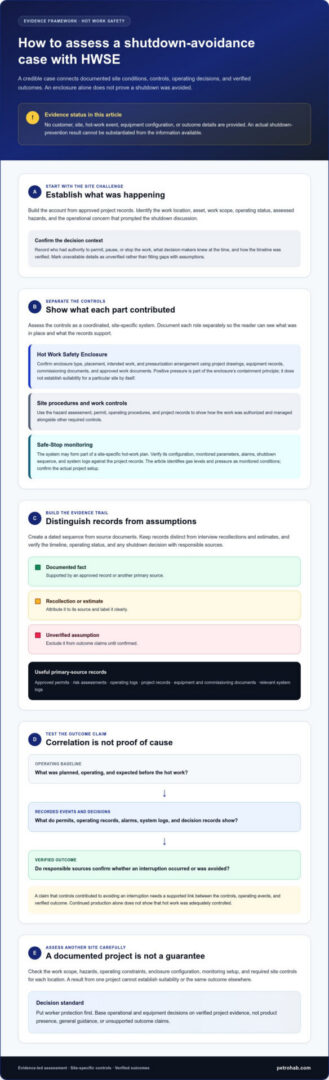
Can hot work continue without interrupting operations? A credible case study on avoiding shutdown with HWSE can help answer that question, but the presence of an enclosure alone proves nothing about the outcome. A useful account documents site conditions, controls, operating decisions, and the evidence behind any shutdown decision. Worker protection comes first, and claims about operational continuity need to be supported by project records.
This article explains how to assess the documented risks and response sequence, then decide whether the evidence supports a link between the controls and an avoided interruption. PetroHab’s modular Hot Work Safety Enclosures and Safe-Stop system, which monitors gas levels and pressure, may form part of a site-specific hot-work plan. Their role and any project outcome need to be verified against records, not assumed.
You’ll find what primary-source documentation to look for, how to distinguish correlation from causation, and what to check when assessing HWSE suitability for a site. Use this framework to weigh the evidence before making an operational or equipment decision.
Key Takeaways
- A credible case study on avoiding shutdown with HWSE starts with verified customer, site, project, and event records, not assumptions.
- Document the enclosure’s role, site procedures, and Safe-Stop monitoring separately so readers can see how each control contributed.
- Compare the planned operating baseline with recorded events and the verified outcome before claiming an interruption was avoided.
- Check Safe-Stop configuration, monitored parameters, alarms, shutdown sequence, and system logs to support conclusions with operating evidence.
- Assess work scope, hazards, operating constraints, and required controls for each site. A documented project does not guarantee the same result elsewhere.
Case Study on Avoiding Shutdown with HWSE: Define the Site Challenge
A credible case study on avoiding shutdown with HWSE begins with a verified project record. No customer, site, hot-work event, or outcome details have been provided for this case, so there is no substantiated incident summary to report. Naming a facility, describing a hazard, or claiming an interruption was prevented without primary-source evidence would mislead readers.
Start by establishing what happened and what decision-makers knew at the time. Personnel protection must govern the decision. Continued production does not show that hot work was adequately controlled. A Hot Work Safety Enclosure uses positive pressure as part of its containment principle, as outlined in this Positive pressure enclosure reference. That general description cannot establish whether a particular configuration was suitable for a specific site.
The following video covers predictive maintenance in a manufacturing setting. It is a separate use case, not evidence about an HWSE project or shutdown-prevention outcome.
What operating conditions created the shutdown concern?
Use approved project records to identify the asset, work location, work scope, and operating status. Then establish what hot-work hazard the risk assessment identified, why the work required controlled conditions, and what operational concern was raised. Confirm who had authority to permit, pause, or stop the work. Mark unavailable details as unverified instead of filling gaps with recollection or assumption.
What evidence establishes the case-study baseline?
Build a dated sequence from source documents, keeping records distinct from interview recollections and estimates. Useful evidence may include approved permits, risk assessments, operating logs, project records, and relevant system logs. Confirm permission to publish, then verify the timeline, operating status, and any shutdown decision with responsible sources.
- Documented fact: supported by an approved record or other primary source.
- Recollection or estimate: attributed to its source and identified as such.
- Unverified assumption: excluded from outcome claims until confirmed.
For background on enclosure principles and terminology, consult PetroHab’s definitive HWSE guide. Keep general guidance separate from evidence about an individual project.
How the HWSE and Site Controls Addressed the Hot-Work Risk
The available project information does not identify a customer, site, or installed or leased equipment configuration. A project-specific account therefore requires records confirming the enclosure type, placement, pressurization arrangement, work scope, and control setup. Without those details, it would be inaccurate to describe how an HWSE addressed a particular site’s hot-work risk or affected operations.
Assess controls as a coordinated system, not as a stand-alone product claim. The enclosure provides a controlled work area, site procedures establish how work is authorized and managed, and monitoring can provide information about specified conditions. The relationship among these elements depends on the project design and documented operating procedures.
How did the enclosure support controlled hot work?
Confirm the configuration using project drawings, equipment records, commissioning documentation, and approved work documents. These sources should establish where the enclosure was placed, how pressurization was arranged, and what work it was intended to contain. The site’s hazard assessment and operating procedures should show how personnel evaluated the enclosure alongside other required controls. PetroHab’s pressurized welding habitat guide provides general background, but it cannot verify a specific installation or its suitability for a particular worksite.
What role did monitoring and shutdown controls play?
PetroHab’s Safe-Stop Automatic Shutdown System monitors gas levels and pressure. Before attributing an event or outcome to it, confirm the project configuration, monitored parameters, operating records, and documented response sequence. A log may establish that an alert occurred, but it does not by itself show what operators did or whether production was interrupted. Compare system logs with permits, operating records, and documented accounts from responsible personnel.
Verify exact operating limits, alarm thresholds, and system responses in project records. Do not infer them from general product descriptions. A protective action, including a shutdown, may be the intended response to a hazardous condition. It should not automatically be labeled a system failure, and uninterrupted operations should not be treated as proof that risk was controlled.
Regulatory references need context too. The linked OSHA hot work regulations concern marine terminal work. Confirm whether they apply to the site rather than presenting them as universal requirements. For readers assessing equipment options, PetroHab’s HWSE and pressurized enclosure offerings provide a starting point for understanding available equipment categories. Any project assessment still needs site-specific review.
What the Case Evidence Shows About Avoiding an Operational Shutdown
A shutdown-prevention claim is only as strong as its source record. No customer-specific permits, operating logs, incident documents, or system records have been provided for this case. An actual avoided interruption, production effect, or causal link between an HWSE and continued operation cannot therefore be verified here. The comparison below shows what a defensible account should establish without filling evidence gaps with estimates.
| Evidence point | Planned baseline | Observed events | Verified outcome |
|---|---|---|---|
| Work and operating status | Establish from approved permit and operating records. | Confirm against dated work records and operating logs. | Not established in the supplied case materials. |
| Monitoring and response | Confirm intended controls and system configuration from project documents. | Check system logs, alerts, and documented operator responses. | Not established without corroborating records. |
| Interruption and impact | Document the planned operating state and any recorded shutdown criteria. | Verify any interruption or change in work status with responsible sources. | Duration, production effect, and avoided interruption are unavailable. |
Which indicators can support a defensible outcome?
Use approved permits and risk assessments to establish the planned work and controls. Compare them with system records, operating logs, and approved incident documentation to determine what happened and when. Attribute each finding to its source, such as a specific log or permit, and confirm reported durations or production effects with the responsible record holder. If a metric is absent, label it unavailable. Do not estimate it or substitute an industry average.
How can the case avoid overstating causation?
Assess other controls, operating decisions, and site conditions alongside the HWSE. A record showing that work proceeded while operations continued may establish timing, but it does not prove the enclosure alone prevented a shutdown. Use causal language only when the evidence supports it. Otherwise, describe the association and its limits. The University of North Carolina at Chapel Hill’s hot work safety policy illustrates the kinds of administrative controls that may also be relevant, but it does not establish which controls applied at another site.
For general context on how engineered systems fit into a wider control approach, see PetroHab’s advanced hot-work safety systems guide. A credible case study on avoiding shutdown with HWSE should distinguish documented project findings from general guidance and state what the evidence cannot show.
How to Assess Whether an HWSE Fits a Similar Shutdown Risk
Begin an HWSE assessment with the work and hazard, not a preferred equipment configuration. The goal is to determine whether an enclosure can form part of a site-specific hot-work plan, with personnel protection as the primary requirement. A previous case study on avoiding shutdown with HWSE may help frame questions, but it cannot replace a qualified review of the current site.
Which project details should a buyer prepare?
Give the manufacturer and site safety team a clear, documented description of the proposed work. Include the work scope, location conditions, operating status, and existing hot-work procedures. Identify the hazards in the site assessment and any constraints that could affect enclosure placement or access. Where available, use drawings, operating records, and approved procedures instead of relying on general descriptions.
Before discussing equipment options, organize the information that will shape the assessment:
- Work and site: tasks, work location, operating conditions, and relevant hazard-assessment findings.
- Controls: existing hot-work procedures, monitoring needs, and enclosure requirements identified by site personnel.
- Practical constraints: access, placement, interfaces with nearby operations, and responsible decision-makers.
- Requirements: technical and compliance criteria confirmed by qualified site personnel.
This preparation helps identify unanswered questions early. It does not establish suitability on its own. Qualified site personnel must assess the proposed arrangement against actual conditions and applicable requirements.
How should options and support be evaluated?
Compare the proposed equipment configuration with the documented work scope, hazards, operating constraints, and required controls. Ask how configuration decisions will be recorded, and clarify who is responsible for setup, supervision, personnel instruction, and maintaining system records. For systems that monitor gas levels and pressure, confirm the proposed monitoring arrangement and how alerts or other responses will be documented. Do not assume a feature or response applies to a project until it has been confirmed for that configuration.
Keep the decision traceable. Record the information reviewed, unresolved assumptions, site approvals, and reasons for selecting or rejecting an option. This gives later reviewers a stronger basis for understanding the decision than an equipment description or shutdown-prevention claim alone.
Once the site team has defined its requirements, discuss the project requirements with PetroHab to explore whether its modular HWSE and related equipment may fit the project. Final selection remains subject to site-specific assessment and approval by responsible personnel.
Case Study Lessons and Next Steps for PetroHab HWSE Projects
A project-specific shutdown-prevention outcome cannot be confirmed from the information available for this article. No customer, site, event, or operating records were supplied. The defensible lesson is about evidence and assessment: evaluate the work scope, hazard controls, equipment configuration, operator response, and operating records together before drawing conclusions. A case study on avoiding shutdown with HWSE does not prove that a similar result will follow at another facility.
What should decision-makers take from the case?
Present only lessons supported by verified project records as case findings. Documenting the work plan, confirming control responsibilities, and retaining relevant operating evidence can inform future reviews. Whether an enclosure configuration, monitoring arrangement, or response is suitable depends on the site’s conditions, work, and approved controls. Personnel protection governs every decision. Do not proceed for the sake of production continuity if the work cannot be performed under acceptable conditions.
What is the next step for a project team?
Prepare a project file before discussing equipment. Include the work scope, hazard assessment, operating constraints, existing hot-work procedures, and available site documentation. Identify the people responsible for safety review and operational decisions. Confirm project-specific technical and compliance requirements with qualified site personnel.
Use the HWSE supplier procurement guide to structure vendor evaluation. Compare proposed equipment with documented requirements, and ask how configuration, rental or purchase options, and any required support arrangements would be addressed. PetroHab manufactures, leases, and sells modular HWSE equipment, but suitability and outcomes require project-specific evaluation.
Next step: assemble the project information and discuss the requirements with PetroHab and the site safety team. Confirm proposed controls, responsibilities, and the evidence plan before making an equipment decision. No equipment choice guarantees that operations will continue. The site’s safety assessment must govern the work.
Build Your Next HWSE Assessment on Verified Evidence
A credible case study on avoiding shutdown with HWSE depends on verified site conditions, documented control actions, and operating records. Without customer and project evidence, no shutdown-prevention outcome can be claimed. For future assessments, separate confirmed facts from recollections and estimates, and treat each site’s hazards, work scope, and operating constraints as project-specific.
PetroHab manufactures, leases, and sells modular Hot Work Safety Enclosures. Its Safe-Stop system monitors gas levels and pressure, and patented Quadra-Lock Panels are also part of its equipment offering. These capabilities may be considered within a site-specific hot-work plan, but equipment alone cannot establish suitability or guarantee uninterrupted operations. Personnel protection must govern every decision.
Prepare the work scope, hazard assessment, operating constraints, and relevant site records before evaluating equipment. Discuss your project requirements with PetroHab as part of that assessment. Clear documentation and rigorous site review help your team make an informed decision about HWSE suitability and the controls required for the work.
Frequently Asked Questions
What evidence is needed for a case study on avoiding shutdown with HWSE?
Use primary project records wherever possible, including approved work documents, operating logs, system records, and interviews with responsible personnel. Identify the source and date for each key claim. Confirm the work scope, site conditions, sequence of events, and outcome before publication. If a metric or causal link cannot be verified, omit it or state the limitation clearly. Do not estimate missing values or use general industry figures as substitutes for project evidence.
Can an HWSE guarantee that a facility will not shut down?
No. An HWSE should not be presented as a guarantee against shutdown. Operating decisions depend on site conditions, hazards, procedures, and the responsible safety team. An enclosure may form part of a project-specific hot-work control plan, but it cannot promise uninterrupted operations. A case study should explain what the documented equipment and controls did, then distinguish those project findings from any general performance claim.
How does Safe-Stop relate to an HWSE shutdown-prevention case study?
PetroHab describes Safe-Stop as an automatic shutdown system that monitors gas levels and pressure. For a specific case, verify the installed configuration, recorded readings, alerts, and response sequence against project documentation. Explain how the system fit into site procedures and what the records confirm. Do not infer trigger values, response times, or outcomes that the evidence does not establish, or claim that monitoring alone eliminated risk.
What should a case study report if no shutdown occurred?
Report the verified work conditions, controls in use, recorded events, and documented operating outcome. The fact that no shutdown occurred does not establish that the equipment alone prevented one. Include other relevant controls and site conditions, and state any evidence limitations. If the project team cannot substantiate that an interruption was avoided, describe the project as an operating example rather than a proven shutdown-prevention result.
How can a buyer assess whether an HWSE suits a hazardous worksite?
Start with the work scope, hazard assessment, site conditions, operating constraints, and project requirements. Have qualified site personnel identify the controls needed and confirm technical details with the equipment provider. Review the proposed configuration, monitoring needs, and arrangements for setup, supervision, and training. A case study can help shape questions, but it cannot replace site-specific assessment or approval by responsible personnel.
What information should be verified before publishing an HWSE case study?
Confirm permission to identify the customer, along with the project location, work scope, timeline, equipment configuration, and supporting records. Verify any stated operational impact, system response, or safety outcome with responsible sources. Check that causal claims are supported rather than inferred from timing alone. If details are confidential or unavailable, state that limitation and leave out the claim instead of filling the gap with invented figures.