Blog Posts
Chemical Plant Turnaround Best Practices 2026: A Safety-First Execution Guide
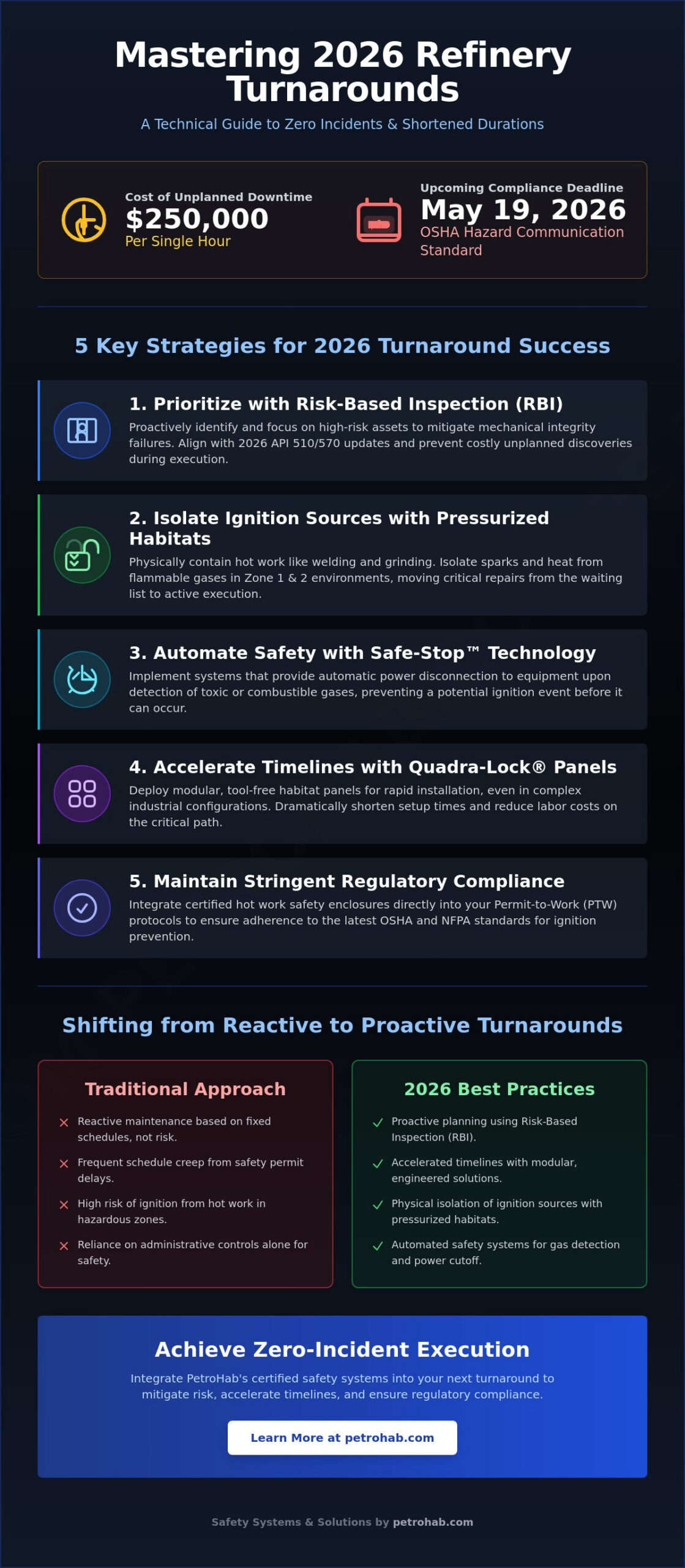
A single hour of unplanned downtime during a refinery shutdown now costs an average of $250,000 in lost revenue. As facilities face the May 19, 2026, OSHA Hazard Communication Standard deadline, the pressure to maintain mechanical integrity while meeting aggressive schedules is at an all-time high. Implementing chemical plant turnaround best practices 2026 requires more than a standard checklist. It demands a technical shift in how you manage hazardous environments and contractor safety to prevent catastrophic failures.
You’ve likely experienced the frustration of schedule creep caused by safety permit delays or unplanned discoveries during API 510 inspections. Managing hundreds of contractors in volatile zones is a high-stakes logistical challenge that leaves no margin for error. This guide provides the rigorous strategies needed to master 2026 refinery turnarounds, focusing on risk mitigation and hot work safety. You’ll learn how to achieve zero safety incidents and shortened durations by utilizing pressurized containment and Quadra-Lock technology to move critical repairs off the waiting list and onto the active execution path.
Key Takeaways
- Prioritize critical assets using Risk-Based Inspection (RBI) to mitigate mechanical integrity failures and prevent unplanned inspection discoveries during the 2026 cycle.
- Implement chemical plant turnaround best practices 2026 by utilizing pressurized habitats to isolate ignition sources from flammable gases in Zone 1 and Zone 2 environments.
- Enhance site safety with Safe-Stop technology. This system provides automatic power disconnection upon the detection of toxic or combustible gases to prevent ignition.
- Accelerate execution timelines through the deployment of modular Quadra-Lock panels designed for rapid, tool-free installation in complex industrial configurations.
- Maintain stringent regulatory compliance with the latest OSHA and NFPA standards by integrating certified hot work safety enclosures into your Permit-to-Work protocols.
Strategic Turnaround Planning: Mechanical Integrity and RBI in 2026
A Turnaround (refining) is a highly structured, planned shutdown of a processing unit designed to perform essential inspections, maintenance, and capital upgrades. These events represent the most significant portion of a facility’s annual maintenance budget and carry the highest operational risk. Executing chemical plant turnaround best practices 2026 requires moving beyond reactive maintenance. You must adopt a proactive strategy that integrates mechanical integrity with rigorous execution timelines to protect both personnel and high-value assets.
Success starts with a 12 to 18 month planning horizon. This window allows engineering teams to identify long-lead materials and coordinate specialized labor well in advance of the shutdown. Shortening this phase often leads to unplanned discoveries during the execution stage, which can inflate costs by millions of dollars. By establishing a firm baseline early, you ensure that every inspection point is accounted for before the first valve is turned.
To better understand the impact of these maintenance cycles, watch this helpful video:
Risk-Based Inspection (RBI) serves as the technical backbone of modern turnaround planning. Rather than inspecting every asset with the same frequency, RBI methodologies prioritize equipment based on its probability and consequence of failure. This approach aligns your mechanical integrity program with the 2026 updates to API 510 and API 570. It ensures that high-risk assets receive the necessary attention while resources are not wasted on low-risk components. This level of technical precision is a cornerstone of chemical plant turnaround best practices 2026.
The Role of Asset Integrity Management (AIM)
Effective AIM programs evaluate specific degradation mechanisms like sulfidation, stress corrosion cracking, and atmospheric thinning relative to current service conditions. Engineers use this data to identify assets that require immediate hot work or total replacement. Integrating advanced Non-Destructive Evaluation (NDE) techniques, such as phased array ultrasonic testing, during the planning phase provides the clarity needed to finalize the repair list. This technical rigor reduces the likelihood of late-stage scope changes that threaten the critical path.
Defining the Scope of Work
A strict scope freeze must occur at least four weeks before the turnaround begins. This discipline prevents schedule creep and ensures that all safety resources, including pressurized welding enclosures and Quadra-Lock panels, are staged and ready for deployment. Coordination across mechanical, electrical, and safety disciplines is mandatory to ensure resource availability for critical path repairs. You should also review current hazardous environment standards to ensure your execution plan meets global compliance requirements for ignition prevention and environmental containment.
Managing Hot Work Risks in Hazardous Processing Zones
Physical execution of hot work remains the most dangerous phase of any facility shutdown. While software can predict maintenance needs, it cannot contain a stray spark in a hydrocarbon-rich environment. Effective chemical plant turnaround best practices 2026 demand a rigorous focus on ignition source management within Zone 1 and Zone 2 areas. You must identify all potential energy sources, from welding arcs to grinding sparks, and implement a definitive isolation strategy. Relying on administrative controls alone is insufficient when dealing with volatile atmospheres.
Every hot work task requires a strict Permit-to-Work (PTW) protocol. These permits shouldn’t be treated as mere paperwork. They’re critical safety contracts that verify the absence of flammable vapors and the presence of active suppression systems. Compliance with OSHA Chemical Hazards standards is non-negotiable. Traditional fire blankets often fail to provide adequate protection because they only deflect sparks rather than sealing the work area. Pressurized habitats offer a superior solution by creating a controlled environment that physically excludes external gases through positive pressure.
Continuous gas monitoring is mandatory for all concurrent operations. When multiple teams work in proximity, the risk of a gas release from an adjacent line increases exponentially. If you’re looking to upgrade your onsite protection, you can explore specialized safety enclosures designed for these high-stakes environments. This hardware-centric approach ensures that safety is a physical reality rather than a procedural hope.
Ignition Prevention Protocols
Define clear physical boundaries for hazardous work areas before the TAR commences. All electrical tools, lighting, and ventilation systems must carry ATEX or IECEx certification to ensure they won’t trigger an explosion. For technician training, use this definitive objective: Ignition prevention is the absolute isolation of all thermal and electrical energy from combustible atmospheres. This clarity ensures that every contractor understands their role as a guardian of the site’s integrity and asset value.
Simultaneous Operations (SIMOPs) Safety
SIMOPs occur when maintenance and production activities overlap, creating complex risk profiles. You must utilize hot work safety systems to physically isolate these zones. These systems allow welding to proceed on the critical path without requiring a total plant degassing. Maintaining constant communication between safety officers and habitat technicians is vital. This ensures that any change in the environment, such as a localized leak, results in an immediate and automatic cessation of hot work activities through integrated shutdown technology.
Advanced Monitoring and Pressurized Containment Technology
Deploying pressurized welding habitats is a critical component of chemical plant turnaround best practices 2026. These systems provide a physical barrier that isolates high-energy ignition sources from the surrounding atmosphere. This allows for essential repairs in Zone 1 and Zone 2 areas without the need for a total plant shutdown. Every enclosure must be constructed from fire-resistant materials that meet the latest 2026 international standards for thermal protection and durability. This ensures the habitat remains a resilient shield against the intense heat generated by welding and grinding activities.
Technological reliability is the foundation of asset protection during a turnaround. You must move beyond simple visual inspections and adopt real-time monitoring solutions. These systems provide the data necessary to verify that the work environment remains within safe operational limits. By integrating advanced sensors and automated controls, you remove the risk of human error in detecting hazardous atmosphere changes. This rigorous approach is what defines market leadership in industrial safety today.
The Mechanics of Positive Pressure
Maintaining a constant pressure differential is the primary method used to prevent hydrocarbon ingress. Positive pressure habitats utilize specialized blowers to force clean, breathable air into the enclosure. This creates an internal environment where the pressure is consistently higher than the atmospheric pressure outside. Manometers are essential tools in this process. They provide technicians with precise, real-time data to ensure the enclosure’s integrity isn’t compromised. Positive pressure containment creates an outward-moving air current that physically blocks flammable gases from entering the work area through any openings.
Automatic Shutdown Systems (ASD)
The Safe-Stop Automatic Shutdown System serves as the definitive fail-safe for hot work execution. This technology integrates directly with gas detectors to monitor for both oxygen depletion and the presence of combustible gases. If the system detects a Lower Explosive Limit (LEL) percentage above the set threshold, it immediately terminates power to all electrical tools and welding machines. This rapid response eliminates the ignition source in milliseconds. Every ASD must also monitor the air supply to ensure technicians always have sufficient oxygen. Fail-safe mechanisms are designed to trigger a shutdown if either the power or the air supply is interrupted, ensuring that chemical plant turnaround best practices 2026 are upheld in every scenario.
Shortening the Turnaround Window: Efficiency through Modular Solutions
Turnaround efficiency in 2026 relies on the physical speed of enclosure deployment. You can’t afford to waste hours on complex, manual setups when every minute of downtime impacts your bottom line. Chemical plant turnaround best practices 2026 dictate the use of modular systems that don’t compromise safety for speed. By choosing systems engineered for rapid assembly, you eliminate the bottleneck of habitat construction on the critical path. This ensures that maintenance crews begin work immediately after a permit is issued, keeping the project on its projected timeline.
Adopting lightweight and durable materials is a logistical necessity in modern refineries. Congested pipe racks and narrow access ways make traditional, heavy equipment difficult to maneuver. Modular solutions allow your team to transport components through tight spaces without specialized lifting equipment. This flexibility is vital when you need to relocate protection systems across different units during multi-phase projects. Standardizing these configurations across the entire refinery simplifies technician training and reduces the risk of assembly errors during high-pressure execution windows.
The Quadra-Lock Advantage
The Quadra-Lock panel system represents a technical leap in environmental containment. Traditional habitats often rely on time-consuming bolts or vulnerable zippers that can fail under thermal stress. In contrast, Quadra-Lock utilizes a patented interlocking mechanism to ensure a gas-tight seal. This design provides a definitive barrier against hydrocarbon ingress while maintaining structural integrity in high-heat environments. The tool-free assembly allows technicians to build or modify enclosures in a fraction of the time required by legacy systems. This speed is essential when responding to unplanned discoveries that require immediate hot work to prevent schedule creep.
Logistics and Resource Optimization
Minimizing the physical footprint of safety equipment is vital for maintaining site access during a crowded TAR. You should consider implementing a hot work safety enclosure rental strategy to scale your protection needs based on the specific phase of the turnaround. This approach allows you to deploy the exact number of habitats required without maintaining a massive permanent inventory. Training onsite personnel for faster relocation ensures that the habitat moves with the work, rather than the work waiting for the habitat. To optimize your execution timelines and ensure total asset protection, contact PetroHab for a specialized modular solution tailored to your facility’s 2026 requirements.
Implementing PetroHab Safety Systems for Zero-Incident Execution
Integrating the PetroHab Hot Work Safety Enclosure (HWSE) into a refinery’s safety management system bridges the gap between administrative permits and physical site protection. While a Permit-to-Work (PTW) authorizes a task, the HWSE provides the technical environment required to execute it safely. Adopting chemical plant turnaround best practices 2026 requires this seamless integration. You must ensure that every hot work permit specifically mandates the use of pressurized containment in hazardous zones. This creates a redundant safety layer that protects personnel and prevents the ignition of volatile hydrocarbons during high-stakes execution.
PetroHab’s global footprint ensures that specialized support is available for international turnarounds, regardless of location. This reach provides facilities with consistent safety equipment and technical expertise across diverse geographic regions. Leveraging this network allows for standardized safety protocols that meet international technical certifications. By aligning your facility with a seasoned safety partner, you instill absolute confidence in your engineering and safety management teams. It’s a strategic move that moves safety from a procedural concept to an operational reality.
Safe-Stop Automatic Shutdown Integration
The Safe-Stop Automatic Shutdown System acts as the central nervous system for environmental monitoring. It allows safety managers to connect multiple habitats to a single interface for centralized control. The system continuously monitors gas levels, internal habitat pressure, and air flow rates. Every component carries ATEX Zone 1 certification, ensuring reliability in the most demanding refinery environments. If any parameter falls outside the defined safety threshold, Safe-Stop terminates power instantly. This definitive technological remedy eliminates the risk of human delay in emergency response.
Certified Training and Supervision
Zero-incident execution depends on the competence of the personnel operating the equipment. You must mandate that all contractors undergo training on PetroHab habitat entry and emergency protocols. Utilizing certified PetroHab technicians to oversee HWSE operations ensures that the integrity of the enclosure is maintained throughout the TAR. These experts manage the granular details of habitat maintenance, allowing your internal teams to focus on core maintenance tasks. After the shutdown, reviewing post-turnaround data helps you refine future chemical plant turnaround best practices 2026 and improve long-term asset integrity management. This data-driven approach ensures that every turnaround is safer and more efficient than the last.
Securing Operational Excellence in 2026 Turnarounds
Achieving zero safety incidents during a complex shutdown requires technical synergy between rigorous planning and advanced hardware. By prioritizing assets through Risk-Based Inspection and isolating hot work with pressurized containment, you move critical repairs off the waiting list and onto the execution path. These chemical plant turnaround best practices 2026 ensure that your facility remains compliant with the latest OSHA and NFPA standards while maintaining aggressive schedules. Reliability is built on proven technology that functions as an active guardian of your site and its personnel.
Our patented Quadra-Lock technology provides a gas-tight seal that legacy systems cannot match. When combined with ATEX and IECEx certified Safe-Stop systems, these solutions offer a definitive fail-safe against ignition in hazardous environments. With global deployment capabilities for Oil and Gas majors, PetroHab stands as a seasoned partner for your high-stakes maintenance cycles. Your facility’s integrity depends on precise execution and uncompromising safety standards that leave no room for error.
Request a technical consultation for your 2026 turnaround safety requirements to secure your high-value assets and personnel. We’re ready to support your mission for operational excellence and site safety.
Frequently Asked Questions
What is a chemical plant turnaround in the context of 2026 operations?
A chemical plant turnaround is a scheduled, high-stakes event where a processing facility is taken offline for essential asset integrity inspections, maintenance, and equipment upgrades. In 2026, these operations are heavily influenced by updated OSHA Hazard Communication Standards and revised API inspection codes. Successful execution requires a proactive strategy that integrates mechanical integrity with rigorous execution timelines to protect personnel and high-value assets.
How does a pressurized welding habitat reduce turnaround downtime?
A pressurized welding habitat reduces downtime by allowing hot work to proceed without the need for a total plant degassing or a complete unit shutdown. By isolating ignition sources from the surrounding atmosphere, these systems allow maintenance crews to perform repairs on the critical path while adjacent units remain operational. This physical containment strategy prevents schedule creep and keeps the turnaround window as short as possible.
What are the essential safety certifications for hot work enclosures?
Essential safety certifications for hot work enclosures include ATEX and IECEx for operation in explosive atmospheres. These international standards verify that the enclosure and its monitoring systems are engineered to prevent ignition in Zone 1 and Zone 2 environments. Adhering to chemical plant turnaround best practices 2026 also requires compliance with updated NFPA 70 and NFPA 70E standards for electrical safety and arc flash protection.
How does the Safe-Stop system prevent ignition in Zone 1 areas?
The Safe-Stop system prevents ignition by continuously monitoring gas concentrations, internal pressure, and air flow rates within the work area. If the system detects combustible gases above a set threshold or a loss of positive pressure, it automatically terminates power to all welding machines and electrical tools. This definitive technological remedy removes the ignition source in milliseconds, providing a fail-safe that administrative controls cannot match.
Can Quadra-Lock panels be used in high-temperature refinery environments?
Yes, Quadra-Lock panels are specifically engineered for the high-temperature and high-stress environments found in modern refineries. The panels utilize fire-resistant materials that maintain their structural integrity and a gas-tight seal even when exposed to intense heat from welding or grinding. Their patented interlocking mechanism ensures the habitat remains a resilient shield against thermal energy throughout the duration of the project.
What is the standard lead time for planning a refinery turnaround?
The standard lead time for planning a successful refinery turnaround is 12 to 24 months. This extensive planning horizon allows engineering teams to identify long-lead materials, coordinate a massive workforce of contractors, and finalize the scope of work. Early planning is a cornerstone of chemical plant turnaround best practices 2026, as it minimizes the risk of unplanned discoveries and budget overruns during the execution phase.
How do modular safety enclosures integrate with Permit-to-Work systems?
Modular safety enclosures provide the physical control measures required to satisfy the conditions of a Permit-to-Work (PTW) for hot work in hazardous zones. While the PTW serves as the administrative authorization, the enclosure acts as the mechanical barrier that isolates the hazard. This integration ensures that the safety requirements documented in the permit are physically implemented in the field, creating a redundant and reliable safety layer.
Why is positive pressure critical for hot work in hazardous zones?
Positive pressure is critical because it creates a constant, outward-moving air current that physically prevents flammable hydrocarbons from entering the enclosure. By maintaining an internal pressure higher than the surrounding atmosphere, the system ensures that any openings or seals remain impenetrable to external gases. This active air barrier is the primary defense against ignition when performing welding or grinding in hydrocarbon-rich environments.