Choosing the Right Hot Work Safety Enclosure Suppliers: A 2026 Procurement Guide
Could a single technical oversight in your procurement process lead to a $1.5 million daily loss during your next scheduled turnaround? You recognize that in Zone 1 and Zone 2 environments, the integrity of your pressurized habitat determines the boundary between operational success and catastrophic ignition. Evaluating hot work safety enclosure suppliers requires more than a standard checklist; it demands a rigorous assessment of engineering excellence and global compliance standards.
Safety managers understand the stress of balancing maintenance schedules with the fear of habitat failure. It’s a high-stakes environment where a 1% deviation in pressure control can lead to an immediate shutdown. This guide provides a definitive framework for selecting a partner that prioritizes technical precision. We’ll examine the critical benchmarks for 2026, including ATEX/IECEx certifications and the deployment of patented modular systems. You’ll learn how to secure a scalable solution that maintains unrivaled safety across all global project sites.
Key Takeaways
- Analyze the evolution of pressurized habitats to understand why supplier selection is the most significant variable in mitigating hazardous area risks.
- Evaluate hot work safety enclosure suppliers based on rigorous technical certifications, including ATEX, IECEx, and ISO 9001:2015, rather than simple fire-resistance ratings.
- Assess the operational advantages of modular panel configurations to ensure structural integrity and versatility in restricted offshore environments.
- Identify why a supplier’s global logistics footprint and the availability of certified on-site supervision are critical for secure decommissioning and setup.
- Discover how patented engineering, such as Quadra-Lock and Safe-Stop systems, establishes the benchmark for protecting personnel and high-value assets.
The Critical Role of Hot Work Safety Enclosure Suppliers in Risk Mitigation
Industrial safety protocols have transitioned from passive measures to active, technologically integrated systems. In the late 1990s, basic welding screens provided minimal spark containment, often failing to address the invisible threat of migrating hydrocarbons. Today, hot work safety enclosure suppliers provide sophisticated engineering solutions that manage ignition sources in Class 1, Division 1 environments. Selecting a supplier is the primary variable in hazardous area maintenance. A failure in habitat integrity can lead to catastrophic explosions, costing operators upwards of $50 million in asset damage and irreversible environmental harm. By 2026, the industry standard mandates that every controlled safety environment must utilize real-world data logging and automated shutdown systems to meet BSEE and HSE requirements.
The evolution of these systems reflects a shift toward total ignition source control. Modern suppliers don’t just sell equipment; they provide a comprehensive risk management framework. This framework is essential for offshore platforms and refineries where the proximity of flammable gases to maintenance activities is a constant reality. Relying on outdated barriers is no longer a defensible position in a regulatory climate that prioritizes the ALARP (As Low As Reasonably Practicable) principle.
Defining the Modern Hot Work Safety Enclosure (HWSE)
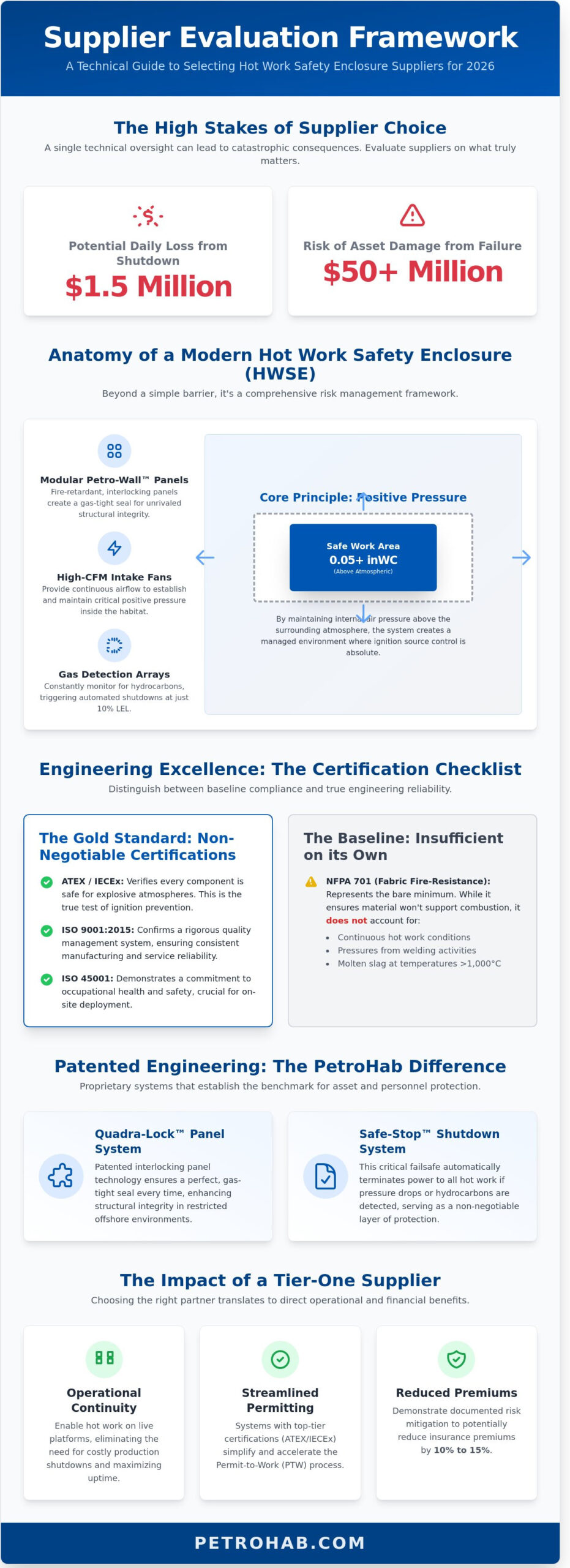
A modern HWSE is a modular system comprising fire-retardant Petro-Wall panels, intake fans, and gas detection arrays. The physics of positive pressure is central to this technology. By maintaining internal air pressure at a minimum of 0.05 inches of water column above atmospheric pressure, the system prevents flammable gases from entering the workspace. These systems provide more than a physical barrier; they create a managed atmosphere where ignition source control is absolute. Our patented Safe-Stop system reinforces this by automatically isolating power if internal pressure drops or gas is detected at 10% of the Lower Explosive Limit (LEL).
The Impact of Supplier Choice on Operational Uptime
High-quality enclosures enable hot work on live platforms, eliminating the need for production shutdowns that can cost $1 million per day. When hot work safety enclosure suppliers provide systems with IECEx and ATEX certifications, the Permit-to-Work (PTW) process becomes streamlined. Reliable suppliers help reduce insurance premiums by 10% to 15% through documented risk mitigation. Key benefits of choosing a tier-one supplier include:
- Unrivaled Integrity: Modular panels that interlock to form a gas-tight seal.
- Regulatory Compliance: Systems that meet ISO 9001 and ISO 45001 standards for safety and quality.
- Operational Continuity: The ability to perform critical repairs without halting revenue-generating activities.
A supplier’s technical precision directly correlates to the speed of the maintenance cycle. It’s a matter of operational survival in the high-stakes energy sector.
Engineering Excellence: Evaluating Technical Standards and Certifications
Selecting hot work safety enclosure suppliers requires a rigorous audit of technical credentials. Surface-level compliance isn’t enough in high-hazard environments. Industry experts rely on ISO 9001:2015 to verify quality management, yet the true test of an enclosure lies in its ATEX and IECEx certifications. These standards dictate the requirements for equipment used in explosive atmospheres. They ensure that every component, from the fan units to the control systems, prevents ignition risks. Reliability is a mathematical certainty, not a marketing claim.
Fabric fire-resistance ratings, such as NFPA 701, represent the bare minimum. While these ratings ensure the material won’t support combustion, they don’t account for the thermal pressures of continuous welding. Leading suppliers provide materials that exceed these baselines. They incorporate layers designed to withstand molten slag at temperatures exceeding 1,000 degrees Celsius. An automatic shutdown system (ASDS) serves as the critical secondary layer of protection. If the system detects a loss of pressure or the presence of hydrocarbons, it immediately terminates power to the ignition source. This failsafe mechanism is non-negotiable for 2026 safety protocols.
Global Compliance Standards for 2026
Procurement managers must distinguish between regional and international requirements. ATEX is mandatory for European operations, while IECEx provides a global framework for equipment safety. In North America, OSHA and ANSI standards define the operational boundaries for pressurized enclosures. By 2026, all suppliers should demonstrate compliance with the latest fire-retardancy updates to ensure long-term site integrity. You can review detailed pressurized habitat specifications to see how these standards apply in practice.
Patented Technology vs. Generic Solutions
Generic habitats often rely on velcro and zippers. These methods are prone to failure under pressure. Engineering flaws in these soft assembly points lead to gas ingress and pressure loss. Patented interlocking panel technology, such as the Quadra-Lock system, creates a mechanical seal that maintains habitat pressure even in high-wind conditions. Modularity is essential for complex pipe geometries because it allows the enclosure to be custom-fitted around irregular obstructions without compromising the air-tight seal. This precision ensures that hot work safety enclosure suppliers provide a solution that is both versatile and impenetrable.
Modular vs. Fixed Systems: Selecting the Optimal Enclosure Configuration
Hot work safety enclosure suppliers offer two primary configurations: modular panels and fixed structures. In the high-stakes offshore sector, modularity is the industry standard for 2026. Fixed systems lack the flexibility required to navigate the congested deck spaces of oil platforms or FPSOs. Modular systems utilize interlocking panels, such as the patented Petro-Wall, to create custom configurations that fit within 0.5-meter clearances. These systems provide the necessary agility to work around existing infrastructure without compromising the pressurized seal.
Structural integrity remains a critical procurement factor. Enclosures must withstand external environmental pressures, particularly in regions like the North Sea where wind gusts can exceed 110 km/h. High-quality hot work safety enclosure suppliers provide systems tested to maintain internal overpressure even during these peak wind events. This ensures the ignition source control remains intact. Beyond wind resistance, the enclosure must facilitate worker safety through integrated window panels for external monitoring and specialized seals for protrusions.
- Airflow Requirements: Systems must achieve a minimum of 20 air changes per hour to prevent the accumulation of toxic weld fumes.
- Visibility: Flame-retardant clear panels allow safety standbys to maintain visual contact with technicians.
- Seal Integrity: Precision-engineered intrusion seals prevent gas ingress at pipe and beam penetrations.
Customization for Complex Geometries
Industrial sites aren’t flat surfaces. Beams, valves, and piping often intersect the intended work area. Modular systems adapt to these obstacles through interchangeable panels and flexible penetration seals. This adaptability reduces setup time by 40% compared to rigid alternatives. For a deeper dive into the engineering behind these configurations, read our guide on pressurized welding habitat technology. The ability to scale a habitat from a 2×2 meter footprint to a 10×10 meter configuration using the same components provides significant logistical advantages.
The Integration of Automatic Shutdown Logic
The habitat’s primary role is isolation, but its secondary role is active monitoring. Modern systems integrate with the welding power source through an automatic shutdown logic, such as the Safe-Stop system. This fail-safe mechanism is mandatory for high-risk zones. The system monitors gas concentrations in real-time, focusing on three critical thresholds. If the Lower Explosive Limit (LEL) reaches 10%, H2S exceeds 10 ppm, or O2 levels drop below 19.5%, the system terminates power to the ignition source in under 0.5 seconds. This immediate response eliminates the risk of human error during a gas release event.
Global Logistics and On-site Support: Beyond the Equipment
Procurement teams often prioritize hardware specifications, yet the logistical capability of hot work safety enclosure suppliers determines project success. Local hubs in Houston, Dundee, and Brazil aren’t just convenient; they’re essential for 24-hour response times. In the North Sea or the Gulf of Mexico, a 48-hour delay in equipment arrival can cost operators $250,000 per day in deferred production. Suppliers must demonstrate a physical footprint that aligns with your asset locations to ensure rapid mobilization and compliance with regional safety standards like Brazil’s NR-34.
The Importance of On-site Expertise
A specialized Habitat Technician ensures the pressurized system maintains a minimum of 50 Pascals of overpressure. Relying on untrained personnel for DIY installation introduces unacceptable risk. PetroHab mandates that all supervisors complete a rigorous hot work habitat training program to verify competency in hazardous zones. These technicians manage the integration of Safe-Stop systems and monitor gas detection sensors. Without this expert oversight, the integrity of the enclosure remains unverified, potentially exposing the facility to ignition risks during welding operations.
Rental vs. Purchase: A Procurement Framework
Asset managers must evaluate the financial impact of their equipment strategy. Projects exceeding 180 days often justify a capital expenditure (CAPEX) approach. However, the total cost of ownership (TCO) includes climate-controlled storage and mandatory 12-month recertification cycles. For shorter turnarounds or one-off maintenance schedules, a welding habitat rental vs purchase analysis usually favors the flexibility of leased hardware. This model shifts the burden of maintenance and hardware updates to the supplier.
- Maintenance: Purchased units require documented inspections every 6 months to maintain ATEX/IECEx compliance.
- Storage: Modular Petro-Wall panels must be stored in environments that prevent UV degradation and seal damage.
- Global Availability: Leading hot work safety enclosure suppliers maintain a global fleet of 500+ units to support simultaneous remote offshore operations.
Reliability isn’t just about the strength of the fabric; it’s about the speed of the support. When choosing a partner, verify their ability to deploy certified technicians to a platform within 12 hours of an emergency request. Consult with our logistics experts to optimize your next deployment schedule.
PetroHab: The Gold Standard for Pressurized Welding Habitats
PetroHab represents the pinnacle of engineering integrity in the energy sector. As leading hot work safety enclosure suppliers, we provide the technology required to transform hazardous areas into controlled work environments. Our systems protect personnel and high-value assets during critical 2026 maintenance cycles through a combination of patented hardware and automated logic.
The Quadra-Lock panel system eliminates structural vulnerabilities inherent in legacy habitats. These panels create a pressurized seal that maintains integrity under significant pressure differentials. When integrated with the Safe-Stop SSS (Safety Shutdown System), the enclosure functions as an active safety barrier. Safe-Stop monitors atmospheric conditions and internal pressure, triggering an automatic shutdown of ignition sources in less than 0.5 seconds if a breach is detected. This speed is critical for preventing disasters in high-risk zones.
The PetroHab Product Ecosystem
The Petro-Habitat offers a complete pressurized environment for extensive welding operations. For localized hot work, the Petro-Shield provides targeted protection with the same level of engineering rigor. Both systems utilize our patented Quadra-Lock technology. This system requires no tools for assembly, which reduces setup time by 40% compared to traditional bolt-together designs. The Safe-Stop SSS remains the industry’s most reliable automatic shutdown technology, engineered to meet ATEX and IECEx standards. It’s a fail-safe solution that removes human error from the safety equation.
Partnering for Zero-Incident Operations
PetroHab acts as a technical advisor for global oil majors operating in the North Sea, Gulf of Mexico, and the Middle East. Our modular, lightweight components are stress-tested to withstand 150 mph wind speeds and extreme thermal loads. We’ve achieved a 99.9% reliability rate across more than 5,000 deployments annually. This track record is why we’re the preferred choice for engineers who prioritize risk mitigation.
Planning for your 2026 maintenance schedule requires early engagement to ensure equipment availability and logistical coordination. Our global reach ensures local support in every major energy hub.
Securing Your Operational Integrity in 2026
Procurement of pressurized welding habitats requires a focus on rigorous engineering and proven field performance. Selecting the right hot work safety enclosure suppliers means looking beyond basic containment; it’s about ensuring every component meets ISO 9001:2015 standards and provides active protection. PetroHab’s patented Quadra-Lock Interlocking Technology eliminates gaps that traditional systems leave behind, ensuring a secure environment for high-heat operations. Our Safe-Stop Automatic Shutdown System (SSS) monitors gas levels and pressure 24/7, providing an immediate technological remedy to atmospheric hazards. With strategic hubs in the US, UK, Brazil, and SE Asia, we deliver specialized equipment and technical expertise to the world’s most demanding offshore and onshore sites. You’re not just buying a habitat; you’re investing in a system that safeguards human life and high-value assets. Our commitment to safety advocacy ensures your hot work projects proceed without compromise. Secure your site’s future with engineering that defines the gold standard in industrial risk mitigation.
Request a Technical Consultation and Quote for Your Next Project
Frequently Asked Questions
How do hot work safety enclosure suppliers ensure positive pressure integrity?
Suppliers utilize high-pressure blowers and specialized sealing systems to maintain an internal pressure of 50 pascals above the external atmosphere. This overpressure prevents the ingress of flammable gases into the workspace. PetroHab’s patented Petro-Wall panels use interlocking designs to minimize air leakage by 95% compared to traditional tarpaulin methods. This ensures the environment remains isolated from external hazards throughout the operation.
What are the essential certifications to look for in an HWSE supplier?
Procurement teams must verify that hot work safety enclosure suppliers provide equipment certified to ATEX and IECEx standards for explosive atmospheres. Look for ISO 9001:2015 quality management and ANSI/AWS F4.1 compliance. These certifications ensure the habitat withstands temperatures exceeding 1,000 degrees Celsius during welding operations. Reliable suppliers provide full documentation for every component, including fire-retardancy test results from independent labs.
Can hot work safety enclosures be used in Zone 1 and Zone 2 hazardous areas?
Pressurized habitats are specifically engineered for use in Zone 1 and Zone 2 environments. They create a controlled atmosphere by purging hazardous gases and maintaining a constant positive pressure. This technology allows operators to perform ignition-source work without shutting down production in the surrounding 15-meter radius. The system acts as a primary barrier between the ignition source and potential hydrocarbon releases.
How much does it cost to rent a pressurized welding habitat in 2026?
In 2026, daily rental rates for a standard 4×4 meter pressurized habitat range from $450 to $750. These costs typically include the Safe-Stop automatic shutdown system and gas detection sensors. Long-term offshore projects exceeding 30 days often qualify for volume discounts of 15% to 20% from major suppliers. It’s important to factor in mobilization fees, which can add $2,000 to the initial project cost.
What happens if the automatic shutdown system detects gas inside the habitat?
The system immediately terminates power to all welding equipment and ignition sources within 0.5 seconds of detection. PetroHab’s Safe-Stop system triggers a visual and audible alarm while simultaneously closing air intake dampers. This rapid response prevents the ignition of any gas that bypasses the primary pressure barrier. The system requires a manual reset by a safety supervisor after the atmosphere is cleared and confirmed safe.
How long does it take to set up a modular hot work safety enclosure?
A trained two-person team can fully assemble a modular 3×3 meter enclosure in approximately 2 to 4 hours. The duration depends on the complexity of the piping or structural penetrations involved. Modular systems reduce labor hours by 40% when compared to custom-built wooden or fabric structures. This efficiency allows for faster project kick-offs and minimizes the downtime of critical facility assets.
Are PetroHab habitats compatible with standard scaffolding systems?
PetroHab habitats are designed to integrate seamlessly with standard 48.3mm diameter scaffolding tubes and various modular staging systems. The flexible Petro-Wall panels wrap around existing structures to maintain a tight seal. This compatibility ensures that 100% of the enclosure’s weight is supported by the site’s existing infrastructure. It eliminates the need for specialized frames, reducing the equipment footprint on crowded offshore platforms.
What is the difference between a welding habitat and a fire blanket?
A welding habitat provides active protection through gas detection and positive pressure, while a fire blanket offers only passive spark containment. Fire blankets don’t prevent gas ingress or monitor the atmosphere for explosive mixtures. A pressurized habitat creates a managed environment that meets the rigorous safety requirements of the 2026 Energy Institute guidelines. It’s a comprehensive engineering control rather than a simple piece of personal protective equipment.