Hot Work Best Practices: A Technical Guide to Safe Operations in Hazardous Zones
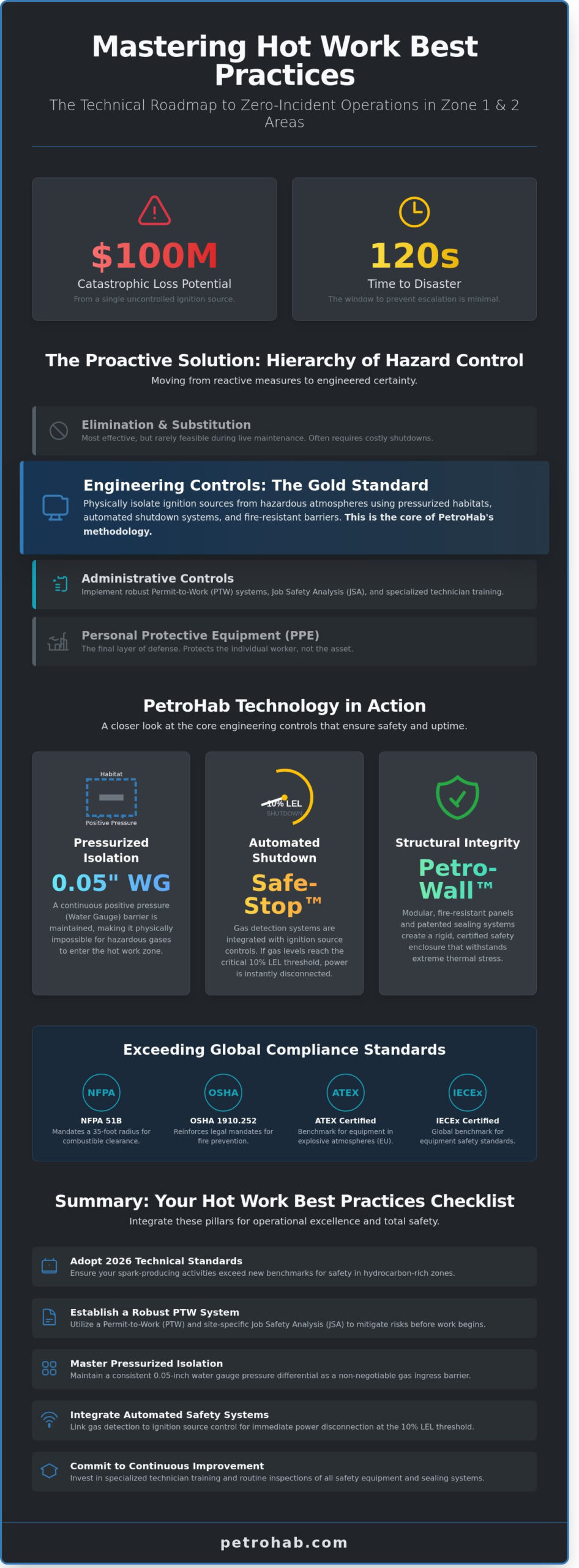
In high-hazard energy environments, a single uncontrolled ignition source can escalate into a $100 million catastrophe within 120 seconds. You recognize that production downtime is an unacceptable cost, yet the necessity of maintenance often forces a dangerous trade-off between safety and operational continuity. This conflict is unnecessary when engineering controls are applied with technical precision. By implementing industry-leading hot work best practices, you can execute critical repairs without compromising the integrity of your Zone 1 or Zone 2 areas. Master the protocols required to achieve zero-incident operations and full compliance with ATEX and IECEx standards today.
We understand the pressure to maintain 100% uptime while managing the volatile risks inherent in offshore and onshore facilities. This guide provides a definitive technical roadmap for mastering hot work best practices through the use of engineered isolation. You’ll learn how to deploy pressurized habitats and patented ignition source control systems, such as Safe-Stop, to eliminate hazards at the source. We’ll analyze the integration of Petro-Wall technology and rigorous safety enclosures to ensure your maintenance schedule never dictates your risk profile. This overview covers everything from initial gas detection protocols to the final certification of a safe work zone.
Key Takeaways
- Understand the 2026 technical standards for spark-producing activities to ensure your operations exceed traditional safety benchmarks in hydrocarbon-rich zones.
- Establish a robust Permit-to-Work (PTW) system and site-specific Job Safety Analysis to mitigate ignition risks before onsite operations begin.
- Master the application of hot work best practices by utilizing pressurized isolation to maintain a consistent 0.05-inch water gauge gas ingress barrier.
- Integrate automated gas detection with ignition source control to trigger immediate power disconnection at critical 10% LEL threshold limits.
- Ensure operational excellence through specialized technician training and the routine inspection of fire-resistant panels and patented sealing systems.
Defining Hot Work and the Hierarchy of Hazard Control
Hot work refers to any operational process involving open flames, sparks, or heat intensive activities. According to the 2026 industrial safety standards, this technical definition encompasses welding, plasma cutting, and abrasive grinding. In the context of oil and gas facilities, the stakes are exceptionally high. Traditional safety measures, such as basic fire blankets or manual watches, often prove insufficient when dealing with pressurized hydrocarbon lines. To understand the foundational risks, safety professionals often ask What is Hot Work? and how its specific hazards interact with flammable atmospheres. A single spark reaching a temperature of 1,200°F can instantly ignite fugitive gas emissions, leading to total asset loss. These incidents aren’t just accidents; they’re failures of containment and isolation.
Implementing hot work best practices requires a disciplined application of the NIOSH Hierarchy of Controls. While elimination and substitution are the most effective methods, they’re rarely feasible during live plant maintenance. This reality makes engineering controls the critical line of defense. PetroHab’s approach prioritizes “engineered isolation” through the use of pressurized hot work safety enclosures. By creating a controlled environment, we move safety from a human-dependent variable to a predictable, mechanical certainty. Our modular Petro-Wall systems provide a rigid, fire-resistant barrier that withstands extreme thermal stress. This methodology ensures that maintenance doesn’t compromise the integrity of the entire facility, maintaining a positive pressure differential that keeps hazardous gases out.
- Elimination: Removing the ignition source entirely by performing work in a designated safe zone, though this often requires costly facility shutdowns.
- Engineering Controls: Utilizing Petro-Wall systems and pressurized habitats to physically isolate the ignition source from the environment.
- Administrative Controls: Implementing strict permitting processes, 24/7 gas monitoring, and rigorous technician training.
- PPE: The final, least effective layer of protection designed to protect the individual worker rather than the asset.
Engineered isolation stands as the gold standard because it addresses the root cause of ignition risk. By controlling the atmosphere at the point of work, operators can continue production without the catastrophic risks associated with uncontained sparks. This proactive stance is what separates industry leaders from those who merely react to emergencies. It’s a calculated investment in the longevity of high-value assets and the safety of the workforce.
The Science of Ignition in Hazardous Atmospheres
The industrial Fire Triangle requires fuel, oxygen, and heat to exist simultaneously. In refineries, fugitive emissions from leaking valves provide a constant fuel source. Safety protocols rely on monitoring the Lower Explosive Limit (LEL). If gas levels reach 10% of the LEL, ignition becomes a mathematical probability. PetroHab’s Safe-Stop systems provide an automated response, shutting down tools before an incident occurs.
Regulatory Frameworks: NFPA 51B, OSHA, and Beyond
Compliance is mandatory. NFPA 51B dictates a 35-foot radius for combustible clearance during spark-producing activity. OSHA 1910.252 reinforces these requirements with legal mandates for fire prevention. Globally, ATEX and IECEx certifications serve as benchmarks for equipment in explosive zones. Failure to meet these standards leads to penalties exceeding $161,000 per incident. Adhering to hot work best practices protects a company’s financial and legal standing.
Pre-Operational Best Practices: The Planning Phase
Effective hot work best practices begin long before a single spark is generated. The planning phase serves as the primary barrier against catastrophic ignition. Engineers must first execute an “Alternatives Assessment” to determine if the task requires heat at all. Cold cutting, mechanical bolting, or hydraulic shearing are often viable substitutes that eliminate the ignition source entirely. If the work can’t be moved to a designated safe zone, the site must be prepared with surgical precision. This preparation relies on a robust Permit-to-Work (PTW) system. This permit isn’t a mere formality; it’s a binding safety contract that dictates the exact parameters of the operation.
Expert oversight is often crucial for developing and managing these complex safety systems. For companies seeking professional guidance on compliance and risk assessment, it’s helpful to learn more about AFN Industrial Services Ltd.
Every PTW must be supported by a site-specific Job Safety Analysis (JSA). This analysis identifies every potential hazard, from volatile organic compounds (VOCs) to structural obstructions. Compliance with OSHA Hot Work Regulations requires that all equipment is inspected and all combustible materials are cleared within a 35-foot (11-meter) radius. In 2024, industrial fire data revealed that 62% of ignition events occurred because flammable debris was left within this critical perimeter. If combustibles can’t be moved, they must be shielded with fire-rated blankets or protected by a pressurized hot work safety enclosure to maintain site integrity.
Hazardous Area Classification and Site Survey
Technicians must map Zone 0, 1, and 2 boundaries before any equipment deployment. Zone 0 areas contain continuous explosive atmospheres where hot work is strictly prohibited without a pressurized habitat. Environmental factors like a 12-knot wind can carry sparks far beyond the standard 35-foot perimeter, necessitating the use of the Petro-Wall system to contain debris. Safety managers use gas detectors to identify “dead air” spaces in drainage systems or low-lying corners where heavy gases like propane or H2S typically accumulate. These pockets represent high-risk zones that require mechanical ventilation before work commences.
The Role of the Fire Watch and Safety Supervisor
The Fire Watch isn’t a passive observer. This individual has the absolute authority to stop operations instantly if they detect a breach in safety protocols. They must maintain a direct, dedicated radio link to the control room at all times. By 2026, industry standards have shifted regarding post-work monitoring. The traditional 30-minute “cool down” period is no longer considered sufficient for high-density insulation or complex piping. Modern protocols now mandate a 60-minute monitoring phase to detect smoldering fires that often remain dormant. This rigorous oversight ensures that the thermal integrity of the site is fully restored before the area is left unattended.
Rigorous planning transforms a high-risk activity into a controlled technical procedure. By integrating patented technologies like the Safe-Stop system, operators ensure that ignition sources are automatically isolated the moment a gas leak is detected. This proactive stance is the gold standard in hot work best practices, protecting both high-value assets and human life in the most demanding environments on earth.
Implementing Pressurized Isolation: The HWSE Standard
Positive pressure isolation acts as the primary defense against hydrocarbon ignition. This method creates a controlled environment where internal air pressure exceeds the ambient pressure of the hazardous zone. Adhering to hot work best practices requires maintaining a minimum differential of 0.05 inches of water gauge (w.g.). This specific pressure threshold ensures that even if a seal is compromised, the outward flow of air prevents the ingress of flammable gases. PetroHab systems utilize sensitive manometers to monitor this differential in real-time; triggering automatic shutdowns if pressure drops below 0.02 inches w.g. for more than 5 seconds.
Selecting between modular and fixed enclosures depends on the specific site geometry. Fixed enclosures often lack the flexibility needed for offshore platforms where space is a premium. Modular configurations allow engineers to build around complex obstructions like structural I-beams or manifold piping. The material integrity of these enclosures is non-negotiable. Panels must consist of high-tensile, fire-retardant fabrics that meet the ANSI/FM 4950 standard for welding curtains. These fabrics withstand temperatures exceeding 1,000 degrees Fahrenheit without losing structural form; ensuring the barrier remains intact during heavy grinding or welding operations.
Sealing the perimeter is a critical task. Pipe penetrations and structural beams create leakage points that compromise the pressure seal. Technicians use specialized fire-stop pillows and high-temperature silicone gaskets to close these gaps. A 100% airtight seal isn’t the goal; the objective is a controlled leakage rate that allows the blower system to maintain the required 0.05 inches w.g. without overworking the motor. Proper sealing techniques reduce the load on the air compressor by 20%, extending the operational life of the equipment during long-term maintenance projects.
The PetroHab Quadra-Lock Advantage
Structural integrity depends on how panels join together. The patented Quadra-Lock technology utilizes interlocking edges that create a physical barrier against gas migration. This system reduces the leakage rate by 35% compared to traditional zipper-bound or Velcro-sealed habitats. In tight offshore quarters, this modularity allows for rapid assembly in under 4 hours by a two-man crew. It provides a consistent safe zone that safety managers can trust. The interlocking mechanism ensures that the habitat remains rigid even when subjected to high external wind speeds of up to 60 knots, which is common in North Sea operations.
Ventilation and Air Quality Management
Safe air quality inside the habitat is vital for technician performance. Standard hot work best practices dictate a minimum of 20 air changes per hour. For a standard 10x10x10 foot habitat, this requires a blower capable of moving 2,000 cubic feet of air per minute. Air intakes must be positioned in designated Safe Zones at least 50 feet away from potential gas sources. This clean air supply effectively manages welding fumes and mitigates heat stress, which is a leading cause of worker fatigue in enclosed spaces. Continuous gas detection at the intake ensures that if the supply air is contaminated, the system initiates an immediate Safe-Stop sequence to protect the personnel inside.
Automated Monitoring and Shutdown Protocols
Automation eliminates human error in high-stakes environments. Manual monitoring alone can’t guarantee the millisecond response times required to prevent a catastrophic event. Integrating gas detection with ignition source control ensures that the moment a sensor detects a flammable atmosphere, all power to welding equipment ceases. Industry standards dictate that automatic power disconnection must occur at a maximum of 10% of the Lower Explosive Limit (LEL). This threshold provides a critical safety margin. It stops the ignition source before the gas reaches a concentration capable of combustion. It’s a non-negotiable standard for maintaining site integrity.
Continuous pressure monitoring acts as the primary defense within a pressurized habitat. Digital manometers measure the differential pressure between the internal environment and the external atmosphere with extreme precision. A drop below 0.05 inches of water column, or approximately 12.45 Pascals, triggers an immediate alert. Maintaining this positive pressure ensures that fugitive hydrocarbon gases can’t penetrate the work zone. While automated systems provide the primary layer of protection, manual shutdown capabilities remain a necessary secondary backup. This redundancy ensures that operators can intervene if mechanical failures occur or if they observe environmental risks the sensors haven’t yet registered. Adhering to these hot work best practices transforms a hazardous task into a controlled, predictable operation.
The Safe-Stop and Safe-Zone Ecosystem
The Safe-Stop system functions as the central nervous system of the hot work safety enclosure. It executes an immediate shutdown of all welding machines and electrical tools the moment a safety parameter is breached. If gas is detected or pressure is lost, the system activates high-intensity visual strobes and 100-decibel audible alarms. These systems interface directly with facility-wide Emergency Shutdown (ESD) protocols. This integration ensures that a local event inside the habitat communicates its status to the entire platform or refinery control room instantly. It’s about total site awareness.
Sensor Calibration and Field Testing
Reliability depends on rigorous maintenance. Operators must perform a “bump test” on gas detectors before every 12-hour shift. This test verifies that sensors respond correctly to a known concentration of test gas. All electronic monitoring components must carry ATEX or IECEx certification to ensure they’re intrinsically safe for use in Zone 1 or Zone 2 areas. Safety managers must document every test in a digital audit trail. This level of meticulousness is a core component of hot work best practices. It provides verifiable proof of compliance during ISO 9001 or regulatory safety audits. We don’t leave safety to chance.
PetroHab’s commitment to engineering excellence ensures that every component of our monitoring system meets these rigorous standards. To secure your facility with the industry’s most reliable ignition source control technology, explore our Safe-Stop and Safe-Zone systems today.
Operational Excellence: Training and Maintenance
Operational excellence in hazardous environments requires more than high-quality equipment. It demands a rigorous synergy between human expertise and mechanical integrity. Within the framework of hot work best practices, the final phase of risk mitigation focuses on the lifecycle of the Hot Work Safety Enclosure (HWSE). This involves structured training, meticulous component maintenance, and the analytical review of system data logs to ensure the habitat remains a reliable barrier against ignition.
Training for Competence, Not Just Compliance
PetroHab-certified training programs move beyond basic safety orientations. Technicians undergo a 24-hour curriculum that includes the theoretical physics of overpressure and practical habitat assembly. Trainees must demonstrate a 100% success rate in sealing complex pipe penetrations using the patented Quadra-Lock system before they receive offshore clearance. Simulation drills replicate the high-pressure conditions of a Category 1 platform, forcing technicians to manage Safe-Stop triggers in low-visibility environments. This ensures that when a technician arrives at a job site, their reactions are instinctive and precise. We don’t settle for theoretical knowledge; we demand demonstrated mastery of ignition source control.
Beyond technical skills, ensuring the physical and medical fitness of personnel is another critical component of operational readiness. Specialist providers like Persona Health offer occupational health assessments to verify that technicians are prepared for the demanding conditions of high-hazard environments.
Maintenance and Storage of HWSE Components
The integrity of fire-resistant panels depends on strict maintenance protocols. Technicians clean silicone-coated fiberglass fabrics using pH-neutral solutions to prevent chemical degradation that could compromise reflectivity. Inspection teams look for “end of life” indicators, such as a 20% reduction in material flexibility or visible fraying of the Quadra-Lock seals. In maritime environments where humidity levels exceed 85%, storage is a critical variable. Components are kept in climate-controlled, airtight containers to prevent fungal growth and salt crystallization on the modular panels. This preservation strategy extends the operational lifespan of the habitat by 30% compared to standard industrial storage methods. Regular maintenance isn’t a suggestion; it’s a technical requirement for safety.
- Daily Inspection: Verify the seal integrity of all Quadra-Lock joints and the tension of the Petro-Wall panels.
- Cleaning: Remove all slag, grease, and metallic dust after every shift to maintain the fabric’s fire-retardant properties.
- Air Ducting: Check for punctures or kinks in the flexible ducting that could impede the 50 Pascal pressure differential.
Response and Analysis
When the Safe-Stop system detects a loss of pressure or gas ingress, it terminates power to the ignition source in less than 0.4 seconds. Emergency response drills focus on this immediate window. Personnel don’t just evacuate; they execute a sequenced shutdown that protects the asset and the crew. Adhering to hot work best practices means the work doesn’t end when the welding stops. Post-project, safety managers review the digital logs stored within the Safe-Stop control unit. These logs provide a millisecond-accurate account of pressure fluctuations and gas levels throughout the project duration. By analyzing these data points, engineers identify recurring atmospheric patterns, allowing for the refinement of safety protocols in future deployments. This data-driven approach transforms every project into a benchmark for future operational success.
Securing Future Operations Through Technical Rigor
Maintaining safety in high-pressure environments demands more than just caution; it requires a disciplined application of hot work best practices. Success relies on the integration of pressurized isolation and real-time gas detection. By utilizing our patented Quadra-Lock technology, operators achieve a 100% interlocking seal that prevents hazardous gas ingress during critical maintenance. This physical barrier works in tandem with ATEX and IECEx certified monitoring systems to provide 24/7 automated protection. We’ve designed these solutions to meet the uncompromising standards of the oil and gas industry. With expert technical support spanning from Houston to Dundee, we ensure your site remains compliant and your personnel stay safe. Every weld and every spark must be managed with absolute precision to avoid catastrophic failure. It’s time to replace uncertainty with engineered certainty. Secure your facility with PetroHab’s gold-standard Hot Work Safety Enclosures. Your commitment to safety ensures a productive and secure future for every member of your team.
Frequently Asked Questions
What are the most common causes of hot work accidents in refineries?
The primary causes of hot work accidents in refineries include the ignition of flammable vapors and the failure to properly isolate hazardous energy. According to the U.S. Chemical Safety Board (CSB), 60 fatalities occurred due to hot work explosions between 1990 and 2010. These incidents often stem from poor gas monitoring or inadequate containment of sparks. In 2010 alone, the CSB identified 11 separate hot work accidents that resulted in multiple deaths.
Can hot work be performed in a Zone 1 hazardous area?
Hot work can be performed in a Zone 1 hazardous area provided a pressurized welding habitat is utilized to isolate the ignition source. Implementing these hot work best practices ensures that the internal atmosphere remains below 10% of the Lower Explosive Limit (LEL). Operators must maintain a positive pressure differential of at least 0.1 inches of water column (25 Pa). This prevents the ingress of external hydrocarbon gases during critical maintenance tasks.
How does a pressurized welding habitat work?
A pressurized welding habitat functions by maintaining a higher internal air pressure than the surrounding atmosphere. This overpressure creates a physical barrier that prevents flammable gases from entering the enclosure. Our systems use redundant blowers to circulate fresh air at a rate of 2,000 cubic feet per minute. Even if a seal is compromised, the positive pressure forces air outward, neutralizing the risk of internal ignition within the habitat.
What is the 35-foot rule in hot work safety?
The 35-foot rule, established by NFPA 51B, requires that all combustible materials be removed or protected within a 10.7-meter radius of the hot work site. If combustibles can’t be relocated, they must be shielded with fire-retardant covers. This 35-foot perimeter serves as the minimum distance to prevent stray sparks from igniting secondary fires. A 2016 NFPA report confirms that adherence to this radius reduces the risk of structural fires in industrial facilities.
What certifications should I look for in a hot work safety enclosure?
You should prioritize enclosures that carry ATEX and IECEx certifications for equipment used in explosive atmospheres. PetroHab’s systems adhere to ISO 9001:2015 quality management standards to ensure engineering integrity. These certifications verify that the modular panels and electronic components meet the rigorous safety requirements defined by international regulatory bodies. They provide a documented trail of compliance for safety managers who must account for every risk factor on a job site.
How often should gas detection sensors be calibrated during a project?
Gas detection sensors require a bump test at the start of every 12-hour shift to verify sensor responsiveness and alarm functionality. Full calibration should occur every 30 days or following a failed bump test according to manufacturer specifications. Maintaining these daily verification cycles ensures that the sensors accurately detect methane at 10% LEL. This protocol triggers immediate shutdown sequences to protect personnel and prevent catastrophic equipment damage during high-stakes projects.
What is the difference between an enclosure and a pressurized habitat?
A standard enclosure provides a physical barrier for sparks, while a pressurized habitat uses active air management to prevent gas ingress. Habitats like our Petro-Wall system integrate with gas detection units to automatically cut power to ignition sources if hazardous vapors are detected. This distinction is critical for hot work best practices. Passive enclosures don’t offer the same level of protection against invisible hydrocarbon leaks that often occur in Zone 1 environments.
How does PetroHab’s Safe-Stop system differ from standard gas detectors?
The Safe-Stop system differs from standard detectors by providing an integrated, automatic shutdown of all hot work equipment. While a standard detector only provides an audible alarm, Safe-Stop terminates power to the welding machine within 0.5 seconds of a gas detection event. This proactive technology eliminates human error during emergencies. It ensures the ignition source is neutralized before an explosive concentration can reach the work area, providing an unrivaled layer of protection.