Blog Posts
Hot Work Risk Assessment Matrix: A Technical Guide for Hazardous Environments
A subjective risk assessment is not a safety protocol; it is a liability. In high-stakes industrial environments, a single point of ambiguity in your hot work risk assessment matrix can lead to a catastrophic ignition event that bypasses standard mitigation layers. You recognize that defining severity for a potential explosion often feels like guesswork when different teams provide inconsistent ratings across shifts. Justifying the high cost of engineering controls to management is difficult when the risk data lacks the technical precision required by ISO 31000 standards.
This guide delivers the rigorous framework required to master these matrices and ensure your facility maintains compliance with NFPA 51B and OSHA 1910 regulations. You’ll learn how to replace manual oversight with definitive technological remedies that protect human life and high-value assets. We’ll examine the specific components of a high-integrity matrix and demonstrate how integrating patented systems, such as Safe-Stop and Petro-Wall, effectively lowers residual risk ratings. This methodical approach transforms a theoretical exercise into an active guardian of your operational integrity.
Key Takeaways
- Understand the mandatory requirements for NFPA 51B and OSHA compliance by quantifying the relationship between hazard probability and potential consequence.
- Learn to implement a standardized 5×5 hot work risk assessment matrix to accurately map event frequency against the magnitude of potential loss.
- Identify why engineering controls and pressurized habitats serve as the primary defense mechanism, far exceeding the effectiveness of personal protective equipment.
- Master the transition from initial hazard identification to the calculation of residual risk through a structured, site-specific assessment process.
- Explore how patented Quadra-Lock panel technology and modular enclosures establish the gold standard for operational integrity in hazardous industrial zones.
The Critical Role of the Hot Work Risk Assessment Matrix
The hot work risk assessment matrix is a rigorous technical instrument used to quantify the intersection of hazard probability and the severity of potential consequences. It functions as a visual grid that safety engineers use to assign numerical values to risks, ensuring that no ignition source is introduced without a calculated defense strategy. This standardized approach is mandatory for compliance with NFPA 51B and OSHA 1910.252 regulations. These standards require a documented process to identify fire hazards before work begins. While qualitative field assessments rely on the immediate observations of a fire watch, a formal corporate matrix provides the overarching safety architecture that governs an entire facility. This tool serves as the primary communication bridge between safety engineers and site managers. It translates complex risk data into clear, actionable protocols that protect high-value assets and human lives. Proper hot work safety protocols depend on this matrix to establish the boundaries of operational integrity.
Identifying Hot Work Hazards in Industrial Zones
Effective risk management starts with the precise categorization of threats within hazardous zones. We divide these into three primary vectors:
- Ignition Sources: This includes welding arcs reaching temperatures of 3,000 degrees Celsius, grinding sparks that can travel 35 feet, and open flames.
- Environmental Factors: The presence of volatile hydrocarbons, pressurized gas lines, and oxygen-enriched atmospheres significantly increases the potential for catastrophic combustion.
- Human Factors: Technician fatigue during extended shifts and communication failures in high-noise areas, often exceeding 85 decibels, create vulnerabilities in even the most robust safety plans.
The Goal of Risk Reduction
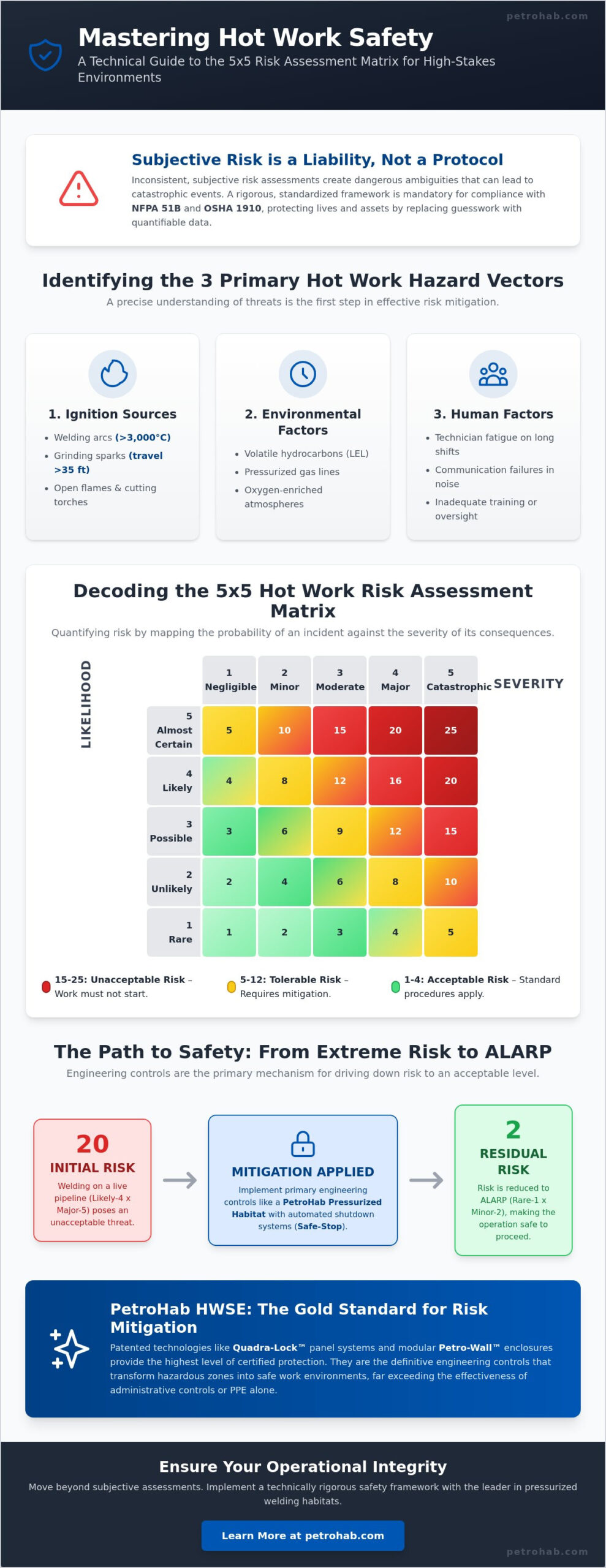
The fundamental objective of utilizing the hot work risk assessment matrix is to drive risk levels toward the ‘As Low As Reasonably Practicable’ (ALARP) principle. Safety managers use the matrix to visualize the transition from ‘Extreme’ initial risk, where the probability of ignition is high, to ‘Low’ residual risk through specific mitigation steps. This process involves deploying engineered solutions like pressurized habitats and automated shutdown systems. In the context of offshore welding safety, ALARP defines the point where the residual risk to personnel and assets is minimized to a level that is technically and economically justifiable. By reaching this state, operators ensure that every precaution has been taken to maintain the integrity of the site.
Decoding the 5×5 Risk Matrix: Likelihood vs. Severity
The hot work risk assessment matrix serves as the technical foundation for every hazardous operation in the oil and gas sector. It utilizes a 5×5 grid to map the mathematical probability of an incident against the magnitude of potential loss. This systematic approach transforms subjective safety concerns into quantifiable data. Safety managers rely on this tool to determine whether a task proceeds or requires immediate engineering controls. The grid functions by assigning a numerical value from 1 to 5 to both axes, creating a total risk score that dictates the necessary level of oversight.
Defining the Likelihood scale requires a disciplined look at frequency. This ranges from ‘Rare’ (Level 1), where an event might occur only in exceptional circumstances, to ‘Almost Certain’ (Level 5), where an incident is expected to occur during most operations. The Severity scale measures the impact of a failure. It begins at ‘Negligible’ (Level 1), involving minor first-aid, and escalates to ‘Catastrophic’ (Level 5), which signifies multiple fatalities or total asset loss. The resulting intersection is color-coded to provide instant visual clarity for the workforce:
- Red (Score 15-25): Unacceptable risk. Work must not start until the hazard is eliminated or significantly reduced through engineering solutions.
- Yellow (Score 5-12): Tolerable risk. Work may proceed only if specific, documented mitigation strategies are active.
- Green (Score 1-4): Acceptable risk. Standard operating procedures and basic PPE are sufficient for the task.
Quantifying Likelihood in Hazardous Locations
Determining probability requires analyzing historical incident reports and real-time sensor data. In Zone 1 environments, where explosive atmospheres occur during normal operations, the frequency rating naturally increases compared to Zone 2. Adherence to OSHA hot work regulations ensures that likelihood is calculated based on standardized safety benchmarks. Gas monitoring frequency is a primary variable here; continuous monitoring reduces the probability of an undetected leak reaching an ignition source. Integrating a pressurized habitat into your workflow provides the definitive technological remedy to lower these scores by isolating the work area from the surrounding atmosphere.
Measuring Severity Across Multiple Loss Types
Severity isn’t limited to a single metric. It encompasses three critical pillars that reflect the high-stakes nature of industrial sites. Personnel safety evaluates the risk of disability or fatality. Asset integrity calculates the cost of equipment destruction and facility downtime; a major offshore fire can result in hundreds of millions of dollars in losses. Finally, environmental impact assesses the risk of leaks or uncontrolled releases that violate ISO 14001 standards. Each pillar must be scored individually, with the highest value typically dictating the final hot work risk assessment matrix entry to ensure maximum protection.
Shifting the Risk Profile: How Engineering Controls Redefine the Matrix
The hierarchy of controls dictates that engineering solutions are superior to administrative actions or personal protective equipment (PPE). While PPE protects the individual worker, it fails to eliminate the hazard itself. Advanced hot work safety systems function as a primary physical barrier between flammable gases and ignition sources. By implementing these systems, safety managers fundamentally alter the hot work risk assessment matrix. Adhering to the NFPA 51B standard ensures fire prevention protocols are integrated into these engineering controls. This shifts the operational focus from reaction to prevention. High-quality habitats are not just safety tools; they are strategic investments in operational uptime. They allow production to continue while maintenance occurs, preventing the high costs of total facility shutdowns.
The Role of Pressurized Welding Habitats
PetroHab’s pressurized welding habitats utilize patented Petro-Wall panels to isolate welding activities from the surrounding atmosphere. These enclosures maintain positive pressure through continuous air intake from a non-hazardous source. This pressure gradient prevents the ingress of hydrocarbons or flammable vapors into the work area. By physically isolating the ignition source, the habitat changes a risk that would otherwise be classified as ‘Extreme’ to a ‘Low’ risk on the matrix. This technological intervention allows hot work to proceed without shutting down neighboring production lines. It provides a controlled environment where technicians work with confidence and precision.
Ignition Source Control and Automatic Shutdown
Automatic shutdown systems redefine the ‘Severity’ and ‘Likelihood’ ratings of gas-related incidents. PetroHab’s Safe-Stop systems integrate gas detection with the immediate termination of the welding power supply. If the system detects a gas concentration exceeding 10% of the Lower Explosive Limit (LEL), it cuts power to the welding machine instantly. This technology eliminates the ‘Almost Certain’ likelihood of ignition in gassy environments. Using ATEX and IECEx certified components ensures the safety equipment itself doesn’t become an ignition source. These systems act as active guardians of the job site through a structured protocol:
- Gas detection sensors monitor the surrounding atmosphere 24/7 for hydrocarbon leaks.
- Logic controllers analyze real-time data from multiple sensor locations.
- Safe-Stop technology terminates power to all ignition sources within milliseconds of a detected hazard.
- Visual and audible alarms provide immediate notification to all personnel in the vicinity.
The integration of these systems ensures that the hot work risk assessment matrix reflects a manageable and controlled operational environment. Compliance with international standards is the foundation of every high-risk assessment PetroHab supports. We prioritize the protection of high-value assets and human life through rigorous engineering and uncompromising safety standards.
Implementing the Assessment: From Hazard Identification to Residual Risk
Executing a hot work risk assessment matrix requires a disciplined, four-stage technical workflow. This process ensures that every potential ignition source is matched with a definitive engineering solution. Operators shouldn’t view this as a bureaucratic exercise, but as a critical engineering protocol for asset protection. The objective is to move from a state of identified hazard to a state of controlled, manageable risk.
- Step 1: Site Walk-through. Identify all combustible materials and potential gas sources within a 15-meter radius, as specified by NFPA 51B standards. This includes checking for hydrocarbon traces in drainage systems or nearby process vents that could release vapors during the operation.
- Step 2: Initial Risk Rating. Assign a probability and severity score based on the environment with no controls in place. This “naked risk” establishes the baseline for the entire operation and highlights the catastrophic potential of unmitigated hot work.
- Step 3: Mitigation Selection. Apply the hierarchy of controls. Engineering solutions, such as PetroHab’s patented Petro-Wall, take priority over administrative procedures or personal protective equipment.
- Step 4: Residual Risk Calculation. Determine the risk level once controls are active. The final score must reach a level that’s As Low As Reasonably Practicable (ALARP) before any permit is authorized.
Integration with the Permit-to-Work (PTW) System
The matrix functions as the technical core of the Permit-to-Work (PTW) system. It’s mandatory to attach the completed hot work risk assessment matrix to every permit to provide field supervisors with an immediate visual reference of the safety landscape. The Fire Watch uses these identified controls as a daily checklist for continuous monitoring. Before any spark is generated, the team must verify habitat integrity. This involves testing the Safe-Stop system to ensure it can automatically isolate ignition sources if gas is detected or if internal pressure drops below 50 Pascals.
Common Pitfalls in Risk Matrix Application
Precision often fails when teams underestimate the severity of gas releases in confined spaces. A minor leak can reach the Lower Explosive Limit (LEL) in less than 60 seconds. Another frequent error is the over-reliance on PPE when engineering controls, like pressurized habitats, are technically feasible. Industry data indicates that 70% of hot work incidents could be avoided by prioritizing engineering over administrative controls. Finally, static assessments are dangerous. If site conditions change, such as a 10 mph increase in wind speed or the start of a nearby venting operation, the matrix must be re-evaluated immediately to ensure the safety of the personnel and the facility.
PetroHab HWSE: The Gold Standard for Risk Mitigation
PetroHab’s Hot Work Safety Enclosures (HWSE) represent the ultimate engineering control within a technical hot work risk assessment matrix. These modular systems provide a pressurized barrier that isolates potential ignition sources from the surrounding hazardous atmosphere. By creating a controlled environment, PetroHab allows for welding, grinding, and cutting in areas where such activities would otherwise be prohibited due to the presence of flammable gases.
The technical superiority of the system lies in the patented Quadra-Lock panels. These panels create a seamless, flame-retardant seal that maintains habitat integrity even under extreme conditions. Unlike traditional welding blankets or makeshift barriers, the Quadra-Lock system is engineered to withstand high-pressure differentials. This ensures that the internal environment remains isolated from external volatile gases, maintaining a consistent level of protection throughout the duration of the project.
Our Safe-Stop technology serves as the final line of defense in ignition source management. It monitors internal pressure and gas concentration levels in real-time. If the system detects gas at 10% of the Lower Explosive Limit (LEL), or if habitat pressure falls below 50 pascals, it immediately terminates power to all hot work equipment. This automated response eliminates human error; it provides a level of reliability that manual monitoring cannot match. PetroHab systems meet the rigid requirements of ATEX, IECEx, and ISO 9001:2015, giving safety managers the empirical data needed to justify high-risk operations.
Why Leading Operators Trust PetroHab
Operators across five continents choose PetroHab for its proven performance on offshore platforms and in downstream refineries. We don’t just ship equipment; we provide expert on-site supervision and rigorous training. This ensures that every enclosure setup is fully compliant with your specific hot work risk assessment matrix. Our systems are highly customizable. We can wrap around complex pipe geometries or fit within the tight constraints of offshore modules where space is a premium. This flexibility ensures that no corner of a facility is left unprotected during maintenance cycles.
Advancing Your Safety Culture
True safety leadership involves moving beyond basic compliance toward a proactive risk management model. PetroHab serves as a critical partner in this evolution. We provide the engineering tools necessary to conduct high-risk maintenance without compromising site safety. It’s time to elevate your operational standards with technology designed for the most demanding environments on earth. Our team is ready to assist in the planning phases of your next shutdown or turnaround to ensure maximum protection.
Maximizing Site Integrity with Advanced Engineering Controls
Managing hazardous operations requires a disciplined approach to the hot work risk assessment matrix. A 5×5 scoring system provides the technical clarity needed to identify where administrative controls fail and where engineering solutions must take over. By focusing on residual risk reduction, safety managers ensure that ignition sources remain isolated from flammable atmospheres. It’s not just about compliance; it’s about the absolute preservation of life and high-value assets in volatile environments.
PetroHab’s Hot Work Safety Enclosures (HWSE) deliver the technical remedy required for these high-stakes scenarios. These systems feature patented Quadra-Lock technology and maintain full ATEX and IECEx compliance. Global oil and gas majors trust these habitats because they don’t compromise on pressurized integrity or modular flexibility. Integrating these systems into your next turnaround ensures that your team operates within a rigorously controlled environment backed by ISO-certified engineering.
Explore PetroHab’s Hot Work Safety Enclosures for Your Next Project
Take the decisive step toward zero-incident operations by choosing the industry’s most trusted safety partner.
Frequently Asked Questions
What is the primary purpose of a hot work risk assessment matrix?
The primary purpose of a hot work risk assessment matrix is to quantify the intersection of probability and consequence for ignition events in hazardous environments. It serves as a definitive decision-making tool for safety engineers to determine if welding or grinding can proceed safely. By assigning numerical values from 1 to 25 to variables like gas presence, the matrix ensures risk levels remain within ALARP parameters.
How do you calculate the risk rating for welding in a Zone 1 area?
You calculate the risk rating by multiplying the Likelihood score by the Severity score on a standard 5×5 grid. In a Zone 1 area, where flammable gases occur during 10 to 1,000 hours per year, the likelihood is typically rated at a 4 or 5. If a potential ignition results in catastrophic asset loss, the severity is 5. This yields a raw risk score of 20 or 25.
What is the difference between initial risk and residual risk?
Initial risk represents the inherent danger of a task before any safety measures are applied; residual risk is the remaining danger after implementing engineered controls. For example, a task might show an initial risk score of 16 for grinding near a flange. After deploying our Petro-Wall enclosures, the residual risk drops to a 4. This lower value allows work to proceed without compromising the facility’s safety integrity.
Can a pressurized habitat lower the risk rating enough to avoid a facility shutdown?
A pressurized habitat effectively lowers the risk rating by reducing the likelihood of gas ingress to zero. This isolation allows for “hot-on-hot” work, meaning production continues while maintenance occurs. Statistics from offshore platforms show that using an ATEX-certified habitat can reduce the risk score by 75 percent. This reduction often keeps the project within the acceptable low-risk range, bypassing the need for a 24-hour facility shutdown.
How often should a hot work risk assessment be reviewed?
You must review the assessment before the start of every 12-hour shift or whenever environmental conditions shift. If a gas detector triggers or wind direction changes by more than 45 degrees, the original matrix values are no longer valid. Standard industry protocols, including those from the Energy Institute, require a re-validation of the permit to work every 24 hours to ensure all engineered controls remain fully functional.
What are the most common hazards included in a hot work matrix?
The most frequent hazards include the presence of hydrocarbons, oxygen-enriched atmospheres, and combustible metallic dust. The matrix also accounts for secondary risks like UV radiation and toxic fumes. In a typical offshore hot work risk assessment matrix, flammable gas accounts for 60 percent of the likelihood variables. Proper identification ensures that systems like our Safe-Stop automatic shutdown are calibrated to specific hazardous thresholds.
Is a risk assessment matrix required by OSHA for all hot work?
OSHA 1910.252 doesn’t explicitly name a “matrix,” but it mandates a thorough hazard assessment before any hot work begins. Using a matrix is the recognized industry-standard method for complying with these federal safety requirements. It provides the documented evidence of due diligence required by inspectors. Failure to provide a structured risk analysis can result in fines exceeding $15,000 per violation during a safety audit.
How does an automatic shutdown system impact the risk matrix?
An automatic shutdown system like Safe-Stop drastically reduces the severity score by terminating the ignition source within milliseconds of gas detection. It acts as a critical mitigation layer that shifts the residual risk into the manageable range. By integrating LEL sensors that trigger at 10 percent concentration, the system ensures that human error doesn’t lead to a catastrophic event. This technical redundancy is vital for high-stakes environments.