
Blog Posts
LEL Monitoring for Hot Work: 2026 Hazardous Area Guide
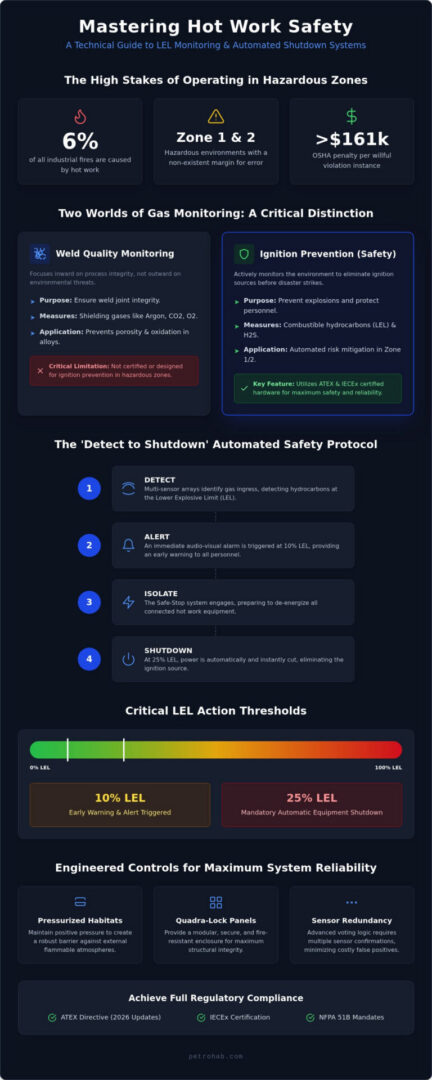
Hot work accounts for approximately 6% of all industrial fires, a statistic that underscores the inherent danger of welding in volatile environments. In a Zone 1 or Zone 2 area, the margin for error is non-existent. You recognize that manual fire watches, while required by NFPA 51B, are often insufficient against the invisible threat of gas ingress. Implementing rigorous LEL monitoring for hot work is no longer optional; it’s a fundamental requirement for protecting high-value assets and personnel from catastrophic ignition events.
This guide provides the technical framework to achieve zero ignition incidents through the seamless integration of gas detection and automatic shutdown technology. You’ll learn how to synchronize the Safe-Stop system with pressurized Hot Work Safety Enclosures to ensure absolute compliance with the January 2026 ATEX directive updates. We’ll detail the precise operational thresholds for equipment de-energization, the role of Quadra-Lock panels in maintaining habitat integrity, and the engineered controls necessary to avoid OSHA willful violation penalties that now surpass $161,000 per instance.
Key Takeaways
- Distinguish between process-quality gas monitoring and safety-critical LEL and H2S detection required for ignition prevention in hazardous zones.
- Implement the “Detect, Alert, Isolate, and Shutdown” logic of the Safe-Stop system to automate power de-energization during gas ingress.
- Ensure full compliance with the 2026 ATEX directive updates and NFPA 51B mandates by utilizing certified automatic shutdown systems.
- Master the integration of LEL monitoring for hot work within pressurized habitats to maintain enclosure integrity against external flammable atmospheres.
- Deploy engineered controls like Quadra-Lock panels to create a modular, secure environment where gas detection systems operate with maximum reliability.
Defining LEL Monitoring for Welding: Quality vs. Safety
Industrial safety managers often mistake process-focused gas analyzers for environmental safety systems. While both tools measure gas concentrations, their engineering objectives are fundamentally different. Refineries and offshore platforms operate in high-risk environments where a single spark can lead to disaster. Relying on equipment designed for weld metallurgy rather than ignition prevention creates a critical safety gap that standard administrative controls cannot bridge. Effective LEL monitoring for hot work requires sensors that look outward at the atmosphere, not just inward at the weld pool.
A welding safety gas detection system is a multi-sensor array designed to isolate ignition sources upon gas ingress.
To better understand the fundamentals of gas detection hardware used in these environments, watch this technical overview:
Shielding Gas Analyzers: Ensuring Weld Quality
Shielding gas monitors focus on the integrity of the arc and the resulting joint. These devices measure Argon, CO2, and Oxygen levels to prevent porosity and oxidation, especially when working with specialized alloys like duplex stainless steel or titanium. Their primary role is quality assurance. These sensors are rarely built to withstand the explosive atmospheres of a Zone 1 area. They don’t have the response times or the ruggedized certifications required to detect a sudden hydrocarbon leak. Using them as a primary safety tool in a hazardous environment is a dangerous misapplication of technology.
Safety-Critical Detection: Preventing Ignition
Safety-critical systems prioritize the detection of combustible hydrocarbons and toxic gases like Hydrogen Sulfide (H2S). The core metric here is the Lower Explosive Limit (LEL), which represents the minimum concentration of a gas in air that can ignite. Professional LEL monitoring for hot work utilizes ATEX and IECEx certified hardware to ensure the detection equipment itself doesn’t become an ignition source. These monitors are engineered to trigger at 10% LEL to provide an early warning, followed by a mandatory equipment shutdown at 25% LEL.
Modern safety protocols integrate these sensors directly into broader hot work safety systems. This integration ensures that if gas is detected, the power to the welding machine is cut instantly. This automated response eliminates the delay inherent in manual fire watches and provides a definitive technological remedy to the risk of explosion. Unlike quality analyzers, these systems are built for environmental containment and active risk mitigation.
The Mechanism of Automatic Shutdown Systems in LEL Monitoring
Detection alone is insufficient in high-hazard environments. For LEL monitoring for hot work to be effective, it must function as a trigger within an automated safety ecosystem. The Safe-Stop Automatic Shutdown System acts as the operational brain, bridging the gap between gas detection hardware and power isolation units. When sensors identify a threat, the system executes a calculated sequence to de-energize equipment before flammable concentrations reach an ignition point. This technological remedy replaces the inherent delays of manual intervention with precise, millisecond response times.
Reliability in Zone 1 and Zone 2 environments depends on sensor redundancy and advanced voting logic. By requiring multiple sensors to confirm a gas presence, the system minimizes the risk of costly downtime caused by false positives. This logic ensures that safety remains the priority without compromising operational efficiency. Properly configured LEL monitoring for hot work utilizes these engineered controls to maintain a stoic defense against environmental hazards. Regular calibration against known gas concentrations ensures the hardware remains sensitive to hydrocarbons while ignoring non-hazardous atmospheric fluctuations.
Sensor Placement Strategies for Hot Work
Strategic sensor positioning is the foundation of effective containment. When utilizing a pressurized welding habitat, technicians must place sensors directly at the air intakes. This prevents the ventilation fans from drawing flammable vapors into the enclosure. Additional detectors are positioned near potential leak sources such as flanges, valves, or seal points. This configuration ensures 360-degree coverage, creating a protective envelope that monitors both the internal workspace and the external environment.
The Shutdown Sequence: From Detection to Isolation
To meet the rigorous safety standards of NFPA 51B, the shutdown sequence must be immediate and absolute. The Safe-Stop system follows a logical four-step architecture to ensure personnel and asset protection:
- Step 1: Detection. Sensors identify gas concentrations exceeding the pre-set safety threshold of 10% LEL.
- Step 2: Alert. The system activates high-decibel audible sirens and high-intensity visual strobes to warn the welding team.
- Step 3: Isolation. The power isolation unit instantly cuts electricity to welding machines, grinders, and any other potential ignition sources.
- Step 4: Containment. Air intake dampers close automatically, sealing the habitat and preventing gas ingress into the pressurized zone.
Safety managers looking to eliminate human error from their ignition prevention protocols can examine the technical integration of the Safe-Stop system to understand how it interfaces with existing site infrastructure.
Regulatory Compliance: ATEX, IECEx, and NFPA 51B
Regulatory compliance in hazardous areas represents the boundary between operational excellence and catastrophic failure. For safety managers, understanding the legal mandate for certified gas detection is the first step in mitigating ignition risks. Standard industrial sensors often lack the robust engineering required for refineries or offshore platforms. ATEX Zone 1 certification is mandatory for equipment used in areas where explosive gases are likely to occur. Equipment lacking this designation can fail under stress, potentially becoming an ignition source itself.
The distinction between general-purpose and explosion-proof hardware is critical for LEL monitoring for hot work. Explosion-proof systems are housed in enclosures designed to contain an internal explosion and prevent it from igniting the surrounding atmosphere. This level of technical precision ensures that the safety system remains an active guardian rather than a liability during a gas ingress event. Adhering to these engineering requirements is a prerequisite for any hot work permit in a classified zone.
ATEX vs. IECEx: Global Standards for Gas Safety
Navigating the landscape of hazardous environment standards requires a granular understanding of regional requirements. While ATEX is the directive for the European Economic Area, the IECEx system provides a global framework for conformity. In the North Sea, the January 2026 update to the ATEX 2014/34/EU Guidelines has clarified digital documentation requirements, making it easier for safety engineers to verify compliance. These certifications don’t just ensure safety; they dictate the terms of equipment leasing and corporate insurance premiums.
OSHA and NFPA Requirements for Gas Monitoring
OSHA standards, specifically 29 CFR 1910.252, integrate the rigorous fire prevention protocols of NFPA 51B. These regulations mandate continuous LEL monitoring for hot work whenever flammable vapors are potentially present. A fire watch is required for at least 60 minutes after work is completed in high-risk zones. Automated systems like the Safe-Stop system don’t replace the fire watch but enhance it by providing real-time data logging for Permit-to-Work (PTW) compliance. Accurate documentation of gas levels at the 10% LEL threshold is essential to avoid OSHA willful violation penalties, which in 2026 can exceed $161,000 per instance.
Integrating LEL Monitoring with Pressurized Habitats
The efficacy of a hot work safety enclosure depends on the synergy between physical containment and real-time atmospheric analysis. Pressurization alone cannot guarantee safety if the source air is contaminated. Therefore, LEL monitoring for hot work must be integrated into the habitat’s ventilation logic. This dual-layered defense ensures that the internal environment remains over-pressured relative to the external atmosphere while simultaneously verifying that the air being pumped into the enclosure is free of hydrocarbons.
Technicians must monitor two distinct zones. External sensors at the air intake prevent the ingress of flammable vapors, while internal sensors detect any potential leaks from the work site itself. This configuration is vital when welding on live pipelines or near high-pressure valves. Managing air exchange rates is equally critical. The system must provide enough fresh air to prevent the buildup of toxic welding fumes without compromising the pressure differential. This balance is maintained through the Safe-Stop system, which acts as the central control unit for both pressure regulation and gas detection.
Positive Pressure and Gas Ingress Prevention
Maintaining a minimum internal pressure of 25 Pascals (0.1 inches of water column) above the external atmosphere is a technical requirement for gas exclusion. Manometers provide a continuous visual and digital verification of this pressure differential. If the pressure drops below this threshold, the gas detection system serves as the primary fail-safe. It immediately identifies if the loss of pressure has allowed external gases to enter the workspace. Strategic intake ducting location is paramount; the air supply must be drawn from a verified clean zone, often high above the deck or upwind from potential leak sources.
Modular Containment with Quadra-Lock Technology
The structural integrity of the enclosure determines the reliability of the safety environment. Quadra-Lock technology utilizes a modular panel system that creates a superior gas-tight seal compared to traditional zip-up or velcro habitats. These panels provide the rigid architecture necessary for mounting gas sensors securely and consistently. A habitat that leaks air is a habitat that invites gas ingress. By ensuring a robust structural seal, Quadra-Lock technology allows the LEL monitoring for hot work to operate with higher precision and fewer false positives.
Safety engineers can request a technical consultation on Quadra-Lock integration to ensure their next project meets these rigorous containment standards. This engineered approach transforms the habitat from a simple spark-containment box into a sophisticated, automated safety chamber.
PetroHab’s Safe-Stop: The Industry Benchmark for Welding Safety
PetroHab has established the Safe-Stop Automatic Shutdown System as the definitive technological remedy for ignition risks in heavy industry. While standard area monitors provide environmental visibility, they often lack the active control required to eliminate the human factor. Safe-Stop integrates LEL monitoring for hot work directly into the welding power supply. This integration ensures that detection lead to immediate de-energization without the delays inherent in manual intervention. It acts as the operational brain, ensuring that every safety component within the hazardous zone responds with calculated precision.
The system’s technical capabilities extend beyond simple gas detection. It functions as an integrated safety hub that manages air intake dampers, high-decibel audible alarms, and high-intensity visual strobes simultaneously. By positioning the Safe-Stop system as the central logic unit, safety managers can synchronize environmental containment with power isolation. This automated architecture is a critical requirement for maintaining zero ignition incidents in Zone 1 and Zone 2 environments. It transforms safety protocols from passive observation into active, engineered protection.
Uncompromising Reliability in Extreme Conditions
PetroHab sensors are engineered to maintain technical precision in the most rigorous industrial settings. From high-humidity offshore platforms in the North Sea to high-temperature refinery environments, the hardware delivers consistent performance where standard equipment fails. Successful deployments on live offshore assets demonstrate the system’s ability to protect personnel and high-value assets during critical maintenance phases. This reliability allows LEL monitoring for hot work to be conducted with absolute confidence, reducing the potential for costly downtime caused by false positives or sensor drift.
Procuring the Right System for Your Project
Selecting the appropriate safety infrastructure is a vital step in project procurement. PetroHab offers flexible rental and sales options to accommodate various project durations and site requirements. For short-term maintenance shutdowns, rental systems provide immediate access to the latest Quadra-Lock technology and Safe-Stop logic. Direct purchase is often the preferred strategy for permanent site safety upgrades where long-term risk mitigation is the priority. PetroHab supports both options with global on-site supervision and certified technician training to ensure operational excellence.
Choosing the right hot work safety enclosure suppliers involves evaluating more than just hardware; it requires a partner committed to safety excellence and regulatory compliance. PetroHab’s seasoned experts understand the granular details of industrial hazards better than anyone else. They act as trusted advisors, ensuring that your safety systems are as durable and resilient as the equipment they protect. Contact PetroHab for a specialized gas detection and habitat consultation to secure your facility against the invisible threats of hazardous area welding.
Achieving Operational Excellence in Hazardous Zones
The integration of automated detection and physical containment represents the highest standard of industrial safety. Effective LEL monitoring for hot work isn’t just about identifying threats; it’s about the immediate, engineered response that follows. By utilizing the Safe-Stop Automatic Shutdown System, safety managers eliminate the risks associated with human error and manual intervention. This system serves as the critical link between environmental monitoring and equipment isolation, ensuring that hot work proceeds only under verified safe conditions.
Maintaining site integrity requires a commitment to rigorous technical standards and proven technology. PetroHab provides the necessary tools to achieve 100% compliance through ATEX/IECEx certified systems and patented Quadra-Lock technology. These modular solutions create a secure, pressurized environment where ignition risks are neutralized at the source. With global 24/7 technical support, your facility maintains a stoic defense against atmospheric hazards regardless of project complexity. It’s time to transition from passive observation to active, automated protection.
Take the next step in protecting your personnel and high-value assets. Request a Quote for an Integrated Safe-Stop and HWSE System to ensure your operations meet the safety benchmarks of 2026.
Frequently Asked Questions
What is the difference between an LEL sensor and a welding gas analyzer?
LEL sensors are safety-critical devices engineered to detect combustible hydrocarbon concentrations in the surrounding atmosphere to prevent ignition. In contrast, welding gas analyzers are process-quality tools that monitor shielding gas purity, such as Argon or CO2 levels, within the weld pool. While analyzers ensure metallurgical integrity, only certified LEL sensors provide the environmental containment data necessary for hazardous area safety.
Can I weld in a Zone 1 area without a pressurized habitat if I have LEL monitoring?
Negative. LEL monitoring for hot work serves as a detection and trigger mechanism, but it doesn’t provide physical gas exclusion. In a Zone 1 environment, where explosive gases are likely to occur, a pressurized habitat is technically required to isolate the ignition source from the hazardous atmosphere. Monitoring identifies the threat, while the habitat provides the engineered barrier necessary for safe operation.
How often do gas detection sensors for welding need to be calibrated?
Technicians must perform a functional “bump test” before every work shift to verify sensor response and alarm activation. A full technical calibration is typically required every 90 days, though high-humidity or contaminated environments may necessitate more frequent intervals. Maintaining a rigorous calibration schedule ensures the hardware maintains the technical precision required to trigger the Safe-Stop system at exactly 10% LEL.
What happens if the LEL monitoring system loses power during welding?
The Safe-Stop system utilizes a fail-safe architecture that automatically isolates all welding power if the monitoring unit loses electrical supply. This logic ensures that no hot work can proceed without active gas surveillance. When power is interrupted, the system de-energizes the equipment immediately, maintaining a stoic defense against potential ignition during an unmonitored period.
Is an automatic shutdown system required by OSHA for hot work?
OSHA 29 CFR 1910.252 mandates the immediate cessation of hot work if flammable gas concentrations reach 10% LEL. While the regulation allows for administrative controls, industry benchmarks favor automated shutdown systems to eliminate human error. Implementing an integrated shutdown system provides a definitive technological remedy that ensures compliance with OSHA’s mandatory LEL monitoring for hot work thresholds and prevents willful violation penalties.
How does PetroHab’s Safe-Stop system handle multiple gas sensors?
The Safe-Stop system utilizes advanced voting logic to process data from multiple sensor locations simultaneously. It typically monitors the habitat’s air intake, the internal workspace, and the external environment near potential leak sources. If any single sensor identifies a concentration exceeding the safety threshold, the system initiates the alert and isolation sequence to protect the site and personnel.
Can gas detection systems for welding detect toxic gases like H2S?
Yes. Industrial-grade monitoring systems are frequently configured with multi-gas sensor arrays to detect Hydrogen Sulfide (H2S), Carbon Monoxide, and Oxygen deficiency alongside combustible hydrocarbons. This comprehensive surveillance is critical in refinery and offshore environments where toxic gas ingress poses an immediate threat to life. The Safe-Stop system integrates these toxic gas readings into its primary alarm and shutdown logic.
What is the response time for an industrial-grade LEL monitoring system?
Industrial sensors typically achieve a T90 response time within 15 to 30 seconds of gas exposure. Once the sensor identifies a breach of the 10% LEL threshold, the electronic isolation of the welding power source occurs in milliseconds. This rapid response provides a critical safety margin, ensuring that all ignition sources are de-energized long before gas concentrations reach the Lower Explosive Limit.