Blog Posts
Offshore Hot Work Permit: Requirements and Safety Protocols for 2026
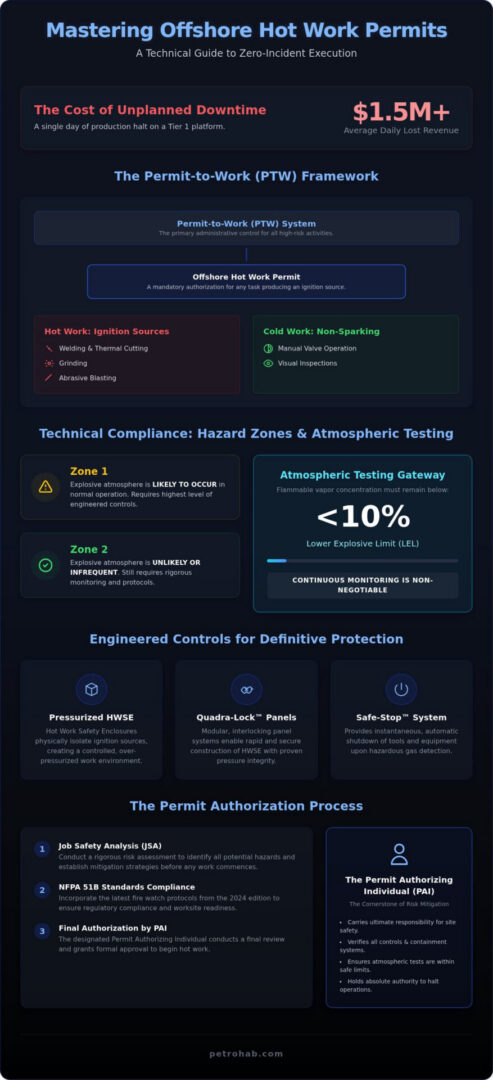
A single day of unplanned production downtime on a Tier 1 offshore platform costs an average of over $1.5 million in lost revenue. For safety managers and engineers, this figure represents more than a financial burden; it reflects the extreme difficulty of balancing operational continuity with the rigorous demands of an offshore hot work permit. You know that in hydrocarbon-rich environments, the margin for error is non-existent. A single spark in a hazardous area doesn’t just threaten your budget; it risks catastrophic loss of life and high-value assets.
This technical guide ensures you master the complexities of permit requirements for 2026, helping you maintain absolute regulatory compliance while eliminating ignition risks. We’ll examine the 2024 edition of NFPA 51B, the transition to digital documentation, and the critical role of atmospheric testing. You’ll learn how engineered controls, such as the Safe-Stop Automatic Shutdown System and modular Quadra-Lock panels, provide a definitive remedy for the physical limitations of live platforms. We’ll outline a methodical approach to achieving zero-incident execution and protecting your personnel through uncompromising safety protocols and specialized environmental containment.
Key Takeaways
- Understand how an offshore hot work permit integrates into the broader Permit-to-Work (PTW) framework to mitigate ignition risks in hydrocarbon-rich environments.
- Navigate the latest 2026 technical requirements for ATEX and IECEx Zone 1 and Zone 2 classifications, including mandatory atmospheric testing thresholds.
- Learn to implement engineered controls like pressurized Hot Work Safety Enclosures (HWSE) featuring Quadra-Lock panels to isolate ignition sources where physical clearance is restricted.
- Master the operational checklist for permit authorization, incorporating 2024 NFPA 51B fire watch standards and rigorous Job Safety Analysis (JSA) protocols.
- Enhance site reliability by integrating the Safe-Stop Automatic Shutdown System to provide instantaneous protection and tool isolation during hazardous gas detection.
The Fundamentals of Offshore Hot Work Permit Requirements
The Permit-to-Work (PTW) system acts as the primary administrative control for high-risk activities on offshore installations. Within this structured framework, the offshore hot work permit serves as the critical authorization required for any task capable of producing a source of ignition. While cold work involves non-sparking activities like manual valve operation or visual inspections, hot work introduces immediate fire risks into hydrocarbon-rich environments. The distinction is absolute; if a task generates heat, sparks, or flames, it requires the rigorous oversight of Hot Work Safety Protocols.
Offshore platforms face greater risks than onshore facilities. Space is limited, and escape routes are restricted. The proximity of production equipment to maintenance areas is often minimal. Consequently, regulatory bodies like the Bureau of Safety and Environmental Enforcement (BSEE), OSHA, and the International Maritime Organization (IMO) enforce stringent standards. These agencies mandate that operators implement engineered solutions to prevent the migration of flammable vapors to ignition sources. Compliance isn’t optional; it’s the foundation of asset integrity.
Defining Hot Work in Maritime and Offshore Contexts
Hot work includes welding, thermal cutting, grinding, and abrasive blasting. These activities are strictly prohibited in classified hazardous areas unless specific mitigation measures are active. An offshore hot work permit is a mandatory safety contract between the operator and the facility. It ensures that every stakeholder understands the risks and the technological remedies required to protect the asset. Operators must identify these hazardous areas through gas mapping and classification before any tool is energized. Failure to isolate these zones leads to catastrophic events.
The Role of the Permit Authorizing Individual (PAI)
The Permit Authorizing Individual (PAI) carries the ultimate responsibility for site safety during maintenance. This role requires technical competency in environmental containment and ignition prevention. A PAI must verify that all combustible materials are removed or shielded. They ensure atmospheric testing remains within safe limits and that modular containment systems, such as those using Quadra-Lock panels, are correctly installed. Their authority is absolute; they’ll halt operations immediately if environmental conditions shift or if pressure integrity in a habitat is compromised. Reliability in this role is the cornerstone of risk mitigation.
Technical Compliance: Navigating Hazard Zones and Gas Detection
Technical compliance defines the viability of any maintenance schedule. In the energy sector, an offshore hot work permit depends on the accurate classification of hazard zones. Standards such as ATEX and IECEx categorize areas based on the frequency and duration of explosive atmospheres. Zone 1 represents areas where explosive gas is likely to occur in normal operation; Zone 2 involves areas where such atmospheres are unlikely or infrequent. Understanding these distinctions is fundamental to Hazardous Environment Standards and dictates the level of containment required for any offshore hot work permit application.
Atmospheric testing is the primary gateway for permit approval. Before work begins, a calibrated multi-gas detector must confirm that flammable vapor concentrations remain below 10% of the Lower Explosive Limit (LEL). This initial test is insufficient on its own. Continuous monitoring is a non-negotiable requirement because offshore conditions change rapidly. According to Industry Hot Work Standards, maintaining this threshold is critical for preventing ignition in production areas. If gas levels fluctuate, the permit’s validity ends immediately.
Zone 1 vs. Zone 2: Impact on Permit Complexity
Zone 1 environments demand the highest level of engineering control. In these areas, explosive atmospheres are a frequent reality, meaning standard administrative controls don’t provide sufficient protection. Operators often require pressurized habitats to isolate ignition sources from the surrounding atmosphere. These enclosures utilize a positive-pressure differential to prevent the ingress of hazardous gases. When configuring these habitats, the use of modular Quadra-Lock panels ensures a tight, reliable seal that meets rigorous offshore specifications. This level of technical precision is what allows high-risk welding to proceed without compromising the safety of the entire platform.
Automatic Shutdown Systems as a Permit Requirement
Manual monitoring alone is vulnerable to human error. Modern safety protocols now integrate gas detection directly with tool power sources. The Safe-Stop Automatic Shutdown System serves as a definitive technological remedy by instantly isolating power if gas levels exceed the 10% LEL threshold or if habitat pressure drops. This integration transforms the permit from a static document into an active safety system. By automating the shutdown process, safety managers ensure that protection is instantaneous and absolute. For those managing high-stakes maintenance, implementing these pressurized habitats ensures full compliance with global safety benchmarks and reduces the potential for costly downtime.
Integrating Hot Work Safety Enclosures (HWSE) into the PTW System
The integration of a PetroHab Hot Work Safety Enclosure (HWSE) into the Permit-to-Work (PTW) system represents a shift from administrative reliance to engineered certainty. On a live production platform, achieving the standard 35-foot clearance for combustibles is often impossible. An offshore hot work permit requires a documented method for isolating ignition sources from the surrounding atmosphere. By deploying a pressurized habitat, operators physically transform a hazardous area into a controlled environment where welding or grinding can proceed safely. This approach aligns with EPA Hot Work Permit Requirements, which demand that permits document fire prevention and protection standards.
Permit Authorizing Individuals (PAIs) prioritize habitats equipped with automatic shutdown capabilities like the Safe-Stop system. If the internal pressure drops or external gas detectors identify flammable vapors, it’s the system’s responsibility to immediately isolate the power source for all hot work tools. This automation removes the latency of human reaction, providing a definitive remedy for accidental ignition. Understanding What is a Hot Work Safety Enclosure? is essential for any safety manager aiming to maintain operational continuity during heavy maintenance cycles.
Maintaining Habitat Integrity with Quadra-Lock Technology
Habitat integrity depends on the quality of the enclosure panels. PetroHab uses fire-resistant materials certified to ANSI/FM 4950, ensuring the structure withstands high-temperature sparks and slag. The patented Quadra-Lock panels provide a modular solution for complex offshore environments. These panels interlock to create a gas-tight seal around intricate piping, structural beams, and irregular deck configurations. This design prevents spark escape while simultaneously blocking the ingress of hazardous gases from the external environment. The modularity of Quadra-Lock ensures that even the most congested platform areas can accommodate high-performance Petro-Habitats.
Positive Pressure and Air Exchange Requirements
To satisfy offshore hot work permit conditions, the enclosure must maintain a constant positive pressure differential, typically at least 0.1 inches of water column (25 Pa). This pressure ensures that air only flows from the inside out, preventing flammable gases from entering the workspace. Additionally, the system must provide sufficient air exchange rates, typically 20 air changes per hour, to remove welding fumes and maintain a breathable atmosphere for personnel. Calibrated manometers provide real-time data to the PAI, verifying that the pressure differential remains within the specified safety parameters throughout the work duration.
Operational Checklist for Offshore Permit Authorization
A procedural checklist is the final barrier against catastrophic failure. For an offshore hot work permit to be valid, every step must be verified by the Permit Authorizing Individual (PAI). This process begins with a comprehensive Risk Assessment and Job Safety Analysis (JSA) to identify site-specific ignition hazards. Operators must then clear the work area of all hydrocarbons and combustible materials, ensuring the environment is prepared for high-risk maintenance. This preparation phase is the foundation of asset protection and personnel safety.
Pre-Work Inspection and Area Preparation
Before any equipment is energized, process piping and adjacent machinery must undergo rigorous Lockout/Tagout (LOTO) procedures. This isolation prevents the accidental release of pressurized hydrocarbons into the work area. Safety teams must also verify the immediate availability of fire suppression equipment, including portable extinguishers and charged fire hoses. Integrating these steps into broader Hot Work Safety Systems ensures that the site is resilient against equipment failure or procedural lapses.
The third step involves the deployment and certification of the PetroHab Hot Work Safety Enclosure (HWSE). Technicians assemble modular Quadra-Lock panels to create a gas-tight seal around the work area, even in congested piping zones. Once the habitat is pressurized, the PAI conducts a final inspection to confirm the pressure differential and the integrity of the enclosure. Continuous gas monitoring is then established, using detectors set to alarm at 10% of the Lower Explosive Limit (LEL). This technical redundancy is essential for permit approval in high-risk zones where gas migration is a constant threat.
In-Progress Monitoring and Emergency Protocols
During the work, constant communication between the habitat crew and the central control room is mandatory. If an alarm sounds or a pressure drop occurs, the permit is revoked immediately, and the Safe-Stop system isolates all power sources. The fire watch remains the active guardian of the deck, monitoring for sparks or smoldering debris. Under the 2024 NFPA 51B standard, this watch must continue for at least 60 minutes after the hot work concludes to ensure no latent ignition risks remain. These duties are critical for maintaining the safety of the entire offshore installation.
Once all technical criteria are met, the PAI provides the final signature, authorizing the commencement of work. To secure your facility against ignition risks, request a technical consultation for PetroHab pressurized habitats today.
Optimizing Offshore Safety with PetroHab Pressurized Habitats
PetroHab provides a definitive technological remedy for the inherent risks of offshore maintenance. Our modular Hot Work Safety Enclosures (HWSE) serve as the industry benchmark for fulfilling offshore hot work permit requirements on live platforms. By integrating hardware with automated logic, we move beyond simple compliance. The synergy between the HWSE and the Safe-Stop Automatic Shutdown System ensures that ignition sources are isolated and power is cut instantaneously if hazardous conditions arise. This calculated approach to safety has allowed Tier 1 operators to reduce permit-related downtime by 40%, protecting both revenue and personnel.
Global operations in the US, Brazil, and the UK allow us to support complex projects with technical expertise tailored to regional regulatory landscapes. We understand that in heavy industry, reliability is the only acceptable standard. Our systems act as active guardians of your installation, ensuring that high-stakes welding and grinding proceed without compromising asset integrity. Every communication and deployment is designed to instill absolute confidence in your safety managers and engineers.
The PetroHab Advantage: Beyond Standard Compliance
Quadra-Lock technology is the signature of our innovation. These patented panels eliminate the gaps found in traditional welding blankets, ensuring total environmental containment. Every panel consists of fire-resistant materials certified to ANSI/FM 4950, which provides the durability needed for high-temperature welding and grinding. This modular design simplifies both assembly and inspection, allowing the PAI to verify habitat integrity quickly. For a deeper analysis of these systems, consult our guide on Pressurized Welding Habitats.
Securing Your Offshore Operation
Operational excellence requires more than just equipment. PetroHab provides on-site supervision and comprehensive technician training to ensure that your offshore hot work permit is executed without incident. We offer flexible commercial models, including both leasing and purchasing options, to support long-term platform maintenance schedules. This flexibility allows safety managers to integrate our systems into their standard PTW workflows regardless of project duration. Protecting your high-value assets and personnel is a sense of duty we share with every client. Contact PetroHab today for a specialized offshore risk consultation to secure your next maintenance cycle.
Advancing Asset Integrity through Engineered Safety
Mastering the 2026 regulatory landscape requires a shift from passive checklists to active engineered solutions. An offshore hot work permit is no longer just a document; it’s a technical commitment to environmental containment. By integrating ATEX and IECEx compliant monitoring systems with pressurized habitats, operators effectively isolate ignition sources in Zone 1 and Zone 2 environments. This meticulous approach to safety ensures that high-risk maintenance doesn’t lead to catastrophic production losses.
PetroHab remains the industry benchmark for safety excellence, offering patented Quadra-Lock modular panel technology that adapts to the most complex platform configurations. With global support for offshore oil and gas leaders in Brazil, the UK, and the USA, we provide the reliability needed to maintain operational continuity. Protecting your personnel and high-value assets is our primary mission. Secure your offshore operation with PetroHab’s advanced Hot Work Safety Enclosures today. We look forward to partnering with your safety team to achieve a zero-incident work environment.
Frequently Asked Questions
What is the primary purpose of an offshore hot work permit?
The primary purpose of an offshore hot work permit is to identify, evaluate, and control potential ignition sources in areas containing flammable vapors or combustible materials. It serves as a mandatory safety contract that specifies the scope of work, identifies hazards through a Job Safety Analysis (JSA), and outlines the necessary engineered controls. This administrative tool ensures that all personnel understand the risks and that the facility remains protected during high-risk maintenance operations.
How long is a typical offshore hot work permit valid?
A typical permit is valid for the duration of a single work shift, generally not exceeding 12 hours. However, validity is conditional and requires immediate re-validation if there’s a change in environmental conditions, a shift in personnel, or an interruption in work. The Permit Authorizing Individual (PAI) must sign off on the document at the start of each shift to confirm that all safety protocols remain active, verified, and effective for the current site conditions.
Is a fire watch required if a pressurized welding habitat is used?
Yes, a dedicated fire watch is mandatory even when using a pressurized welding habitat. While enclosures provide physical containment, the 2024 NFPA 51B standard requires a fire watch to monitor for latent ignition risks and sparks that may escape during personnel transit. The fire watch must remain on-site for at least 60 minutes after work completion. This redundancy ensures that any smoldering debris is identified and extinguished before it causes a catastrophic event on the platform.
Can hot work be performed in Zone 0 offshore environments?
Hot work is strictly prohibited in Zone 0 offshore environments. Zone 0 is defined as an area where an explosive gas atmosphere is present continuously or for long periods. No authorization can be granted for these locations because the risk of ignition is absolute. Maintenance in these areas requires the facility to be shut down, purged, and certified as gas-free before any heat-generating tools are introduced to the site for repair or construction.
What happens if gas is detected near the hot work area?
If gas is detected at concentrations exceeding 10% of the Lower Explosive Limit (LEL), all work must stop immediately. An integrated Safe-Stop Automatic Shutdown System will instantaneously isolate power to welding machines and grinding tools. The permit is revoked, and the area must be evacuated until the source of the leak is identified and rectified. Work cannot resume until the PAI conducts a new atmospheric test and issues a fresh authorization for the task.
Who is responsible for issuing the hot work permit on a platform?
The responsibility for issuing a hot work permit lies with the Permit Authorizing Individual (PAI), often the Offshore Installation Manager (OIM) or a designated Area Authority. This individual must possess the technical competency to evaluate the Job Safety Analysis and verify that all engineered controls are in place. They hold the ultimate authority to grant or deny access to hazardous areas, ensuring that all maintenance aligns with international safety standards and facility protocols.
What are the specific requirements for offshore welding enclosures?
Offshore welding enclosures must be constructed from fire-resistant materials certified to the ANSI/FM 4950 standard. These habitats require modular components, such as Quadra-Lock panels, to ensure a gas-tight seal around complex platform structures. Additionally, they must feature integrated gas detection and maintain a positive pressure differential. These specifications prevent the ingress of flammable vapors while containing sparks and slag, providing a definitive technological remedy for ignition risks in congested production zones where space is limited.
How does positive pressure contribute to permit safety compliance?
Positive pressure ensures that the atmosphere inside the enclosure remains isolated from external hazardous gases. By maintaining a higher internal pressure than the surrounding environment, the system forces air to flow outward through any minor gaps, effectively blocking the entry of flammable vapors. This engineered control is a critical requirement for offshore hot work permit compliance in Zone 1 and Zone 2 areas, as it creates a controlled workspace for high-temperature operations.