Blog Posts
Pressurized Enclosures for Hazardous Areas: 2026 Guide
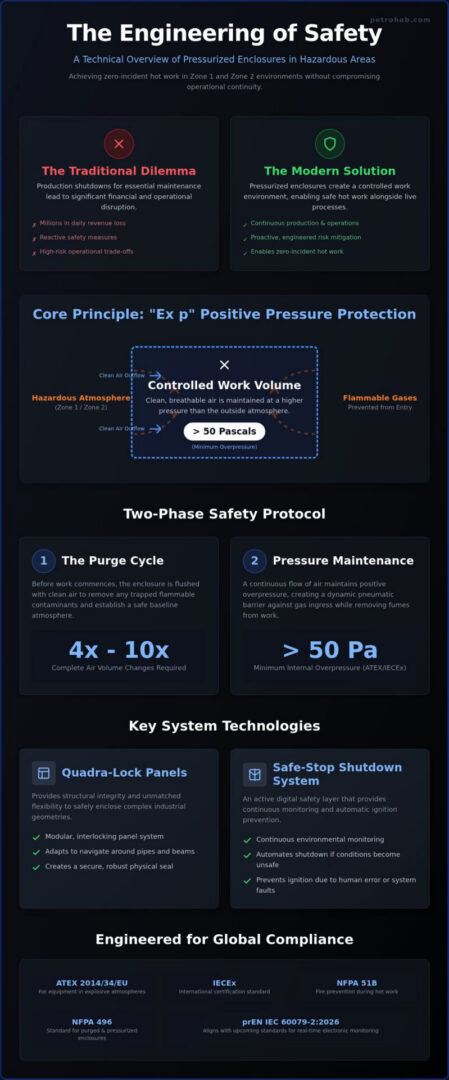
In high-consequence hydrocarbon environments, the decision to halt production for maintenance often feels like a forced choice between fiscal viability and human life. Deploying a pressurized enclosure for hazardous areas resolves this tension by creating a controlled environment where hot work proceeds safely alongside active processes. You’re likely facing intense pressure to meet the January 2026 updates to the ATEX 2014/34/EU guidelines while minimizing the astronomical costs of refinery turnarounds. It’s a difficult balance, but maintaining a minimum internal pressure of 50 Pascals is now just the baseline for modern compliance.
This guide provides the technical mastery needed to execute zero-incident hot work while ensuring regulatory alignment for offshore and onshore sites. You’ll learn how to leverage the structural integrity of Quadra-Lock panels and the active protection of the Safe-Stop Automatic Shutdown System. We’ll examine the transition from passive containment to dynamic risk mitigation, focusing on the specialized engineering required to protect personnel and high-value assets in Zone 1 and Zone 2 environments. By the end of this manual, you’ll understand how to integrate these systems into a comprehensive safety ecosystem that eliminates the risk of catastrophic ignition.
Key Takeaways
- Understand the “Ex p” protection principle, where controlled overpressure prevents the ingress of flammable gases into the work volume.
- Master the technical requirements for the purge cycle to clear contaminants before initiating any hot work activities.
- Learn how a pressurized enclosure for hazardous areas ensures compliance with the latest ATEX, IECEx, and NFPA 51B standards for Zone 1 and Zone 2 operations.
- Discover how modular Quadra-Lock panels provide the structural flexibility required to navigate complex industrial geometries such as pipes and beams.
- Evaluate the role of the Safe-Stop Automatic Shutdown System in providing continuous environmental monitoring and active ignition prevention.
Understanding Pressurized Enclosure Systems in Hazardous Locations
The “Ex p” protection method relies on maintaining a consistent internal pressure to prevent the ingress of flammable gases. This fundamental principle ensures that even if a small leak occurs, the outward flow of clean air prevents explosive atmospheres from reaching ignition sources. A Positive pressure enclosure creates a barrier that is both physical and pneumatic. While standard stationary electrical enclosures use this method for small components, a modular pressurized enclosure for hazardous areas scales this technology for human personnel. Stationary boxes are fixed assets, whereas modular habitats are deployed dynamically to address specific maintenance needs. This flexibility is essential for repairing live-site equipment where fixed barriers are impractical. These systems transform high-risk zones into designated safe working areas, allowing personnel to operate tools that would typically be prohibited.
The Evolution of Pressurized Habitats
Early safety enclosures were often rigid, heavy steel structures that were difficult to transport and install. Modern habitats have evolved into modular, flexible systems that utilize advanced fabric-based materials. These textiles meet stringent fire-resistance standards, such as those required for offshore welding operations in the North Sea or Gulf of Mexico. These modern systems also incorporate high-visibility panels and flame-retardant properties that exceed the capabilities of older, static designs. The patented Quadra-Lock panels represent a major breakthrough in this evolution; they interlock to create a secure seal that adapts to complex site geometries. In 2026, the industry has shifted toward integrated electronic monitoring, aligning with prEN IEC 60079-2:2026 standards for real-time environmental data. This digital safety layer ensures the physical barrier remains uncompromised by human error or environmental shifts.
Why Production Shutdowns are No Longer Mandatory
The economic impact of a facility shutdown can reach millions of dollars per day in lost revenue. Utilizing a pressurized welding habitat provides a cost-effective alternative to total outages. It functions as a temporary engineering control that isolates ignition sources from potential fuel. Tier 1 hydrocarbon assets rely on these habitats to maintain operational continuity during complex repairs or refinery turnarounds. By deploying a pressurized enclosure for hazardous areas, safety managers mitigate the risk of catastrophic ignition while preserving the site’s production schedule. This approach moves the industry away from reactive safety measures toward proactive, engineered risk management. A Hot Work Safety Enclosure is a temporary engineering control that isolates ignition sources from the surrounding hazardous atmosphere.
The Science of Positive Pressure and Purging Mechanisms
The mechanical integrity of a pressurized enclosure for hazardous areas depends on a precise pneumatic barrier. Engineering standards, specifically the NFPA 496 Standard, dictate that an internal overpressure of 0.05 inches of water gauge (w.g.) is the recognized baseline to prevent gas ingress. However, for Zone 1 environments under 2026 ATEX and IECEx requirements, maintaining a minimum of 50 Pascals (Pa) is essential for compliance. This pressure differential creates a physical outward flow of air through any microscopic gaps, ensuring that flammable hydrocarbons can’t enter the work volume. It’s not just about static pressure; the system requires continuous airflow to manage heat from welding and ensure toxic fumes are removed. Air ducting must be positioned strategically to maintain this atmospheric integrity and worker comfort during extended shifts.
Calculating Purge Volumes for Large Habitats
Before energizing any hot work equipment, the enclosure must undergo a rigorous purge cycle. This process flushes the internal volume with clean air to remove any trapped flammable contaminants. For large-scale habitats, safety protocols typically require between four and ten complete volume changes. High-capacity blowers are critical in offshore environments where wind and air density fluctuations can impact performance. Efficiency depends on the habitat’s shape and internal obstructions, such as piping or structural beams, which can create “dead spots” where gas might linger. Technicians must calculate these volumes precisely to ensure the atmosphere is fully remediated before work begins.
Maintaining the Pressure Differential
Maintaining a pneumatic seal requires superior panel integrity. Traditional zip or Velcro systems often suffer from excessive leakage, making it difficult to sustain the required differential. Quadra-Lock panels solve this by providing a robust mechanical connection that minimizes air loss. Technicians use manometers to monitor these levels in real-time, providing an immediate warning if the pressure drops below the safety threshold. Managing the piston effect is also critical during personnel transitions. When a worker enters or exits the habitat, the internal volume changes rapidly. Advanced systems use compensatory blowers to mitigate these fluctuations and prevent accidental shutdowns. To ensure your site meets these rigorous standards, you can explore specialized pressurized habitats designed for extreme industrial conditions.
Compliance Standards: ATEX, IECEx, and NFPA 51B Requirements
Compliance in high-risk industrial sectors isn’t merely about paperwork; it’s the foundational framework for operational safety. In 2026, the prEN IEC 60079-2:2026 standard provides the definitive requirements for any pressurized enclosure for hazardous areas. This regulation ensures that equipment design and construction can withstand the rigorous demands of explosive atmospheres. According to OSHA hazardous location standards, environments are classified based on the frequency and duration of flammable gas presence. Zone 1 requires the highest level of enclosure integrity because explosive atmospheres are likely to occur during normal operations. Zone 2 requires a different protection level since hazards are infrequent. The material specifications for these enclosures are strictly dictated by hazardous environment standards, ensuring that every panel and seal can withstand the thermal and chemical stresses of a hydrocarbon-rich site.
NFPA 51B, specifically the 2024 edition, serves as the operational anchor for fire prevention during welding, cutting, and other hot work. It mandates that hot work only proceeds when a designated area is cleared of combustibles or protected by a validated engineering control like an HWSE. Third-party certification for automatic shutdown components is non-negotiable. Without it, the reliability of the system during a gas ingress event cannot be guaranteed. This certification provides safety managers with the assurance that the equipment will perform as expected under catastrophic conditions.
ATEX vs. IECEx in Enclosure Certification
Safety managers must understand the distinction between regional ATEX directives and the international IECEx system. The nameplate provides the definitive proof of compliance. Marking strings such as Ex pxb for Zone 1 or Ex pzc for Zone 2 indicate the specific protection level. Type X purging is mandatory for Zone 1 environments; it ensures that power is automatically disconnected if internal pressure fails. This fail-safe mechanism is what separates a certified safety system from a simple fabric tent. It’s essential to verify these marking strings against the site’s specific hazardous zone classification before deployment.
Integrating HWSE into the Permit-to-Work (PTW) System
Integrating a pressurized enclosure for hazardous areas into the Permit-to-Work (PTW) system fundamentally changes the site’s risk profile. The HWSE acts as a temporary engineering control that isolates ignition sources. Documentation must be meticulous. Gas test records and continuous pressure logs are required to validate that the environment remains within safe parameters. The Fire Watch remains a critical human element, but their role shifts to monitoring the enclosure’s external integrity and the Safe-Stop system’s status. This ensures that the technical remedy and human oversight work in unison to prevent accidents.
Operational Benefits of Modular Hot Work Safety Enclosures (HWSE)
Modular habitats provide a level of adaptability that stationary electrical boxes cannot match, making them the preferred pressurized enclosure for hazardous areas in dynamic work environments. These systems must often be constructed around existing infrastructure, including complex pipe runs and structural beams. They utilize a modular framework that accommodates uneven flooring and tight clearances common in offshore environments. The integration of flame-retardant, high-visibility panels ensures that the workspace is both safe and observable from the exterior. Rapid assembly and disassembly cycles provide significant efficiency gains, often reducing setup times by 40% compared to traditional scaffolding and fire-blanket methods. Maintaining this integrity requires disciplined training for all on-site personnel. Every technician must understand the procedural requirements for entering and exiting the enclosure without triggering a pressure-drop alarm or compromising the pneumatic seal.
The Quadra-Lock Advantage for Structural Integrity
Patented Quadra-Lock technology creates a superior mechanical seal that outperforms legacy panel connectors such as zippers or Velcro. This interlocking design ensures that the pneumatic barrier remains uncompromised even during heavy industrial use. The fire-resistant materials are engineered for extreme durability, resisting the corrosive effects of salt spray and hydrocarbon exposure in harsh offshore conditions. Quadra-Lock panels allow for 360-degree visibility while maintaining pressure, which is a critical requirement for effective safety supervision and fire watch duties. This transparency allows supervisors to confirm that all internal safety protocols are being followed without having to enter the habitat, reducing the number of personnel in the immediate work area.
Minimizing Downtime in Refineries and Offshore Platforms
The ability to perform emergency repairs on live lines without a total facility shutdown is a primary driver for adopting hot work safety enclosures. In a refinery setting, reducing the duration of a planned turnaround results in substantial revenue protection. Lightweight, modular components facilitate easy transport to remote sites or congested offshore platforms where deck space is at a premium. These systems act as a mobile safety barrier that can be redeployed across different work scopes within the same project. By choosing high-performance Petro-Habitats, operators ensure that maintenance remains a controlled variable rather than a production bottleneck. This strategic deployment of technology allows for continuous production while essential hot work proceeds in a secure, monitored environment.
Implementing PetroHab Technology: Quadra-Lock and Safe-Stop Systems
PetroHab delivers a unified safety solution that combines the physical integrity of an HWSE with the active monitoring of the Safe-Stop system. This pressurized enclosure for hazardous areas operates as a complete ecosystem, typically supported by professional on-site supervision. The Safe-Stop Automatic Shutdown System serves as the primary intelligence center for the habitat. It continuously analyzes the internal environment to ensure that atmospheric conditions remain within safe operational parameters. The system specifically targets two critical threats through its sensor array:
- Continuous monitoring for Lower Explosive Limit (LEL) concentrations to prevent ignition.
- Detection of Hydrogen Sulfide (H2S) to protect personnel from toxic exposure.
- Immediate isolation of power to all tools if internal pressure drops below 50 Pascals.
The fail-safe mechanism is engineered for speed. If gas is detected or pressure is lost, the system terminates power to welding machines and grinders in milliseconds. This rapid intervention stops the work before a hazard can escalate into a catastrophic event. By integrating the physical barrier of Quadra-Lock panels with this electronic guardian, operators achieve a redundant safety architecture that satisfies the most rigorous 2026 compliance standards.
Safe-Stop: Beyond Simple Pressure Monitoring
The Safe-Stop system utilizes dual-sensor redundancy to ensure maximum reliability in volatile offshore and onshore environments. This design prevents a single component failure from compromising the entire safety protocol. When a threshold is breached, the unit activates high-intensity audible and visual alarms to alert workers both inside and outside the habitat. For complex projects involving multiple work scopes, these units integrate with advanced hot work safety systems. This connectivity allows for facility-wide monitoring and centralized data logging, giving safety managers real-time visibility into the status of every pressurized enclosure for hazardous areas on the site.
Selecting a Supplier: Rental vs. Purchase Strategies
Asset managers must evaluate their acquisition strategy based on the frequency and duration of their maintenance projects. Equipment leasing is a strategic choice for short-term projects or specific refinery turnarounds. It provides access to the latest technology without the long-term burden of capital expenditure. Purchasing is a superior option for facilities with permanent maintenance crews who perform daily hot work. Regardless of the chosen model, the role of on-site supervision remains critical. PetroHab provides certified training and expert oversight to ensure every deployment is executed correctly. This professional guidance ensures that the Quadra-Lock panels are installed to maintain maximum pneumatic integrity, protecting both personnel and high-value assets during high-risk operations.
Advancing Safety Excellence in High-Risk Environments
The transition from passive containment to active, engineered safety systems is the hallmark of modern industrial maintenance. By integrating a pressurized enclosure for hazardous areas into your workflow, you eliminate the need for costly production halts while maintaining absolute compliance with ATEX and IECEx standards. Success in 2026 requires more than just a physical barrier; it demands the technical precision of patented Quadra-Lock panel technology and the active protection of Safe-Stop automatic shutdown systems. These technologies work in unison to transform volatile environments into controlled workspaces where hot work proceeds without compromise.
You don’t have to choose between productivity and safety when you have the right engineering controls in place. Contact PetroHab for a Pressurized Enclosure Quote to discuss your specific site requirements and ensure your personnel are protected by the industry benchmark. Your commitment to a zero-incident environment starts with choosing equipment that’s as resilient as your operations.
Frequently Asked Questions
What is the minimum pressure required for a pressurized enclosure in a hazardous area?
The minimum internal pressure required for a pressurized enclosure for hazardous areas is 50 Pascals (Pa) relative to the external atmosphere. This value is equivalent to approximately 0.05 inches of water gauge (w.g.). Maintaining this differential ensures that air flows outward in the event of a minor leak, preventing flammable hydrocarbons from entering the workspace. Compliance with prEN IEC 60079-2:2026 requires continuous monitoring to verify this pressure remains constant during all hot work operations.
How does an automatic shutdown system work with a welding habitat?
An automatic shutdown system, such as the Safe-Stop system, functions as the central safety controller. It integrates with the habitat’s sensors to monitor pressure levels and gas concentrations, specifically LEL and H2S. If the system detects a pressure drop or gas ingress, it immediately terminates power to all ignition sources inside the enclosure. This fail-safe mechanism prevents accidents by ensuring that welding or grinding equipment can’t operate in a potentially explosive atmosphere.
What is the difference between Type X, Y, and Z purging for enclosures?
These designations define the level of protection provided by the purging system based on the hazardous zone. Type X purging reduces the classification within the enclosure from Zone 1 to non-hazardous and requires an automatic power shutdown upon pressure loss. Type Y reduces Zone 1 to Zone 2. Type Z reduces a Zone 2 area to non-hazardous and typically requires an alarm rather than an automatic shutdown. Selecting the correct type depends on the site’s specific risk assessment.
Can hot work be performed in Zone 0 with a pressurized enclosure?
No, hot work can’t be performed in Zone 0 environments using a pressurized enclosure for hazardous areas. Zone 0 is defined as an area where an explosive atmosphere is present continuously or for long periods. Pressurized habitats are engineered and certified specifically for Zone 1 and Zone 2 locations. In Zone 1, hazards occur occasionally; in Zone 2, they’re unlikely or infrequent. Attempting to use these enclosures in Zone 0 exceeds their certified safety parameters.
What materials are used to ensure the fire resistance of a welding habitat?
Modern habitats utilize specialized flame-retardant textiles designed to withstand the thermal stresses of welding and cutting. These materials must comply with international fire safety standards for offshore and onshore industrial sites. The structural integrity is further reinforced by Quadra-Lock panels, which provide a mechanical seal while resisting heat. These high-visibility materials allow for effective external supervision while ensuring the physical barrier remains uncompromised by sparks, slag, or intense radiant heat during hot work.
How often should gas detectors be calibrated in a pressurized system?
Gas detectors within a pressurized system must be calibrated according to the manufacturer’s recommendations and local site protocols. Most safety managers require a bump test before every shift to verify sensor responsiveness. A full calibration is typically performed every three to six months depending on environmental exposure. Rigorous calibration ensures that the Safe-Stop system can accurately detect LEL and H2S levels, maintaining the reliability of the automatic shutdown fail-safe during critical maintenance tasks.
What happens if the pressure inside the HWSE drops below the set point?
If internal pressure falls below the 50 Pascal threshold, the Safe-Stop system triggers an immediate response. It isolates the power supply to all tools and activates high-intensity audible and visual alarms to alert the crew. This rapid intervention is critical because a loss of overpressure allows external flammable gases to enter the work area. Work can’t resume until the pressure is restored and the enclosure undergoes a full purge cycle to remediate the internal atmosphere.
Is a fire watch still required when using a pressurized welding enclosure?
A dedicated fire watch is mandatory even when utilizing a pressurized welding enclosure. While the Safe-Stop system provides automated monitoring and shutdown capabilities, NFPA 51B standards require human oversight to manage external hazards. The fire watch monitors the area for sparks that might escape the enclosure and ensures that the external environment remains safe. This combination of automated engineering controls and diligent personnel creates the redundant safety layers necessary for high-risk hydrocarbon environments.