Refinery Turnaround Safety: A Technical Guide to Ignition Source Control and Pressurized Isolation
The most dangerous 30 days in a refinery’s lifecycle aren’t during peak production, but during a scheduled outage when 2,500 contractors converge on a site filled with residual hydrocarbons. Managing refinery turnaround safety during these windows requires more than just standard permits; it demands absolute control over every potential ignition source. You’re likely facing the immense pressure of a $50 million budget and a non-negotiable deadline while trying to maintain zero-incident performance across thousands of simultaneous tasks.
We understand that balancing essential hot work with the proximity of live units is a logistical challenge that requires uncompromising technical precision. You’ll master these complexities by implementing advanced pressurized isolation and automated shutdown systems designed to protect your personnel and high-value assets. This guide details the integration of ATEX-certified modular habitats and patented Petro-Wall technology to ensure your next turnaround meets the highest NFPA standards without sacrificing your critical path schedule.
Key Takeaways
- Identify the specific risk factors inherent in scheduled shutdowns and implement a systematic management approach for the 2026 operational landscape.
- Master the mechanics of pressurized isolation by deploying modular Hot Work Safety Enclosures (HWSE) to maintain positive pressure against hazardous gases.
- Navigate the complexities of SIMOPS by applying technical protocols that ensure safe welding and grinding adjacent to live refinery units.
- Utilize a rigorous five-step framework to integrate refinery turnaround safety into early-stage risk mapping and site geometry planning.
- Leverage patented Quadra-Lock and Safe-Stop technologies to engineer unrivaled reliability and automated ignition source control into your safety protocols.
The Critical Role of Refinery Turnaround Safety in 2026
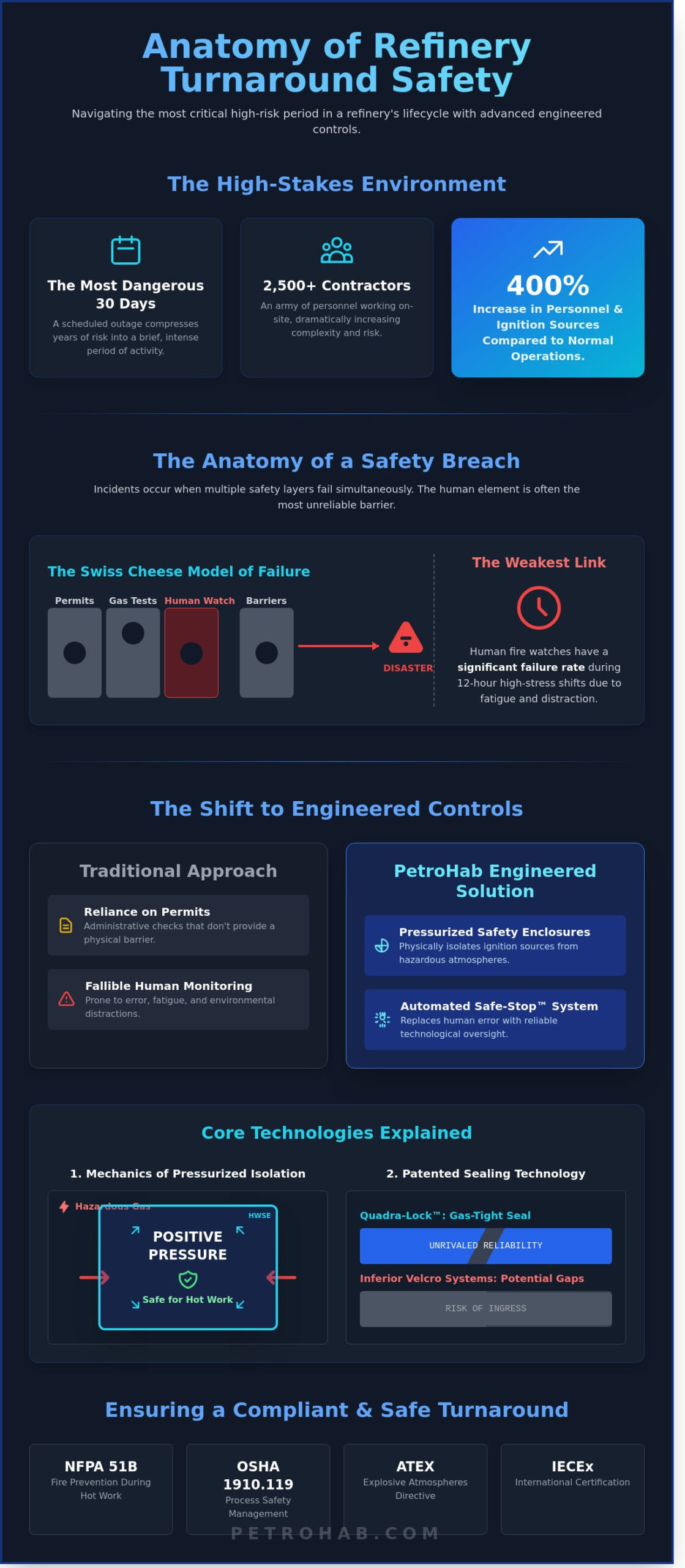
Refinery turnaround safety is the systematic management of risks during scheduled periods of maintenance, inspection, and debottlenecking. In the 2026 industrial landscape, a Turnaround (TAR) represents the most volatile phase of a facility’s lifecycle. These events compress years of wear and tear into a few weeks of intense activity. During these windows, the density of ignition sources and personnel increases by as much as 400 percent compared to normal operations. This concentration of activity creates a high-stakes environment where the margin for error is non-existent. Safety managers must account for the intersection of volatile hydrocarbons and high-energy maintenance tasks.
The economic impact of a safety failure is staggering. A single day of unplanned downtime in a 200,000 barrel-per-day refinery can result in $1.5 million in lost revenue. When a catastrophic incident occurs, these figures escalate into billions due to asset replacement, legal liabilities, and environmental remediation costs. Beyond the balance sheet, the protection of human life remains the primary objective. Primary hazards during these periods include:
These environmental liabilities often involve complex soil and groundwater contamination issues, requiring detailed hydrogeological studies to manage effectively. For those responsible for long-term site integrity, it’s valuable to discover HYDPOLL and their approach to industrial environmental analysis.
- Flammable Vapors: Residual hydrocarbons in “dead legs” or poorly purged vessels.
- Confined Spaces: High-risk entry into reactors and towers where atmospheric changes occur rapidly.
- High-Density Contractor Activity: Simultaneous operations (SIMOPS) where different crews perform conflicting tasks in close proximity.
The Anatomy of a Turnaround Safety Breach
Ignition events during maintenance rarely result from a single failure. The Swiss Cheese Model of industrial accidents demonstrates how multiple layers of protection, such as permitting, gas testing, and physical barriers, must fail simultaneously for a disaster to occur. Human fire watches often represent the weakest link in this chain. Data indicates that human monitors have a significant failure rate during 12-hour high-stress shifts due to fatigue and environmental distractions. PetroHab’s Safe-Stop system addresses this by providing automated ignition source control, replacing fallible human observation with rigorous technological oversight. This approach has become the gold standard in hot work safety.
Regulatory Landscape and Standards Compliance
Regulatory bodies have tightened oversight as we move through 2026. NFPA 51B remains the foundational standard for hot work, requiring stringent fire prevention measures. OSHA 1910.119, which covers Process Safety Management, mandates that refineries implement rigorous mechanical integrity programs. We’re seeing a decisive shift toward engineered controls over administrative ones. Relying on a permit or a warning sign is no longer sufficient. Modern safety protocols prioritize hot work safety enclosures like the Petro-Wall. These modular, pressurized habitats provide a physical and atmospheric barrier that isolates the ignition source from the hazardous environment. This engineered approach ensures compliance with ATEX and IECEx standards, providing a level of integrity that manual methods cannot replicate.
By integrating patented technologies and adhering to these evolving standards, refinery operators can mitigate the inherent risks of a turnaround. The goal is a seamless execution where maintenance objectives are met without compromising the safety of the workforce or the integrity of the facility.
Mechanics of Pressurized Isolation: How HWSE Protects the Site
Pressurized isolation operates on a fundamental principle of fluid dynamics: air naturally moves from areas of high pressure to areas of low pressure. By maintaining an internal environment at a higher pressure than the surrounding refinery atmosphere, a Hot Work Safety Enclosure (HWSE) creates a physical barrier that prevents the ingress of flammable gases. This mechanism is a cornerstone of refinery turnaround safety, as it allows welding, grinding, and cutting to proceed in close proximity to live process units without the risk of an ignition event.
The physical structure of a PetroHab HWSE relies on the patented Petro-Wall system. These panels are constructed from high-tenacity, flame-retardant materials that meet the rigorous requirements of the ANSI/FM 4950 standard. To ensure the enclosure remains gas-tight, the panels utilize Quadra-Lock technology. This interlocking mechanism provides a secure, overlapping seal at every seam, eliminating the gaps that often plague inferior, Velcro-based systems. It’s this mechanical integrity that allows the habitat to withstand the external wind loads and internal pressure fluctuations common in industrial environments.
Refinery environments are inherently volatile. According to OSHA safety standards, fire and explosion hazards are among the most significant risks during maintenance and turnaround cycles. Utilizing a pressurized habitat mitigates these risks by isolating the ignition source from the fuel source. The system doesn’t just provide a physical shield; it provides a controlled, monitored micro-climate where safety is managed through real-time data and automated responses.
Maintaining Positive Pressure Integrity
Precision monitoring is required to verify that the enclosure remains a safe zone. Digital manometers continuously measure the pressure differential between the interior of the HWSE and the external environment. A minimum pressure of 0.05 inches of water column (12.5 Pa) is typically required to ensure gas exclusion. If the pressure drops below this threshold, the system provides immediate visual and audible alerts to the technicians inside and the safety watch outside.
The role of air ducting is equally critical. Heavy-duty, anti-static ducting delivers a continuous supply of clean, breathable air from a designated non-hazardous zone. To maintain air quality and prevent the buildup of welding fumes, the system must achieve a specific air exchange rate. Industry protocols often mandate at least 20 air changes per hour. Calculating the required cubic feet per minute (CFM) involves multiplying the enclosure volume by the desired exchange rate and dividing by 60. For a standard 10x10x10 foot enclosure, a blower must deliver at least 333 CFM to meet safety requirements.
Automated Ignition Source Control
The Safe-Stop system acts as the central nervous system of the HWSE, integrating gas detection with an automatic shutdown (ASD) capability. This system monitors the air intake for hydrocarbons and other toxic gases using infrared or electrochemical sensors. If gas concentrations reach a Lower Explosive Limit (LEL) threshold, usually set at 10% for an alarm and 25% for a full shutdown, the Safe-Stop system immediately terminates power to all hot work equipment inside the habitat.
Fail-safe mechanisms are built into the hardware to handle utility losses. If the blower loses power or if the internal pressure is lost for more than 30 seconds, the main electrical contactor drops out. This design ensures that hot work cannot continue unless the environment is proven safe. Personnel can also trigger an immediate shutdown via emergency stop buttons located both inside and outside the enclosure. For engineers planning complex maintenance, integrating these modular safety systems ensures that protection is not left to human error, but is instead governed by uncompromising technological logic.
Managing SIMOPS: Safe Hot Work Near Live Units
Simultaneous Operations, or SIMOPS, represent one of the most complex phases of industrial maintenance. In the context of a partial refinery shutdown, SIMOPS involves executing high-risk hot work within meters of operational hydrocarbon-processing equipment. This proximity creates a volatile environment where a single spark can lead to catastrophic ignition. Maintaining refinery turnaround safety requires a rigorous approach to isolation that goes beyond basic permits. These turnarounds represent essential site upkeep that ensures long-term mechanical integrity and operational reliability.
The primary challenge lies in the potential for fugitive emissions from live units to drift into the hot work area. Traditional methods often require a full site shutdown to mitigate this risk, which leads to massive revenue loss. PetroHab’s pressurized hot work safety enclosures (HWSE) solve this by creating a controlled internal environment. By maintaining positive pressure, the system prevents external gases from entering the workspace. It transforms a hazardous area into a temporary safe zone, allowing production and maintenance to coexist without compromising the site’s integrity.
Risk Assessment for Simultaneous Operations
Safety managers must identify every potential leak path from neighboring live units before a single arc is struck. This includes valves, flanges, and vents within a 15-meter radius of the work site. Environmental factors like wind direction are critical variables in turnaround planning. A 10 mph breeze can carry flammable vapors directly into a welding zone in seconds. PetroHab applies the hierarchy of controls by substituting open-air welding with engineered isolation. This proactive strategy minimizes the reliance on human vigilance alone. We focus on three critical risk factors:
- Source Identification: Mapping all active hydrocarbon lines adjacent to the shutdown unit.
- Environmental Monitoring: Continuous assessment of wind speed and direction to predict vapor travel.
- Physical Separation: Utilizing the patented Petro-Wall to provide a flame-retardant barrier between live assets and ignition sources.
Ignition Control in ATEX Zones
Operating in ATEX Zone 1 or Zone 2 areas during a turnaround requires uncompromising ignition source control. PetroHab’s HWSE effectively reclassifies the interior space as a non-hazardous zone for the duration of the work. Our modular panels provide a physical barrier that contains sparks, slag, and heat. We integrate ATEX-certified gas detection systems that monitor the habitat’s perimeter and air intake 24 hours a day. This ensures refinery turnaround safety remains the priority even in high-density equipment areas.
In a 2022 project for a major Gulf Coast refinery, the implementation of PetroHab habitats allowed for concurrent welding on a hydrotreater while the adjacent FCC unit remained live. This engineered isolation reduced total project downtime by 15%. The site safely logged over 4,000 man-hours of hot work without a single LTI or ignition event. The Safe-Stop system provides an automated fail-safe for these scenarios. If gas is detected at 20% LEL, the system immediately isolates power to all welding equipment. It’s a definitive technological remedy for a high-stakes problem. Our systems are designed to be as durable and resilient as the refineries they protect.
Turnaround Safety Planning: A 5-Step Integration Framework
Effective refinery turnaround safety isn’t a result of chance; it’s the outcome of a rigorous, five-step integration framework designed to neutralize ignition sources before work begins. This structured methodology ensures that Hot Work Safety Enclosures (HWSE) function as a seamless extension of the facility’s safety culture. PetroHab’s approach prioritizes technical precision to protect both personnel and high-value assets during high-stakes maintenance windows.
- Step 1: Early-Stage Risk Mapping. Engineers identify ‘hot spots’ during the pre-planning phase, typically 12 to 18 months before the scheduled shutdown. This involves locating high-risk zones near crude distillation units or fluid catalytic crackers where hydrocarbon presence is most likely.
- Step 2: Geometry Selection. Site leads determine if modular Petro-Wall panels or custom-tailored enclosures are required. Our modular systems adapt to 90% of standard refinery layouts, while bespoke configurations address complex pipe racks and restricted spaces.
- Step 3: Pre-Turnaround Training. All personnel, including third-party contractors, undergo 16 hours of mandatory habitat safety training. This ensures every operator understands the pressurized environment, seal integrity, and emergency egress protocols.
- Step 4: Real-Time Monitoring. During the execution phase, the Safe-Stop system provides continuous gas detection and automated shutdown capabilities. If LEL levels exceed 10%, the system cuts power to all ignition sources in less than 2 seconds.
- Step 5: Post-Turnaround Analysis. After completion, safety teams analyze the digital logs. Reviewing these 2,000+ data points allows for a 15% improvement in safety efficiency for the next maintenance cycle.
The digital transformation of industrial safety means that managing these data points is as critical as managing the physical hardware. Ensuring the cybersecurity and reliability of the networks that collect and analyze this safety data is a crucial, often overlooked, aspect of a modern turnaround. For comprehensive support, many firms rely on managed IT specialists like SpaceCenter Systems to protect their operational technology infrastructure.
Sourcing and Logistics for Safety Equipment
For projects exceeding 45 days, purchasing PetroHab equipment often provides a better ROI than long-term rentals. However, 70% of refineries choose the rental model for short-term turnarounds to minimize storage and maintenance overhead. Logistics management is vital. Our technicians oversee the deployment of air ducting and spark-arresting systems across the site. This ensures every habitat maintains its 50-pascal overpressure requirement regardless of its distance from the primary air intake. We manage the granular details so your engineers can focus on the critical path.
Permit-to-Work (PTW) Integration
Integrating HWSE into the PTW system streamlines the authorization process for refinery turnaround safety protocols. By listing the pressurized habitat as the primary engineering control, safety managers can reduce the time spent on manual gas sniffing by 30% per shift. Before striking the first arc, a supervisor must verify the habitat’s integrity and the functionality of the automatic shutdown valve. This creates a definitive, data-driven checkpoint that eliminates human error and ensures compliance with ATEX and IECEx standards.
The PetroHab Advantage: Engineering Reliability into Refineries
PetroHab delivers more than equipment; we provide an integrated safety ecosystem designed for the most volatile environments on earth. Our patented Quadra-Lock and Safe-Stop technologies serve as the industrial foundation of this commitment. By utilizing these systems, operators ensure that refinery turnaround safety isn’t a variable, but a constant. We build our Hot Work Safety Enclosures (HWSE) to withstand the relentless rigors of 24-hour maintenance cycles. Every component reflects our pursuit of technical perfection and operational durability.
Our fire-resistant materials aren’t just compliant; they set the global industry benchmark. Petro-Wall panels feature a specialized silicone-coated fiberglass construction that meets and exceeds the ANSI/FM 4950 standard for welding curtains and blankets. These panels endure continuous temperatures of 1,000°F (538°C) without losing structural integrity or allowing heat transfer that could ignite external atmospheres. This thermal resistance protects high-value assets and personnel from sparks and slag during intensive welding operations, maintaining a secure barrier between hot work and hazardous gases.
PetroHab operates with a massive global footprint, maintaining strategic hubs from Houston to Dundee. This reach allows us to deploy technical experts to any refinery within 48 hours. Our commitment to zero-incident performance is backed by rigorous on-site training programs that empower your workforce. In the 2023 fiscal year, PetroHab-supervised projects achieved a 100% safety record with zero lost-time incidents across 150,000 man-hours. We don’t just lease hardware. We certify that every technician on site understands the critical nature of ignition source control and habitat management.
Innovative Safety Hardware
The Quadra-Lock system uses a tool-free interlocking mechanism that creates a virtually airtight seal between panels. This modular design reduces labor requirements by 35% during the assembly phase, allowing crews to focus on the turnaround itself. When paired with our Safe-Zone gas detection systems, the enclosure becomes an intelligent safety cell. The Safe-Zone unit monitors Lower Explosive Limit (LEL) levels with 99.9% accuracy. If gas concentrations reach 10% of the LEL, the Safe-Stop system triggers an immediate shutdown of all hot work equipment within 0.8 seconds, neutralizing the threat before an ignition can occur.
Partnering for Success
We don’t believe in one-size-fits-all solutions. Our team functions as a dedicated safety consultant to address the unique challenges of refinery turnaround safety. We specialize in engineering custom enclosures for complex geometries, including vertical columns and congested pipe bridges where standard habitats fail. Every solution is calculated to maximize protection while minimizing the footprint on the refinery floor. We provide the technical documentation and risk assessments required to satisfy the most stringent ISO and ATEX compliance audits. Contact PetroHab for a turnaround safety consultation to secure your next project and ensure your facility remains a benchmark for industrial safety.
Securing the Future of 2026 Turnaround Operations
Executing a 2026 refinery schedule demands a disciplined approach to ignition source control and pressurized isolation. We’ve detailed how Hot Work Safety Enclosures (HWSE) mitigate risks during complex SIMOPS, ensuring that live units and maintenance zones coexist without incident. Integrating a 5-step safety framework allows for precise management of hazardous energy across the site. PetroHab’s systems offer the gold standard in protection. Our patented Quadra-Lock™ technology ensures structural integrity in high-risk environments, while our ATEX and IECEx certified systems provide the technical assurance required by global supermajors. Prioritizing refinery turnaround safety isn’t merely a checkbox for compliance; it’s a strategic investment in protecting human life and high-value assets. You’ve explored the mechanics of pressurized habitats and the necessity of rigorous planning. Now, it’s time to deploy these engineered solutions to your facility. Our team is prepared to help you achieve zero incidents and maintain maximum operational uptime throughout your next project. Success starts with a commitment to unrivaled engineering and meticulous site control.
Request a Quote for Your Next Refinery Turnaround
Frequently Asked Questions
What is the difference between a welding tent and a pressurized habitat?
A welding tent provides basic physical shielding from sparks and weather, but it doesn’t offer protection against flammable gases. PetroHab’s pressurized habitats maintain a positive pressure differential of 50 pascals to actively exclude hazardous vapors. This engineering ensures that the internal environment remains non-hazardous even if the external atmosphere contains hydrocarbons. Unlike a simple tent, our HWSE systems use patented Petro-Wall panels that withstand temperatures up to 1,000 degrees Fahrenheit.
How does a pressurized habitat prevent gas ingress during a turnaround?
The habitat prevents gas ingress by keeping internal air pressure higher than the surrounding atmosphere. This pressure differential creates a constant outward flow of air through any small openings or seals. It’s a fundamental principle of refinery turnaround safety that ensures flammable gases can’t enter the work zone where ignition sources are present. Our Safe-Stop system monitors this pressure constantly to ensure the 50-pascal threshold isn’t breached during hot work operations.
Are PetroHab habitats ATEX and IECEx certified?
PetroHab systems carry full ATEX and IECEx certifications for use in Zone 1 and Zone 2 hazardous areas. Our Safe-Stop control units comply with the IEC 60079-13 standard for pressurized rooms, which is the gold standard for ignition source control. These certifications mean our equipment has passed rigorous third-party testing for electrical and thermal safety. We provide full documentation for every unit to satisfy the 100% compliance requirements of global energy companies.
What happens if the gas detection system senses a leak outside the habitat?
If the external gas detectors sense flammable vapors at 10% of the Lower Explosive Limit, the Safe-Stop system automatically cuts power to all tools. This shutdown occurs in less than 0.5 seconds to eliminate any risk of ignition. The system also triggers a 95-decibel siren and visual beacons to alert the crew immediately. This rapid, automated response is a critical layer of refinery turnaround safety that removes the possibility of human error during an emergency.
How long does it take to set up a PetroHab HWSE on-site?
A standard 2×2 meter enclosure typically takes 2 trained technicians approximately 4 hours to assemble and certify. The modular design of our Petro-Wall panels allows them to fit around complex piping and structural beams without custom fabrication. This speed reduces mobilization time by 30% compared to traditional plywood or scaffolding enclosures. Once the structure’s built, the pressure test and system calibration take an additional 30 minutes before hot work begins.
Can hot work be performed in a Zone 1 area using a pressurized habitat?
Hot work is permissible in Zone 1 areas when a pressurized habitat’s used to reclassify the internal space as non-hazardous. The system must maintain at least 10 air changes per hour and a consistent overpressure to meet international safety codes. By using our HWSE, operators can perform welding or grinding without shutting down adjacent equipment. This capability is essential for maintaining production schedules while performing necessary repairs in high-risk environments.
What are the maintenance requirements for HWSE panels?
Petro-Wall panels require a detailed visual inspection every 12 months to check for fabric thinning or seal degradation. We replace any panel that shows more than 5% surface damage or any visible punctures to ensure the enclosure’s integrity. The silicone-coated fiberglass is durable, but it’s inspected after every deployment for chemical exposure or thermal stress. Additionally, the Safe-Stop sensors require calibration every 6 months to maintain their 0.1 pascal sensitivity rating.
Does using a pressurized habitat reduce the number of fire watches needed?
Using a pressurized habitat can reduce the required fire watch personnel by 50% because the environment’s continuously monitored by automated sensors. In many jurisdictions, a single fire watch can oversee two habitats if they’re within a 15-meter radius and have clear lines of sight. This optimization saves approximately 12 man-hours per shift on large-scale projects. The automated shutdown system provides a level of reliability that manual observation can’t match, allowing for leaner, safer crew configurations.