
Blog Posts
Safety Enclosures for Safer Vessel and Tank Entry
A safety enclosure for vessel and tank entry helps control the work area around an opening and supports air-quality management, communication, planned access, and rescue readiness. It does not replace atmospheric testing, entry controls, or a rescue plan. These safeguards must work together before anyone enters.
Confined spaces leave little margin for missed signals or changing conditions. An enclosure can help organize the work, but safe entry and exit also depend on monitoring the atmosphere, maintaining contact with workers inside, and preparing for emergencies before work begins.
This article explains how enclosures fit into that wider safety system. It covers their role in ventilation and air-quality controls, what to consider for entry and exit, how outside attendants maintain communication, and why rescue arrangements must be planned alongside the work.
Key Takeaways
- Atmospheric conditions can change during work, so plan ongoing testing and ventilation as part of the entry controls.
- Coordinate entry and exit routes with fall protection and a retrieval method before work begins.
- Keep a competent watcher outside the space and establish a reliable way to communicate with entrants.
- Prepare rescue arrangements and practise them before entry; rescuers must not become additional casualties.
- Use a work enclosure as one part of the safety system, alongside atmospheric monitoring, trained workers, and established entry procedures.
Air quality management and rescue procedures
Plan the vessel-entry enclosure around the opening, airflow, worker access, communication method, and rescue route. Position it so ventilation equipment and a davit arm can operate without blocking entry or retrieval.
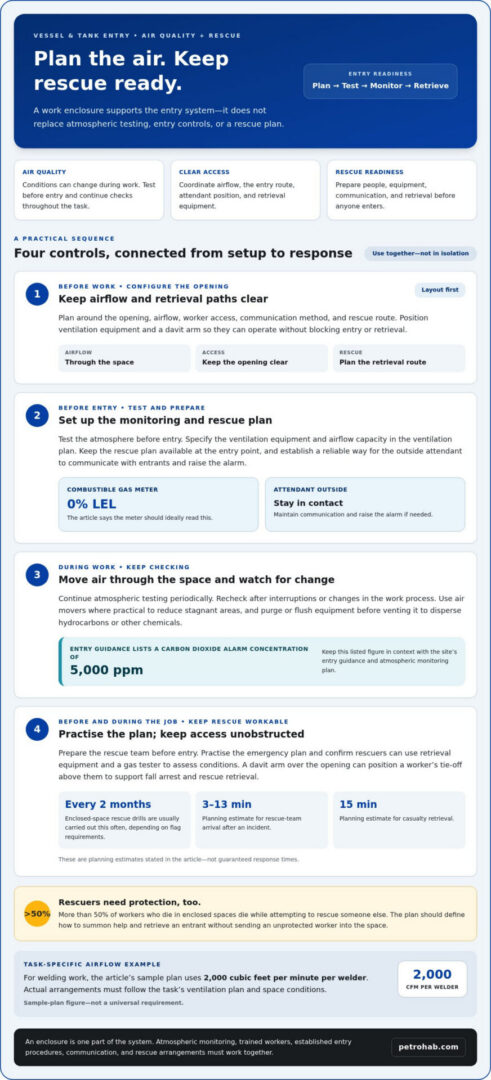
Air management continues throughout the job. Test the atmosphere before entry and periodically during work, because conditions can change as equipment, residues, or work activities affect the space. A combustible gas meter should ideally read 0% LEL. A ventilation plan should specify the equipment and airflow capacity needed for the work. These are sample-plan figures, not universal requirements.
For context on enclosed-space hazards and entry controls, watch this video:
Ventilation must move air through the space, not merely at its entrance. Use air movers where practical to reduce stagnant areas, and purge or flush equipment before venting it to disperse hydrocarbons or other chemicals. Maintain atmospheric testing during the task, including checks for changes after interruptions or work-process changes. A carbon dioxide alarm concentration of 5,000 ppm is listed in the entry guidance.
Rescue readiness depends on people, equipment, and access working together. Keep a standby attendant outside the opening to maintain communication and raise the alarm. The rescue plan should be available at the entry point and explain how the entrant will be retrieved. A davit arm positioned over the opening can place the worker’s tie-off above them, supporting fall arrest and rescue retrieval. Depending on the hazards, entrants may need a body harness and safety line, respirator, and protective clothing.
Prepare the rescue team before entry. Practise the emergency plan and confirm rescuers can use retrieval equipment and a gas tester to assess conditions. Enclosed-space rescue drills are usually carried out every two months, depending on flag requirements. Planning estimates place rescue-team arrival at 3 to 13 minutes after an incident, with casualty retrieval taking 15 minutes. Those intervals make a ready team and unobstructed access essential.
Ventilation also affects readiness. Keep the airflow plan coordinated with the entry route, attendant position, and retrieval setup. For welding work, the sample plan uses 2,000 cubic feet per minute per welder; actual arrangements must follow the task’s ventilation plan and space conditions.
Tank fall-protection planning should be integrated with air-quality management and rescue procedures, so protection measures support the whole task rather than entry alone. Fall-protection systems for tank work should account for entry and exit strategies, as well as the retrieval of workers during emergencies. Companies should develop an emergency rescue plan and conduct regular drills to check that the plan is effective. SOLAS Chapter III Regulation 19.3.6 is cited for emergency drill training requirements.
Confined-space rescue skills may include using emergency retrieval equipment and a gas tester to check whether tank entry conditions are safe. The guide estimates that the rescue team arrives at the scene 03 -13 minutes after an enclosed-space incident. These preparations help keep response actions coordinated with atmospheric assessment and the planned retrieval route, while allowing drills to reveal gaps before an actual emergency.
Entry and exit hazards in confined spaces
Plan entry around the task, space layout, materials, tools, worker competence, and emergency response. Because an enclosure changes the work area, assess its impact on access and exit routes before entry.
Other controls include ventilation, barriers, and entry procedures such as permits, atmospheric testing, and standby attendants. Each addresses specific hazards, but does not automatically replace an enclosure when the work requires one.
A permit-required confined space is governed in the United States by OSHA standard 29 CFR 1910.146. An enclosure may be considered when the work introduces hazards, such as hot work, that need additional control; the space’s classification and site procedures guide the decision.
OSHA standard 1910.146(g)(1) requires training for covered employees to perform assigned confined-space duties safely. Site procedures can add controls for materials, ignition sources, access, and inspection. Choose enclosure material based on the task and exposure; fire-resistant materials are relevant for hot work, but no single fire rating suits every entry.
Warning Signs and Nearby Vapor Hazards
Warning signs identify an active vessel entry and alert nearby workers to access restrictions and potential hazards. Place them where people can see them before reaching the opening. Nearby vapor releases can affect the work area and complicate entry, so include surrounding equipment and activities in the hazard assessment. Signs support safety controls, but do not replace atmospheric testing or work authorization.
Assess the entire entry operation before work starts. Map the route between the work area and opening, identify obstructions, and check whether hoses, cables, tools, or enclosure panels could narrow the path. Curved or sloped tank walls can increase fall risks inside the tank. Allow entry only for authorized, competent workers, and establish a rescue method before anyone enters.
Rescue risk extends beyond the person inside. More than 50% of workers who die in enclosed spaces die while attempting to rescue someone else. Unplanned entry can expose rescuers to the same atmosphere or access hazards. The emergency plan should define how assistance is summoned and how retrieval can proceed without sending an unprotected worker into the space.
Rescue Access and Emergency Egress
Rescue access and emergency exit describe how entrants leave and rescuers reach them through the entry route. Position enclosure components so they do not block the opening, retrieval equipment, or an entrant’s path out. Confirm that attendants can reach the opening and communicate with entrants. A clear route matters during routine exits and emergencies, when obstructions can delay retrieval.
Inspect the setup before each entry and after any change to the enclosure, ventilation arrangement, or work area. Check access panels, seams, anchorage, and equipment placement for damage or obstruction. Record defects and correct them before work resumes. For project-specific enclosure considerations, review vessel-entry enclosure information.
Outside watchers and worker communication
A competent outside attendant monitors the work environment and stays in contact with workers inside. During industrial tank entry, this means watching the opening, tracking changing conditions, and knowing how to raise an alarm without leaving the post unattended.
Position the attendant where they can see the entry point and communicate with the entrant. If the tank shape blocks direct sight, agree on another reliable communication method before work starts. Make sure both parties understand the signals, including how the entrant will report discomfort, equipment problems, or a need to exit. A missed signal should prompt a defined response, not guesswork.
Set communication expectations during the pre-entry briefing. Identify who is entering, who is watching, and who receives an emergency call. Agree on check-ins and clear phrases for routine status updates, stopping work, and evacuation. For example, if an entrant reports a ventilation problem, the attendant should relay the message through the designated channel and follow the site response plan. Avoid improvised signals that another crew member could mistake for routine conversation.
The attendant has an active role: observe the opening and nearby work, listen for messages, and alert the responsible team when conditions or the work plan change. They should not take on duties that distract from monitoring. Before entry, clarify who can authorize a pause, who summons rescue support, and how the entrant will be accounted for if communication fails.
Communication equipment and enclosure layout must work together. Keep cables, hoses, and panels clear of the attendant’s position and the entry route. Test radios or other selected devices before entry, and agree on a backup signal in case the primary method fails. The method must work in the actual environment, including where equipment noise or enclosure materials affect speech or visibility.
Use a concise handover when attendants change. The outgoing attendant should brief the replacement on entrant status, current work, known hazards, the communication method, and any unresolved issues. The incoming attendant should acknowledge the handover before taking the post. If required communication cannot be maintained, stop entry activity and follow the site procedure until monitoring is restored.
Record key communication arrangements in the entry plan, including the attendant’s identity, agreed contact method, escalation steps, and the person coordinating the emergency response. This gives the crew a shared reference rather than relying on memory. A clear plan helps the attendant recognize and promptly communicate developing problems, while keeping the entrant connected to support outside the space.
Toxic gas and oxygen-deficient atmospheres
A tank opening doesn’t reveal the atmosphere inside. Oxygen can be deficient, while toxic or combustible gases may be present without visible warning. RightShip’s assessment counted 31 enclosed-space incidents among 360 incidents assessed, with 39 lives lost in enclosed-space incidents since 2019. These figures show why entry decisions must rely on instrument readings, not assumptions about the space.
Use a suitable portable instrument to test the atmosphere before entry and monitor it as work continues. The acceptable oxygen range in the guide is 19.5% to 23.5%; normal air contains 21% oxygen. The guide also lists 10 ppm of hydrogen sulphide as a concentration that can cause nausea and eye irritation. Extended exposure to hydrogen sulphide concentrations of 50 ppm and over can cause death.
Other gases require separate attention. The guide lists alarm concentrations of 35 ppm for carbon monoxide, 0.5 ppm for chlorine, 3.0 ppm for nitrogen dioxide, 25 ppm for ammonia, and 0.1 ppm for ozone. A single reading cannot represent every hazard. Select instruments for the contaminants expected in the vessel, and check oxygen and atmospheric changes while work is underway.
Combustible-gas results also affect the entry decision. The guide lists 10% of the lower explosive limit as the alarm concentration for flammable or combustible gas. It says a space with more than 1% of the lower flammable or explosive limit on a combustible gas indicator should not be entered. These thresholds are not interchangeable. Follow the applicable entry procedure and act on the instrument’s readings before an entrant crosses the opening.
Instrument selection is addressed by IMO MSC. 1/ Circ.1477 for portable atmosphere-testing instruments in enclosed spaces. SOLAS Chapter XI 1, Regulation 7 is also cited for enclosed-space atmosphere-testing instruments. Workers must understand how to operate breathing gear before entry. A respirator doesn’t make an untested atmosphere acceptable, and an enclosure doesn’t establish that the air inside is safe.
Changing conditions require a clear response. If readings move outside the permitted range or an instrument alarms, stop work, alert the attendant, and have entrants leave by the planned route. Never send an unprotected worker inside to investigate. RightShip’s records include fatal enclosed-space events involving toxic gas, fumigant inhalation, and asphyxiation. Each hazard calls for appropriate detection, trained entrants, and a rescue plan suited to the vessel and its atmosphere.
What OSHA rules apply to vessel and tank entry enclosures?
In the United States, OSHA’s permit-required confined-space standard is 29 CFR 1910.146. It governs entry procedures, not a standalone enclosure specification. An enclosure therefore belongs within the broader entry-safety plan, alongside hazard evaluation, atmospheric controls, communication, and rescue arrangements.
Under OSHA standard 1910.146(g)(1), employers must train covered employees to perform their assigned confined-space duties safely. Training should match each person’s role. For example, entrants need to understand their entry instructions, while attendants must understand their monitoring and communication responsibilities. Rescue personnel need preparation for the tasks assigned to them.
When using an enclosure for vessel or tank work, assess how its position affects the entry opening and surrounding work area. Panels, ventilation equipment, hoses, and cables must not obstruct the route or interfere with the entry plan. The enclosure does not replace the permit, atmospheric testing, or emergency procedures required for the space.
OSHA compliance depends on the specific work and space. Identify hazards associated with the task, equipment, and materials, then document controls as part of the entry process. If hot work is planned, coordinate its controls with the confined-space plan. A welding permit or site procedure may apply to the task, but it does not replace confined-space entry requirements.
State-plan requirements and site procedures can shape how a U.S. worksite implements its safety program. Include the enclosure review in job planning: identify who authorizes entry, monitors the work, handles communication, and initiates an emergency response. Make responsibilities clear to everyone on the entry team.
Before work begins, review the permit and confirm that the enclosure setup supports the documented controls. Check that the opening remains accessible, ventilation works as planned, and rescue equipment can reach the entrant. Train workers on the equipment and procedures they will actually use, rather than relying on general awareness alone. Reassess the setup if the task, atmosphere, or work area changes.
OSHA’s confined-space rule provides a framework for safe entry, while the enclosure must fit the space and work plan. To discuss an enclosure for vessel-entry work, review vessel-entry enclosure options.
Fall protection may also be relevant around vessel and tank entry enclosures. Under OSHA general-industry rules in the United States, the Occupational Safety and Health Administration (OSHA) requires fall protection at 4 feet or more above a lower level. Under OSHA construction rules in the United States, the Occupational Safety and Health Administration (OSHA) requires fall protection at 6 feet above a lower level. In the United States, an open vertical entry in a walking-working surface must be guarded or covered under 29 CFR 1910.28(b)(3).
Companies should maintain a zero-tolerance policy for unplanned confined-space entries that violate company safety rules. Where work requires PPE, U.S. OSHA standard 1910.132(f)(2) requires each affected employee to demonstrate understanding of the required PPE training and the ability to use PPE properly before doing that work. Include these considerations in the entry team’s preparation, and ensure the enclosure arrangement does not undermine the applicable protections or the established safety rules.
PetroHab: PetroHab Hot Work Safety Enclosure (HWSE)
PetroHab LLC manufactures, leases, and sells Hot Work Safety Enclosures (HWSEs) for hazardous industrial environments. Its Petro-Habitat™ Hot Work Safety Enclosure is designed for pressurized hot work, including welding inside vessels and tanks. It complements, but does not replace, confined-space permits, atmospheric testing, communication, or rescue procedures.
PetroHab LLC also offers pressurized welding enclosures and the Safe-Stop Automatic Shutdown System, which monitors gas levels and pressure. Quadra-Lock Panels use patented technology, while the enclosures use fire-resistant materials. These offerings address specific hot-work containment and monitoring needs; selection should align with the task and site controls.
For vessel or tank work involving hot work, contact PetroHab LLC to discuss its enclosure options and lease or sale arrangements, or visit petrohab.com.
Define the Enclosure Scope for Your Next Entry
Before the next vessel or tank job, turn the work plan into clear enclosure requirements. Identify the hot-work activity, site conditions, and interfaces with existing entry controls. A safety enclosure for vessel and tank entry should suit the operation, not substitute for the permit process or rescue planning. This job-specific review helps determine whether an enclosure belongs in the scope and what equipment should support it.
PetroHab offers the Petro-Habitat™ Hot Work Safety Enclosure (HWSE), the Safe-Stop Safety Shutdown System, and Quadra-Lock® panels. Safe-Stop monitors differential pressure and gas levels, while the enclosure provides a controlled space for hot work. Consider these products alongside the hazards and controls identified for your job.
Bring your planned application into the next discussion and identify the enclosure requirements that matter to your operation. Contact PetroHab about entry enclosures to discuss a suitable path forward for your work.
Frequently Asked Questions
What is a safety enclosure for vessel and tank entry?
A safety enclosure for vessel and tank entry creates a defined work area around vessel or tank operations and can contain hot work within a controlled boundary. It can help separate the activity from surrounding operations, but it does not establish that the tank atmosphere is safe or replace entry controls. For example, welding inside a vessel still requires task-specific atmospheric controls and an entry plan.
What ventilation and air monitoring are required inside a tank-entry enclosure?
Ventilation and monitoring must suit the space, work activity, and potential contaminants. Plan airflow to reach the work area and reduce stagnant pockets, then test the atmosphere before entry and monitor it during work. Select instruments for expected hazards, such as oxygen deficiency, combustible gas, or toxic contaminants. If readings change or alarms activate, stop work and follow the site response plan.