Blog Posts
Critical Pressurized Habitat Mistakes: Engineering a Zero-Ignition Environment in 2026
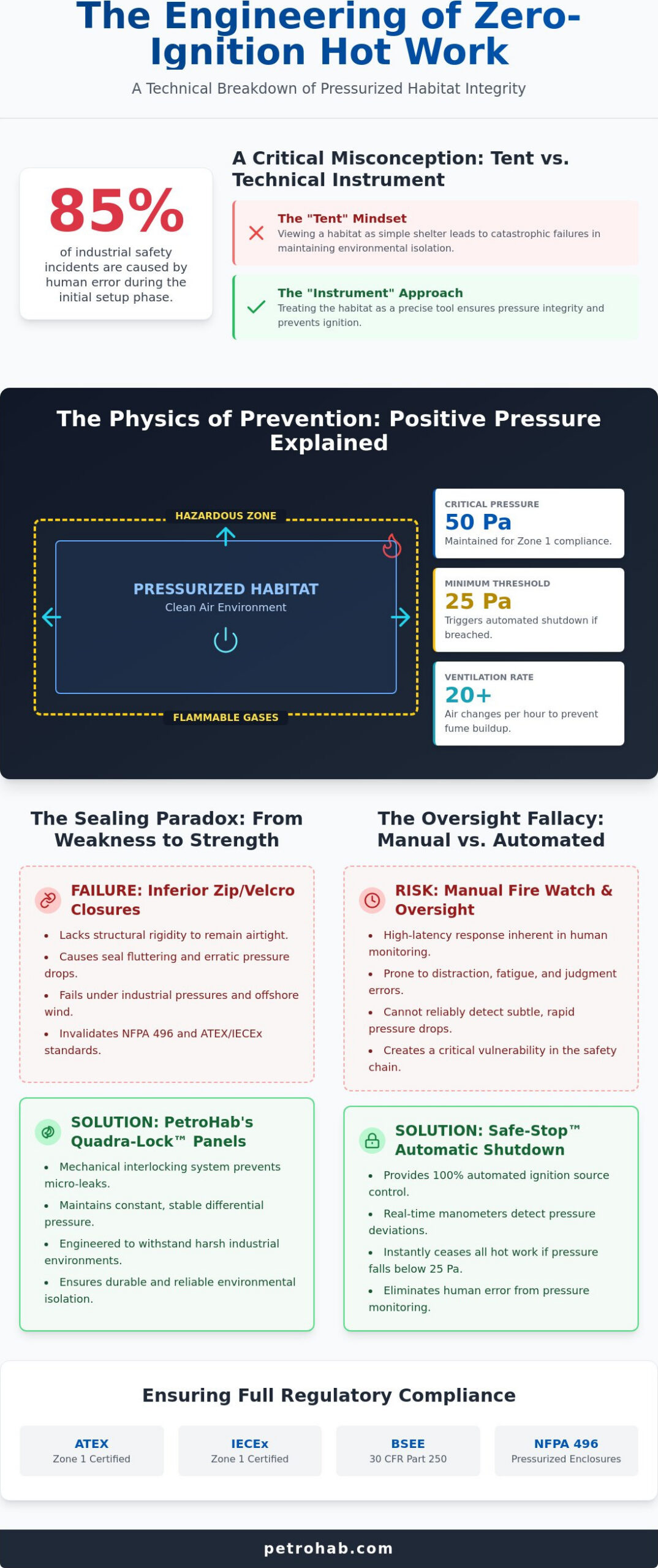
Eighty-five percent of industrial safety incidents are caused by human error during the initial setup phase. In the high-stakes environment of heavy industry, treating a pressurized welding enclosure as a basic tent rather than a precise technical instrument is a catastrophic mistake. You understand that maintaining a constant differential pressure is the only way to safeguard personnel and high-value assets during hot work. This article identifies the technical and operational failures that compromise habitat integrity and lead to regulatory non-compliance. We’ll examine how advanced pressurized habitat safety features, such as the Safe-Stop automatic shutdown system and Quadra-Lock panels, rectify these engineering oversights. You will gain a roadmap for achieving zero-ignition incidents while ensuring seamless integration with your digital Permit-to-Work systems. PetroHab LLC provides the technical data required to maintain strict compliance with 2026 ATEX and IECEx Zone 1 standards. By replacing manual oversight with 100 percent automated ignition source control, you protect your refinery turnaround from costly unplanned downtime and shield your team from the hazards of 1,500°F molten slag.
Key Takeaways
- Master the physics of positive pressure to ensure your enclosure functions as a definitive environmental barrier rather than a simple welding tent.
- Identify critical pressurized habitat safety features that automate ignition source control and eliminate the latency inherent in manual fire watches.
- Resolve the ‘Sealing Paradox’ by utilizing Quadra-Lock modular panels to prevent hazardous gas ingress at interface gaps and penetration points.
- Ensure full regulatory compliance with ATEX and IECEx Zone 1 standards by integrating Safe-Stop technology into your Permit-to-Work systems.
- Learn to identify and rectify makeshift sealing failures that compromise habitat integrity and lead to costly refinery downtime.
Why Positive Pressure Is the Only Barrier Between Routine Work and Catastrophe
A pressurized habitat functions as a sophisticated environmental isolation system, engineered to permit grinding and welding in areas with potential hydrocarbon presence. Unlike standard physical shielding, this system creates an impenetrable barrier by utilizing active ventilation to maintain an internal density higher than the surrounding atmosphere. This fundamental mechanism of a positive pressure enclosure ensures that flammable gases are physically prevented from entering the work area where ignition sources exist. For safety managers, understanding the engineering behind these pressurized habitat safety features is essential for effective risk mitigation. PetroHab LLC maintains that a 50 Pascal (Pa) differential is the critical line of defense for Zone 1 compliance, as detailed in The Definitive Guide to Hot Work Safety Enclosures (HWSE) in 2026. This pressure ensures that air flows outward through any potential leak path at a velocity that prevents the diffusion of external contaminants.
The Fluid Dynamics of Ignition Prevention
Air velocity at the enclosure seals acts as a kinetic wall against gas ingress. In the context of 2026 standards, differential pressure is defined as the precisely measured variance between the internal containment atmosphere and the external ambient environment. High-precision manometers transmit this real-time data to the Safe-Stop system, which monitors for any deviation below 25 Pascals. This automated oversight ensures that the isolation barrier remains active even during the pressure fluctuations common on offshore platforms. By maintaining at least 20 air changes per hour, the system prevents the stagnation of air and ensures that the internal environment remains breathable and free of localized fume buildup.
Regulatory Risks of Pressure Loss
Pressure decay is more than a technical anomaly; it’s a breach of ATEX and IECEx Zone 1 certifications. If internal pressure drops below mandated levels, the Permit-to-Work (PTW) is instantly invalidated, necessitating an immediate cessation of all hot work. PetroHab LLC recognizes that such failures expose safety managers to significant legal liabilities and the operator to massive financial losses from production halts. For offshore operations, the Bureau of Safety and Environmental Enforcement (BSEE) mandates specific protections when welding occurs within 10 feet of pressurized equipment, as per 30 CFR Part 250. Utilizing Quadra-Lock panels prevents the micro-leaks that lead to these regulatory breaches, ensuring the habitat remains a durable safety instrument throughout the project duration.
The Sealing Paradox: How Modular Interface Gaps Compromise HWSE Integrity
The ‘Sealing Paradox’ describes a fundamental engineering challenge: the modularity required for complex refinery setups often introduces the very leak paths that compromise environmental isolation. When pressurized habitat safety features rely on inferior zip or Velcro closures, they fail to sustain the mechanical tension generated by high-pressure industrial blowers. These fasteners lack the structural rigidity to remain airtight when external wind speeds fluctuate or internal air-handling units increase output. In offshore environments, this lack of mechanical interlocking leads to seal fluttering, which causes erratic pressure drops and eventually invalidates the NFPA 496 standard for purged and pressurized enclosures. Engineering out these gaps is the only way to ensure the habitat functions as a reliable safety instrument rather than a simple welding tent.
Mechanical failure in habitats without rigid seals is particularly prevalent in offshore wind conditions. The constant vibration of drilling decks and the force of the pressure buffer itself push standard fabric interfaces to their limit. If the panels don’t interlock, the outward force of the positive pressure creates micro-gaps at every seam. These gaps allow the pressurized air to escape faster than the blower can replenish it, leading to a total loss of the safety barrier. PetroHab LLC recognizes that a habitat is only as secure as its weakest interface, which is why modularity must be balanced with absolute structural continuity.
Material Integrity: Fire-Resistance vs. Fire-Proof
Panel materials must do more than just hold air; they must maintain structural integrity under extreme thermal stress. We utilize ANSI/FM 4950 certified fabrics that resist degradation when exposed to continuous 1,000°F temperatures. Inferior materials become brittle over time, creating microscopic fissures that allow air to escape from the pressure buffer. These micro-leaks are often the root cause of ‘nuisance trips’ in automated systems, as the blower struggles to compensate for invisible structural decay. Ensuring your panels are truly fire-resistant rather than merely flame-retardant is a critical step in long-term asset protection and air retention.
The Quadra-Lock Solution for Panel Interfacing
PetroHab LLC engineered the Quadra-Lock panel to resolve the structural vulnerabilities of modular habitats. Unlike standard overlapping methods that rely on friction or adhesive strips, Quadra-Lock uses a patented mechanical interlock that creates a continuous, airtight seal across all modular interfaces. This system eliminates the ‘Sealing Paradox’ through mechanical interlocking that transforms individual modular panels into a singular, structurally sound containment unit. In high-vibration environments, this rigid connection prevents the micro-shifting that leads to pressure loss. For operators seeking a definitive remedy for interface leakage, the PetroHab Hot Work Safety Enclosure provides the most resilient structural foundation available in 2026.
The Fallacy of Manual Oversight: Why Automated Shutdown Systems are Non-Negotiable
A fire watch is a critical personnel requirement, but it isn’t a technical safety barrier. The common industry objection that a diligent observer can manually monitor a manometer and Lower Explosive Limit (LEL) levels ignores the fundamental physics of gas migration. In a high-pressure environment, the latency gap between gas detection and ignition is measured in milliseconds. Human reaction time, even for a trained professional, typically exceeds three to five seconds when factoring in perception, processing, and physical intervention. By the time a manual fire watch identifies a pressure drop or a gas spike, the ignition source has already been exposed to the hazard.
The Safe-Stop automatic shutdown system eliminates this latency. It functions as an uncompromising guardian that monitors pressurized habitat safety features with electronic precision. Unlike human oversight, an automated system doesn’t experience fatigue or distraction. It provides a definitive fail-safe by linking environmental sensors directly to the power supply of all hot work equipment. For a deeper technical exploration of these integrated protections, consult A Comprehensive Guide to Advanced Hot Work Safety Systems in 2026, a standard developed by PetroHab LLC to eliminate human error.
Sensor Placement and Calibration Failures
Technical failure often stems from improper LEL sensor positioning. If sensors are placed without regard for prevailing wind direction or gas density, they may fail to detect a plume before it enters the air intake. PetroHab LLC mandates dual-sensor redundancy. This ensures that both internal habitat pressure and external gas concentrations are monitored from multiple points. Manual logs often overlook calibration drift, where sensor sensitivity decays over time. Automated systems detect these discrepancies during startup, preventing the use of compromised equipment that a manual fire watch would assume is functional. This technical rigor is essential for maintaining the integrity of the containment barrier.
Safe-Stop: The Technical Anatomy of a Shutdown
The Safe-Stop system integrates directly with welding machines and power tools to cut electricity in less than one second upon detection of a hazard. When internal pressure drops below the 25 Pascal threshold or gas levels reach 10% LEL, the system initiates a structured sequence. First, it triggers an audible 100-decibel alarm to alert personnel. Simultaneously, it isolates the power source and shuts down the air-handling unit to prevent further gas intake. Precision engineering allows for smart threshold management, which reduces nuisance trips that cause unnecessary downtime while maintaining an absolute safety envelope. This level of control is impossible to replicate through manual observation. By utilizing Quadra-Lock panels to minimize leaks, PetroHab LLC ensures the Safe-Stop system can focus on genuine atmospheric threats rather than compensating for structural failures.
Operational Failures in Enclosure Penetrations and Atmospheric Control
Structural integrity provides the foundation, but operational execution determines whether a habitat remains a safety barrier or becomes a liability. Penetration points, including structural beams, pipes, and cable trays, represent the primary sites for pressure leakage in modular setups. Many operators attempt to resolve these gaps using makeshift materials like duct tape, rags, or standard plastic sheeting. These materials fail instantly under the thermal stress of welding or the mechanical force of high-velocity air. They provide zero resistance to hydrocarbon ingress and compromise the entire pressure buffer. PetroHab LLC maintains that relying on such uncertified solutions is a direct violation of offshore safety protocols.
Effective atmospheric control requires more than just high-volume blowers. It demands a strategic air ducting configuration that facilitates a fresh air sweep across the entire internal volume. This prevents the accumulation of toxic welding fumes and the pooling of heavier than air flammable gases. When selecting a vendor, you must verify their ability to provide specialized pressurized habitat safety features that address these granular operational risks. For detailed criteria on vendor selection, review our guide on Choosing the Right Hot Work Safety Enclosure Suppliers.
The 5-Step Protocol for Habitat Integrity
Rigorous adherence to a standardized assembly protocol eliminates the 85 percent of safety incidents caused by human error during setup. Our technical team recommends the following sequence:
- Step 1: Conduct pre-work atmospheric testing and establish baseline pressure logging to calibrate the Safe-Stop sensors.
- Step 2: Secure Quadra-Lock panels and verify seal tension across every modular interface to eliminate micro-gaps.
- Step 3: Seal all penetrations using specialized fire-resistant sleeves and high-temperature gaskets designed for industrial geometries.
- Step 4: Verify Safe-Stop connectivity to all ignition sources and conduct a full system function test to ensure shutdown latency is under one second.
- Step 5: Document the finalized setup in the digital Permit-to-Work system to create a verifiable audit trail for safety compliance.
Managing Air Exchange Rates
Calculating the required Cubic Feet per Minute (CFM) is a balancing act between fume extraction and positive pressure maintenance. Excessive extraction can create a vacuum effect that compromises the 50 Pascal threshold, while insufficient flow allows dead spots to form where hazardous gases pool despite the overall positive pressure. The Air Exchange Rate is the mandatory requirement for a minimum of 20 air changes per hour (ACH) within a Hot Work Safety Enclosure to ensure the continuous removal of hazardous fumes and the maintenance of a breathable atmosphere. To ensure your site meets these rigorous 2026 standards, contact PetroHab LLC for a technical consultation on your specific enclosure and pressurized habitat safety features.
PetroHab LLC’s Engineered Solution: Achieving Zero-Ignition Through Quadra-Lock and Safe-Stop
Engineered systems transform safety from a variable human performance into a constant technical state. By integrating the Safe-Stop automatic shutdown system with Quadra-Lock panels, PetroHab LLC eliminates the inherent structural and operational failures that compromise standard enclosures. Our mission is to provide an uncompromising barrier that achieves zero-ignition incidents in the most hazardous industrial environments. We act as a strategic partner in global safety compliance, ensuring that your facility meets the highest international benchmarks for hot work protection. This approach moves beyond simple equipment rental; it establishes a rigorous safety culture backed by technical precision.
The durability of Quadra-Lock panels is proven in the harshest offshore environments. From the high-velocity winds of the North Sea to the extreme humidity of the Gulf of Mexico, these panels maintain their integrity. These pressurized habitat safety features are rated to withstand continuous temperatures of 1,000°F and intermittent exposure to molten slag up to 1,500°F. This resilience ensures that the isolation barrier remains impenetrable throughout the duration of the hot work permit, regardless of external conditions.
Modular Scalability Without Safety Compromise
PetroHab LLC systems adapt to complex platform geometries without creating the leak paths common in inferior setups. The 1-meter by 1-meter Quadra-Lock panels provide the structural rigidity needed for high-vibration drilling decks. These modular components allow for custom configurations around existing infrastructure while maintaining a definitive environmental seal. For short-term refinery turnarounds, equipment leasing provides a cost-effective solution for immediate mobilization. Conversely, multi-year maintenance programs benefit from the ownership of a standardized safety fleet. With regional hubs in Houston, Dundee, and Brazil, PetroHab LLC ensures rapid deployment and technical support for global operations.
Ensuring Long-Term Asset Protection
The Return on Investment (ROI) of an advanced HWSE is realized by preventing a single hour of unplanned downtime. Industry benchmarks indicate that offshore downtime costs operators upwards of $25,000 per hour. Beyond immediate production saves, utilizing certified PetroHab LLC systems reduces corporate liability and can lower insurance premiums by demonstrating a commitment to the highest standards of due diligence. Our technology protects personnel and high-value assets from the catastrophic financial and physical consequences of a hot work fire. We recommend conducting regular safety audits to ensure your site adheres to the latest Hazardous Environment Standards. The future of industrial protection lies in smart habitats that utilize integrated digital monitoring to provide a permanent, verifiable audit trail of environmental integrity throughout 2026 and beyond.
Securing Your Operational Future with Precision Engineering
Achieving a zero-ignition environment requires a transition from passive shielding to active, engineered containment. You’ve seen how modular integrity relies on mechanical interlocking rather than inferior adhesives; similarly, you understand why automated systems must replace the latency of manual fire watches. Maintaining a 50 Pascal pressure barrier is the only verified method to ensure Zone 1 compliance and protect high-value assets from hydrocarbon ingress. By addressing the technical failures in penetration sealing and atmospheric control, you eliminate the primary causes of safety incidents and unplanned refinery downtime.
PetroHab provides the industry standard in pressurized habitat safety features through our ATEX and IECEx certified systems. Trusted by global supermajors, our patented Quadra-Lock technology ensures structural stability in the most demanding offshore conditions. These systems don’t just meet regulatory requirements; they establish a new benchmark for industrial reliability. You can secure your site today by opting for technology designed to fail-safe every time. Request a Technical Consultation and Quote for PetroHab HWSE Systems to begin your transition to a zero-ignition workspace. We stand ready to partner with your team to maintain the highest levels of site safety and operational excellence.
Frequently Asked Questions
What is the most common cause of pressure loss in a welding habitat?
Improperly sealed penetration points like pipes, beams, and cable trays are the primary causes of pressure decay in modular setups. Using makeshift materials like duct tape or rags fails to maintain the required internal density, leading to immediate pressure loss. You must use specialized fire-resistant sleeves and high-temperature gaskets to ensure these interface points don’t compromise the 50 Pascal safety threshold during operations.
Can I use a pressurized habitat in a Zone 0 environment?
No, pressurized habitats are engineered specifically for Zone 1 or Zone 2 environments where explosive atmospheres occur occasionally. Zone 0 areas contain continuous concentrations of flammable gases, making the introduction of any ignition source, even within an enclosure, a violation of international safety standards. These systems are designed to isolate hot work from intermittent hazards, not to operate within a permanent explosive plume.
How often should gas sensors in a pressurized habitat be calibrated?
Gas sensors must undergo a function test and calibration check at the start of every shift or mobilization phase to ensure maximum reliability. This rigorous protocol ensures that the Safe-Stop system accurately detects LEL concentrations at the 10% and 25% thresholds. Frequent calibration compensates for any technical decay or environmental drift, maintaining the integrity of your digital Permit-to-Work audit trail.
What is the difference between a fire-resistant and a fire-proof habitat panel?
Fire-resistant panels, such as those used in a PetroHab HWSE, are designed to withstand specific thermal loads like 1,000°F continuous heat without structural failure. Fire-proof is often a misnomer in heavy industry; instead, look for ANSI/FM 4950 certification to ensure the material prevents flame propagation. High-quality panels must resist molten slag up to 1,500°F to protect personnel and high-value assets during heavy welding.
Why is an automatic shutdown system required for hot work in Zone 1?
Human reaction time is insufficient to prevent ignition when gas ingress occurs in a high-pressure environment. Automatic shutdown systems are critical pressurized habitat safety features because they cut power to ignition sources in less than one second. This eliminates the latency gap inherent in manual fire watches, providing a definitive fail-safe that human oversight simply cannot replicate in a high-stakes refinery environment.
How does the Quadra-Lock system improve habitat assembly time?
The Quadra-Lock system reduces assembly time by approximately 50-60% compared to traditional zip or velcro enclosures. Its modular, interlocking design allows technicians to secure 1-meter panels quickly without compromising the airtight integrity required for high-vibration offshore decks. This efficiency minimizes unplanned downtime during refinery turnarounds while ensuring a continuous, rigid seal that resists the mechanical stress of industrial blowers.
What happens if the pressure inside the habitat falls below 50 Pascals?
While 50 Pascals is the recommended operational baseline for Zone 1 safety, the Safe-Stop system triggers an audible 100-decibel alarm if pressure drops below 25 Pascals. If the pressure isn’t immediately restored, the system automatically isolates all power to welding machines and grinders. This structured sequence prevents the accumulation of hazardous gases within the enclosure, effectively engineering out the risk of a workplace accident.
Are pressurized habitats required for offshore welding projects by BSEE or OSHA?
Yes, BSEE mandates specific protections under 30 CFR Part 250 for welding conducted within 10 feet of pressurized equipment on offshore platforms. Utilizing pressurized habitat safety features allows operators to obtain necessary waivers for hot work that would otherwise be prohibited in proximity to live processes. These systems ensure full compliance with OSHA 1910.252 and NFPA 51B standards for onshore and offshore hot work operations.