Manometers for Pressurized Habitats: A Technical Reference for Hot Work Safety
A pressure drop of just 0.05 inches of water gauge can be the singular point of failure between a secure work environment and a catastrophic hydrocarbon ingress event. You recognize that maintaining the integrity of a Hot Work Safety Enclosure requires more than just a visual check; it demands precise instrumentation that functions without fail. Integrating high-accuracy manometers for pressurized habitats is the only way to verify that your positive pressure differential remains constant against external atmospheric hazards. It’s the standard expected for high-value asset protection and personnel safety.
Confusion over ATEX and IECEx requirements often leads to the selection of inadequate monitoring tools, which causes inaccurate readings or frequent false shutdowns. You don’t have room for error when managing ignition source control in hazardous environments. This technical reference serves as your definitive guide to selecting, installing, and maintaining manometers to ensure absolute regulatory compliance and operational safety. We’ll examine the specific calibration steps needed to meet OSHA 1910 standards, evaluate the role of patented seal technologies, and explain how to maintain habitat integrity under extreme offshore conditions.
Key Takeaways
- Understand the critical role of differential pressure as the primary barrier against hydrocarbon gas ingress in pressurized welding environments.
- Identify high-resolution technical specifications and sensitivity requirements when selecting manometers for pressurized habitats to maintain regulatory compliance.
- Compare analog and digital monitoring technologies to determine the most reliable solution for data logging and real-time alarm capabilities in hazardous zones.
- Implement professional best practices for pressure port placement and calibration to eliminate false readings and ensure habitat integrity.
- Discover how integrating pressure monitoring with the patented Safe-Stop system automates ignition source control for enhanced risk mitigation.
The Role of Differential Pressure Measurement in Hot Work Safety Enclosures
Differential pressure represents the physical delta between the internal atmosphere of a Hot Work Safety Enclosure (HWSE) and the external environment. In hazardous oil and gas facilities, this measurement isn’t merely a metric; it’s a life-saving barrier. Manometers for pressurized habitats provide the real-time data required to maintain overpressure, ensuring that the interior remains free of flammable vapors. By maintaining a higher pressure inside the enclosure than the ambient air, the system creates an invisible pneumatic shield. This shield prevents hydrocarbon gas from reaching ignition sources like welding arcs or grinding sparks.
The relationship between manometer readings and ignition source control is absolute. If a manometer indicates a drop in pressure, the integrity of the enclosure is compromised. PetroHab utilizes specialized manometers for pressurized habitats to validate the seal of its patented Quadra-Lock panels. These modular panels rely on precise interlocking mechanisms that, when properly pressurized, eliminate the risk of gas bypass. A steady manometer reading confirms that the interlocking system is functioning as engineered, providing a controlled environment for high-risk operations.
Preventing Ingress in Hazardous Zones
A minimum overpressure of 0.05-inch water column (wc) serves as the technical threshold required to prevent flammable gas ingress. In Zone 1 and Zone 2 environments, the physics of overpressure dictates that air moves from high-pressure areas to low-pressure areas. Maintaining this 0.05-inch wc ensures that even if a small leak occurs in the paneling, air will leak out rather than allowing hazardous gases to leak in. Failing to monitor this pressure during live plant operations can lead to catastrophic outcomes if a gas pocket reaches an active welding site. Constant monitoring is the only way to guarantee that the barrier remains effective against external atmospheric changes.
Regulatory Requirements for Pressure Monitoring
Compliance with NFPA 51B and OSHA 1910.252 mandates rigorous monitoring of hot work environments. Manometers serve as the primary validation tool during Permit-to-Work (PTW) safety checks, providing quantifiable evidence that the enclosure is fit for hot work. Safety managers rely on these readings to authorize high-risk activities in volatile sectors. For a deeper understanding of these protocols, consult The Definitive Guide to Hot Work Safety Enclosures (HWSE) in 2026. These standards ensure that every pressurized habitat functions as a robust defense against industrial accidents, protecting both personnel and high-value assets.
Technical Specifications: How Manometers Monitor Habitat Integrity
Precision monitoring is the foundation of pressure-dependent safety. High-performance manometers for pressurized habitats serve as the primary diagnostic tool for maintaining the integrity of a hot work safety enclosure. These instruments don’t just measure air; they validate the barrier between a controlled work environment and potential hydrocarbon hazards. Reliability in these systems is a prerequisite for any hot work permit on a live facility.
Operational success depends on the manometer’s ability to detect minute fluctuations before they escalate into safety breaches. PetroHab systems utilize these instruments to provide real-time data to the Safe-Stop automatic shutdown system. This integration ensures that if the pressure falls below the established safety threshold, all ignition sources are instantly isolated. Maintaining this gold standard in hot work safety requires a deep understanding of the technical parameters that govern pressure measurement.
Measurement Units and Sensitivity Standards
In the oil and gas sector, habitat pressure is typically measured in inches of water column (in. wc) rather than Pascals (Pa), though digital units often provide both. A standard pressurized habitat operates within a narrow window of 0.1 to 0.5 in. wc. This range is equivalent to approximately 25 to 125 Pa. High-resolution sensitivity is critical because a drop of only 0.05 in. wc can indicate a significant compromise in the Petro-Wall panels or a failure in the air intake system. Differential pressure is the variance between the internal habitat atmosphere and the external hazardous environment. Dual-port manometers are mandatory for this calculation, as they simultaneously sample the protected interior and the ambient deck pressure to provide an accurate net reading.
Ruggedization for Offshore and Refinery Use
The hardware must withstand the corrosive realities of salt spray and industrial chemicals. Manometers for pressurized habitats used in offshore environments require housings made from 316L stainless steel or high-impact, UV-stabilized polymers. Ingress Protection (IP) ratings are a non-negotiable metric for electronic components. An IP66 rating is the minimum requirement to ensure the device remains functional during heavy rain or wash-down procedures.
Environmental compensation is another vital technical requirement. Atmospheric changes, temperature shifts, and wind gusts can all impact pressure readings. For instance, a wind speed of 25 knots can create a localized pressure drop on the leeward side of a habitat. Advanced manometers filter this “noise” to prevent false alarms while maintaining a 100% response rate to genuine pressure losses. Integrating these specifications into your hot work safety protocols ensures compliance with the most rigorous international standards, including ATEX and IECEx requirements for Zone 1 and Zone 2 environments.
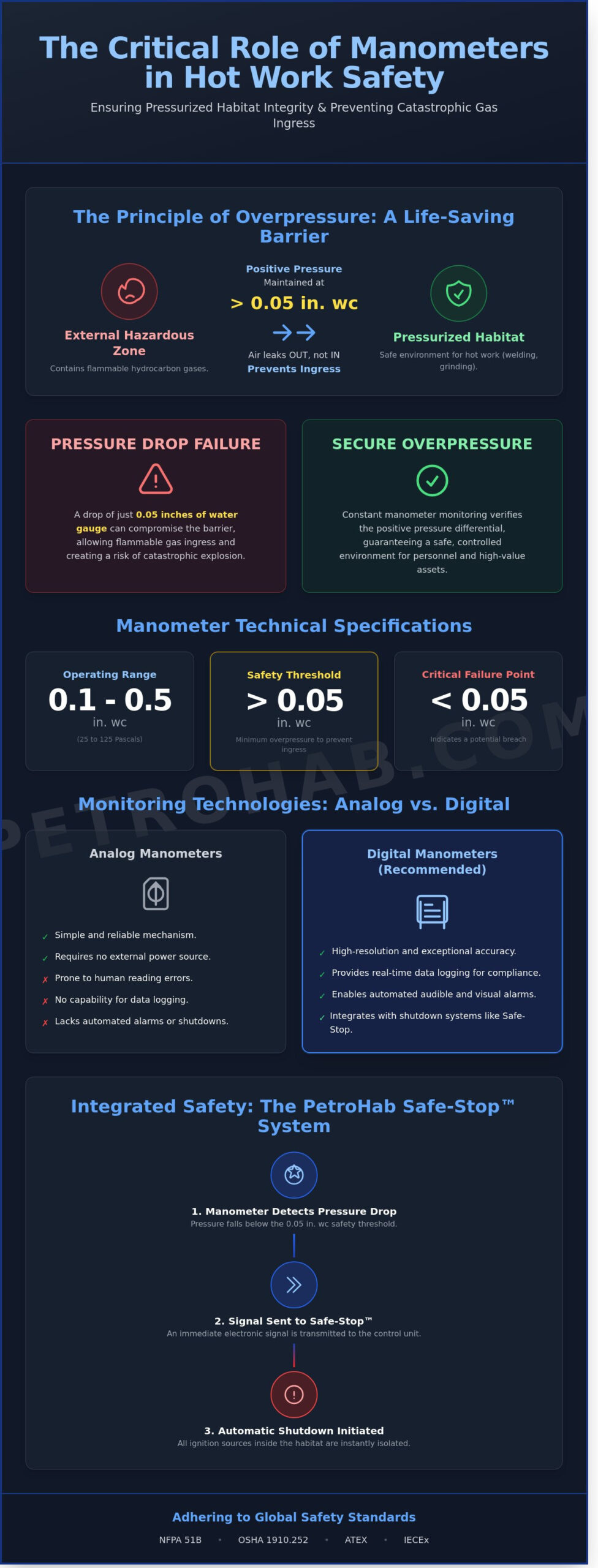
Comparing Manometer Technologies for Hazardous Zone Applications
Selecting the correct manometers for pressurized habitats involves a critical evaluation of mechanical reliability versus electronic precision. Analog Magnehelic gauges are favored for their durability and independence from power sources. They utilize a silicone rubber diaphragm and a magnetic linkage that provides a continuous reading without the risk of electronic failure. These gauges typically operate within a temperature range of 20 to 140 degrees Fahrenheit, making them resilient in most offshore environments. Their lack of internal circuitry makes them inherently safe for use in explosive atmospheres without complex certification requirements.
Digital manometers provide a higher degree of granularity. These devices often feature an accuracy rating of plus or minus 0.50 percent of the full scale. This precision is vital when monitoring the subtle pressure differentials required to maintain the integrity of a hot work safety enclosure. Digital units offer backlighting, which is an essential feature for visibility in the poorly lit or confined spaces common in industrial sites. They also allow for remote monitoring, sending real-time data to safety managers outside the immediate work area. Integrating these tools with an ATEX certified gas detection system ensures a comprehensive safety net that links pressure maintenance with atmospheric monitoring.
Performance in the Field
Field conditions often dictate the choice of technology. Analog gauges excel in environments with extreme temperature fluctuations where digital LCD screens might lag or fail. However, digital tools offer data logging capabilities that are indispensable for incident investigations. They provide a timestamped record of pressure levels, proving that the habitat maintained its 50 Pascal (0.20 inches w.c.) overpressure requirement throughout the duration of the hot work. This documentation is a key component of modern safety audits and risk management protocols.
ATEX and IECEx Certification Requirements
Electronic monitoring tools used in Zone 1 or Zone 2 locations must carry Intrinsically Safe (IS) ratings. Using non-certified electronic manometers introduces a potential ignition source into an environment where flammable vapors may be present. PetroHab ensures that all electronic components within our systems meet global standards like ATEX and IECEx. This commitment to compliance protects personnel by ensuring that even in a fault condition, the device cannot generate a spark or heat sufficient to cause an explosion.
Choosing between fixed-mount and handheld tools depends on the operational phase. Fixed-mount manometers provide the continuous, hands-free monitoring necessary during active hot work. They are often hard-wired into the Safe-Stop system to trigger an immediate shutdown if pressure falls below the safety threshold. Handheld manometers are better suited for the initial setup phase. Technicians use these portable tools to conduct spot checks and verify the seal integrity of Petro-Wall modular panels before work begins.
Operational Best Practices: Installation, Calibration, and Monitoring
Precision is the baseline for all hot work safety protocols. Without it, safety is an illusion. Utilizing manometers for pressurized habitats requires a meticulous approach to both hardware placement and data interpretation. If a manometer is installed incorrectly, it provides misleading data that can lead to catastrophic ignition in hazardous environments. Technicians must treat the manometer as the primary guardian of the enclosure’s integrity, ensuring every reading reflects the true pressure differential between the internal workspace and the external atmosphere.
Installation and Port Placement
Technicians must position pressure ports in areas of static pressure to avoid “dead zones” or false high readings. Ports should never be placed directly in the path of air intake or exhaust vents. High-velocity air movement near these openings creates Venturi effects that can artificially pull or push the pressure reading, resulting in errors of up to 0.02 in. wc. Optimal placement is usually mid-wall, at least three feet away from any forced-air source.
- Tubing Management: Keep impulse tubing lengths under 15 feet whenever possible. Long runs increase the risk of kinks and signal lag.
- Secure Mounting: Use modular attachments to fix the manometer to the habitat frame. This prevents vibration-induced drift and ensures the device remains level.
- Clear Pathways: Ensure the tubing is protected from heavy foot traffic or equipment movement that could crush the line.
Continuous Monitoring and Alarm Response
Maintaining a constant overpressure is the only way to prevent flammable gases from entering the workspace. The industry standard for a low-pressure alarm setpoint is 0.05 in. wc. This threshold provides a necessary buffer, allowing for minor fluctuations while ensuring the enclosure remains protected. Technicians shouldn’t just watch the numbers; they must understand the rhythm of the habitat. Sudden drops often indicate a seal failure or a door left open too long, while slow drifts often signal atmospheric pressure changes or temperature shifts.
The standard operating procedure (SOP) for any pressure drop below 0.05 in. wc is an immediate, non-negotiable halt to all hot work. Technicians must strike the arc only after the pressure is restored and stabilized for at least 60 seconds. Before starting any shift, a full calibration check is required. This involves venting the high-pressure port to the atmosphere to confirm the device returns to a true zero. If the device doesn’t zero out, it’s likely due to internal sensor drift or debris in the tubing, requiring immediate maintenance. For a deeper look at the systems that support these protocols, see our Pressurized Welding Habitats: The Definitive Guide to HWSE Technology.
To ensure your facility meets the highest standards of ignition source control, you can request a technical consultation with our safety engineering team today.
Beyond the Gauge: Integrated Pressure Monitoring in PetroHab Systems
Relying solely on visual readings from manometers for pressurized habitats introduces a margin for human error that modern hot work safety standards cannot accept. While analog gauges remain vital for local verification, PetroHab elevates habitat safety by integrating these measurements into an automated ecosystem. This transition from passive observation to active, automated ignition source control ensures that safety is never dependent on a technician’s constant attention. Our systems utilize a dual-layered approach where digital sensors work in tandem with analog manometers to provide a fail-safe environment for high-risk operations.
Redundancy is the cornerstone of our engineering philosophy. By employing both traditional manometers and advanced digital pressure transmitters, we ensure that monitoring continues even if one component fails. This integrated strategy eliminates the risks associated with manual logging and provides a real-time data stream that safety managers can rely on. High-value assets and human lives require the certainty that only an automated, integrated monitoring system can provide.
Safe-Stop Automatic Shutdown Integration
The Safe-Stop system represents the pinnacle of ignition source control technology. It functions by receiving continuous data from high-precision differential pressure sensors that monitor the habitat’s internal atmosphere. If the pressure falls below the mandatory threshold, typically 50 pascals or 0.2 inches of water gauge, the system initiates a countdown. The Safe-Stop system acts as the ‘brain’ that processes manometer data to protect the facility.
PetroHab utilizes a strict 60-second rule for sustained pressure loss. If the required overpressure is not restored within one minute, the Safe-Stop logic automatically terminates power to all welding machines, grinders, and other potential ignition sources. This protocol prevents the ingress of flammable gases before they can reach a dangerous concentration. By automating this response, we remove the hesitation and variability of human intervention, ensuring that the habitat remains a controlled environment regardless of external conditions.
The PetroHab Advantage in High-Stakes Environments
Our commitment to safety extends beyond the hardware. We combine the physical integrity of our patented Quadra-Lock panel system with the technical precision of our electronic monitoring suites. This synergy ensures that the enclosure doesn’t just hold pressure but actively communicates its status to the facility’s safety network. Our global support team provides on-site supervision to ensure that every manometer and sensor is calibrated and deployed according to rigorous ISO and ATEX standards.
Choosing PetroHab means investing in a system that maximizes project uptime by preventing accidental shutdowns caused by faulty readings or minor fluctuations. Our technical experts oversee the installation and operation of these systems, providing a level of oversight that is unrivaled in the industry. For operators who prioritize risk mitigation and operational excellence, our integrated solutions are the gold standard. Contact PetroHab for a quote on pressurized habitat rentals and integrated monitoring systems to secure your next hot work project.
Securing Industrial Integrity through Engineered Pressure Control
Maintaining a constant positive pressure differential isn’t just a procedural requirement; it’s the definitive barrier against hydrocarbon ingress. High-precision manometers for pressurized habitats serve as the central nervous system of any hot work safety enclosure, providing the data needed to maintain total ignition source control. PetroHab brings a decade of experience in global oil and gas safety to every project, ensuring that technical specifications meet the highest operational demands. Our patented Quadra-Lock technology provides unrivaled structural integrity, while our ATEX and IECEx compliant systems guarantee reliability in the most volatile hazardous zones.
Safety managers rely on these integrated technologies to protect personnel and high-value assets from catastrophic events. By prioritizing calibrated monitoring and robust installation practices, companies can eliminate the variables that lead to workplace accidents. We’ve spent 10 years refining these systems to act as an active guardian on your job site. It’s time to move beyond basic gauges and adopt a comprehensive safety solution that’s as resilient as your workforce.
Request a Technical Consultation for Your Next Pressurized Habitat Project
We look forward to helping you achieve the gold standard in hot work safety.
Frequently Asked Questions
What is the minimum positive pressure required for a welding habitat?
A minimum positive pressure of 0.1 inches of water column, which equals 25 Pascals, is the industry standard for a pressurized welding habitat. This pressure differential ensures that the internal atmosphere remains isolated from external flammable gases. PetroHab systems maintain this threshold to prevent hydrocarbon ingress as specified in IEC 60079-13 standards. If pressure falls below 0.05 inches of water column, the system triggers an immediate shutdown of all ignition sources to protect personnel and assets.
Do manometers for hot work habitats need to be ATEX certified?
Manometers for hot work habitats must be ATEX or IECEx certified when installed within Zone 1 or Zone 2 hazardous areas. Compliance with Directive 2014/34/EU ensures the instrument doesn’t become an ignition source itself. Using non-certified manometers for pressurized habitats violates global safety protocols and compromises the integrity of the enclosure. PetroHab utilizes only certified instrumentation to guarantee reliable monitoring in volatile offshore and onshore environments.
How often should a manometer be calibrated for offshore use?
Manometers require professional calibration every 12 months to maintain technical precision in harsh offshore conditions. Salt air and vibration can degrade sensor accuracy over time, so annual verification against ISO 17025 standards is necessary. PetroHab recommends checking zero-point calibration before every shift to ensure the 0.1 inch water column threshold is accurately monitored. Documented calibration records are essential for audit compliance and maintaining the gold standard in hot work safety.
Can a digital manometer be used in a Zone 1 hazardous area?
A digital manometer can be used in a Zone 1 hazardous area provided it carries an intrinsically safe rating, typically Ex ia or Ex ib. These devices are engineered to limit electrical and thermal energy to levels that can’t ignite a flammable atmosphere. PetroHab incorporates high-precision, intrinsically safe digital sensors into its monitoring arrays. These sensors provide real-time data to the Safe-Stop system, ensuring continuous protection without introducing new risks into the volatile environment.
What causes pressure fluctuations inside a hot work safety enclosure?
Pressure fluctuations within a hot work safety enclosure are typically caused by personnel movement through airlocks or changes in intake fan velocity. External wind speeds exceeding 25 knots can also create pressure differentials that affect the manometer readings. Minor leaks in the modular Petro-Wall panels or ducting obstructions are other common factors. Constant monitoring is required to adjust air flow and maintain the necessary 0.1 inches of water column to keep the enclosure secure.
Is an analog gauge better than a digital manometer for habitat monitoring?
Digital manometers are superior for habitat monitoring because they integrate directly with automated shutdown systems like Safe-Stop. While analog Magnehelic gauges provide a reliable visual backup, they lack the ability to trigger electronic alarms or log data for safety audits. Digital sensors offer a precision of +/- 0.01 inches of water column, providing much tighter control over the pressurized environment. PetroHab utilizes digital technology to ensure instantaneous response to any loss of pressure.
How does the Safe-Stop system use manometer data?
The Safe-Stop system continuously processes manometer data to maintain ignition source control within the habitat. If the pressure drops below the 0.05 inch water column safety limit, the system automatically terminates power to welding machines and tools within 0.5 seconds. This logic-driven response eliminates the human error factor during a pressure loss event. By linking manometer readings to the power supply, PetroHab ensures that hot work only occurs under verified, safe conditions.
What happens if the manometer shows a drop in pressure during welding?
When a manometer detects a pressure drop below the 0.05 inch water column setpoint, the system activates an audible and visual alarm. Simultaneously, the Safe-Stop system cuts power to all ignition sources to prevent a potential fire or explosion. Welders must stop work immediately and evacuate if the pressure can’t be restored within 30 seconds. This protocol preserves the integrity of the enclosure and protects the facility from the dangers of hydrocarbon ingress.