The Definitive Guide to Hot Work Safety Enclosures (HWSE) in 2026
A single ignition event in a Zone 1 environment represents a failure of engineering, not a failure of chance. You recognize that the $500,000 daily cost of a production shutdown is a heavy price to pay for minor repairs, yet the complexity of Permit-to-Work protocols exists for a reason. The risk of hydrocarbon ignition remains the primary threat to both your personnel and your facility’s structural integrity. Utilizing a hot work safety enclosure allows you to manage these risks with mathematical precision rather than administrative guesswork.
This guide delivers the technical specifications required to master pressurized welding habitats and ensure zero-incident operations throughout 2026. You’ll gain the expertise to maintain 100% compliance with ATEX and IECEx standards while preventing toxic gas ingress during critical maintenance. We’ll analyze the structural advantages of Petro-Wall modular panels and the automated response logic of Safe-Stop systems from PetroHab LLC. This technical overview establishes the definitive framework for performing hot work without halting production, backed by the industry’s most rigorous engineering standards.
Key Takeaways
- Understand the critical engineering behind positive pressure systems and integrated gas detection to maintain a secure environment in hazardous zones.
- Discover why modular, interlocking panel technology provides superior structural integrity and versatility compared to traditional zip-up welding habitats.
- Learn how to align your operations with global safety standards like ATEX and IECEx by implementing a certified hot work safety enclosure.
- Streamline your Permit-to-Work (PTW) process and reduce operational downtime through advanced ignition source control and real-time monitoring.
- Evaluate the total cost of safety to determine whether rental or purchase models best support your facility’s long-term risk mitigation strategies.
What is a Hot Work Safety Enclosure (HWSE)?
A hot work safety enclosure (HWSE) is a modular, pressurized environment engineered to isolate ignition sources from flammable gases in high-risk industrial zones. While early iterations in the late 1980s were simple “welding tents” made of heavy canvas, modern systems are sophisticated engineering solutions. These habitats now integrate advanced sensors and airflow management to meet rigorous ISO 9001:2015 standards. You’ll primarily find these systems protecting personnel and assets on offshore drilling platforms, at oil refineries, and within chemical processing plants where the margin for error is zero.
The core of an HWSE consists of several critical components that work in unison to maintain operational integrity. Our patented Petro-Wall fire-retardant panels provide the physical barrier, while a dedicated air intake system draws fresh air from a remote, “safe” location. Monitoring controls, such as our Safe-Stop system, continuously analyze the internal and external atmosphere to ensure the integrity of the habitat is never compromised. This level of technical precision is what differentiates a professional habitat from a mere physical screen.
The Problem: Why Hot Work is Inherently Dangerous
Industrial facilities operate within the constant presence of the “Fire Triangle”: fuel, oxygen, and an ignition source. In a hydrocarbon-rich environment, two of these elements are frequently present by default. Hot work tasks like welding, grinding, and torch cutting introduce the third element. A single spark from a grinder can reach temperatures exceeding 1,300°C and travel over 10 meters from the work site. Without containment, these molten particles or slag pose an immediate threat of explosion if they contact fugitive gas emissions or flammable liquids. The risk isn’t just a localized fire; it’s a catastrophic event that can compromise the entire facility’s structural integrity.
The Solution: How Enclosures Mitigate Risk
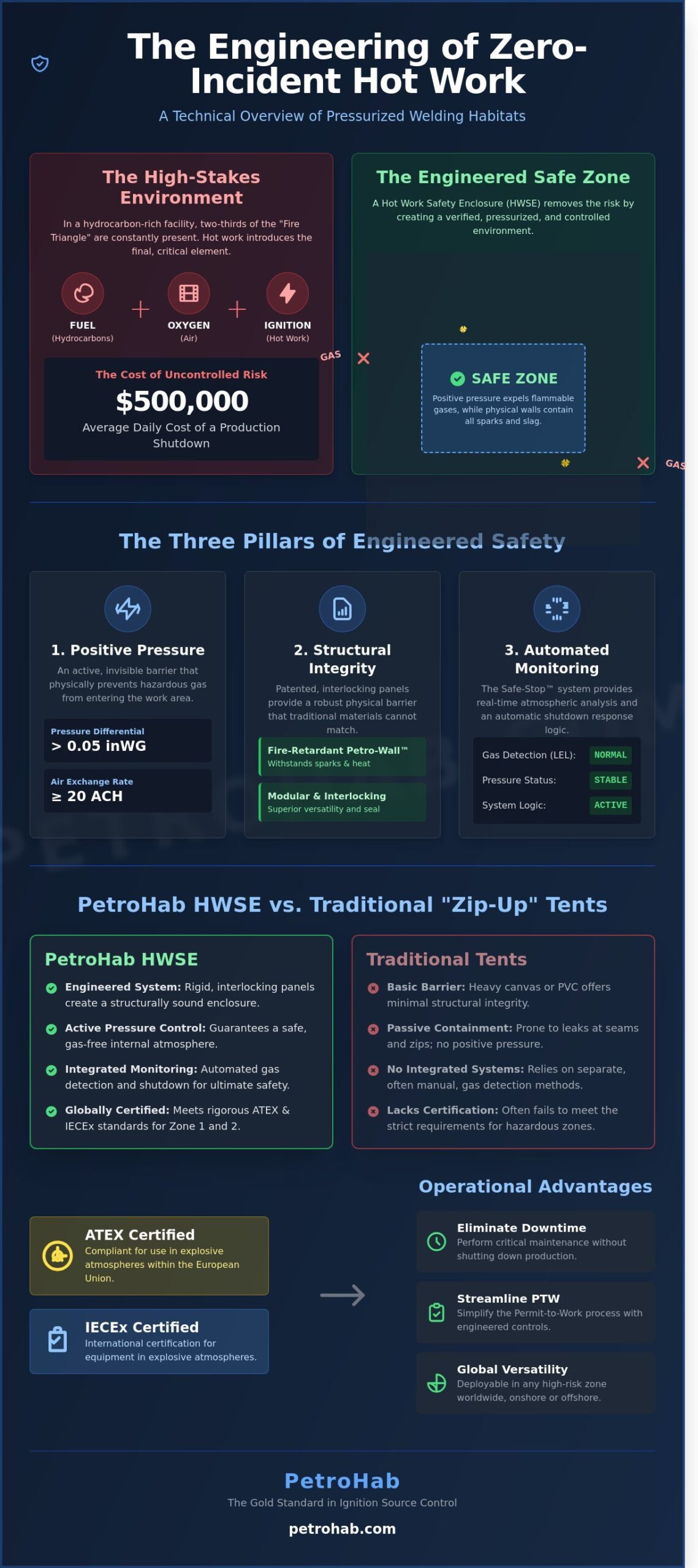
Mitigation requires more than just a physical shield. An effective positive pressure enclosure creates a verified “Safe Zone” within a classified hazardous area. This technology relies on a dual-layer defense strategy. First, the physical barrier contains sparks and slag at the source. Second, atmospheric control ensures that internal air pressure remains higher than the external environment. A hot work safety enclosure is a pressurized modular system that prevents the ingress of flammable gases. By maintaining this pressure differential, the system ensures that even if a gas leak occurs nearby, the hazardous vapors cannot enter the space where the ignition source is active.
- Physical Integrity: Panels must withstand continuous exposure to sparks and heat without degrading.
- Atmospheric Control: Gas detection systems must be calibrated to trigger an immediate shutdown if flammable gases are detected at the air intake.
- Compliance: Systems should adhere to ATEX or IECEx standards to ensure they’re safe for use in Zone 1 or Zone 2 environments.
This disciplined approach to safety transforms a volatile work site into a controlled environment. It allows critical maintenance to proceed without shutting down entire production lines, saving operators millions in potential lost revenue while maintaining the highest safety protocols. By utilizing a hot work safety enclosure, safety managers can authorize essential repairs with the confidence that they’ve implemented the gold standard in ignition source control.
The Engineering of Safety: Positive Pressure and Gas Detection
The core functionality of a hot work safety enclosure (HWSE) rests on the physics of overpressure. By maintaining an internal pressure at least 0.05 inches of water gauge (inWG) higher than the external atmosphere, the habitat creates a continuous outward flow of air. This prevents the ingress of flammable hydrocarbons or toxic gases into the work area. It’s an active barrier, not a passive one. While the fire-retardant panels stop sparks, the pressurized air column stops the invisible threats that cause catastrophic explosions. Safety managers must view the HWSE as a dynamic pressure vessel rather than a simple tent.
Maintaining Atmospheric Integrity
Atmospheric integrity begins with the air intake stack. To ensure the habitat remains a safe zone, the system draws air from a “clean” location, typically 15 to 20 feet above the work site or from a remote upwind position. This air is pumped into the enclosure to achieve a minimum of 20 air changes per hour (ACH). This high rate of exchange ensures that any fumes generated by welding or grinding are purged immediately, maintaining a breathable environment for technicians. Precision manometers monitor the pressure differential across the habitat walls in real time. If the pressure drops below the 0.05 inWG threshold, the system provides an immediate alert.
A common misconception among site supervisors is that a habitat is just a fireproof room. This misunderstanding ignores the critical role of the OSHA hot work standard, which demands rigorous control of ignition sources in hazardous environments. Without positive pressure, a fireproof room can still accumulate explosive gas mixtures. PetroHab LLC’s engineering ensures that the internal atmosphere remains isolated from the surrounding Zone 1 or Zone 2 hazards, providing a controlled environment where hot work can proceed without shutting down entire production trains. You can explore the technical specifications of our modular safety systems to understand how we protect your assets.
Automated Ignition Source Control
An advanced gas detection system works in tandem with an automatic shutdown mechanism to eliminate human error. This integrated system monitors for Lower Explosive Limit (LEL) gases and toxic substances like Hydrogen Sulfide (H2S). The logic is simple but absolute. If the gas detectors sense a concentration of LEL gases reaching 10%, an audible and visual alarm triggers. If the concentration reaches 25% LEL, or if there’s a total loss of internal pressure, the automatic shutdown system immediately cuts power to all ignition sources, including welding machines, grinders, and non-certified lighting.
- Dual-Monitoring Redundancy: Industry standards now require dual-monitoring, where gas levels are checked at both the air intake and inside the enclosure.
- Instantaneous Response: Power is severed in less than 0.5 seconds upon a confirmed gas excursion or pressure loss.
- Manual Override Prevention: The system’s architecture prevents technicians from bypassing safety protocols to continue work in unsafe conditions.
Redundancy is the hallmark of PetroHab LLC’s design. By utilizing both pressure sensors and gas detection, the system accounts for multiple failure modes. For instance, if a panel is accidentally ripped, the manometer detects the pressure drop before gas has a chance to diffuse inward. Conversely, if the air intake is compromised by a sudden gas leak upwind, the gas detectors shut down the work before the contaminated air reaches the enclosure. This layered approach ensures that the hot work safety enclosure remains the gold standard for risk mitigation in high-stakes oil and gas environments.
Structural Integrity: Modular Panels and Interlocking Tech
The structural design of a hot work safety enclosure determines its efficacy in hazardous zones. It isn’t a simple tarp or temporary tent; it’s a precision-engineered barrier designed to isolate ignition sources from flammable gases. Industrial facilities are rarely flat or open. They consist of a dense maze of 10-inch pipes, valves, and structural H-beams. A functional enclosure must adapt to these complex geometries without compromising the internal pressure seal. PetroHab’s modular approach ensures that the habitat conforms to the specific layout of the site, providing a tailored fit that traditional, fixed-size enclosures cannot match.
The Quadra-Lock Advantage
PetroHab’s patented Quadra-Lock technology solves the inherent weaknesses of traditional “zip-up” or “velcro” habitats. Zippers often jam in sandy environments, and velcro loses its grip when contaminated by oil or grease. The Quadra-Lock system uses a 1-meter by 1-meter modular panel design that interlocks to eliminate gaps. This modularity allows for the seamless “intrusion” and “protrusion” of structural elements. By utilizing these standardized panels, crews reduce project downtime by approximately 60% compared to constructing custom plywood enclosures. A standard 2-meter cube habitat can be fully pressurized in under 3 hours, allowing hot work to commence without delay.
Fire Resistance and Heat Shielding
Material science is the foundation of industrial safety. PetroHab panels are manufactured from heavy-duty silicon-coated fiberglass that meets NFPA 701 and BS 476 Part 7 standards. These panels act as a thermal shield, protecting the facility’s external assets from the extreme internal heat of welding arcs. The panels are rated to withstand continuous temperatures of 1,000°F (538°C) and can resist intermittent exposure to molten slag up to 1,500°F (815°C). While the hot work safety enclosure contains the ignition source, operators must still adhere to OSHA guidelines on fire watch duties to maintain a secondary layer of site security and compliance.
Durability testing ensures these systems survive offshore wind loads reaching 65 mph. They remain functional in ambient temperatures ranging from -40°F in Siberian oil fields to 130°F in the Arabian Peninsula. This resilience ensures that the integrity of the pressurized environment remains uncompromised regardless of external conditions. The panels don’t just stop sparks; they provide a controlled environment where technicians can work with the same precision they would have in a fabrication shop. By choosing a hot work safety enclosure with high-spec material integrity, safety managers eliminate the risks associated with panel melting or structural collapse during critical maintenance windows.
The interlocking tech also facilitates easy panel replacement. If a single panel sustains damage during a heavy lift or through mechanical impact, technicians replace that specific 1-meter section rather than decommissioning the entire habitat. This modularity keeps the project on schedule. It demonstrates PetroHab’s commitment to operational excellence and the protection of high-value assets in the most demanding environments on earth.
Operational Integration: Compliance and Permit-to-Work
Integrating a hot work safety enclosure into an active industrial facility isn’t just about physical assembly; it’s about rigorous adherence to global safety protocols. These systems act as the primary barrier between high-energy ignition sources and potentially combustible atmospheres. When you deploy a habitat, you’re implementing a controlled environment that satisfies the stringent requirements of ATEX, IECEx, and OSHA. This technical alignment ensures that critical maintenance doesn’t compromise the integrity of the entire site or its personnel.
Operational success depends on the habitat being “fit for purpose” before the first arc is struck. This requires a methodical pre-work checklist that leaves no room for error. Technicians must verify seal integrity, confirm positive pressure levels of at least 0.05 mbar, and test the functionality of automatic shutdown systems like the Safe-Stop. Without these verified metrics, the enclosure is merely a structure. With them, it’s a certified safety asset that protects lives and multi-million dollar infrastructure. Safety isn’t optional. It’s the baseline for every weld.
Navigating Regulatory Frameworks
Compliance begins with understanding the specific demands of ATEX Zone 1 and Zone 2 environments. In these high-risk areas, every component of the enclosure must meet third-party certification standards to prevent static buildup or mechanical sparking. For offshore operations, the Bureau of Safety and Environmental Enforcement (BSEE) mandates specific protections when welding occurs within 10 feet of pressurized equipment. A PetroHab enclosure meets these 30 CFR Part 250 requirements, providing the necessary isolation to maintain legal and operational compliance during complex brownfield projects. We don’t guess at safety; we engineer for it.
Step-by-Step PTW Integration
The Permit-to-Work (PTW) process becomes significantly more efficient when a pressurized habitat is utilized. By isolating the hazard, the habitat allows safety managers to reclassify the immediate work area, often reducing the administrative complexity of the permit. This integration follows a precise, disciplined sequence:
- Job Safety Analysis (JSA): A detailed assessment of the enclosure site identifies potential gas ingress points and structural obstacles before mobilization.
- Control Room Coordination: Establishing dedicated communication channels ensures the control room monitors habitat pressure status in real-time.
- Gas Detection Calibration: Internal and external sensors are calibrated to trigger alarms at 10% LEL and automatic shutdowns at 25% LEL.
- Post-Operation Inspection: After dismantling the hot work safety enclosure, a mandatory 60-minute fire watch ensures no latent hot spots remain.
On-site supervision by certified habitat technicians is the final pillar of operational integration. These experts don’t just monitor equipment; they manage the interface between the hot work crew and the facility’s safety systems. Their presence guarantees that the system operates within its engineered parameters throughout the entire shift. This level of oversight is what differentiates a standard enclosure from a gold-standard safety solution. We provide the expertise that keeps your facility running without incident.
Sourcing and Implementation: The PetroHab Solution
PetroHab defines the industry benchmark for pressurized habitats. Selecting a hot work safety enclosure requires a technical evaluation of the Total Cost of Safety. This metric accounts for equipment longevity, compliance with ISO 9001:2015 standards, and the mitigation of catastrophic fire risks. PetroHab offers two primary configurations to meet varied operational demands. The Petro-Shield provides maximum thermal protection for high-intensity welding operations. Alternatively, the Petro-Lite offers a lightweight, modular solution for restricted access areas or projects with strict weight limitations. Both systems utilize the patented Petro-Wall technology, ensuring a seal that prevents the escape of sparks or the ingress of flammable gases.
Rental vs. Purchase: A Strategic Decision
Determining whether to lease or buy equipment depends on the project’s duration and frequency. Short-term leasing is the standard choice for 30-day turnarounds or 60-day shutdowns. This model provides immediate access to the latest Safe-Stop technology without the burden of long-term storage or capital expenditure. It’s an efficient way to scale safety resources during peak maintenance periods. For facility teams managing multi-year maintenance programs, ownership is often more cost-effective. Owning assets ensures 24/7 availability for unplanned repairs, which is critical for maintaining operational uptime. Owners must commit to annual recertification protocols. This process involves rigorous testing of the ignition source control systems and panel integrity to ensure continued compliance with ATEX and IECEx standards. PetroHab provides clear documentation and support for these mandatory safety checks.
The PetroHab Global Support Network
Logistics shouldn’t compromise safety. PetroHab maintains regional hubs in Houston, Dundee, and Brazil to ensure rapid mobilization of equipment. These locations serve as central nodes for technical support and hardware distribution. For complex offshore installations, the value of PetroHab-certified technicians is unrivaled. These experts manage the installation of the hot work safety enclosure, ensuring the habitat maintains positive pressure even in high-wind environments. Their presence mitigates the risk of human error during setup, which is a primary factor in 85 percent of industrial safety incidents. PetroHab’s training capabilities also extend to on-site personnel. We empower your team to operate the Safe-Stop systems with precision, turning your workforce into a proactive layer of defense. This global reach ensures that whether you’re operating in the Gulf of Mexico or the North Sea, your site remains protected by the gold standard of pressurized habitats.
Safety managers and engineers must prioritize reliable risk mitigation to protect both personnel and high-value assets. PetroHab’s engineering team is ready to analyze your specific site hazards and recommend a tailored enclosure configuration. Consult with a PetroHab safety expert to secure your next project.
Standardizing Safety for the Next Decade of Energy Production
Managing ignition risks in high-hazard environments requires more than just physical barriers. It demands a sophisticated hot work safety enclosure that integrates positive pressure engineering with ATEX and IECEx compliant monitoring systems. Operators must prioritize structural integrity through modular designs that withstand rigorous offshore conditions while maintaining strict permit-to-work compliance. PetroHab’s 15 year record of zero-incident offshore operations demonstrates that total risk mitigation is achievable through precise technical execution. It’s the only way to ensure your facility remains operational during critical maintenance windows.
Our patented Quadra-Lock™ Technology ensures every panel provides a gas-tight seal, eliminating the variables that lead to catastrophic failures. By choosing a solution tested across 15 years of global deployments, you’re not just buying equipment; you’re implementing a proven safety standard. Systems like our Safe-Stop and Petro-Wall aren’t optional upgrades; they’re essential safeguards for modern industrial sites. It’s time to replace outdated safety protocols with engineering that’s designed for the realities of 2026. Protect your assets and personnel with PetroHab’s patented HWSE technology by requesting a quote today. Your commitment to zero-incident operations starts with the right equipment.
Frequently Asked Questions
What is the difference between a pressurized habitat and a standard welding tent?
A pressurized habitat maintains a controlled internal environment through positive pressure, while a standard welding tent only provides physical shielding. PetroHab habitats use the Petro-Wall system to create an airtight seal that prevents hydrocarbon ingress. Standard tents lack the 0.5-inch water gauge pressure differential required to isolate ignition sources in hazardous areas. This technical distinction allows for hot work in proximity to live processes where tents are prohibited by safety protocols.
How does the Safe-Stop system work during a gas leak?
The Safe-Stop system automatically terminates all power and gas flow to the hot work area within 0.5 seconds of detecting a gas leak. It monitors the atmosphere via redundant sensors calibrated to trigger at 10% of the Lower Explosive Limit. By instantly removing the ignition source, the system prevents combustion even if flammable gases reach the enclosure. This fail-safe mechanism ensures that human error or equipment failure doesn’t result in a catastrophic event.
Can hot work safety enclosures be used in offshore Zone 1 environments?
Yes, a hot work safety enclosure is engineered specifically for use in offshore Zone 1 and Zone 2 hazardous areas. PetroHab systems meet ATEX and IECEx standards for explosion protection in environments where flammable gases occur during normal operations. These enclosures provide a 100% isolated environment, allowing 24-hour maintenance cycles without requiring a total platform shutdown. This capability reduces operational downtime by an average of 15 days during major turnarounds.
What are the main fire-resistance standards for HWSE panels?
HWSE panels must meet the ANSI/FM 4950 standard for welding curtains, blankets, and pads to ensure operational safety. Petro-Wall panels are rated for continuous temperatures of 1,000 degrees Fahrenheit and intermittent exposure up to 2,000 degrees Fahrenheit. They also comply with the NFPA 701 fire test for flame propagation. Using materials that exceed these three specific international standards ensures the enclosure remains intact during high-intensity grinding or welding tasks.
How long does it typically take to assemble a modular safety enclosure?
A standard 2-meter by 2-meter modular hot work safety enclosure typically takes two technicians between 2 and 4 hours to fully assemble. The patented interlocking panel design eliminates the need for specialized tools or complex fasteners during the build process. Larger, custom configurations may require up to 8 hours for completion. This rapid deployment capability allows teams to begin hot work within a single shift, maintaining tight project timelines in refinery environments.
Do I need a certified technician to operate a pressurized welding habitat?
You need a certified habitat technician to install, monitor, and decommission a pressurized welding habitat to comply with ISO 9001 safety management systems. These professionals undergo a 40-hour training program to master the Safe-Stop integration and pressure differential calculations. Their presence ensures the system operates within the 50-Pascal pressure threshold required for safety. Relying on certified personnel mitigates the 30% increase in risk associated with improper habitat setup by untrained staff.
What happens if the habitat loses positive pressure during operation?
If the habitat loses positive pressure, the Safe-Stop system triggers an audible 100-decibel alarm and immediately kills power to all welding equipment. The system is designed to detect pressure drops below 25 Pascals, which is the minimum safety margin for preventing gas ingress. This response happens in less than 1 second to ensure no sparks remain active when the atmospheric integrity is compromised. Work won’t resume until the pressure is restored and the system is manually reset.
Are PetroHab enclosures compatible with scaffolding systems?
PetroHab enclosures are fully compatible with standard 1.9-inch diameter scaffolding tubes and modular ring-lock systems. The flexible Petro-Wall panels allow for easy integration around existing structural supports and piping penetrations. This adaptability ensures a 100% airtight seal even in complex offshore environments with dense equipment layouts. Using these modular components reduces the need for custom fabrication by 40%; it’s the gold standard for versatile site protection.