The Ultimate Guide to Vetting Hot Work Safety Enclosure Manufacturers in 2026
Can a single compromised seam in a pressurized habitat be the catalyst for a catastrophic ignition event? In high-risk environments where 2024 industry safety reports indicate that 15% of offshore incidents still stem from inadequate ignition source control, you understand that there’s no room for technical ambiguity. Selecting from the available hot work safety enclosure manufacturers requires more than a cursory review of marketing brochures. It demands a rigorous, data-driven analysis of structural integrity and automated safety protocols to maintain operational continuity.
We’ve developed this guide to provide a comprehensive procurement framework for 2026. You’ll gain the specific criteria needed to evaluate manufacturers against ATEX and IECEx standards while ensuring your operations remain secure and compliant. We’ll examine the technical specifications of patented technologies like Petro-Wall and Safe-Stop systems to ensure your facility achieves zero-incident performance. This analysis details the engineering requirements for durable, reusable systems that protect both human life and high-value assets during hazardous operations. By the end of this guide, you’ll have a calculated strategy for selecting a safety partner that prioritizes technical precision over hyperbolic claims.
Key Takeaways
- Learn to identify the engineering flaws of traditional velcro-based systems and the necessity of patented interlocking panels for maintaining structural integrity in high-wind offshore conditions.
- Understand how to evaluate hot work safety enclosure manufacturers based on their integration of automatic shutdown systems (ASD) and real-time gas detection for Zone 1 and Zone 2 environments.
- Master a 2026 procurement checklist that prioritizes global certifications, including ISO 9001, ATEX, and IECEx, to ensure absolute regulatory compliance and material fire resistance.
- Gain insights into the critical role of pressurized, fire-retardant habitats in mitigating risk and protecting high-value industrial assets from ignition hazards.
- Discover how to match specific operational hazards with specialized equipment tiers to maintain an unrivaled safety margin during complex hot work operations.
The Critical Role of HWSE Manufacturers in Risk Mitigation
A Hot Work Safety Enclosure (HWSE) is a sophisticated, pressurized, and fire-retardant habitat designed to isolate ignition sources from flammable atmospheres. Choosing between various hot work safety enclosure manufacturers isn’t merely a procurement decision; it’s a critical safety determination that directly impacts the integrity of offshore and onshore assets. The industry has moved beyond the era of simple fire blankets and tarps. Modern systems now rely on automated, pressurized environments that monitor gas levels and structural stability in real-time. Adhering to Hot work safety principles requires more than just a physical barrier. It demands a system that prevents gas ingress and resists structural collapse under extreme conditions.
Low-quality enclosures often fail at the seams or lack the structural rigidity to withstand wind loads or internal pressure fluctuations. Since 2018, industry data suggests that substandard habitat failures have contributed to localized fire incidents during refinery turnarounds. High-tier manufacturers mitigate these risks through rigorous engineering and patented technologies. They ensure that every component, from the interlocking panels to the ventilation units, works in unison to maintain a controlled environment.
Beyond Fire Retardancy: The System Approach
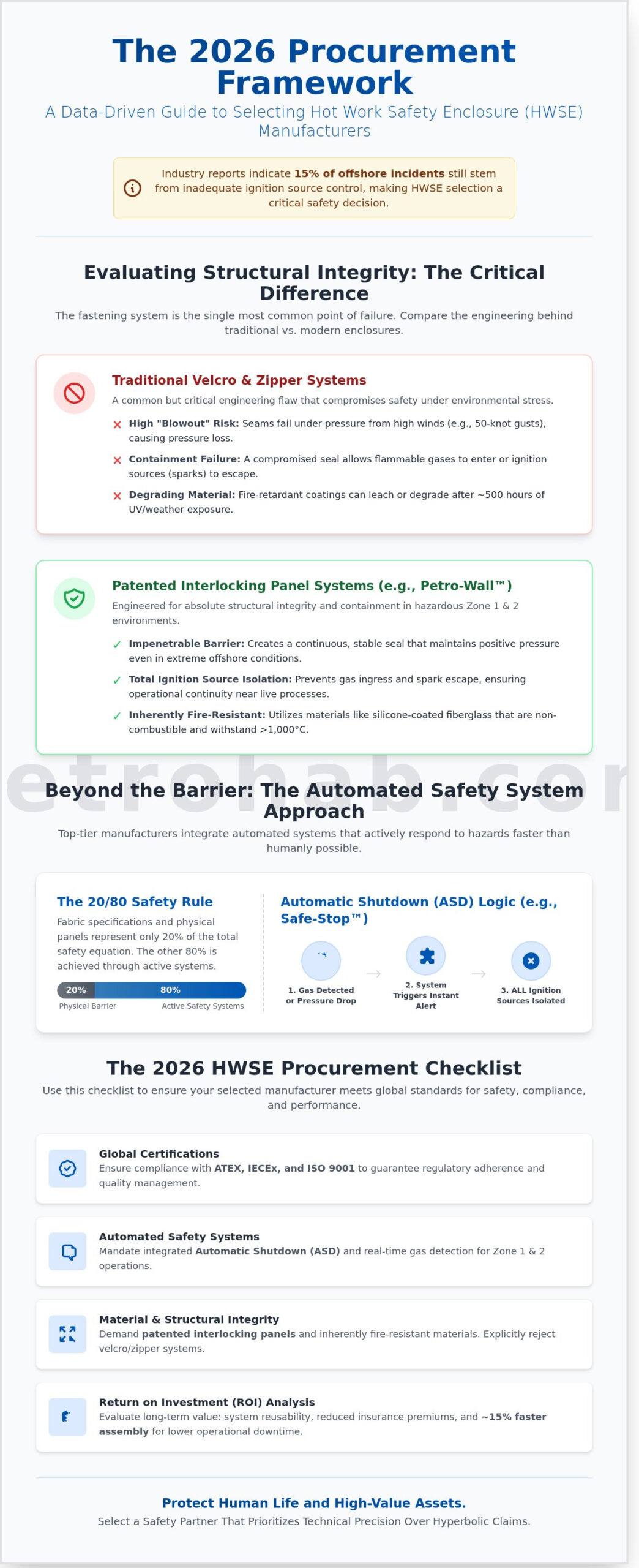
Fabric specifications represent only 20% of the total safety equation. The primary defense mechanism of an HWSE is the maintenance of positive pressure, which physically prevents hydrocarbon gases from entering the work area. Top-tier hot work safety enclosure manufacturers integrate automated shutdown systems, such as PetroHab’s Safe-Stop, to isolate power the moment pressure drops or gas is detected. This automation improves Permit-to-Work (PTW) efficiency by reducing the manual monitoring burden on safety personnel. It allows operations to continue safely in proximity to live processes, provided the pressure differential remains constant.
Economic Impact of High-Quality Enclosures
Premium manufacturing delivers a measurable return on investment through reduced operational downtime. Modular habitats allow for rapid assembly, which can shave 15% off the timeline of a standard refinery turnaround. Longevity is another factor; high-grade materials like Petro-Wall panels are designed for hundreds of deployments. Verified safety technology also plays a role in risk assessment. Facilities utilizing ATEX and IECEx certified systems often see a reduction in insurance premiums, as these certifications provide documented proof of ignition source control and risk reduction. Investing in high-quality manufacturing isn’t just about safety; it’s about protecting the bottom line from the catastrophic costs of unplanned shutdowns.
Evaluating Structural Integrity: Patented Interlocking vs. Traditional Methods
Structural integrity determines the success or failure of ignition source control in hazardous environments. Many hot work safety enclosure manufacturers still rely on velcro or zipper-based fastening systems. These methods represent a critical engineering flaw. Under the pressure of a 50-knot offshore gust, these systems often suffer “blowouts,” where the seal fails and the internal pressure drops. This compromise allows sparks to escape or flammable hydrocarbons to enter the workspace. Compliance with OSHA general requirements demands more than just a temporary fabric wall; it requires a pressurized, impenetrable barrier that remains stable under environmental stress.
Material science is equally vital when assessing a manufacturer’s hardware. You must distinguish between genuine fire-resistant fabrics and those with mere fire-retardant coatings. Fire-retardant chemicals can leach out or degrade after 500 hours of UV exposure or heavy rain. High-quality habitats use silicone-coated fiberglass or similar materials that are inherently non-combustible. These materials maintain their physical properties even when exposed to continuous welding slag at temperatures exceeding 1,000 degrees Fahrenheit. This durability ensures the habitat remains a reliable shield throughout the entire duration of a project.
The Quadra-Lock Advantage
PetroHab’s patented Quadra-Lock technology replaces flimsy fasteners with a mechanical interlocking panel system. This engineering ensures a 100% seal by physically mating the panels together, creating a rigid structure that doesn’t sag or gap. It eliminates spark escape routes that are common in traditional habitats. When vetting hot work safety enclosure manufacturers, ask for structural stability tests. Reliable systems must withstand internal pressures exceeding 50 Pascals without panel separation. This precision engineering defines the gold standard in hot work safety, providing a level of reliability that zippers simply can’t match.
Handling Protrusions and Intrusions
Offshore production platforms and refineries rarely offer flat, unobstructed surfaces for habitat installation. They’re filled with complex piping, I-beams, and valve clusters. Modular panels allow for surgical precision when sealing these areas. While custom sleeves are common, they often fail at the junction point where the sleeve meets the habitat wall. A 2023 deployment on a live North Sea platform demonstrated that modular interlocking panels maintained a constant 0.1-inch water gauge pressure despite 15 separate pipe penetrations. This structural adaptability prevents gas ingress and protects high-value assets. Safety managers should evaluate modular habitat configurations to ensure they can handle the specific geometric challenges of their site.
Vetting Automation: Gas Detection and Automatic Shutdown Systems
Hazardous environments classified as Zone 1 or Zone 2 demand absolute ignition source control. Manual monitoring alone cannot guarantee safety in these high-stakes areas. Leading hot work safety enclosure manufacturers integrate automated systems to eliminate the risk of human error. These systems act as a continuous digital sentry. They monitor the atmosphere for combustible gases and toxic vapors with a precision that exceeds human capability. This level of automation is the modern standard for risk mitigation in 2026.
Automatic shutdown systems (ASD) serve as the primary defense mechanism within these habitats. According to the NFPA 51B Standard, controlling fire hazards during welding and cutting is a regulatory necessity. If the system detects a breach in integrity or a gas ingress, it reacts within milliseconds. Real-time pressure differential tracking through integrated manometers ensures the internal environment remains positively pressurized. This positive pressure prevents outside contaminants from entering the enclosure. It’s a binary state of protection: either the environment is verified as secure, or the work stops immediately.
Electronic components must carry ATEX and IECEx certifications to operate in explosive atmospheres. These certifications provide objective proof that the equipment won’t become an ignition source itself. When you evaluate hot work safety enclosure manufacturers, verify that every sensor and control box meets these international benchmarks. Using non-certified electronics in a refinery or offshore platform is an unacceptable liability that compromises the entire safety chain.
The Safe-Stop Shutdown Mechanism
The Safe-Stop system provides a technical solution for immediate risk mitigation. It monitors for Lower Explosive Limit (LEL) at a 10% threshold and Hydrogen Sulfide (H2S) at 10 parts per million. Once these limits are reached, the system cuts power to all welding equipment instantly. In the event of a total power loss, the system defaults to a fail-safe state. This locks out all hot work activity until the site is verified as secure by safety personnel. This protocol ensures that equipment failure never leads to an unprotected ignition source.
Ventilation and Air Quality Engineering
Effective air quality management requires more than simple fans. Advanced PetroHab Air Ducting systems facilitate the removal of toxic welding fumes while maintaining worker thermoregulation. These systems provide a minimum of six air changes per hour to ensure a breathable atmosphere. This constant flow of fresh air prevents the buildup of heat and hazardous particulates. It protects the operator and ensures the facility’s high-value assets aren’t exposed to corrosive byproducts. Proper ducting is a critical component of the enclosure’s engineering integrity.
The 2026 Procurement Checklist for HWSE Manufacturers
Procuring a pressurized habitat requires a rigorous technical evaluation. Safety managers must look beyond marketing brochures to verify the engineering integrity of the system. Use this five-step checklist to vet potential hot work safety enclosure manufacturers before finalizing your 2026 operational budget.
- Step 1: Verify global certifications. Ensure the manufacturer holds current ISO 9001:2015 certification for quality management. For hazardous areas, ATEX and IECEx compliance for all electrical components is mandatory.
- Step 2: Audit material testing reports. Request original laboratory data for fire resistance. Panels should meet or exceed NFPA 701 standards to ensure they don’t support combustion or spread flames.
- Step 3: Evaluate modularity. Time is a critical factor in offshore environments. Systems like the Petro-Wall utilize a 1×1 meter or 2×2 meter panel design to facilitate rapid assembly in confined spaces.
- Step 4: Assess shutdown hardware. The enclosure must integrate an automatic shutdown system, such as Safe-Stop, which terminates the hot work if pressure is lost or gas is detected.
- Step 5: Review on-site support. Confirm the availability of certified supervisors who can manage the build and provide technical oversight during high-stakes operations.
Certification and Compliance Audit
A reputable manufacturer provides current, third-party verified certificates for every component. Don’t rely on self-certification. In 2026, compliance with NFPA 51B remains the benchmark for fire prevention during welding and cutting. Manufacturers must demonstrate how their habitat design maintains the required 0.1 inch (25 Pa) water gauge pressure to prevent the ingress of flammable gases. This technical precision separates professional-grade enclosures from basic welding tents.
Service and Support Capabilities
Operational continuity depends on global reach. Leading hot work safety enclosure manufacturers maintain support hubs in key energy corridors, including Dundee, Houston, and Southeast Asia. Beyond hardware, human competency is vital. Investing in hot work habitat training ensures your crew understands the nuances of ignition source control. PetroHab provides certified technicians who specialize in complex habitat builds for high-risk zones. This expertise reduces the likelihood of operational delays caused by improper installation.
Why PetroHab is the Global Standard for Hot Work Safety
PetroHab defines the benchmark for hot work safety enclosure manufacturers through a rigorous application of engineering integrity and patented technology. Our commitment to safety isn’t a marketing claim; it’s a technical reality backed by ISO 9001:2015 certifications and a history of incident free operations in the most volatile environments. We prioritize the mitigation of ignition risks in Class 1, Division 1 and 2 environments by using our patented Petro-Wall panels. These panels are constructed from high grade silicone coated fiberglass cloth that resists temperatures up to 1,000 degrees Celsius. This level of technical sophistication distinguishes us from other hot work safety enclosure manufacturers that rely on generic, uncertified materials.
Our tiered product ecosystem provides scalable protection to suit specific operational hazards. The Petro-Habitat serves as the flagship pressurized solution, featuring the Safe-Stop automatic shutdown system. This system monitors pressure and gas levels; it’s capable of terminating power to the ignition source in less than five seconds if a breach occurs. For applications where full pressurization isn’t required, the Petro-Shield and Petro-Lite tiers offer flexible, non-pressurized thermal protection. These systems allow for rapid deployment in remote offshore operations where logistics and deck space are critical constraints.
- Engineering Excellence: Every component is tested to meet ATEX and IECEx standards, ensuring compliance with global safety mandates.
- Global Reach: We maintain a logistics network that supports offshore assets in the North Sea, Gulf of Mexico, and Southeast Asia.
- Operational Integrity: Our systems are designed to minimize downtime while maximizing the protection of personnel and high value assets.
Customized Solutions for Complex Projects
Industrial facilities rarely feature standard layouts. PetroHab engineers bespoke enclosures that adapt to irregular piping, structural beams, and restricted access points. This modularity ensures a tight seal regardless of the site’s geometry. When determining the best acquisition strategy, safety managers should evaluate the welding habitat rental vs purchase model based on their 2026 project timelines. While rental models reduce upfront costs for single shutdowns, purchasing provides long term asset control for recurring maintenance cycles.
Taking the Next Step in Asset Protection
Transitioning to PetroHab technology begins with a technical assessment. To begin the process, our engineers require specific site data, including the classification of the hazardous area and the dimensions of the intended work zone. This data allows us to configure the ventilation rates and pressure differentials necessary for a compliant pressurized habitat. Don’t leave your site safety to chance. Contact PetroHab for a Quote to speak with a technical advisor and secure your facility with the industry gold standard.
Securing Operational Continuity Through Advanced Ignition Control
Selecting the right hot work safety enclosure manufacturers is a critical decision that dictates the safety profile of your entire facility. In 2026, the industry requires more than just a physical barrier. It demands a sophisticated system capable of active risk mitigation. PetroHab’s patented Quadra-Lock technology provides the structural integrity needed for high-pressure environments. This interlocking panel system eliminates the gaps found in traditional methods. When combined with the Safe-Stop automatic shutdown system, it provides a comprehensive solution for ignition source control. Our global infrastructure, with primary hubs in Houston, Dundee, and Brazil, ensures that these critical safety assets are available whenever and wherever your project requires. You’re not just renting equipment; you’re implementing a verified safety standard. Our technical precision and commitment to protecting human life make us the definitive partner for hazardous area management. Don’t leave your site’s integrity to chance. We’re ready to secure your next project with unrivaled engineering excellence.
Request a Quote for Pressurized Welding Habitat Rental
Frequently Asked Questions
What is the difference between a fire-retardant and a fire-resistant habitat?
Fire-retardant materials slow fire spread through chemical treatment, whereas fire-resistant materials naturally withstand high temperatures without igniting. PetroHab’s patented Petro-Wall panels use 100% fire-resistant silicone-coated fiberglass that maintains integrity at 1000°C. Fire-retardant fabrics often lose effectiveness after repeated exposure or washing cycles. Choosing fire-resistant technology ensures the enclosure remains a reliable barrier during continuous welding operations, protecting personnel and high-value assets from thermal hazards in volatile environments.
How does an automatic shutdown system prevent ignition in a hazardous zone?
An automatic shutdown system, such as the Safe-Stop system, terminates hot work power instantly when it detects gas ingress or loss of pressure. If gas levels reach 10% of the Lower Explosive Limit (LEL), the system cuts electricity to the welding equipment. This prevents the ignition source from interacting with flammable vapors. These systems act as the primary fail-safe for hot work safety enclosure manufacturers aiming to eliminate human error in high-risk environments.
Can hot work safety enclosures be used in offshore Zone 1 environments?
Yes, hot work safety enclosures are engineered specifically for use in ATEX and IECEx defined Zone 1 and Zone 2 areas. The habitat creates a controlled environment by maintaining internal pressure 50 Pascals higher than the external atmosphere. This pressure differential prevents hydrocarbons from entering the enclosure. Rigorous compliance with ISO 9001:2015 standards ensures these units function reliably on oil platforms and FPSOs where explosive gases are frequently present.
What is the typical setup time for a modular Petro-Habitat?
A standard 2×2 meter modular Petro-Habitat typically requires 2 to 4 hours for full assembly and commissioning by a trained two-person team. The modular design uses interlocking panels and quick-connect frames to accelerate deployment. This efficiency reduces operational downtime during critical maintenance windows. Every component’s designed for rapid integration without compromising the airtight seal required for pressurized operations in hazardous locations across the oil and gas sector.
Do HWSE manufacturers provide on-site training for my welding crew?
Leading hot work safety enclosure manufacturers provide comprehensive on-site training and certification programs for all personnel operating the habitat. PetroHab technicians deliver 8-hour training modules covering assembly, Safe-Stop calibration, and emergency evacuation protocols. This ensures your crew understands the technical nuances of pressure maintenance. Proper training reduces the risk of operational errors that could compromise the integrity of the pressurized enclosure during active hot work operations.
What certifications should I look for in an HWSE manufacturer?
You must verify that the manufacturer holds ISO 9001:2015 for quality management and that their systems carry ATEX or IECEx certifications for explosive atmospheres. Equipment must meet the ANSI/ASSE Z117.1 standard for safety requirements regarding confined spaces. Look for specific test reports confirming the 1000°C temperature resistance of the wall panels. These certifications serve as documented proof that the manufacturer adheres to the highest global safety benchmarks available.
How does positive pressure prevent gas ingress into the habitat?
Positive pressure works by forcing air out of any structural gaps, ensuring that external gases can’t enter the enclosure. The system maintains an internal pressure of 0.1 to 0.5 inches of water column above the ambient pressure. If a leak occurs, air flows outward, creating a physical barrier against flammable vapors. This continuous airflow is monitored by the Safe-Stop system, which triggers an alarm if the pressure drops below 25 Pascals.