Blog Posts
Automatic Shutdown Systems for Welding Habitats: The 2026 Safety Standard
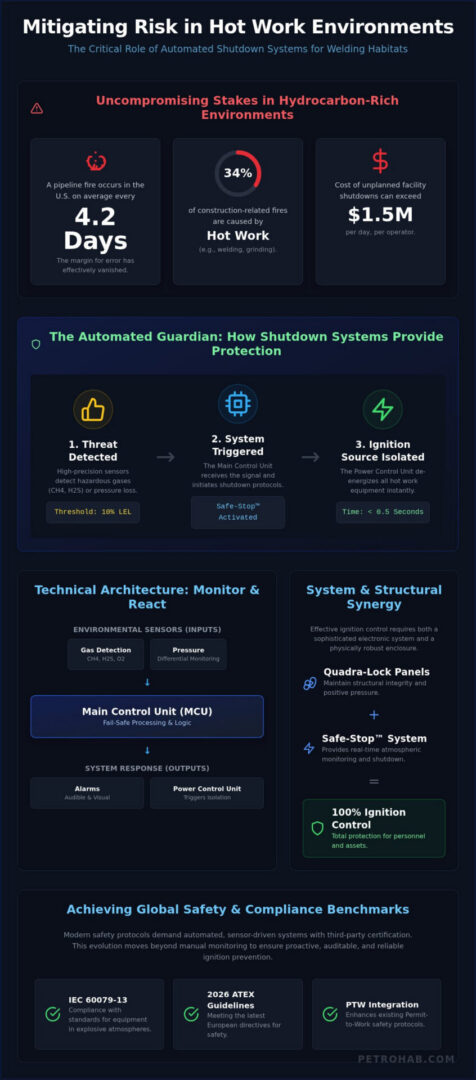
With a pipeline fire occurring on average every 4.2 days in the United States, the margin for error in hydrocarbon-rich environments has effectively vanished. Hot work activities, including welding and grinding, now account for approximately 34% of construction-related fires. You understand that a single spark in a volatile zone doesn’t just threaten a project timeline; it risks catastrophic asset loss and personnel safety. Maintaining operational continuity while managing these risks requires more than a physical barrier. It demands a sophisticated automatic shutdown system for welding habitats that acts as an uncompromising guardian over your site.
This article explores how the Safe-Stop system and Quadra-Lock panels provide a definitive remedy for ignition control by monitoring environmental variables in real-time. You’ll discover how advanced sensors detect gas leaks at 10% of the Lower Explosive Limit and trigger a full power isolation within 0.5 seconds. We will examine the 2026 safety standards, including the latest ATEX guidelines and IEC 60079-13 compliance, to ensure your facility achieves 100% safety compliance without sacrificing production uptime. This technical overview provides the data-driven insights needed to mitigate risk and protect high-value assets in high-stakes industrial environments.
Key Takeaways
- Understand the critical role of an automatic shutdown system for welding habitats in isolating ignition sources from volatile hydrocarbons like CH4 and H2S.
- Examine the technical architecture of the Safe-Stop™ system, including the integration of Main Control Units and high-precision gas sensors.
- Navigate the regulatory requirements of IEC 60079-13 and the 2026 ATEX guidelines to ensure your hot work operations meet global safety benchmarks.
- Discover how to integrate automated safety monitoring into existing Permit-to-Work (PTW) protocols for enhanced site-wide risk mitigation.
- Explore the synergy between Quadra-Lock panel technology and pressurized enclosures in maintaining the structural integrity required for effective gas detection.
The Critical Role of Automatic Shutdown Systems in Hot Work
An automatic shutdown system for welding habitats is an integrated safety mechanism designed to de-energize hot work equipment the moment hazardous conditions are detected. In the high-stakes environment of offshore platforms and refineries, the primary objective is absolute: preventing ignition by isolating sparks from flammable hydrocarbons such as methane (CH4) and hydrogen sulfide (H2S). While manual monitoring was once the standard, it’s no longer sufficient for modern high-pressure zones. Human reaction times can’t compete with automated logic, and a single oversight can lead to a catastrophic event.
Beyond the immediate threat to life, there’s a staggering financial imperative. Industry data indicates that unplanned facility shutdowns can cost operators upwards of $1.5 million per day. An automatic shutdown system for welding habitats mitigates this risk by allowing production to continue safely in adjacent areas while maintenance is performed. This technological remedy ensures that safety isn’t a bottleneck but a facilitator of operational excellence. It bridges the gap between high-risk maintenance and continuous production.
Ignition Source Control and Environmental Containment
Effective risk mitigation relies on a multi-layered defense strategy. The shutdown system acts as a secondary barrier, working in tandem with the positive pressure maintained inside the enclosure. If sensors detect a loss of pressure or the presence of gas, the system must provide immediate power isolation. Advanced systems achieve this in less than one second, effectively neutralizing the ignition source before a flammable mixture can reach it. Adhering to fundamental Hot work safety principles requires this level of technical precision. The physical integrity of the habitat, reinforced by Quadra-Lock panels, ensures that environmental containment remains intact during these critical events.
The Evolution of Hot Work Safety Technology
Industry standards have moved past the era of manual fire watches. Modern safety protocols demand automated, sensor-driven logic that provides a digital audit trail for compliance. This evolution has led to the development of sophisticated hot work safety enclosures that integrate directly with the shutdown hardware. Today’s Tier 1 operators prioritize 3rd party certified systems, specifically those meeting ATEX and IECEx standards. This shift toward automation ensures that ignition prevention is proactive rather than reactive. By removing human error from the equation, facilities can maintain 100% safety compliance while protecting their most valuable assets.
Technical Architecture: How Shutdown Systems Monitor and React
The technical architecture of an automatic shutdown system for welding habitats is built on a foundation of redundancy and precision. At its core, the system utilizes three primary components: the Main Control Unit (MCU), the Power Control Unit (PCU), and a network of specialized gas detection sensors. This hardware works in unison to monitor differential pressure, oxygen levels, and concentrations of toxic or flammable gases. To ensure absolute reliability, the architecture follows a “Fail-Safe” principle. If a sensor fails, a cable is severed, or the control unit loses power, the system defaults to a safe state by immediately de-energizing all connected equipment. Adherence to OSHA hot work regulations requires such rigorous monitoring to prevent atmospheric hazards from escalating into industrial disasters.
Before a shutdown occurs, the system initiates visual and audible alarm protocols. High-intensity beacons and sirens provide personnel with a critical window to stabilize their work before the PCU executes a hard power isolation. This structured response prevents equipment damage while maintaining a stoic focus on personnel protection.
Gas Detection and Atmospheric Monitoring
The system employs both internal and external monitoring to create a comprehensive safety envelope. External sensors monitor the air-feed intake to ensure no hydrocarbons enter the habitat from the surrounding environment. Simultaneously, internal sensors track methane (CH4), hydrogen sulfide (H2S), and oxygen (O2) depletion. Sensors are calibrated to trigger a shutdown if gas levels reach 10% of the Lower Explosive Limit (LEL). In offshore environments, these sensors must meet strict calibration standards to remain accurate despite high humidity and salt spray.
Pressure Differential and Airflow Logic
Maintaining positive pressure is the primary defense against gas ingress. The system uses high-precision manometers to monitor overpressure, typically maintaining a set point of 0.10 inches of water column (approximately 25 Pascals). If a door is left open or a Quadra-Lock panel is breached, the pressure drop is detected instantly. The system is programmed to shut down power if pressure falls below the 25 Pascal threshold, ensuring that no hot work occurs without the protection of a verified atmospheric barrier.
MCU and PCU Interaction
The MCU acts as the system’s brain, processing data from every sensor and managing the alarm logic. When a hazard is confirmed, it sends an instantaneous signal to the PCU, which acts as the executor by physically cutting power to welding machines and grinders within 0.5 seconds. The MCU-PCU link serves as the primary safeguard against human error by removing the need for manual intervention during a safety breach. For operators looking to upgrade their current infrastructure, reviewing the technical specifications of the Safe-Stop system provides a benchmark for modern hardware integration.
Compliance and Standards: IEC 60079-13 and ATEX Requirements
Compliance in hazardous zones isn’t a suggestion; it’s the technical baseline for risk management. IEC 60079-13:2017 remains the definitive international benchmark for pressurized rooms. It dictates exactly how an automatic shutdown system for welding habitats must behave when pressure drops or gas is detected. For Tier 1 operators, ATEX and IECEx certifications are non-negotiable anchors of reliability. These aren’t just marketing labels. They represent rigorous engineering validations. Third-party certification from recognized bodies ensures the system’s logic and hardware can withstand the specific hazards of offshore and onshore sites. It provides the absolute confidence safety managers need when authorizing hot work in volatile environments.
The classification of the work area—Zone 1 or Zone 2—dictates the required protection level. In Zone 1, where an explosive atmosphere is likely to occur in normal operation, the shutdown system must be exceptionally robust. This often requires redundant sensors and higher-rated enclosures for control units. In Zone 2, the risk is lower but still requires a definitive technological remedy. Regardless of the zone, the shutdown system must react with high precision to maintain the enclosure’s integrity. There’s no room for compromise when ignition prevention is the goal.
Global Regulatory Landscapes for Hot Work
Different regions enforce varying degrees of oversight. In the Gulf of Mexico, BSEE requirements mandate strict adherence to safety and environmental management systems. In the North Sea, UK HSE guidelines influence how operators manage hot work. These hazardous environment standards determine which equipment is fit for purpose. Choosing a system that meets these global criteria simplifies mobilization across international borders. It ensures that your operations remain 100% compliant, regardless of the jurisdiction.
Standardizing Safety Through Advanced Systems
The industry has moved past the era of non-certified or “home-made” habitats. Standardized solutions provide the traceability needed for modern safety audits. Every component, from the Quadra-Lock panels to the internal fans and lights, must meet the relevant zone rating. This ensures no weak links exist in the safety chain. Maintenance records and digital logs from the automatic shutdown system for welding habitats provide the verifiable data trail that 2026 regulatory guidelines now demand. This data-driven approach removes ambiguity from safety inspections and guarantees operational excellence.
Operational Integration: PTW Systems and Site Workflows
Successful deployment of an automatic shutdown system for welding habitats requires seamless integration into the facility’s Permit-to-Work (PTW) system. It’s not enough to simply install the hardware; the system must be a formal component of the safety hierarchy. Before work begins, technicians conduct a comprehensive pre-work site survey to identify potential ignition paths and gas ingress points. This assessment ensures that sensors are positioned strategically to intercept hazards before they reach the enclosure. Training for both habitat technicians and hot work performers is mandatory. Every participant must understand the system’s logic and the specific actions required if an alarm sounds.
Daily testing protocols are a non-negotiable part of the workflow. Before the first spark is struck, operators perform a full logic test to verify that the sensors communicate correctly with the MCU and that the PCU successfully isolates power. This routine verification provides the documented evidence needed for safety audits and gives the workforce confidence in their protective equipment. For organizations aiming to standardize these procedures, consulting with PetroHab safety experts ensures that site workflows align with international best practices.
Minimizing Downtime During Maintenance
The primary economic advantage of these systems is the ability to perform “live” welding on active platforms. By using pressurized welding habitats, operators can contain hot work within a localized environment. This eliminates the need for facility-wide shutdowns, which we previously noted can exceed $1.5 million in daily losses. Real-world applications show that localized containment allows production teams to maintain output while critical repairs proceed. The airtight seal provided by Quadra-Lock panels ensures that the internal atmosphere remains isolated, protecting the asset while maintenance crews work safely in proximity to active hydrocarbon streams.
Emergency Response and Fail-Safe Procedures
When the system detects a hazard and initiates an automatic shutdown, established emergency response protocols take over. Personnel must immediately evacuate the enclosure and wait for the atmosphere to be re-certified. This process involves a secondary gas test to ensure levels have returned to a safe state before power is restored. On-site supervision plays a critical role here. The habitat supervisor manages the safety system alerts and coordinates with the platform’s central control room. These fail-safe procedures ensure that even in a high-stress scenario, the response remains methodical and focused on risk mitigation.
The PetroHab Safe-Stop™: Uncompromising Protection
The PetroHab Safe-Stop™ represents the pinnacle of ignition control technology. As a specialized automatic shutdown system for welding habitats, it provides a high-fidelity interface between environmental sensors and power isolation hardware. While other systems might rely on generic components, Safe-Stop™ is engineered specifically for the rigors of the oil and gas sector. It monitors H2S, CH4, and Oxygen levels with surgical precision. This reliability ensures that personnel can perform hot work with the confidence that their environment is being guarded by a seasoned veteran of the field. It’s the active guardian that bridges the gap between hazardous conditions and operational continuity.
PetroHab’s modular design sets it apart from traditional “velcro and zip” enclosures. These older models often struggle with atmospheric leakage, which leads to inconsistent pressure readings and potential gas ingress. In contrast, the patented Quadra-Lock panels create a robust, airtight seal. This structural integrity is essential for the automatic shutdown system for welding habitats to function without interruption. By providing a stable pressurized environment, PetroHab reduces the risk of nuisance trips and allows for continuous production during critical maintenance windows. It’s a calculated technological remedy for the most demanding industrial sites.
Engineered for Integrity: Safe-Stop™ and Quadra-Lock™
The synergy between the Safe-Stop™ hardware and Quadra-Lock™ panels is the foundation of PetroHab’s safety philosophy. Quadra-Lock™ panels prevent the minute pressure leaks that often trigger false shutdowns in inferior habitats. These panels are manufactured from high-grade, fire-resistant materials that maintain their integrity even in extreme offshore conditions. This durability ensures that the secondary barrier remains intact throughout the duration of the project. The Safe-Stop™ system serves as the definitive remedy for hot work hazards.
A Partner in Safety Excellence
Choosing PetroHab means more than just acquiring hardware; it’s about securing a dedicated safety partner. The company provides global support through leasing, sales, and comprehensive on-site supervision. Certified training programs ensure that your habitat technicians are fully proficient in operating advanced hot work safety systems. Every refinery and platform layout presents unique challenges, and PetroHab’s experts specialize in customizing enclosure configurations to meet these specific needs. For a technical consultation on your next project, contact the PetroHab engineering team to discuss how to optimize your site’s safety protocols and protect your high-value assets.
Securing Operational Continuity through Advanced Ignition Control
The evolution of industrial safety in 2026 demands a shift from passive containment to active, intelligent protection. Implementing a certified automatic shutdown system for welding habitats is the most effective way to eliminate the risk of catastrophic ignition in hydrocarbon-rich zones. By integrating Safe-Stop™ technology with patented Quadra-Lock™ panels, operators create a definitive atmospheric barrier that protects both personnel and high-value assets. This combination ensures that hot work remains compliant with international standards while preventing the high cost of unplanned production shutdowns.
Relying on outdated, manual safety watches is no longer a viable strategy for Tier 1 facilities. True safety excellence requires a system that monitors H2S, CH4, and pressure levels with uncompromising precision and responds in less than one second. PetroHab provides the ATEX & IECEx certified systems and global on-site supervision necessary to maintain these rigorous standards across any refinery or offshore platform. Take the next step in fortifying your facility’s safety protocols. Request a Technical Quote for Safe-Stop™ Systems today to secure your site’s operational future.
Frequently Asked Questions
What is the response time of an automatic shutdown system?
The response time for an automatic shutdown system for welding habitats is typically 0.5 seconds or less. This rapid isolation is critical to prevent ignition when hazardous gases are detected at 10% of the Lower Explosive Limit. The system monitors environmental conditions in real-time, ensuring that power to all welding and grinding tools is cut almost instantly. This performance benchmark is essential for maintaining compliance with international safety standards and protecting personnel in high-risk zones.
Can a welding habitat be used without an automatic shutdown system?
Operating a welding habitat without an automatic shutdown system is not recommended and often violates regulatory standards like IEC 60079-13. Without automated monitoring, there’s no fail-safe mechanism to isolate ignition sources if gas ingress occurs. Manual fire watches cannot match the sub-second response times provided by digital logic. Using an integrated system like Safe-Stop™ is the only definitive way to ensure 100% safety compliance and protect high-value assets during hot work.
Which gases does the Safe-Stop™ system monitor?
The Safe-Stop™ system specifically monitors for methane (CH4), hydrogen sulfide (H2S), and oxygen (O2) levels. These sensors are calibrated to detect flammable gases at 10% of the Lower Explosive Limit and alert personnel to oxygen depletion or enrichment. By tracking these specific atmospheric variables, the system provides a comprehensive safety envelope for both offshore and onshore facilities. This multi-gas monitoring capability is a core requirement for modern environmental containment and ignition prevention protocols.
How does the system handle a loss of differential pressure?
When the system detects a drop in differential pressure below the 25 Pascal threshold, it initiates an immediate power isolation. Positive pressure is the primary defense against gas ingress, and any breach, such as an open door or panel failure, compromises this barrier. The MCU processes the pressure loss signal and triggers the PCU to de-energize all hot work equipment. This fail-safe response ensures that sparks cannot exist in an unpressurized, potentially hazardous environment.
Is the Safe-Stop™ system ATEX and IECEx certified?
Yes, the Safe-Stop™ system is fully ATEX and IECEx certified for use in hazardous areas. These international certifications verify that the equipment has undergone rigorous third-party testing for reliability and safety in explosive atmospheres. For Tier 1 operators, these anchors of quality are non-negotiable requirements for equipment mobilization. Maintaining these standards ensures that the automatic shutdown system for welding habitats meets the highest engineering integrity expectations for global oil and gas operations.
What happens to the hot work power supply during a gas alert?
During a gas alert, the Power Control Unit (PCU) physically isolates the power supply to all welding machines, grinders, and other ignition sources. This action occurs automatically without the need for human intervention. The system also activates high-intensity visual and audible alarms to alert personnel to evacuate the enclosure. Power remains isolated until the atmosphere is re-tested and certified safe by a qualified technician, preventing any accidental ignition during a hazardous event.
How often do the gas sensors need to be calibrated?
Gas sensors should be calibrated and bump-tested according to the manufacturer’s specifications and site-specific safety protocols. In extreme offshore environments, daily verification is often required before the commencement of hot work to ensure sensor accuracy. Regular calibration prevents sensor drift and ensures that detection thresholds, such as the 10% LEL limit, remain precise. This maintenance routine is a critical component of the broader mission to eliminate workplace accidents in volatile industrial settings.
Does the system require a dedicated technician to operate?
Yes, the operation of the Safe-Stop™ system typically requires a certified habitat technician or supervisor. These individuals are trained to set up the hardware, calibrate sensors, and monitor the control units during hot work activities. They also manage the integration with the facility’s Permit-to-Work system and oversee emergency response procedures. Having a dedicated expert on-site ensures that the equipment is used correctly and that all safety protocols are strictly followed throughout the project.